
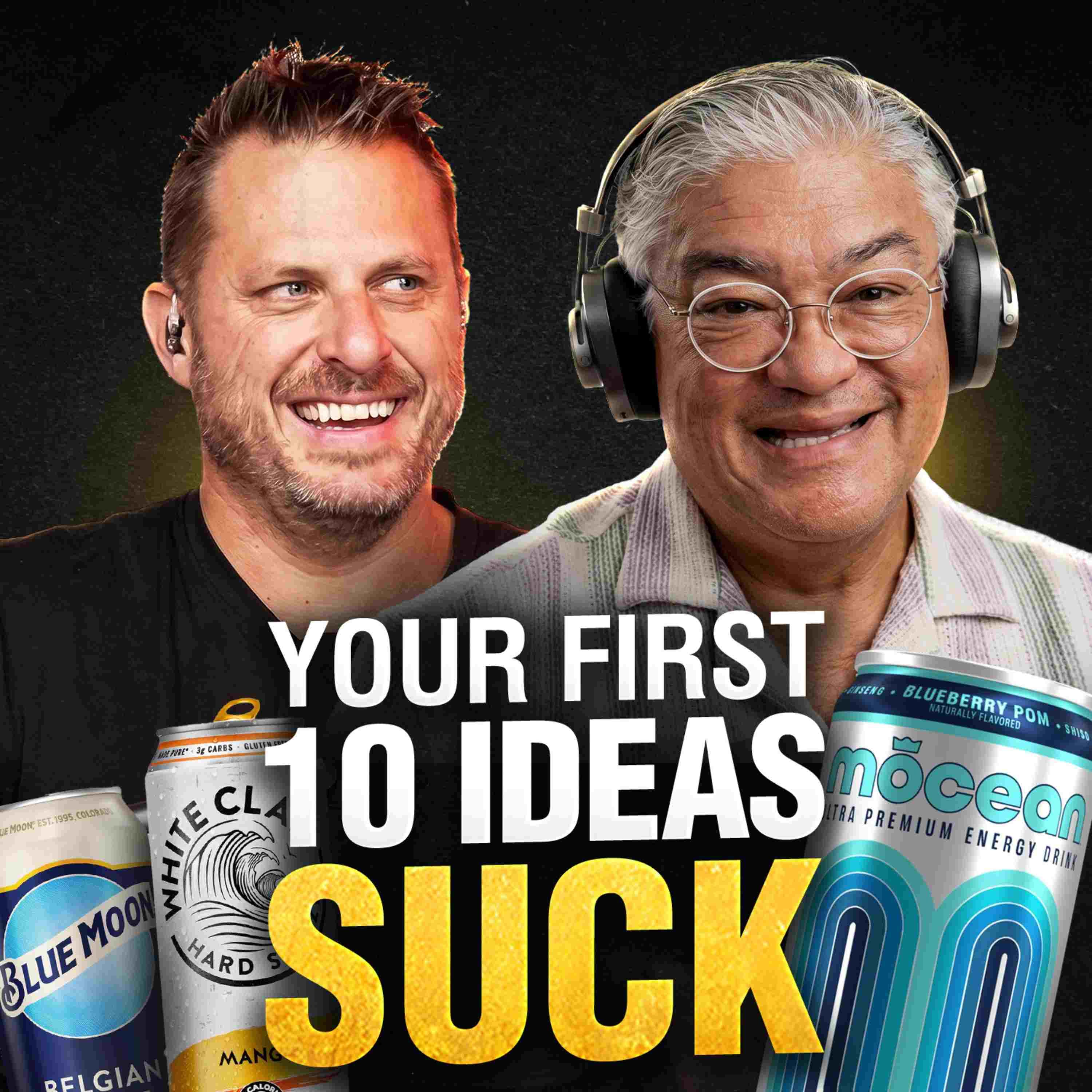
Build a Brand That Sells: Lessons From Blue Moon, White Claw, and mōcean
Former brewmaster Tony Vieira on saving Blue Moon, scaling White Claw during COVID, overbuilt breweries, and launching mōcean with his son.
- Distinguish pipeline fill from recurring demand before investing in capacity — Tony's rule is "don't build the church for Easter Sunday," and building a brewery for first big orders is what sank many craft brewers.
- Product rituals build brands: Blue Moon's orange wheel (not wedge) created an engageable habit, mirroring Corona's lime, and orange peel was already in the formulation.
- Drinkability plus a psychological 'pressure relief valve' made Blue Moon work — it let new drinkers claim craft status without committing to hops, and it was a beer men and women would both drink.
- Cross-gender appeal is a growth engine: guys started drinking White Claw because their girlfriends already were, and mōcean deliberately over-indexes with women 53/47 because women are typically the household buyers.
- Virality can outrun paid marketing — Trevor Wallace's "there are no laws when you're drinking Claws" was unpaid, and the marketing team seeded a fake White Claw definition in Urban Dictionary.
- Founders should challenge their own assumptions: Tony tells entrepreneurs their first 10 ideas suck, and Ryan reframes it as falling in love with the customer's problem, not the idea.
- Premium ingredients force premium packaging and positioning — mōcean's expensive botanicals required an ultra-premium package to match, landing it alone in the upper-right quadrant of the category.
- Specify taste requirements before formulating: Tony insisted the drink taste good both cold and warm for commuters, and was willing to walk away from a lab that said it couldn't be done.
First thing I tell them is your first 10 ideas suck and you need to understand if you fall in love with the wrong idea, you're screwed.
White Claw became, in a very short amount of time, the fastest growing alcoholic product in the history of alcohol since the Mesopotamians were spitting in pots.
What I tell people is don't build the church for Easter Sunday because you're going to have a lot of empty seats the rest of the year.
As we started to do all the machinations originally, we came up with so many ideas and so many names and this and that. People who ask me, what advice do you give to an entrepreneur coming out of the gate? First thing I tell them is your first 10 ideas suck and you need to understand if you fall in love with the wrong idea, you're screwed. That's for founders. That can happen. You got to be able to challenge your own assumptions and your own ideas to make sure you're not going down the wrong path.
You don't win by following the playbook. You win by rewriting it. 700 episodes deep with the people who actually built something real. No theory. No fluff. No shortcuts. This is Right About Now with Ryan Alford. On today's episode of Right About Now, I talked to Tony Vieira, CEO of Motion Drinkworks with the brand Motion, the one you need to remember. Let me tell you, it's not every day you talk to someone who transcended multiple industries all under different roofs. We're talking. Blue Moon, White Claw. Yeah, you know those brands, you know those names, and you know the impact they've had in their markets. Well, Tony was right there, front and center, growing both of them. Made Blue Moon a number one craft beer, and then took White Claw to meteoric heights as the brewmaster.
Yeah, we're brewing it all right here, right now. Stay tuned. Tony, what's up, man? Welcome to Right About Now. Hey, Ryan. Thanks for inviting me. You had me at Blue Moon and you blew me away with White Claw. I like a beverage or two myself. These are names that have been in the Alford home quite a bit. And I'm always fascinated how these stories came to life. You've touched quite the properties, my friend. Yeah, it's been a great career. You know, 36 years in brewing until I decided to go into non-alc and energy last year. Do you regret it? How's that going? I had a good gig. My last role was as the brewmaster for White Claw, and I led quality for them, vice president of brewing.
And it was a good gig. I could have stayed for a long time. My son and I, Christian, who's my business partner, had decided that we wanted to try to do a better for you energy drink. We weren't happy with what we saw in the market. We worked on this concept for four years, trying to pick names. What was the demographic that we were really going to go after? All of those sort of decisions. In the end, I retired last summer and we launched last fall and it's so far so good. We're pretty happy with where we are. Not every day does someone work on the brands and the scale and the size that you have. And I'm always fascinated. These are highly successful brands.
Clearly had someone that knew the right ingredients. Pun intended there for you as a brewmaster. Dad jokes are included free, Tony. Starting with Blue Moon, who decided to put the orange in the Blue Moon? The original brewmaster for Blue Moon was a guy named Keith Villa. And he decided to do the orange wheel on presentation. And it was brilliant. Kind of like the Corona line. It created a habit that people really engaged with. It's symbolic of the branding. Keith Villa was the original brewmaster, and I worked on the brand when it had been flagging for a while, and then I worked on it when it came back, and it became the number one craft beer in the country way back. But I guess it was a decoration at first.
Was it always intended to be an ingredient, so to speak? It was. There's some orange peel in the formulation, et cetera, so it sort of made sense, but the wheel, instead of a wedge, it was a classic look that you just didn't get anywhere else. It really helped that brand out. The aesthetic of that beer with the orange, even the logo and everything else, always stand out in the category. I knew they had been successful, but I did not realize that you guys took it all the way to number one in craft or came back, Roy. Yeah, exactly. It started out, there were a bunch of brand line extensions of Blue Moon as well. Blue Moon was made by Coors when I joined. What happened was a lot of the brands just weren't doing well.
A lot of the line extensions were doing well. They started to drop out. We stopped making them left and right. The only one left was Blue Moon Belgian White. There were some issues with some of the production of it, which I worked on. As we got those issues resolved, the company decided that they wanted to do a full-on nationwide launch. Overnight, that's how Blue Moon became the number one craft beer in the country at the time. Yeah. And a lot of people, that's all they know of Blue Moon is the Belgian White, right? Right. That's the principal brand for that brand family. The Belgian White is. What's really interesting is there were a lot of people that didn't realize that Blue Moon was made by Coors.
And I was getting my master's at Vanderbilt and I was having beers with some of my classmates one night and one of my classmates, significant other was there and she loved Blue Moon. And when I told her that I made it, And she said, I thought you were for Coors. And I said, well, Coors owns Blue Moon. And she was really offended. She thought we had been deceitful to her because it didn't have the Coors name on the label. It was tough to explain to her.
I know these craft people, and they're listening right now because there's a lot of them. They like to think that it was brewed in the backyard with a wooden spoon, the dog barking next to him, and he's got barely two nickels to scrub to his name, and that's craft beer. That's part of the exercise of the whole experience. There's so many craft brewers out there. And thankfully, the quality of craft beer has increased significantly over the years. 20, 30 years ago, it was a complete crapshoot. Spend seven or eight bucks on a six pack and drink part of one and then stick it in the back of the refrigerator until your brother-in-law shows up. Give it to him. I went to work for Mike's Hard Lemonade that's makers of White Claw.
I could not get traditional brewers to come work for me because they would rather puke blood than to make Mike's Hard Lemonade. As it turns out, now everybody's trying to figure out how to do it. These RTDs, whether they're spirit-based, everybody wants to be able to do it because it is a viable market. That was my experience. I couldn't get people to come work for me. What was the decision that maybe happened? It put me in the room with Blue Moon that at the time might have seemed wrong, but it ended up being right. Or the flip. Sometimes everything goes as planned and you had a strategy and it worked and you look brilliant. And then sometimes reality is most of the time there's a combination of skill, luck and strategy.
Any moments that come to mind? They were close to killing the brand. This was back from 97, 98, something like that. A couple of years after the brand had been launched and they were having so much trouble with the line extensions. And the Belgian white was the only thing that seemed like it had any legs that I do believe that they were close to make or break it moment. We used to brew all of the Belgian white in, of course, out of Memphis, Tennessee. There were some challenges. There was an old brewery. There were some challenges with consistency. There were challenges using this ale yeast exclusively for the Blue Moon production. It's like anything else. It's like if you're making a sourdough bread, you got to keep that starter going or it gets unhealthy.
And if you're not brewing often enough, it's hard to keep that yeast healthy. There were a bunch of issues that we had to work through and resolve. We got those resolved. The quality of the beer went up. Borg decided we're going to roll this out nationwide and they put the money behind it. I think had it not done so well right out of the gates after they had done that, it might not be a brand out there today, but it did well and it's continued to be very successful for them. Right time, right place. Sometimes different winds. A lot of times it does. The other thing you talk about decisions that whether they were intended or not, but there is one thing about that particular formulation is that it is extremely drinkable.
That's not really hoppy. It's sort of like this is where you were leading to with White Claw. It was a brand that men and women could agree on. It's not a thing that's very typical. Hey, the guys could drink a Belgian white and so could his girlfriend. And that became a very big deal. That was a huge deal for White Claw. Maybe it's the drinkability of both is why they're both successful. But it is funny how they got there in different places because I was kind of going down this path of brand versus product. At the end of the day, Blue Moon, I'm not a craft tricker. I'm a Michelob Ultra guy. also known as water with a little bit of beer. And I can admit it, but it's just don't drink that much beer anyway.
I can drink several Blue Moon. I cannot drink several craft, typical like IPAs and all that stuff. Like I just get so hoppy. It will wear you out. We talk about the drinkability of these products. The other thing was the psychological aspect for Blue Moon in particular. If you were a new beer drinker, no longer cool to drink a Budweiser, but an IPA might be overwhelming for you. This was a little pressure relief valve that consumers could go to. They could be a craft beer drinker and not be necessarily a hop head. That was the other thing. The timing of Blue Moon's expansion was ripe for the way the market was beginning to evolve. White calls, the whole other end of the spectrum. I almost go towards how'd you get dudes drinking white calls?
I was old enough when it came out that I didn't give a shit like what people thought about what I drank. If I liked it, I liked it. But I understand 21-year-old dudes aren't always wanting to drink wine coolers. It's not a wine cooler, I know, but the perception. White Claw was a product that changed my life significantly. At the time, we were making Mike's Hard Lemonade and Cayman Jack is another product that the company used to make. When White Claw came up, the marketing team had said, hey, we got this idea for another brand. There were a couple of seltzers that were out. None of them were doing really well. There were a lot of folks. There were two camps. Mark Anthony Brewing is the parent company of the company, White Claw and Mike's Hard Lemonade.
There were two camps there. One was, hey, we don't need something to distract from Mike's Hard Lemonade. Let's double down on Mike's Hard Lemonade. We don't need to do this. And then there was the other camp that said, you know, it would be nice to have something else in another arrow in our quiver. We went forward with White Claw. And as it turns out, it was right before COVID is when we started it. There were a couple of phenomena that happened. One was COVID started people pantry loading. When you talk about getting dudes to drink White Claw, how that came about was because all their girlfriends were drinking White Claw. One of the things where they said, I guess I could do that. I can drink a White Claw.
If you're going to drink it, sure, I'll drink. Guys are shameless. That was kind of what happened. It was the University of Georgia fraternity or something. I think they were on CNN where they had done an interview with them about how they were really upset with White Claw. And the reason being was because their cost to throw a party had gone up because it used to be that they could just pour punch into a bowl. And now they had to buy cases of White Claw. but they were buying pallets of it. It was crazy. And White Claw became, in a very short amount of time, the fastest growing alcoholic product in the history of alcohol since the Mesopotamians were spitting in pots. Nothing has ever grown that quickly, that fast.
It was a game changer. It was crazy. And then, of course, the other thing that happened with it was comedian Trevor Wallace. He was the guy that came out with, there are no laws when you're drinking Claws. He did this on his own. He wasn't paid by us. He just happened to do something and it went viral. And then it became the thing to put White Claw in your little home videos and post them. And a lot of the marketing was brilliant, but also there was a huge viral aspect to why that brand took off. Well, I mean, some of the smart with the naming from the get go, it was easily transitioned to the social sphere goes to show you the power. You had to see that firsthand, Tony.
Was it fun? You had it being around it. Sure, it can be daunting. It's our busiest shit. How was it in the throes of all that? We built three breweries in three years and we didn't own any before that. The smallest one was half a million square feet. The largest one was 1.3 million. And then the middle one was 1.2 million square feet. Enormous breweries. That was all because of the White Claw volume. When we were doing Mike's Hard Lemonade, when I started, we were doing like 18 million cases a year total. When White Claw came along, we were doing maybe 27 million. Overnight, we were doing 80 million after that. It was bananas. Yeah. And we built all of these breweries during COVID because breweries are considered one of the essential industries and nobody was doing any construction.
Right. So we had all the access to every construction engineer. We've got to get these beer plants. We've got to keep everybody happy at home. We don't want any outbreaks at home. We've got to keep them happy. Keep that beer. Keep that beer flowing. Tony, I need four more cases, four more. Before we got the breweries up and running, every single case that we sold was pre-sold. It was sold on allocation. We just couldn't keep up with the demand. How does it not overcome you? How do you manage it? No lie. It was one of the most stressful times of my career and probably anyone who was at Mark Anthony at that time. As much as we loved the White Claw sales, getting to the point where we could sell all of those cases was amazing.
We had a very small team at the time and we stayed very tight, really strong project controls in order to oversee multiple construction sites at the same time and trying to satisfy the market. We could not produce enough White Claw. And there were some mistakes that were made. We built the breweries to make even larger volumes of White Claw and that volume peaked back then. There's capacity in those breweries right now that they could use. The downside was if you built it too small, every case that you could have sold isn't being sold. Talking with Tony Vieira. He is the CEO and founder of Motion Drinkworks. We're talking his time with Blue Moon and, of course, White Claw. The business lesson, you ride the wave, baby, and you grow and you got to make enough and you make it and everything has its peak.
How do you stay in business when you've built 27 plants or whatever? I know it wasn't that many, but you know what I mean? I don't know how the balance of that is. What I tell people is don't build the church for Easter Sunday because you're going to have a lot of empty seats the rest of the year. And don't build the brewery for filling the pipeline. That's a different demand signal than standard demand signal. Your everyday sales versus you got to supply 4,000 Walmarts next week versus the Walmart selling a couple of cases every week. We talked about craft brewers early on. That's what debunked a lot of craft brewers is they built new breweries based on their pipeline fill. for their first big orders.
And then all of a sudden it was crickets in the brewery because they didn't have the same demand signal coming in. How is White Claw? I know they aren't at the peak, but is it still wildly popular? White Claw is still the number one seltzer and seltzer is a real category. There was some talk of, is this a category that's going to stick around? Remember Not Your Father's Root Beer, the hard root beer? That was kind of a flash and really spiked in And White Claw is here to stay. They are getting a bigger piece of the seltzer pie every year. They're probably over 60% of the seltzer market. Their volume has been about the same for the last several years. So we decided to throw in the comfort and the blanket of the corporate environment.
Start out. Well, I thought I was. You're ready to. I don't know if you retire though, Tony. I know you work with your son, but semi-retire with Drinkworks and Motion. What's helped you and what's hurt you from your corporate career? The White Claw experience was incredible. It was the first brand that I really worked on from ground zero all the way through. Saw how the... Sausage was made. Things like you'd love this marketing crew. When they came up with the White Claw name, one of the first things they did was they went into the Urban Dictionary and they put in a definition of what White Claw is. And they made up a definition. There was two surfers that were talking to each other. White Claw was three rogue waves.
I rode the White Claw. So seeing things like that is really interesting, this sort of guerrilla approach. With Mark Anthony, the owner there was a guy named Anthony von Mandel. He was a stickler on quality. His was quality and flavor and meet the consumer where they are. I believe that that's exactly the right way to approach particularly these fast-moving consumer goods like the energy drink market serves. What's the good, bad, and the ugly of working with family? It's actually been good. My son is the arts, and he's the marketing guy. He's the brand guy. Got the art and the science. Yeah, I'm the science side. He's the art side. And he keeps me in check. He's very good. He's the one that's behind what we call our brand voice, which is we say if Ryan Reynolds and Liquid Death had a baby, that's the voice of our brand.
It's a little bit snarky. So working with my son has been really good in that sense. He certainly knows me well enough to challenge me. It has helped a lot in getting to some decisions quickly. As we started to do all the machinations originally, we came up with so many ideas and so many names and this and that. People who ask me, what advice do you give to an entrepreneur coming out of the gate? First thing I tell them is your first 10 ideas suck and you need to understand if you fall in love with the wrong idea, you're screwed. That's for founders. That can happen. You got to be able to challenge your own assumptions and your own ideas to make sure you're not going down the wrong path.
That's a good lesson. Don't fall in love with your idea. Fall in love with your customer's problem. That's a really good way to put it. That was at least like 99% of the time would get you something good. This is entrepreneurs, founders, and I don't even think it's like ego necessarily. I think it's more nurturing than that. The baby, your idea, and wanting to do it right, and wanting to be successful. Then you got to step out and go, well, what creates success? It's hard to let go of ideas that you spend time machinating on, thinking through this stuff, and you think you've come up with something that's so awesome and everybody will get it. Unless you have people that you can trust that will say, hey, you're way off base, we would have ended up in a worse position than we are.
We're happy with where we ended up with our product name. That's indicative of Motion for an Energy Drink, and it's got Ocean in the name, and it works well for us, but we almost had some terrible names. I can tell you that we keep going back to craft brewers. And the reason that we were struggling so much with names is because there are 10,000 breweries in the country right now. And every one of them has, what, 10 beers minimum? Every name that you like, someone's got it. And you don't want to get any flashes. So you keep searching.
Talk to me about where Motion sits in the marketplace, what we're trying to do, who your avatar is, all those things. What we decided to do with Motion was we wanted to make an energy drink that really was targeting a more adult market. The classic traditional energy drinks, they've been around for 20, 30 years. They pretty much have targeted males. and a lot of males from 16 to 24 years old. And a lot of them were high in calories and a lot of synthetic ingredients, et cetera. So we decided that we wanted to try to make an energy drink that was truly clean label, real caffeine and other functional benefits from the botanicals that we selected and looking for a white space because it's a crowded market.
We're having this conversation that started during COVID. We said, what if we did a better for you energy drink that gave you daily immune system support? We feel a foundation for anybody who is trying to stay healthy is an immune system that's healthy and then you can build the rest of the house on top of it. We said, you know what? That's a place we'll go. We needed to make it up ultra premium because the ingredients were expensive. And so the packaging had to match up with the positioning. And as it turns out, you put a four box together. We sit by ourselves in the upper right hand quadrant of a four box. without a lot of competitors at all, especially because of the immunity support that we have.
The formulation is actually a formulation using Eastern medicine. My mother was a little Filipino witch doctor. When I was little, when I was six, she would give me the echinacea and the elderberry and the zinc and the magnesium and all that. That's all the stuff that ended up in our formulation. It's very specific functional benefits along with delivering this energy and electrolytes for hydration. We slightly over-index with females, which is in the beverage world is a good thing because generally the women of the household are the buyers. We slightly over-index for women, but it's 53% to 47%. Where do we find Motion? We are available on Amazon. We are available on our own website, which is www.drinkmotion.energy. And we're in some retailers around in the Massachusetts area, especially on Cape Cod.
That's where I live. But we are now in negotiations with several multi-chain national and regional retailers. We're pretty sure we're looking at a 2027 for a lot of these things. But we've only been on the market really for a couple of months now. It's a brand new product. The bigger question is, why do I not have one on my table? Tony, I need some motion. Yeah, I'm going to send you guys something. I'd be your best marketer, man. Everybody knows I'm an energy drink guy. I don't have a lot of vices, but that's one of them. And yours doesn't sound like a vice. This one's got 10 calories. It's sweet. It tastes good. I'm a formulator. I knew what I wanted and I had gone to a lab in LA to sort of put the final touches on this formulation.
And I was talking to the CEO of this lab and said to him, look, we want this drink to taste good. Got to be awesome when it's cold. And it's got to taste really good when it's as it warms up, because if you're commuting or something, nothing worse than trying to choke down a bad energy drink if it's warm. Anyways, the guy said to me, you're talking about an energy drink that's not done. And I said, well, hold on a second. I'm probably talking to the wrong lab. Next thing you know, we got to an understanding, but the product is good. It's not overly sweet, but it's got some sweetness and it uses non-nutritive sweeteners that are natural. So stevia, and it's made with real juices, et cetera.
So it's got a nice profile. It's fairly different from some of the traditional energy drinks, in that it's not as strong a flavor. I'm an equal opportunity energy drink guy. And if it's got vitamins and antioxidants or whatever, hey, I can kill two birds with one stone. I don't drink coffee. A lot of people I know that don't. You were the guy that we built this thing for. My son's not a coffee drinker either. Six years ago, his wife's having a baby, their first child. So he's 32 at the time. They're in the hospital. He goes down to get energy drink, then to go back up to the labor room. He realizes he's about to grab or buy a cotton candy flavored energy drink. He basically said to himself, what am I doing?
I got to do something different with I'm about to be a dad. Right. Yeah. So that's how the whole thing started. I can relate to that. No cotton candy for me. I like a little something, but I don't know the cotton candy stuff. Tony, you mentioned it, but where can everybody learn more about what you guys are doing? We do have a website. It's www.drinkmotion, and that's M-O-C-E-A-N.energy. And you can find all sorts of information about our functional ingredients, and you can buy our product there. It's also available on Amazon. It's an Amazon Prime listed product, and then some local stores on Cape Cod mostly. Catch the wave with Tony Vieira, the CEO of Motion. And I got this Drinkworks here, the overarching brand. Yeah, Motion Drinkworks is the company and Motion is the brand.
I like it. Tony, it's been a pleasure, man. I appreciate your time. Yeah, Ryan. Thank you. I enjoyed the conversation. Hey, guys, you're here to find us. RyanIsRight.com. We don't just talk about what's now. We talk about what is right. What is going on in the world? What helps today? Not what helps 10 years ago or 10 years from now. It's about the lessons that real business leaders and true entrepreneurs like Tony are doing out there that you can learn from. And if nothing else, get a little pep in your step with motion. We'll see you next time on Right About Now. Here's the truth. Information doesn't change your life. Execution does. So don't just listen to this episode and move on. Take the idea.
Make the call. Launch the thing. Fix the problem. Build what you keep talking about building. For more, follow Ryan Alford on Instagram, at Ryan Alford. And watch or listen to every episode at ryanisright.com. This is Right About Now. Now quit waiting. Go win.
Podcast Advertising Is About to Change | Jeff Umbro
Jeff Umbro of The Podglomerate joins Ryan Alford on the shift to programmatic podcast ads, video, consolidation and the decline of narrative shows.
Moses Heredia: Why Struggle Was His Biggest Advantage
Global Processing Systems CEO Moses Heredia on going from the crop fields to $4.25/hour telemarketing to founding a company out of a pickup truck.
Dan Novaes: Turning Phone Attention Into Income
Mode Mobile CEO Dan Novaes on scaling from $100K to $25M, launching the EarnPhone, and why data plus action is what brands really pay for.