
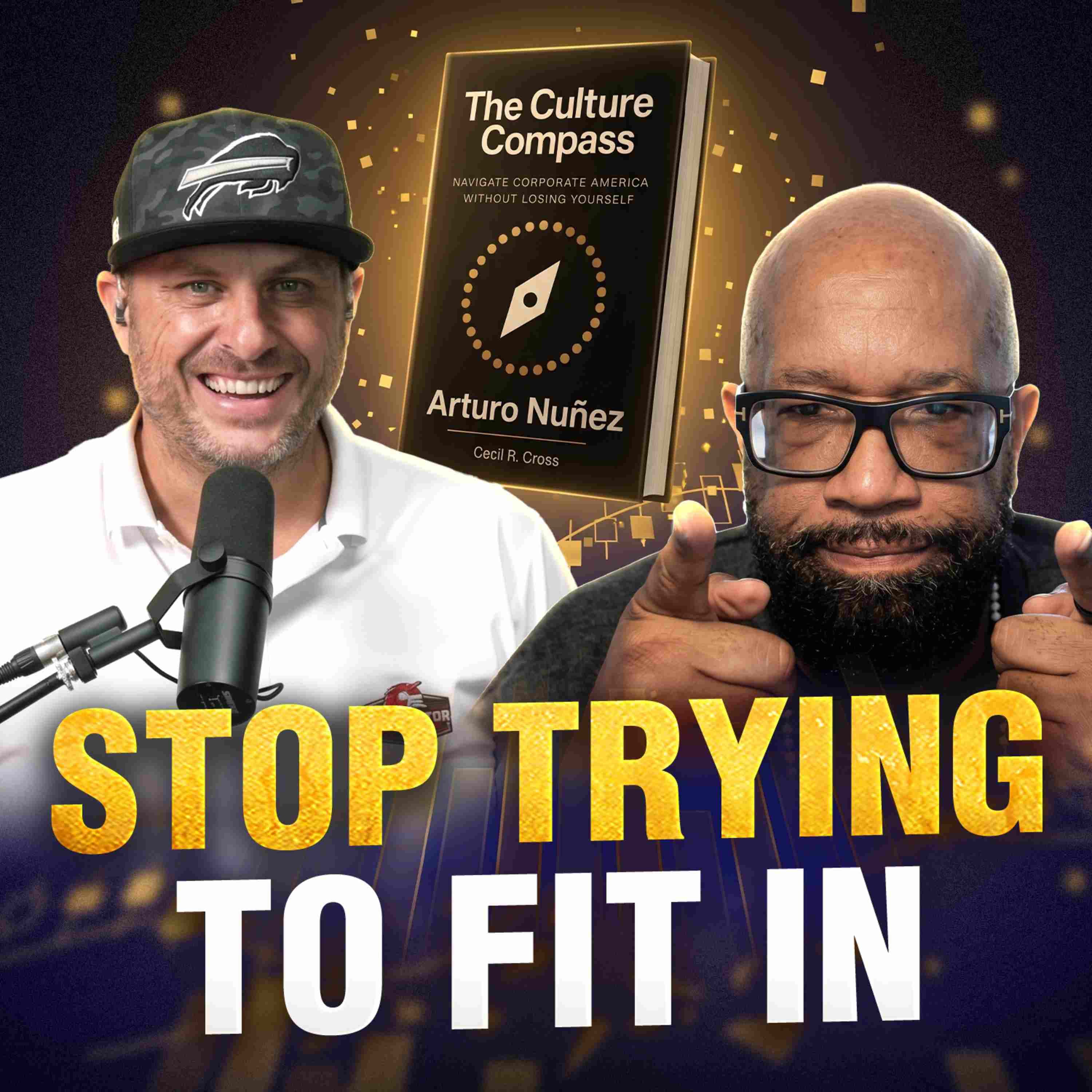
Stop Trying to Fit In: How to Navigate Corporate Culture Without Losing Yourself with Arturo Nuñez
Nike and Apple marketing veteran Arturo Nuñez on authentic storytelling, word of mouth, Kobe's obsession, and why AI could kill apps in two years.
If there's one thing for a brand to tell their story about how amazing their product is, the only thing better than that is a customer telling the story of how great a brand is. So if you do great work, your customer will tell your story for you.
I went from just do it to don't do it.
I believe within 12 to 24 months, there'll be no more apps. You will ask your AI for what you want, and your AI will figure out how to make it happen with apps or without apps.
On today's episode of Right About Now, I sat down with Arturo Nunez. He is a longtime marketing executive. He's an entrepreneur. He's a brand strategist. Nike, Apple, Pepsi, NBA, just a few of the names that he's worked with. Lots of great stories. This is one you don't want to miss just for the stories alone. Insights on marketing, storytelling, the difference between Nike and Apple culture. Fascinating stuff. And of course, his book, What? that comes out. Culture Compass. Culture Compass coming out October 6th. Arturo Nunez here right now. Kobe used to say I wasn't the fastest guy. I wasn't the tallest guy. I didn't jump higher than most of the guys. I just was obsessed with the craft of being a basketballer. Obsessed. Kobe would say things to me and I'd be like, wait, what?
Oh, I'm playing such and such today. When he puts his left foot down, as soon as his heel touches, I know I can blow right by it. You don't win by following the playbook. You win by rewriting it. 700 episodes deep with the people who actually built something real. No theory, no fluff, no shortcuts. This is Right About Now with Ryan Alford.
What's up, Wachturo? Welcome to Right About Now. What's up, Ryan? How we doing today? You good? Hey, man, I am always good. Even when I'm bad, I'm good. I have to tell myself that. People would die to do some of the things I get to do and the pleasure to do it. Even when I'm up to my ears with four kids and everything else, you know how it is. A hundred percent. I fully get it. Gratitude, gratitude. Just happy to be here. Happy to get another day. attitude and gratitude at all times. The two things you can control. Fully agree. Man, you've done a lot. You got a book coming out, Simon & Schuster. We know that name. Culture Compass. We'll get to it a little bit.
Who the hell is Arturo Nunez? Arturo Nunez is a guy born and raised in New York City, Harlem, New York to be specific. Immigrant parents came from Cuba and Venezuela. Spanish was my first language. learned English in school, and spent the better part of my life, man, working in marketing at companies. I learned marketing early. I think I was 16, 17 years old. I had my first job at Colgate-Palmolive in marketing and learned that marketing was just the art of storytelling. Can you tell a story? Can you tell a cool story that it's gonna get people excited to learn more about a product, a service, whatever. company. And I got to do that. I got to do that from some of the best companies in the world.
Got to learn that from some of the best companies in the world. I've worked into sports, worked at Nike and the NBA. So I got to tell stories about some of the greatest athletes in the world. And then I went international, started doing that everywhere, South Africa, India, Asia, the Middle East, you name it. I've been really blessed, man, to be able to be a storyteller for a living. Storyteller and connecting people to products and companies. Arturo, I spent a lot of time in the ad agency business, so I got to ask, I think that's what side you were on. Were you on the agency side when you were working or were you on the brand side? I was on the brand side, but I worked with every agency under the sun.
What was your role? Were you working with, obviously you're doing storytelling, so probably on the creative executions. Yeah, creative execution side, I started out as an assistant brand manager, associate brand manager, like people do in marketing. You get assigned a brand and you got to figure out how to tell stories about that brand and everything from the copy, the packaging, the whole consumer journey, what it looks like in the store, what shelf it's on, et cetera. And then I graduated over time to become a marketing director where I work with the agency, figure out what the commercials look like, figure out how to tell authentic stories. Man, listen, consumers can understand when something's not authentic. And people think that they can just write a check to LeBron James and it's going to solve all their marketing problems.
If LeBron James has nothing to do with your product, doesn't use your product, doesn't care about your product, the consumer is going to see right through that. It's going to look phony as hell, and they're not going to move the needle. So how do you tell authentic marketing stories that make people emotionally connected to brand? That's the real stuff. And that's what I got to do as a marketing director and a VP with the help of amazing agencies from Wyden Kennedy to Young and Rubicam, BBDO, DDB, you name it. I worked with everybody over time. I know all those names. I worked with Hill Holiday and McCann and McGarry Bowen. I spent six years in Manhattan doing that gig and working with a lot of the same things.
Well, let's compare stories sometimes. I want to get your perspective on this before we dive straight into some of the topics of the book. With the way social media has changed, the way attention spans have changed, the democratization of content. We had good Arturo in 2008 to 2011, 12, 13. We own the airways with the TV spots because that's all everybody had to watch. If you were watching videos, but it wasn't like it is today, now you got attention splintered everywhere. How did you navigate that time period and being able to storytell across with the media changing the way it did? We had it really good, bro. We have people with undivided attention. And today that attention is boom, scattered to the winds. So that means you got to be even better and you got to be even faster to be able to tell a story that captivates.
Yo, I think the average watch time on social media is nine seconds. If you don't grab them in nine seconds, it's a wrap. How much can you do in nine seconds? You got to be really good at storytelling to pull people in. And by the way, you could do slockey junk, a scare tactic media. Oh my God, right? brands aren't doing that that's not real work you got to be better at your craft you got to know how to entice your audience you got to understand how to target your audience and tell a story that's meaningful and authentic to break through all of the clutter people have millions and millions of choices today how do you become something they want to listen to something they care about how do you understand what people care about and bring them more of that i think it's really important and part two is every company in the world is going to tell you they're great their product's great even when the product's shit they're going to tell you it's great every company in the world you
So how do you tell an authentic story about something that matters to people and get those people to repeat your story? If there's one thing for a brand to tell their story about how amazing their product is, the only thing better than that is a customer telling the story of how great a brand is. So if you do great work, your customer will tell your story for you. That's the game changer. Ryan's going to tell me his podcast is great. What's better? The thousands of people that tell me Ryan's podcast is great. That's even better. I believe them more than I believe you. You're supposed to say it's great, right? Yeah.
I was walking down the dock in my boat this past weekend, and a woman yelled at me, and I didn't know who it was. And she was a friend of one of the people in our marina. And she goes, I love your podcast. As he was talking about this guest I had on, I mean, we've had 600-something episodes now. People will come up to me and say, it's not like every day. It's a business show. We're pretty niche, but a popular niche show. That always means the most, and it does, man. You know, that's your fans, man. If you got your fans talking, you know you did something right. There's nothing a brand can say that has, I don't know, even a tenth of the power of word of mouth.
It's so funny. We've gone through 50 years of modern marketing and word of mouth is still it. Unbeatable. It's still unbeatable. That moment where somebody sees you and says, hey, man, I love what you do. I was literally on an airplane flying from Qatar to London and I was sitting next to this Indian kid and we start talking. And I've never talked to anybody when I sit next to him on a plane, but for some reason we got up a conversation. He told me he was from Mumbai. We start talking and I told him that I had previously worked for Nike. And he was like, oh my God, one of the greatest campaigns of all time was Bleed Blue. We did this campaign in India around cricket of all sports called Bleed Blue.
And basically, Ryan, just to put it in a nutshell, what we did was, yo man, what if we took NCAA college football fandom and applied it to cricket? Face painted people, body painted, colors, flags, madness. We applied it to cricket. We did a campaign called Bleed Blue. And this kid was talking about this campaign. Dude, that was 15 years ago. He literally was like, I remember that campaign, Bleed Blue. And when I told him that it was me and my team that did it, he literally said to his parents who were across the aisle, yo, this is the Bleed Blue guy. They were blown away. Dude, that's 15 years old. There's nothing better for a marketer to say, man, I did something that stuck, that people really appreciated, that people got into.
That was a really cool moment. I love that story, man. They're leading the story where I was going to go. I was going to go, tell me something about a good story. That was a good one. And I'm sitting here. When I hear people talk about marketing campaign, that's a brilliant idea there. That's going left when everybody goes right. But it also makes sense on so many levels. Connective tissue's there, but it's not what you expect. I love that. finding a truth, finding a truth, something unexpected, learning something about your subject or your topic that's going to pique people's curiosity. I'll give you one more story. I'll give you a Kobe Bryant story. It's a Kobe Bryant story. I'm talking to Kobe Bryant one day and he says, you know, I love away games more than home games.
I Hey, Kobe, hold on. You're one of the famous Los Angeles Lakers. You play in one of the best arenas in the country. Half of Hollywood shows up to watch you play. You guys have a history of achievement and success and championships. You're a god in that building. What do you mean you like playing away games more than home games? He said, Arturo, nothing gets me more excited. And by the way, Ryan, I cleaned that up. That's not the way he said it. He said, nothing gets me more excited than watching a fan... with a kid on his shoulder, with a foam finger, with a Timberwolves jersey, leaving the arena with five minutes left because they had no chance to win. Nothing gets me more excited than that.
And at that moment, I was like, Kobe, you are a savage. Who creed like this? Who was an absolute savage? And that's who that guy was. And by the way, if you remember, Nike did a campaign about how he was fueled by hate. He was fueled by hate. He loved the haters. Hate me more. That was the campaign. He loved the opposition. People saying he can't. That's what fueled him. That's what drove him. That's what drove the best performances in his career is people saying he couldn't do something. That's a powerful, unique human truth, unique to that savage individual. God bless him, rest in peace. but a beautiful story about how you could find a colonel and create a story around that colonel. It is.
I love that. And he was a savage. I can relate on some levels, but nothing compares to one of the all-time greats. I wish he was still around. Culture is an interesting word. It gets used a lot, especially when I was at the agency world. Culture gets thrown around a lot. I know it gets thrown around in the corporate world a lot. Weaponized is probably the wrong word. Attempted to be a weapon of change, like our culture, but it, It rarely has substance in a lot of the places that I've heard it used, but let's start up here and then we're going to drill down to the tenants in the book about culture within business. Culture in its broadest form is just the way you see the world.
What informs the way you see the world? What beliefs, practices, customs, history, family, heritage informs the way you see the world? That to me is culture. A lot of people could share a culture. That doesn't mean you have to come from the same parents, the same background, to share a culture. And in corporations, there's a culture too. How do we talk about the work? How do we do the work? What do we believe about ourselves? What are the words that would synthesize what we stand for as company? That's the culture of company. And by the way, I tell people all the time, you got to be really careful. I consult for startups. You got to be really careful because if I hire a bunch of people from Google and I don't have a strong culture in my startup, guess what they're going to default to?
They're going to default to the culture they know. Google culture. Hey, nobody told me to do this differently. I'm going to do it the way I know how to do it, which is Google culture. When I left Nike and joined Apple, totally different culture. So I had to go from the way I did things at Nike, the way we talked about marketing at Nike, the way we looked at the brand and the products at Nike, to a whole different way of looking at products and brands and storytelling at Apple. Apple had a different culture. And so you have to understand the paradigm of the culture. What is this place about? Who founded this place? What do they believe in? What's the mission and vision statement?
Why should it matter? Why does it why should it matter to customers? That's the culture of the company. And the better you understand the culture of the company, the more effective you'll be in that culture. If you're running a podcast, you're drinking an energy drink. That's part of the culture of your podcast. And I come in drinking beer. We're going to have a problem if I'm your employee. I don't know if we would have a problem. I mean, you know, it'd have been all the time of day is I might have a beer instead of an energy drink. It's 5 p.m. somewhere, right? It's quitting time somewhere right now. Our second tagline is we take the BS out of business. Sometimes it's an energy drain.
Sometimes it's a beer. Let's be honest. It's Beer Truck Monday or Tuesday. Yes. Culture difference between Nike and Apple. Go. I went from just do it to don't do it. That's it. I worked with Apple and I thought you might go there and you did. I didn't work for them, but I worked with them. I went from just do it to don't do it. And by the way, mad respect for Apple. It's not a $3 trillion company by accident. They're doing something's going horribly right at Apple. Horribly right. Something's going really well. at Apple. But the difference was Nike's culture was all about inspiration and innovation. And Apple's culture was all about finding the best people in the world and having them do a very, very specific task.
And sometimes not even know how it fits into the whole thing. I was one of the most senior marketing people at Apple, one of 33 in the world, most senior people in marketing. And there were many times a company was doing something, launching something, about to tell a story I had no idea about. And if I went to my boss, the CMO of Apple, and Apple... Ask him about it. He'd be like, I don't know what you're talking about. It's in your business. You don't need to know that. That's not need to know for your job. None of your business, move on. That wasn't Nike. Nike was open book. Yo, let's inspire everybody. Oh, the guy that's working on golf is doing something great about Tiger.
I'd learn all about that. Even though I'm in basketball. Very open communication style. Very inspirational communication style at Nike. Very closed silo, need to know, private secrecy environment at Apple. Both effective. Nike's not too effective today. was effective when I was there, but Apple's very effective today. Both effective, just very different ways of getting at the work and inspiring their people and motivating their people. Yeah, Nike's lost their way a little bit with losing their categories. They didn't have to really open up a checkbook if they wanted me to come solve that. Some of it's easy, some of it's hard.
I say the same thing because I was there in the belly of the beats for eight years and we were doing very, very well. If they hit me up, yesterday's price is not today's price, as Fat Joe likes to say. But for a big check, I can help fix that too. Some of it's pretty obvious. It goes deeper than that. Apple was, the white is more telling than you recognize. The white in the stores, that signifies their whole sort of being. It's like one way or the highway. What color is white? White. It's hospital-like. It's sanitized. You know what I mean? Nothing is left to dance. We do everything deliberately by design. Yeah. It's good when your products had clear differentiation. That gap started to close with smartphones and things like that.
But all we get now is better cameras and better battery. One of the questions that I ask when I do public speaking is, hey, everybody in the room, raise your hand if you know your monthly Apple bill. Next to nobody raises their hand. Next to nobody. So wait, let me get this straight. There's a company that has 3 billion people in an ecosystem, charging them monthly for goods and services, and nobody knows their bill? Nope. And you're not going anywhere. You're not going anywhere. It's powerful. It brought to mind, this is just straight from the cuff here, as you said that, Arturo. Well, I reserve the right to strict it from the record. But what they say, the devil's greatest trick is making everybody think he didn't exist.
What Apple's done is, hey, the cell phone companies are the ones that charge you. No, you're paying $20 there, $10 there, $5 there, but you have no idea. You do, but you don't. iCloud, Apple TV, Apple Music, Extra Storage, 30% of every app you download. Yo, they've got a business model. It's bulletproof. Yes, it's brilliant. The app store things, I think, bothers me now with owning my own app and doing things. That's annoying. It's kind of a damn all taxes. 30%, man. I got a prediction about that. You heard it here first. I believe within 12 to 24 months, there'll be no more apps. You will ask your AI for what you want, and your AI will figure out how to make it happen with apps or without apps.
So you'll say, hey, man, I want a Domino's pizza. You know how I like it. Your app will be like pepperoni and ground beef, right? Yeah, absolutely. Make it happen. And it will show up at your house, period, full stop. I don't think it's a bad prediction. My prediction has been you getting to this place of apps of one, which is kind of what you're describing a little bit. Personalize the app site. Development costs, you would have never had apps of one. But now with that going away, the democratization of all the coding and the LLMs, kind of knowing the functionality of all the apps, all that programming there. You said it's just one prompt, one question away. Why do I need it? I got 50 apps on my phone.
I use like five of them. What do I need those for? If my AI knows what all those apps are, knows my logins or whatever, I don't need to go to Amazon. Hey man, send me a lamp. It looks like this. Got it. It'll be there tomorrow. I don't care how the AI got me the lamp. It could have gotten logged into the lamp store. It could have gotten a Bed Bath & Beyond. It could have gotten a Home Depot. It could go to Amazon. I don't give a shit. I want the lamp. The lamp comes tomorrow. That's it.
This episode is brought to you by HighLevel. Make sure to check out the link in the show notes to sign up for your 14-day free trial. If you run a business, you know leads rarely arrive when it's convenient. A call comes in while your team is helping another customer. If someone reaches out, but the follow-up gets delayed, an invoice sits unsent, or a promising lead gets stuck in the wrong stage of your pipeline. I've built enough businesses to know that growth has a way of exposing every gap in your systems. That's why High Levels Voice AI and managed AI agents caught my attention. High Levels Voice AI can answer incoming calls, qualify leads using information from your website or uploaded documents, and even book or reschedule appointments.
When your team is busy, Voice AI can keep that conversation moving instead of letting a potential customer slip away. Then high levels managed AI agents can handle multi-step actions across your CRM. They can update pipeline stages, send invoices, and execute follow-up sequences across SMS, email, and social. That means fewer repetitive tasks for your team and a more consistent process for every lead coming into the business. For me, the real value of AI isn't adding another complicated tool. It's using technology to handle the work that slows your team down so your people can focus on building relationships, serving customers, and growing the business. If you're ready to create better systems and get more from every opportunity, use the link in the show notes to sign up for your 14-day free trial.
UI UX becomes the friction. The app is the friction that you get out of the way, right? Because apps are there to solve the problem. If you can solve the problem without having any UI UX. Great. It's so funny. We could go down. I'm down the rabbit hole now, Arturo. UI UX is meant to be the solution, right? Great user experience, user design. It's really just friction design well. Because you don't want the friction. You don't want the app. You don't want to hit the button. You don't want to hear the thing. You want to just know and get what you want when you want it. Ryan, I consult for a company, a startup that's a great startup. It's called Felix Pago. And what they do is they do remittances.
Basically they send money from the U S to Latin America. People in Latin America need to send money to their family. They send us stuff. The first time I met with those guys, they talked me through their deck. They talked me through the business, whatever, whatever. They said, Arturo, you know, you're a marketing expert. What do you think? And I said, well, I got good news and bad news. Who do you want? They're like, well, give us the bad news. I was like, nobody wants remittances. And they looked at me like I was crazy. They're like, what are you talking about? Our business is on fire. Every day, millions of people are using the brand. What do you mean nobody wants remittances? I said, nobody wakes up in the morning and goes, you know what I really want to do, Ryan?
I want to send a remittance to Guatemala. No one does that. And never, not once. What people wake up and do is go, I can't believe I'm missing my little niece's birthday in Mexico City on Saturday. I want to send a little something, make sure she's good. I want to make sure she has that dress she wants. I want to make sure grandma's having her big potluck dinner on Sunday. I want to make sure the table's full. There's nothing missing over there in Panama and in Nicaragua, wherever. That's what they really want to do. So if we focus on that, that's the true need. No one needs a remittance act for what? No one wakes up thinking about that. It's getting to what people really want.
What do they want to do? What's going to move the needle for them? What's going to make them happy and solve the problem they're trying to solve? That's the core. And they understood it. And they were like, cool, let's make the storytelling about that. Hey man, don't miss grandma's dinner. Here's a way for you to show up. Here's a way for you to be there, even when you're not there. That's what it's all about. Yep. We're going to share stories. A client, they wanted to do a campaign and they wanted it to be about, it was a B2B campaign and it was executives. And it was all the hours we add back to a busy executive stay. Like we give them their time back. So they don't want their time back.
They want, to be on the golf course at Wednesday at 10 a.m. They don't want time back. We need to show them on the golf course at 10 a.m. having a cocktail with another executive because they don't want their time back. They want what they want, which is 85% of these guys, it was male audience, 85% of them played golf four days a week. It was in the data. It was in the research. They don't want time back. They don't want more time. They want to be on the golf course. And then it enabled that. And the whole spot was about them being on the golf course. And the payoff was, well, why are they on the golf course at 10 a.m. If they're such a busy executive?
It was because we gave that back to them. That's right. That's right. Same story. You got to give them what they want, not what you think they want. Imagine if I said to you, never miss your kid's baseball game again. I got your interest, right? Never miss your kid's baseball game again. Cool. That's better than telling you the computer's 30% faster, right? I don't care about that. I care about making it to my kid's baseball game. What's going to allow me to do that? The game's at 3 p.m. I'm normally working at 3 p.m. What's going to allow me to get there at 3 p.m. and watch my kid play baseball? That's what I really want. There's something really interesting about your principles with culture.
And I know the terms are there, but I liked it at least when I did my outline. And I know you had to say it because people think of it this way. Diversity and inclusion is important, but culture is really what that's about. I even find myself this way. I'll be like, man, I am really opinionated down this one lane. I don't like that I'm not seeing all sides of this. And I think that's what culture does for you. And I think you're either ignorant to that, you're close to it, but there's no denying that it has a lot of power and impact that accompanies. Huge power and impact is what builds momentum towards your mission and vision. And culture in the broadest sense, I say this all the time, culture is good business.
And a lot of people are like, oh, Arturo, you know, they did culture some soft thing. Nice to do, nice to have, whatever. Brian, real simple. I'm going to give you a simple example. I got a guy in China and he has access to millions of followers in China and they're looking for a podcast. And this guy knows the media landscape in China. He knows how to do business in China. He knows how to get business licensing in China. He knows how to get money out of a business in China, back to the United States, et cetera, et cetera. And he thinks that your podcast would do great be working yeah sign me up yeah you want to take that meeting or not i want to take that meeting let's take that meeting i'll take it that meeting so is culture good business yeah culture's good business signing up that guy to help us get a million new followers in china it's great business let's do that i don't know yeah pretty straightforward
And it's the same thing within your company. If you've got a broad team and you're working with clients of all types or whether you are or aren't, if having a profile within your own company to have influence, perspective, ideas is very meaningful when you are having those same briefings with those clients who survey those types of customers, it's undeniable. Ryan, I say it like this. I say the quality of your life is a quality of relationships. Quality of your life is a quality of relationships. I think Tony Robbins is attributed with having said that first. I'm sure he didn't say it first. He just got it right. Check. Cool, Tony. If every time I come to your office, Ryan, you win and I lose, I'm going to stop coming to your office.
Right? What's in it for me? I'm losing. Oh, I got Ryan on my calendar. Hey, that's going to be an L. Why would I want to go do that? If every time I come to your office, I lose, I'm going to stop coming to your office. So it's incumbent upon you and I to build win-win situations. And the people that do that inside the system, get their stuff done, get their stuff prioritized, get the budget they want, get the team that they want, have the resources of the company. Because there's something in it for everybody. All the stakeholders. Win-win situations. Building win-win situations. That takes an understanding of what people want, what they need, what they're trying to solve, what they care about. It's just like the customer.
But it's internal. Hey, Ryan, if I want you to have me on every week, I better know damn well what your goals are. And what you're trying to do, and I got to be able to deliver something to do that. I better line up the Indian people after the Chinese people to get a million of them too. If I want to be on here every week, I got to understand something about you or it's not going to happen. If it's not a win-win situation, it's not going to happen. If you lose by interacting with me, you're not going to want to interact with me. And so I think that in a way, that is a culture of collaboration and consistent collaboration and focus on goals builds winners.
I'm going to summarize. I want you to expand. It's really what I tell people all the time is stop trying to be everybody else. Start being yourself. People try to minimize and try to fit what they're around versus leaning into what makes them different. That was sort of my takeaway from the synopsis of everything. Lean into that a little bit for me. 100%. Culture is your advantage. Meaning you're unique you. Man, listen, when you were in the womb, Ryan, there were 90 trillion possibilities. Somebody way smarter than me did that math. There were 90 trillion possibilities. Of those 90 trillion possibilities came you. You are unique. You're not a coincidence. You're a miracle. So you're here for a specific reason. for a purpose, to manifest your greatest capability while you are here.
A lot of companies, a lot of organizations want you to be like everybody else. And then they'll fire you because they don't need you because you're like everybody else. You got to bring you to the game. What do you bring that's different? What do people remember about you? When you leave the room, what will they say about Ryan? What does Ryan always deliver? What does Ryan consistently deliver? That's what it's about, bringing your you to the game. And people get deluded into the idea where I just want to fit in. That's not going to work. That's not going to get you all the way to the brass ring. You got to bring something unique and you're qualified to do that because you are a unique human being.
You can't be like anybody else. Ryan, newsflash, everyone else is taking it. Everyone else, they all take it. People have a hard time with that, though. There is a balance, a delicate balance in the corporate world and the professional world of being yourself versus fitting in. How would you tell people to navigate that? There's probably a good way and a bad way to do that. I tell a lot of stories, Ryan, because stories are the way that people first learn. When you were a kid, they read your story. That's how people learn. There's a guy named John Cage. John Cage was a musician, composer, a music creator, way back in the day. And John Cage did a song called Four Minutes and 33 Seconds of Silence.
When it came time during his show, he sat at the piano for four minutes and 33 seconds and did nothing. And when he finished that, everybody... Oh, that's incredible. Wow, John Cage, ladies and gentlemen, amazing. John Cage was able to do that because he was a master composer and musician before that. You can't break the rules until you master the rules. You have to master the rules first to be able to break them. Time and time again, the people who have broken the rules, done crazy out of the box stuff, did that after they mastered the game. You know, you look at whatever, Messi, name a sport, whatever, the greatest baseball athlete, is it Shohei, is it Aaron Judge, whatever. They're able to bring their uniqueness once they master the game.
Once the coach is not breathing down your neck because he's worried you don't know how to hit. Once you prove you can hit, hey man, do whatever you want. You think they're telling Aaron Judge whether to swing 3-0 or not? They're not. He's Aaron Judge. You know what I mean? He's already proven he can hit the ball. So now he can break the rules. It's 3-0. He might take that cut because he's Aaron Judge. You try that as a rookie, see how quickly you're on the bench. Right? I love that. I love that, man. A lot of people listening, especially if you're younger, need to hear that story, which is you can be Billy Badass and different, and you could be your cultural self and all that, but you got to prove it first.
And not because you've got a fate fitting in or something. You can do it your own way, but you need to put some wins on the board to show that you've got the credibility. Yeah, you got to deliver. You want that raise, you want that promotion, but how about you show me something? I'm Show me. Don't tell me. Ryan, I have people that come to me for mentorship all the time and they come to me and I listen to them and I'm like, my guy, you're bringing a baseball bat to a soccer game. How can I help you? You're not even in the game. You're not even in the game. You're wearing your helmets on the basketball court. You're not even in the game. You got to get in the game, understand the game you're playing and master the game.
And then you can break the rules. Then you can bring your unique self. Then you can have an out-of-the-box opinion. Then you can deviate from the norm. But you got to understand the game. Otherwise, you don't have the credibility to do any of that. You don't have any wins. You got to establish some wins. And you deliver that by mastering the game. Understanding the game you're playing and mastering the game first. Talking with Arturo Nunez. He's the author of The Culture Compass. Arturo, when I was going through parts of the book, I started thinking about AI and how your book is actually more relevant because of AI. Because AI has given us all the answers. And what makes everything different is the human element, the cultural element, the perspective.
We've all got the answers at our fingertips. It's more the layer on of everything that's in this book that is more relevant, more important than it's ever been. Ryan, I couldn't agree with you more. And it's funny because people said, oh my God, the DJ business is dead because everybody has access to all the music. Now, why would anybody hire DJ? Okay, really? Cool. Ryan, you and I have all the music. Okay, in the next five minutes, go ahead and let's play like Diplo or Jazzy Jeff or Tiesto. Yeah, good luck with that. But why? You got all the music. What do you mean you can't do it? Because I'm not them. I just spent 40 years figuring out how to do this, so I can't do that.
Hey, Ryan, you got a dictionary, right? You got a dictionary? You got access to the words, right? You got all the words, right? Cool. Maya Angelou, go do it. Zero chance. Why? You got all the words. It's all available to you. AI actually makes the expert, the craftsman, even more important. Wow, that guy's really good. You know why? Because I got all the words and I can't do that. Because I got all the records and I can't do that. Because I got all the answers from AI and I still can't do that. That's what makes me special. Yeah. Culture, taste is a really interesting word. That's why. The taste makers have never been more important. And culture is a big part of that. I don't know what led Michael Jackson to put together the beats and the dancing and everything he did brilliantly.
Throwing away all the throw out to the side, all the controversy and just looks on man talent. It's like, I don't know. But that's a taste and ability and a creativity and that was so far ahead of its time. And there's countless examples, but that is what today sort of exposes the wannabes really quickly. People can either be intimidated by that or they can go lean into your different, express what you think, what you are, what you've been through instead of synthesizing it to this standard because a computer can synthesize it. We got to be more human. Do the things that the computer can't do. Be more you. You know, you mentioned Michael Jackson. Yeah. Great example. My kids, I got kids, 23-year-old and 17-year-old.
And they'll talk about Beyonce or Bruno Mars or Billie Eilish or Katy Perry or Taylor Swift, whatever they talk about. And I'm always like, you know, I'm old school. dude. I date myself. So I'm like, Hey, let me show you kids something. And I pulled up a video on YouTube. And the video was Michael Jackson at a concert in Croatia, somewhere, Serbia, someplace in Eastern Europe. And people fainted when he came on stage, Ryan, Ryan, people in the front row that paid four grand for a ticket. When they asked those people, how was the show? They were like, I don't know. I didn't see the show. He came on stage and I fainted. I missed the whole show. I was back in the tent with the ER people.
Come on, bro. Nobody does that now. Off the wall, go put that on for somebody that's never heard, doesn't know that is in today. And just marvel at that. It's the 50th anniversary of Stevie Wonder's album Songs in the Key of Life. An album that is perfect from beginning to end. 50th anniversary. That guy hasn't had a number one hit since 1969. Everybody knows all the songs on Songs in the Key of Life everywhere in the world. It's insane. How? How? How? Yo, man, he did the work. That's craftsmanship right there. That's craftsmanship. That's the best musicians on earth playing together. That album probably took years to make. Not the three months that it takes to put out a rap song today. Took years to make.
You can tell the quality. The quality's there. And that's why it's timeless. It is parallel to sort of like everything today. We've got the tools that do speed things up and we can lean into that, but there's a taste and a blend that happens when talent meets opportunity meets ability and just a fire to get it done and a willingness to put your neck out there. Kobe used to say, I wasn't the fastest guy. I wasn't the tallest guy. I didn't jump higher than most of the guys. I just was obsessed with the craft of being a basketballer. Obsessed. Kobe would say things to me and I'd be like, wait, what? Oh, I'm playing such and such today. When he puts his left foot down, as soon as his heel touches, I know I can blow right by it.
What are you talking about? I've watched film of the guy I'm playing against tonight. Endless film, hours of film. I know exactly what to do against this particular guy. That's a crazy level of obsession. By the way, Kobe said, Michael Jackson and I were friends. He said that to me one day. And I said, you and Michael Jackson were friends? He's like, yeah. I was like, what did you have in common? It's like the obsession with details, the obsession with craft, and the fact we sacrifice everything to be the best at what we do. There it is. Not a lot of people want to do that today, Ryan. Not a lot of people willing to do that today. It's a lot of work. It's a lot of work, but it's rewarding and it pays off.
Arturo, talk to me about where everybody can get the book, details, website, all that stuff. Thank you, my brother. The Culture Compass comes out October 6th on Simon Schuster, available everywhere you buy your books, Barnes and Noble, Amazon books, Apple books, you name it, available everywhere books are sold. The audio book is on Spotify. It's on Audible, wherever you listen to your podcast, the audio book will be there in my voice. I thought that was going to be easy to do. It was really hard. It took me five days in the studio to read my book perfectly, which is crazy. But available where you find your media. I hope that people go out and take a look. There's chock full of insights for anybody who's navigating an organization, navigating a culture, trying to be their best selves, trying to show up as their full selves.
It's a great guide for all of that. And available October 6th, Simon Schuster, everywhere you find great books and great podcasts and great audiences. Arturo, it's been a lot of fun, man. Ryan, thank you, man. I really appreciate you opening your doors to your place, man. I love the work that you do. Sharing your audience with me, really appreciate it. Love to come back one day, maybe with some more stories for you. I didn't get into my Ron and MJ stories. We can do that too. Open invitation, my friend. This is exactly how I like these to go. This felt like talking with an old friend and sharing stories more than it worked. I'm blessed to do it. I'm blessed to have you on. Thank you, Ryan.
I really appreciate you, man. Next time we'll do it a little later. We'll crack a beer. Let's do that. Hey, exactly. Hey, man, I would do it. Hey, either here in South Carolina or I'll come down to Miami or something. You're right. You're welcome to some of this problem. All right. Hey, guys, you know where to find us. Ryan is right dot com. You'll find the entire episode, audio, video, highlight clips. You'll have a link to the book. It is Culture Compass out October 6th. He is Arturo Munez. I am Ryan Alford. See you next time. All right. Here's the truth. Information doesn't change your life. Execution does. So don't just listen to this episode and move on. Take the idea. Make the call. Launch the thing.
Fix the problem. Build what you keep talking about building. For more, follow Ryan Alford on Instagram, at Ryan Alford. And watch or listen to every episode at ryanisright.com. This is Right About Now. Now quit waiting. Go win.

How to Build a Profitable Turo Fleet With George Madden
George Madden shares real Turo numbers: cheap economy cars, $1,000 a month per car, commercial insurance traps, and co-hosting for hands-off investors.

Matt Britton on Generation AI, Coding and Slow CEOs
Matt Britton, author of Generation AI, tells Ryan Alford why AI 10x's creative "stars," why coding and college are at risk, and why speed is the ultimate

The End of Traditional SEO: Getting Found in the AI Era
Jason Kocina joins Ryan Alford to explain how businesses stay visible as search shifts to AI answers, and why messaging still beats every channel.