

Generation AI: Why Coding, College Degrees and Slow CEOs Are on the Clock with Matt Britton
Matt Britton, author of Generation AI, tells Ryan Alford why AI 10x's creative "stars," why coding and college are at risk, and why speed is the ultimate
- Assess whether your role is a "star" or an "extra": if you create IP, audience or creative solutions, AI multiplies you; if you move paper, enter data or wait to be told what to do, that work is already automatable.
- Stop optimizing for knowledge of tools and start optimizing for identifying which problems need solving — Matt's graphic designer example is that value moved from turning the knobs and dials to knowing what to tell AI to design.
- Matt would put coding and advanced math (calculus, trigonometry) on the chopping block for kids, while keeping reading and spelling as the foundation of communication — open coding jobs in the US have dropped like a stone.
- Prompt engineering is no longer a durable skill; reasoning models now clarify intent and typos don't matter, so hiring should test whether a candidate can build and run agents, not just write prompts.
- Learn the three levels of AI: call-and-response prompting, automations built in tools like Zapier, Make.com or n8n, and agents that have autonomy and can interact with the outside world — including making phone calls and taking over your computer.
- Build creativity into kids early through play — Matt makes up his own lyrics to songs with his children to teach them to color outside the lines, because retraining adults to be creative later is extremely hard.
- For leaders: speed is the ultimate moat, so eliminate management layers and break down silos now rather than waiting for a convenient moment, because there is never a good time and the best time is now.
- Expect a hardware boom in three to five years — household robotics, talking toys, camera-equipped AirPods and mixed reality glasses — as the hardware cycle catches up to the software cycle.
if you're a star in Hollywood or if you're a star in the boardroom, you're going to be 10x your impact.
So it's much more about understanding the problems that need to be solved versus knowing how to solve the problem.
Speed is the ultimate moat right now. And the larger the company, the slower they are, whether it's bureaucracy or legal concerns or data privacy or just middle management layers.
A lot of big companies are run by CEOs in the late 50s, early 60s with golden parachutes that just don't want to shake things up. And that leadership might be okay for them because they're going to be retired in five years. But for the rest of the company, they're going to be in such a disadvantaged place because of the lack of change that's been embraced.
You don't win by following the playbook. You win by rewriting it. 700 episodes deep with the people who actually built something real. No theory. No fluff. No shortcuts. This is Right About Now with Ryan Alford. What's up, guys? Welcome to Right About Now. We're always talking about what's now, what's right. Because, hey, that's what we do here on your number one marketing and business show on Apple Podcasts. We appreciate you for making that. Can you believe it? I can believe it. I'm a big fan. Thank you. We appreciate it. We've got Matt Britton. He is the author of Generation AI. There's nothing more right now than AI. Matt, I hope to have you on, Matt. Yeah, I'm pumped to be here. Generation AI made very clever titles.
Like, has no one thought of that yet? You got Generation Alpha, all this. I have so many things in my head. I mean, I've kind of contained myself a little bit, Matt, because I know you're a wealth of knowledge on this topic. But man, Fortune 500 companies... Let's set the table. We can do the whole what you've done, how you've done it. But let's lead up to today a little bit of who the hell Matt Britton is. I've spent my entire career helping large companies kind of decode the new consumer. When I first came out into the workplace, the new consumer was Generation Y, which is known as the millennials, who is the internet generation. That was the first generation to grow up with the internet in the household.
A lot of people don't is only really 25 years old in terms of being a mainstream consumer consumption tool. Before that, it was used in government and very sparsely in business. But we're still in the early days of the internet itself. Then over time, it became Gen Z. Gen Z is known as the iPhone generation, the social media generation, the first generation to grow up with both in a household, which obviously changed society in a big way. And now it's Gen Alpha, which is the AI generation. Right now, Gen Alpha is age zero to 15. They are never going to be a big one. going to know a world without AI, a world without technology that you can talk to. So with each of these major changes, what I found is large companies first push it off.
They try to say it's just a fad. And then over time, they either adapt or they get run over. And that's kind of been the theme throughout my career is trying to help companies not get run over to try to make the needed changes to disrupt themselves from the inside out so it doesn't happen to them. Yeah. The irony is when you were just talking mad, maybe thinking of something like with the internet and smartphones or everything. We've really had AI in our pocket for a while. We can call it AI now, but the moment we had a Google browser that we could search for knowledge and it feed it back to us, that was artificial intelligence, right? Right. A computer is breaking down tons of articles, knowledge that's out there, and giving you back the best results.
Yeah, that was an algorithm. And yes, AI, you're right, has been around like if you think about Netflix, and it tells you what it thinks you want to watch, or Spotify shows you the music it thinks you're gonna like that is AI. It's also true that the internet existed before America Online came out. But it wasn't until ChatGPT came out that AI was really unleashed to the masses. And the true power of what it can do was unleashed. And that's why we've seen such an incredible groundswell of interest and innovation come out since then. Yes. And I do this a lot. I think as you get older, I hopefully get wiser. I try to think outside of my own realm because I recognize I've been a marketer, an innovator and new media guy.
And I can sometimes realize that I'm in the know at a high level on certain things. And I always want to go, how aware are people of certain things? And with AI in particular, I've been kind of trying to sound the board a little bit, too. Not as eloquently as your book, but just saying, hey, we need it. This is happening. happening. You need to know what is going on. What's your guesstimate or estimate, Matt, on the percentage of people that know how much they should know about AI? On one hand, ChatGBT, I think, has 100 million paid users right now. That's pretty mainstream. It got to 1 million, 10 million, and 100 million users faster than any other technology product in history. But on the other hand, when I speak at conferences all around the world, and I ask people pretty rudimentary questions about AI and its capabilities, people really don't have a clue.
The reality is most people who do know about AI think AI is just chat GPT asking it to make a recipe for lasagna or to write a blog post for you. And they just understand the surface. And I think even the percentage of people that understand the surface is probably not as much as we would think. And you're right. We do suffer from Stockholm syndrome, so to speak, like we are in the inside of it. But when you get out there, you really realize that it is such the early days. And the thing about AI is different than other technologies. It's just the rate of change is mind boggling. Even people like myself that spend the majority of their waking hours in AI, it's so hard to keep up because its ability to increase its compute power is unlike anything we've ever seen before.
Yeah, that's the part that's crazy. The speed of advancement. Some of these things we feel like happened overnight, but it was actually like a 10 year thing, you know, to be like maximized. And now with AI and agentic AI, which I want to pick your brain on, we'll get to that. But then we'll start with 101. We'll build the 401 to use the textbook, Matt. But it's crazy how fast it's moving. And I do want to pick your brain on that as well. I've got my earmarked topics. Okay. Agentic AI and then the energy consumption and what it takes to go to some of these next levels is All of that where it needs to be. The infrastructure. Hold on to a discussion. Let's talk the book in general.
What are we trying to tell people with this book? What are people absorbed from this? The book is a societal view of what I believe AI's impact is going to be. Not just AI, but the fact that we have this new generation coming in that knows nothing but AI. AI. Because when you have new generations come in whose brains are hardwired differently, they become the catalyzing force for change. And what the book really tried to communicate is AI's broader impact as a result of both Gen Alpha and this new technology on business, culture, and society. And I kind of go deep into a variety of different temples and pillars of society, whether it's the future of the workforce and careers, love and relationships, parenting and education, entertainment and media and commerce.
The main drivers of culture and business are going to be shaken to their very core. And I try to go deep into each of those topics so people really understand the gravity of the shift that is about to really rock society. Yeah. I've heard myself probably the last year make this comment. I've heard other people... Say it. Let's make sure today, with the fastest things are changing, that you think it's true or not, Matt. AI is definitely going to take jobs. It already has. It already has. And you're seeing layoffs that impact it. But those that can use it the best are in a decent position. Is that a fair statement? They're in an amazing position. I think that if you are a star, and we can get into what it means for entertainment, but if you're a star in Hollywood or if you're a star in the boardroom, you're going to be 10x your impact.
And if you're an extra on a movie set or an extra in the office, you're going to be out of work. And that's sort of the analogy I like to give is that if you have IP value, if you have an audience, if you're creative, a lot of the things, frankly, you possess, right? You can leverage AI to create more content, to talk to people on a more personalized basis, to be more efficient and effective. But if you come into work every day waiting to be told what to do, and you're in a deterministic role where basically you move paper from one hallway to the other, or you're entering data, or you're just responding to queries, that's exactly what AI is now capable of doing in a way that arguably is better than humans are.
And if you are in one of those roles, you really need to have a complete change of course in terms of what you see as the future of your career or you're not going to have one. And that's a hard truth to swallow that many people are avoiding. But one I really tried to head on in the book. Talking with Matt Ritten. He is the author of Generation AI. Matt, I have four boys and I told them the trade skills. is actually going to get more valuable, I think. Shoot. In the short term. That's kind of what you're hinting at a little bit. If you're not wanting to be a white-collar guy that's tech forward using these things, everything you said, boardroom, executive, whatever that is, but at a high level, then get really good at a skills trade.
You know, like... become the best builder, plumber, whatever it might be. We've had this knowledge economy for so long where people were compensated for possessing knowledge. And that could be knowledge and knowing how to code, knowing how to write a contract, knowing how to read an x-ray, knowing how to do someone's taxes. All things that AI is going to take the place of workers for. AI arguably can already do your taxes better, write a contract better in most use cases than the professional services world can. If you're not going to be a builder in AI and be a problem solver in AI, then AI will disintermediate you. At the same time, what you've aptly pointed out is, if you're a problem solver in the physical world, that that becomes a skill set that becomes even more in demand.
So yes, the trade skills, I think, are going to have a boom and they already are. The issue is that, Many parents aspire to send their kids to these higher education institutions that are predicated on facilitating the knowledge economy. And they're teaching kids skills that I would argue are going to be no longer relevant once they get out. I spoke at the end of last year from 700 college professors who kind of know this and are just mind boggled about what it means to be an educator in this world. When they're using textbooks that were written long before ChatGPT ever even came out. I had this discussion with my ex-wife. We have a good relationship. And we had two boys together, four now. And I had this exact discussion with her, but it didn't last very long because she doesn't get it.
And I love her, the mother of my children. I'm remarried, happily remarried for 10 years. I was having this discussion with them that the universities that we know it is like, I'm not opposed to them going to college. It's just I'm opposed to them going to what college is right now. Because it's a waste of time. I'm fine with getting the social skills, team skills. That's still by it. But the learning is so antiquated. That's just knowledge. Memorization of knowledge. And it's not because we as humans should stop learning, but it's so antiquated. Learning isn't memorization and regurgitation. When we went to school, you didn't even have to pay attention during class. If you can cram information the night before and spit it out the next day, you would get a good grade in a test and seen as a good student.
But now knowledge is commoditized. The notion of learning is no longer memorization. It's really understanding some core new soft skills that I think will become the skills in the workforce, which are creativity, problem solving, critical thinking. That's really what matters. You think of, for example, graphic design. A graphic designer to date has been heavily compensated for the ability to turn the knobs and dials to take basically an image and change the shadows or the lighting or make it look a certain way. Right now, if you give AI a prompt, it can do that. So what does that mean for a graphic designer? It means a graphic designer is no longer going to be rewarded for understanding how to use the knobs and dials. It's gonna be rewarded on knowing what to tell AI to design.
So it's much more about understanding the problems that need to be solved versus knowing how to solve the problem. So knowing how to solve the problem is memorization and skills, but knowing the problems that need to be solved, being strategic, that's where the huge opportunities lie moving forward. Either the greatest or worst analogy I've ever had. I'm going to go down this road, Matt. You can be as critical as you need. If it works, you can tell me it works. If you're like, yeah, right, put this in the bag. We used to cook. by rubbing flint together to get a fire. The skill of starting that. And then in today's world, we have microwaves. The equivalent that I'm thinking, ah, I still know how to start this with flint.
Well, that's great. I'm using this microwave so I can cook four other things while it's going on. Is that a good analogy? That's a good analogy. The best analogy I use is photography. You used to need to know how to develop the film to be a photographer. You used to need to know how to operate these technical DSLR cameras and knowing stuff like ISO and F-stop. And now 99.9% of all pictures are taken on the iPhone. And you just need to know where to point the thing to and pick a filter and how it looks. Now, are there still use cases for professional photographers for weddings, for special events? Sure. Are they dwindling? Yes. What makes a great photographer right now is not knowing the technical skills of how to turn the knobs and dials, how to develop film.
It's actually having an eye on where to point the camera to. And AI is the ultimate analogy for that, is where do you point AI? How do you unleash its power? You no longer need to know how to do the knobs and dials because that's all beneath the surface. Yes. I think I took you one step, you took nine more. One day, one thing we're going to see is a boom in robotics. AI has evolved incredibly fast. The hardware side of AI hasn't, and that's just because of the physicality of hardware and the development cycles are longer. But what's going to start to happen is you're going to see a new range of hardware, whether it's toys that kids can talk to. I'm sure you've seen the movie Ted.
Kids are going to be able to talk to their toys. And they're going to remember things about the kid. And they're going to be friends with their toys. Sounds crazy, but they will. And you're going to have robotics in the household. And at first, robotics are going to mow your lawn and maybe cook for you. But over time, it's going to take your kids to school. If you think about it, autonomous vehicles, robo taxis are basically that. But there's just going to be a robot inside that's going to hold your kid's hand and walk them to school. We are going in that direction. Robotics are going to be taking over society in three to five years as soon as the hardware cycle catches up with the incredible software cycle of AI.
Yeah, it's going to be interesting what happens with like the smartphone. Early in my career, middle of my career, what do you want to call it? I'm still in the middle of my career, Matt. Yeah, man, I'm young guy. So I tell myself, worked with Steve Jobs teams on the first iPhone launch with Verizon and AT&T and all the other wireless companies. with Motorola. Then we had all these new innovations happening on the device and that cycle is slow. There's not a lot of innovation. It's just better battery, slightly better camera, slightly thinner. That's it. Exactly. That's going to be transformed with hardware, like you're saying, that's lagged with fully integrating this and voice and all that stuff, right? 100%. I thought a lot about hardware because I have this device called Limitless, which is
you can either wear or like put on your laptop. And when I'm in the office, I use it and it records every single thing that everybody says during the day. At the end of the day, it gives me summaries of what I said I would do, creates a to-do list for me, even adds things to my calendar, right? So it's listening at all points. It almost performs like a second brain. And over time, I can go back and say, what did I tell Joe that I would do when we met a couple of weeks ago? And we'll know it instant. That's one kind of early marker of the future of hardware is a device like that. if you think about the AirPods, the AirPods are one day and whether Apple makes or another company is going to have a camera in them.
So it's going to see what you're seeing. It's going to be able to obviously listen to you and you're gonna be able to hear. So with those devices, the only thing that's missing is a screen. Because once you have the screen, you basically replicate everything the iPhone does. People can say, what about a keyboard and voice recognition is getting so good that I'm not sure we're going to be typing for that much longer. And if we're not typing for that much longer, should kids even be taught to spell? How do you get the screen? Well, if you see what Meta and Mark Zuckerberg are doing with their Meta Gray Band glasses. They're creating mixed reality, where if you're wearing sunglasses, you can see a screen that's overlaid.
If you're wearing glasses and you have AirPods, it basically can replicate what the iPhone does. The question is, what is the future going to just be wearables? And we're going to be looking back at a time where we're holding up our phone all day as kind of like ancient history. I think we will. Our contacts and glasses. And you'll have probably built into the contacts. Well, that can be built. That's the ultimate payoff. A lot of people say, well, the technology is not there, but it wouldn't surprise me in years from now if contact lenses is the ultimate device because that can do everything. That will give you the screen overlay. And then we're going to be moving towards singularity, which Ray Kurzweil wrote about, which is the merging of man and machine.
Scary, but we're heading in that direction. Yeah, I'll go down one layer further, but like the Matrix in a world where your eyes see what the computer screen is and what that world is. If you're watching the YouTube video, which you should be to see how good looking that Britain is, the author of Generation AI. I'm doing this like the physical world that I'm in. Does it matter where I am? Can I be in a ditch in Cambodia as long as my contact lenses are showing me a reality that I want? Well, that's why, you know, the Apple Vision Pro came out, which is these kind of immersive, they look like ski goggles that you wear. Have you ever tried it before? I have. Got a little dizzy, but I saw the future.
You saw, exactly. And you put those on. And if you watch a movie or, you know, a sporting event, it's like you're there and you could just be sitting on an airplane. Obviously, there are some issues with that. Like you said, you got dizzy and removes you from reality. But we're slowly inching towards it. I think 10 years from now, we're going to look back and all say to each other, how did we get here? How is this world so completely different? Over the last year or two is when that all started to change. kind of become in a stage of evolution where we're at the end of one cycle. I would call it like the digital revolution that started with the internet and included social media and included the iPhone and cloud computing.
We're starting a completely new evolution, technological revolution in society that's being powered by AI. It's going to take us to places that we've never imagined before. You brought up the interesting thought of do we learn to read? Is it a waste of time to be learning math? If the computer does it for you, why do we need a math? There was a time when people would say you're crazy if, to hear some of your points earlier, if you didn't learn how to milk a cow growing up or how to create fire. Reading and spelling is important because it's probably the foundation of how we communicate. But when you talk about math or calculus or trigonometry, these advanced theories of mathematics, these are things that humans just aren't going to have to do anymore.
I would actually put coding in that territory. If you look at open coding jobs in the United States, it's dropped like a stone. Companies are not hiring engineers anymore because AI knows how to code quicker, better, faster than humans. And if it's not 100% there today, I promise you it'll be there a year from now. Coding is really not a skill humans arguably were ever supposed to learn because it's not human language, it's computer language. And now AI is going to be able to, based on any prompt, create any technology-driven product, software-driven product you want just through a simple prompt. So that's a perfect example of something that people probably won't have to learn for much longer because basically it's all going to be done for you.
So I would put math in that same category. Now, there's a critical thinking component behind math, understanding how to solve the problem. And maybe math is more of a means to an end. And maybe it always was. But I think it's a really interesting point.
This episode is brought to you by HighLevel. Make sure to check out the link in the show notes to sign up for your 14-day free trial. If you run a business, you know leads rarely arrive when it's convenient. A call comes in while your team is helping another customer. If someone reaches out, but the follow-up gets delayed, an invoice sits unsent, or a promising lead gets stuck in the wrong stage of your pipeline. I've built enough businesses to know that growth has a way of exposing every gap in your systems. That's why High Levels Voice AI and managed AI agents caught my attention. High Levels Voice AI can answer incoming calls, qualify leads using information from your website or uploaded documents, and even book or reschedule appointments.
When your team is busy, Voice AI can keep that conversation moving instead of letting a potential customer slip away. Then High Level's managed AI agents can handle multi-step actions across your CRM. They can update pipeline stages, send invoices, and execute follow-up sequences across SMS, email, and social. That means fewer repetitive tasks for your team and a more consistent process for every lead coming into the business. For me, the real value of AI isn't adding another complicated tool. It's using technology to handle the work that slows your team down so your people can focus on building relationships, serving customers, and growing the business. If you're ready to create better systems and get more from every opportunity, use the link in the show notes to sign up for your 14-day free trial.
You went there, my mental gymnastics were working at least a little lagging. If you're the thoroughbred out in front, I was just a little behind you going. I think maybe it was never about solving the problem, more about using your brain and thinking, forcing the synapses to fire off. Well, that's a skill set. I run a software company called Suzy. We have 250 employees and the employees that will be with me as long as they want to be with me are going to be the ones that come into work every day and look for problems to solve. not the ones who come into work every day and wait to be told what to do. And that's that problem-solving mentality. And if you combine that agency and problem-solving with a knowledge of AI, you really become limitless and unstoppable in this new world.
Where if you don't, again, you're just basically an order taker, good luck because you're not going to be around for much longer in your current position. Exactly. I told someone the other day I'm interviewing someone or I'm talking to someone that's wanting to get a job with me or someone else. If you can't blow my mind with a prompt, I might tune out. If you aren't using an agent to do some task for you, you're probably not getting hired at all. Prompting is really just the tip of the iceberg in terms of how to use AI. Yeah, because two years ago, 18 months ago, it was prompt engineering. Yeah, I don't think that's a role anymore. AI now has gotten good enough where it can understand what you're trying to accomplish.
And with some of these reasoning models, it'll continue to come back and clarify where you're looking to accomplish and we'll go out and do it. Prompt engineering is going to be a blip in the evolution over time. You still need to understand the foundations and fundamentals of prompting, but it's not necessarily a unique skill set anymore that I would say is in demand in the AI-driven world. Yeah. I agree. The knowledge of prompt engineering has sort of become cheap. That knowledge and by the factor with which these models have gotten better, combined with the availability of the prompts that matter. Because the model keeps training itself. So if somebody asks something with a great prompt and there's a positive feedback loop, then it could extract those kind of words and it can correlate maybe a specific...
prompt that's slightly not as good to whatever that prompt was that it did in the past that worked. And it keeps going down that path where you probably know if you use ChatGPT, you don't really have to write full sentences because it kind of knows you. So you don't have to spell right. You just have to give it an inkling of what you're trying to accomplish and it'll do it for you, which is fascinating because it was not that way with the earlier models. No, because I'll start typing through a prompt. I know I have typos because I'm typing really fast and I hit bang the inner key. It doesn't matter. Typos don't matter a anymore. That's how I usually am in life is I run so fast.
And then someone else usually picks up the pieces behind me because I'm just not really tidy in the way I work. I just go so fast. But AI, you don't need to pick up the pieces. You don't need to correct your spelling. It's just going to understand for you. And that is another good analogy of what we're talking about is knowing how to spell is far less important than knowing what you want to accomplish. It's okay if you don't spell it right. AI will do that for you. You just need to understand what you want to accomplish. And that's really the hallmarks of really truly going down the right path in this new world. Yeah, creativity has never been more valuable. And that won't get lost.
The thing about creativity, Ryan, is a lot of optimists say, so Microsoft announced that they were cutting 9,000 people. And that was a quarter after they cut 6,000 people. It's 15,000 people. You know, almost as many people to fill Madison Square Garden have been terminated by one company alone in the last six months. And what a lot of people say is, oh, they're just going to have to reskill. And once they reskill, there's going to be more jobs for them. And that's an optimistic view. I think the issue is it's very hard to teach somebody to be creative, especially later in life, which is why I have four kids as well. Remarries as well. We have a lot in common. I have two girls and two boys.
But what I'm trying to learn the second time around my younger kids is really what's important for them to learn because the world has changed so much. And one of those areas I really want to teach them is creativity. So like when a song is playing, I will like make up lyrics to the song about maybe a family vacation. And now they're starting to do it. And making up lyrics to a song is coloring outside the lines. It's not knowing the words to the song. It's making up your own lyrics to the song. And some people are like, well, why are they singing their own version of the song? It's like, well, if you just do sing what everybody else sings, well, good luck in an AI-driven world.
But if you learn how to make up your own lyrics, color outside the lines as a kid, that's how you develop those creative skill sets. Because those 15,000 people that got laid off, if they're not creative, it's going to be very hard for them to somehow become creative. And that's where I think one of the biggest risks is with all this job loss that we're seeing. Yes. I love that. I tell a lot of what I call dad jokes, my kids. But I'll say this. Why does that not surprise me? Bill, let me tell you this. There's a method to the madness. Yeah. I do it because they see how fast I take something that has nothing to do with it and the connection I make.
And now my oldest son kind of does it better than me. It is actually more funny because he's creatively connecting the dots from one thought to another, which is kind of the beauty of like dad jokes a little bit. It's at least the ones that I tell him. They're intellectual dad jokes. I'm not saying they're really hilariously funny. Humor is about intelligence and being insightful. And that's a huge hallmark of future success. Jerry Seinfeld, the insights he had, if he worked in that agency, he would have created the greatest TV commercials of all time. Teaching humor is a great example of laying down the foundations of the skill sets that are going to be important moving forward. Yeah, it can take you dots, solve problems and all those things.
In this strange way, we had so much convenience. You got Emma. And ironically, we're recording this when Amazon Prime is right. Just getting started here. You can't miss it if you're near a billboard, a phone, a prime day. We've been caught all this convenience and ease and all these things. And that's a wonderful thing. but it's also gotten us comfortable and not sort of pushing ourselves to creatively think. It's a great insight. I give a lot of talks to universities and professors and people that work at colleges. Isn't it bad that artistry is going away? And isn't it bad that we're devaluing creativity? And my answer is always the same is, it doesn't matter if it's bad or good. We're not going backwards. The train has left the station.
People aren't going to stop using AI because it's bad for humanity. And there is going to be a lot of negative consequences, job loss included, from AI, but it could cure cancer. There's so many things that it can unlock. And that's been the case with every technology. It's always become demonized. There's always been people that have been fearful of it. But it advances society. And we just have to accept it because it's here, whether we think it's good or bad or otherwise. Yeah, 100%. You got prompts and asking to do things. I would almost call it the implementation, the acting upon what is generated in a way. I would say right now there's really three levels of AI that most people need to understand. The first, the 101, if you will, is the call and response, which is like you put in a prompt, you get an answer.
And that's just like a better version of Google in a lot of ways. And it's obviously it's conversational and it does a lot. But anything you need to know in any format, you could ask ChatGPT or Grok or Claude or Google's Gemini and you're going to get the answer back. So that's kind of the 101. 201 is automation, where you can use a tool like Zapier, for example, or Make.com or NAN, where basically you can say, I want you to take this Google sheet, extract these three lines from the Google sheet, write a blog post about that and post it. That's kind of an automation where basically you build these steps where AI is kind of the blood, if you will, in between the organs of the individual applications that you're using.
And I'm talking about any application, be Google Drive, Google Sheets, Instagram. It could even create content for you. And I've done a ton and built a ton of automations for my company using tools like that. Agents are the next level. Because automations are deterministic. You're basically setting out what it should do. This is what you do, step one, two, three, and four. Agents, you're giving AI autonomy, where based upon the inputs, you're letting it decide what tools to use and how to accomplish things for you. That's one. And the other things agents do is they actually can interact with the outside world. I want you to plan a trip with my four kids somewhere where it's at least 80 degrees and there's a 10% less chance or less of rain.
And here's my budget and here's a part of the world and I want you to book the entire trip for me. And it will then take agency, if you will, based upon everything it knows about you to not only do the research for you, but actually go out and book the entire trip for you. And if that actually involves it making a phone call and using an AI agent to speak to somebody at the Ritz-Carlton, it's going to do that for you as well. And when you start to think about the implications of that, an AI agent, it could also take over your computer for you. And it could start actually doing things on your computer. And it starts to really replicate a lot of what you and I do all day.
So it's both scary, but incredibly fascinating. And if used the right way, it could make us way more productive. Yeah. I mean, everything from lead generation to customer service. Creative, all sorts of things. And the more data that you give an agent, the more context it has, the better it can be. And if you combine that, Ryan, with your ability to clone yourself, clone your look, tone, and feel, your likeness, your voice, one day, it's going to be able to do podcasts for you. It sounds crazy, but if I told you 15 years ago that... Half a million people would go to a festival called the Electronic Daisy Carnival to see David Guetta and Tiesto push buttons for music that they didn't create with instruments.
You would have said that was crazy, too. But we listen to electronic music. So why wouldn't we watch computer generated content? Right. Yeah. You're not far off. And we do editing now where I don't have to re-record things because I have my voice cloned. We'll fix a word or two or a sentence or two very easily. Today is the worst it's ever going to be with all this. If you can get away with that now, with AI doubling its potency every seven months, where are we going to be two, three years from now in terms of how accurate that voice cloning or the video cloning of you is going to be? I mean, we're going to be at a place where I'm not going to know if I'm talking to your AI avatar or not.
We are going to be there. Yeah. Now you led me right into it. In a world where you don't know what's real and what's not, eventually be backlash. Is there going to be a social media network? It's just goes. We're the real network. There's no way I, we only want authentic relationships and people. It doesn't feel like that's far off. Potentially. A backlash or an opportunity. If you look at the organic food industry, those people that will go to Whole Foods and spend a lot more money for food that they know is organic. I do think there will be industries and niche business opportunities that for sure allow people to have the confidence that it's all real. The question is, how nostalgic does that become over time?
Is that going to be the equivalent of people going into a vinyl store today? We don't know because society is so conditioned now to listening and streaming music that all of a sudden vinyl, even though maybe the sound and fidelity is so much better, it's looked at as sort of like a niche, nostalgic hobby. Will us consuming real content from real humans be that one day? I don't know the answer to. Yeah, it's interesting because when we're recording, there was a big backlash, some new album that's like risen up. I heard about that. An AI-generated band. AI generated band for the most part. They're like trying to say it's not, but I think it pretty much was. But you think it's a backlash. Yeah, I think I read that it's had like 400,000 downloads or streams.
So people can choose not to listen to it, but certain people obviously enjoy it. Yeah, you made the right analogy. If that chocolate ice cream tastes good, are you going to stop eating it? If you like it, you like it. But it does get into what was the art that it took to make a hit a topic. hit on radio and now, you know, the hour room and everything else, they can formulate what they think your human ears want to hear. Yeah, there's auto tune. You look at the Beatles and it was four guys with real instruments playing with very little electronic manipulation. And now that's not the case anymore. Is that really how their voice sounds or is it auto tuned? Is that really drums?
Is that really a guitar? That music is a great analogy for kind of the synthetic nature of AI. And the reality is people are okay with it. And you don't see rock bands in the top 100 of hits anymore. Sure, there's country music, but even that has a niche audience. A lot of the mainstream top 100 is electronically creative music. Yeah, exactly. My dad has been in a band his whole life. I can play instruments would probably fall over on some level. Hear me say this, but if I can hit a button and I'm on stage and it strums the most beautiful guitar lake of all time, does anyone care? Maybe they appreciate the talent. Do you appreciate the talent of me knowing how to work my fingers and make them bleed?
Or what it took to put it into the buttons in the queue of my mixer or whatever, like you said, the DJ? We're talking about you and I, and then we're talking about our parents. But what about Gen Alpha, who never knew a world where people were playing real instruments? They're not going to yearn for something that they've never experienced. So the only world they're going to know when it comes to entertainment content is synthetically generated entertainment content. And for them, they're going to love it, and maybe they'll want to look back nostalgic. I'm not sure if you're not sure if you're not sure if you're not sure if you're not sure if you're not sure if you're not sure if you're not sure if you're not sure if you're not sure if you're not sure if you're not sure if you're not sure if you're not sure if you're not sure if you're not sure if you're not sure if you're not sure if you're not sure if you're not sure if you're not sure if you're not sure if you're not sure if you're not sure if you're not sure if you're not sure if you're not sure if you're not sure if you're not sure if you're not sure if you're not sure if you're not sure if you're not sure if you're not sure if you're not sure if you're not sure if you're not sure if you're not sure if you're not sure if you're not sure if you're not sure if you're not sure if you're not sure if you're not sure if you're not
what it all meant. I want to close out with a couple questions, Nat, on two levels. One, a consumer level, one kind of business level. I know you counsel businesses at the highest level. What are you telling, probably applicable, you probably can make the answer applicable to small, medium, or large business. Yeah, 100%. What are you telling the largest and most prominent businesses you talk to that they should be doing? How are you counseling them? And I'll give you the second part, which is just what would you say to the consumer out there that's either in the workforce or has children? It'd be a lot of respect. Speed is the ultimate moat right now. And the larger the company, the slower they are, whether it's bureaucracy or legal concerns or data privacy or just middle management layers.
So many companies are set up and kind of the organizational design really prevents them from taking advantage of AI. Because in order for you to really leverage AI, you need to eliminate layers, break down silos and move incredibly fast. Less is more, which is why you're seeing the smartest companies in the world reduce their workforces. But you're not like the Amazons of the world and the Microsofts of the world and Meta. But a lot of other companies aren't doing yet because they're seeing the future while other companies don't. I don't tell companies they should cut their staff, but they need to reorganize in a way... with their eliminating bottlenecks and breaking down silos so they can move fast because it's easier than ever to build a great technology and get going and compete with far less people.
You know, Sam Altman, the CEO of OpenAI behind ChatGPT, said he thinks we're going to see in the next couple years a one-person company worth a billion dollars. Think of how many companies that have thousands of people that aren't worth a billion dollars. That's the biggest change I think needs to come is organizational design. And of course, with that, just everything. a completely new realm of skill sets that need to be adapted by people in order to be successful at an organization. So organizational design, the right skill set and the right vision and leadership is really what it takes to adaptively evolve throughout this. And many companies won't. You're going to see so much roadkill, so many blockbusters, if you will. Circuit cities come out of this because the ability for a new entrant to compete faster than ever is unlike anything we've ever seen.
I'd love to read you the two pages. Started my agency, Radical. The first two pages was literally marketing at the speed of now. It was our headline. And it was literally, I was like, speed will be our differentiator. Creativity will be our fuel. And it's just funny. And none of this AI shit was even here. But you could see that coming, the nimbleness, the necessary to take advantage of all of this and That's it, really, what you just said. It's so funny. And I understand it. It's easy for, I guess, us talking heads to say these things. And when there's a billion dollar lawsuit behind every corner, you got to move fast, man. You get too much thinking, too many layers, too much red tape and everything.
And a lot of that takes courage as a leader. So if you're leading an organization, if you're leading a midsize agency, you're going to have to make some hard decisions. And you can't be fearful of change. You need to focus on the things that are important, not necessarily urgent. Like in other words, you can operate your business this week or this month, the same way as you have in the past, but it's death by a thousand cuts. But there's never a good time to say, you know what? We really don't need these jobs. We need these jobs. We don't need these departments. We need to combine these departments. There's never a good time to do it. But actually, the reality is the best time to do it is now.
Because if you think AI is changing the world today, like we have no idea where we're going to be one, three, five years from now. Yeah. If you fear change, it's going to bring a lot of fear of something a lot worse. Yeah. And a lot of big companies are run by CEOs in the late 50s, early 60s with golden parachutes that just don't want to shake things up. And that leadership might be OK for them because they're going to be retired in five years. But for the rest of the company, they're going to be in such a disadvantaged place because of the lack of change that's been embraced. Yeah. They don't have to get uncomfortable. You got a five year runway. The worst thing that can happen to them is maybe it's not as cushy when they finish, but there's not the possibility of absolute failure.
And so they don't want the discomfort of what that change looks like. 100%. Matt could talk to you all day about all of this. Tell everyone where they can learn more about the book. Find it. Find you. All those things. My book is called Generation AI. It's anywhere books are sold. You just go on Amazon or anywhere else that sells books and type Generation AI and you'll find it. To learn more about me, you can go to mattbritton.com. M-A-T-T-B-R-I-T-T-O-N dot com. We'll have all of that in the show notes. And I'm going to hold Matt and twist his arm to see if he will do, we do a weekly news show. I'd like to have you like a specialist come on for that little 10-minute segments every now and then.
We've got an AI story if you want to. I'd love that. Be awesome. Matt, hey, can't wait to build on our relationship. Really appreciate you coming on the show. Your wisdom is enormous, and I really love the way you deliver it. Thanks, Ryan. Appreciate you, and thanks for having me on. Hey, guys, you're here to find us, ryanisright.com. You'll find all the links to Matt's book, his website, and how to keep up with him. We appreciate him for coming on. But more than that, we appreciate you for making us number one. We'll see you next time. Here's the truth. Information doesn't change your life. Execution does. So don't just listen to this episode and move on. Take the idea. Make the call. Launch the thing.
Fix the problem. Build what you keep talking about building. For more, follow Ryan Alford on Instagram, at Ryan Alford. And watch or listen to every episode at ryanisright.com. This is right about now. Now quit waiting. Go win.
The New Rules of AI and Business: Adapt or Get Left Behind
Ryan Alford and top AI voices break down agents, prompting, trade skills and AI coaching, plus why the gap between adopters and holdouts is widening fast.
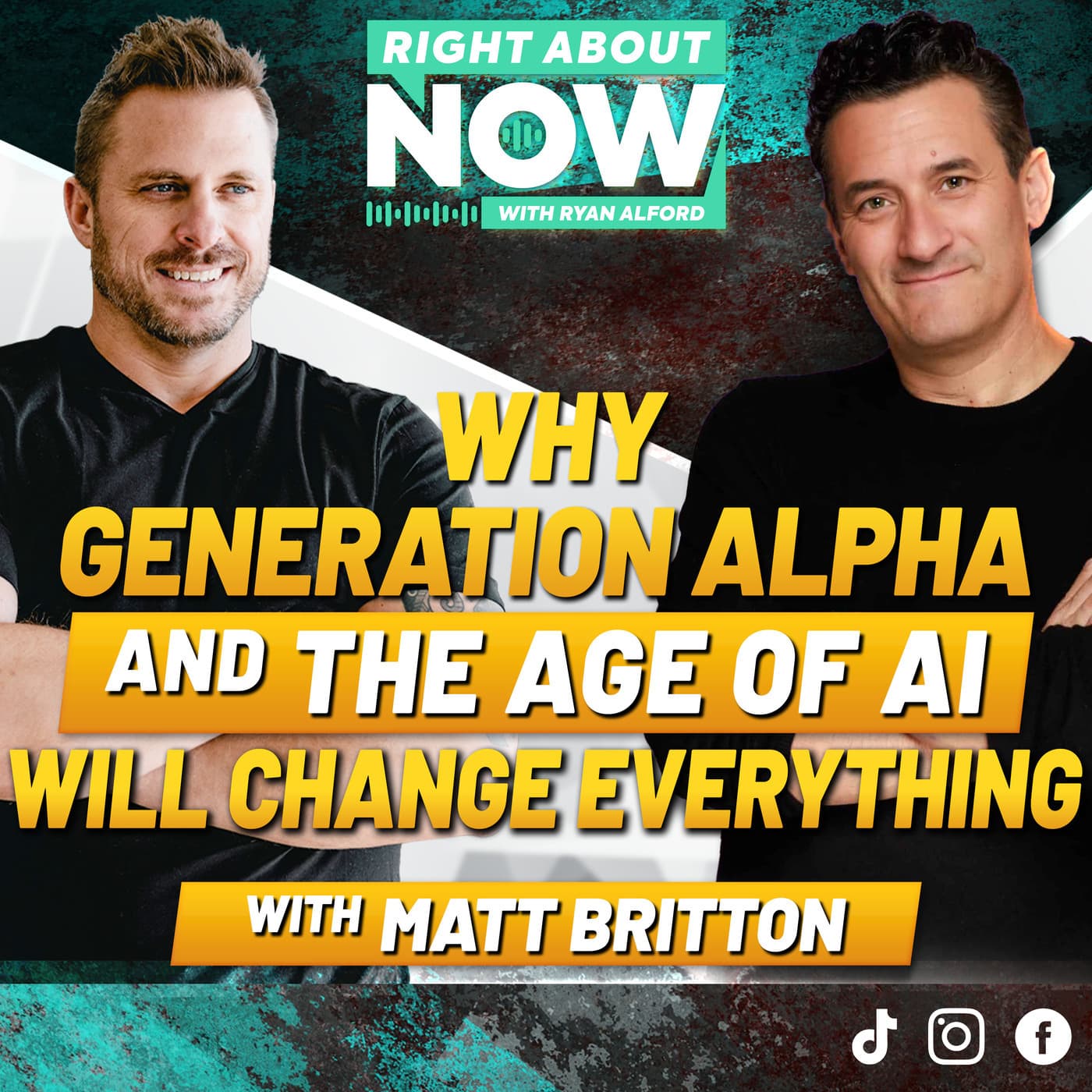
Gen Alpha, AI Agents and the End of Prompt Engineering
Matt Britton, author of Generation AI, joins Ryan Alford on how AI agents, robotics and Gen Alpha will reshape work, education and business speed.
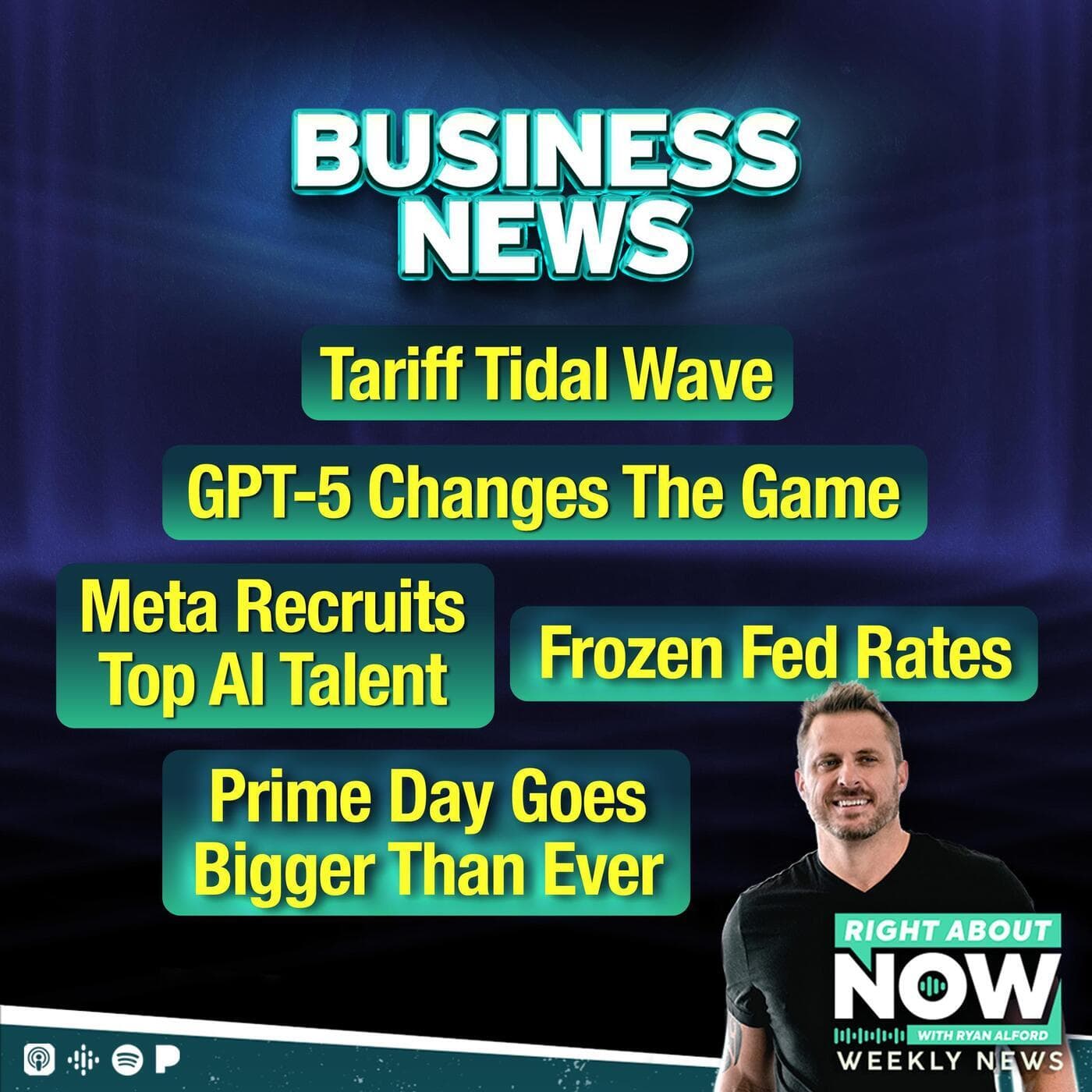
Tariffs, GPT-5, Prime Day and Frozen Fed Rates
Ryan Alford breaks down 25% tech tariffs, GPT-5 consolidating AI stacks, Meta poaching Apple talent, Amazon's 96-hour Prime Day and the Fed's July hold.