
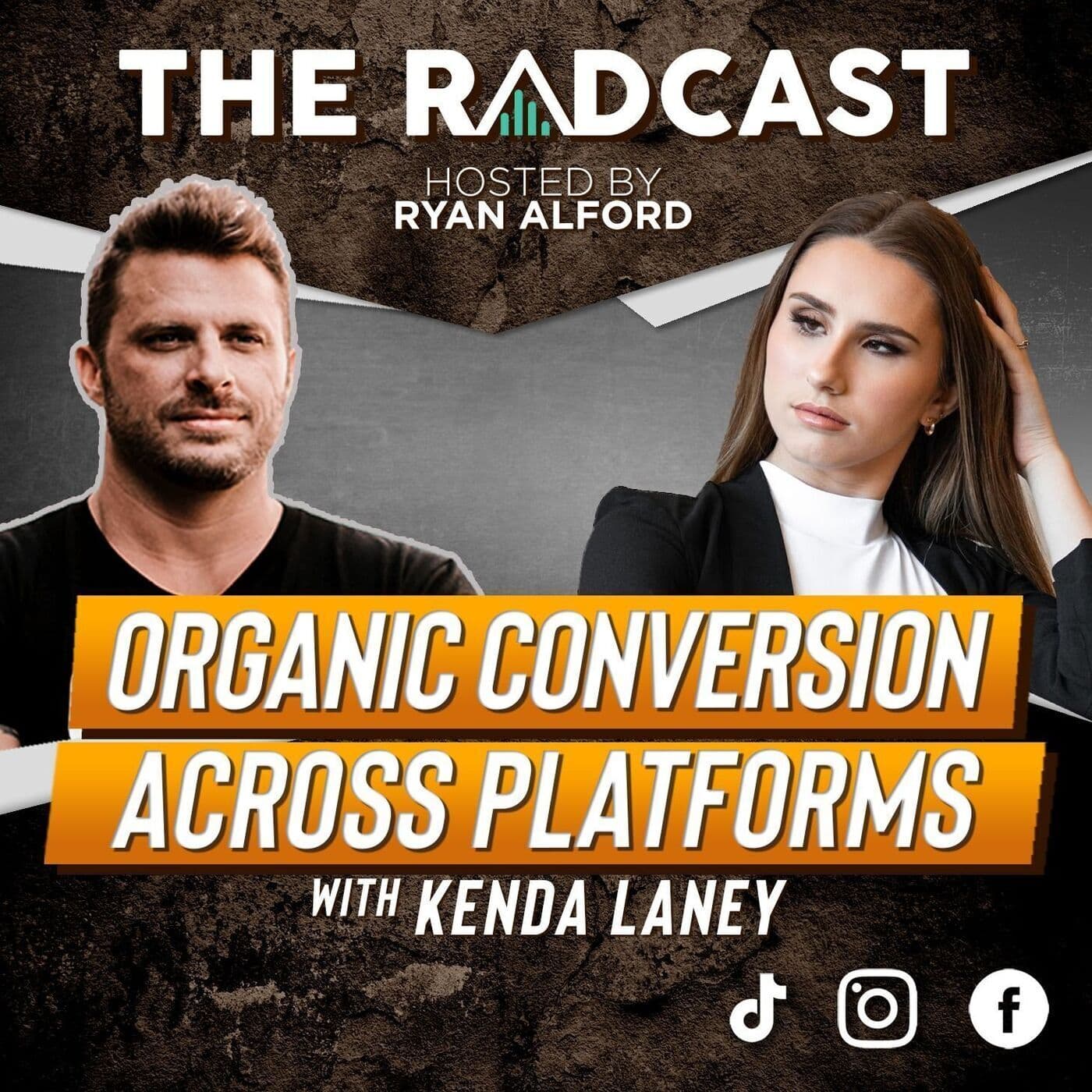
Organic Conversions Across Platforms with Kenda Laney
Kenda Laney breaks down TikTok's watch-time algorithm, Instagram as a nurturing platform, the four buyer types, and her million dollar content plan.
- TikTok's algorithm is driven primarily by watch time — if people finish and share your video you get reach, so the fix for low views is more interesting content, not blaming the algorithm.
- Treat TikTok as your outreach platform and Instagram as your nurturing platform; drive traffic from TikTok to Instagram, a lead magnet, or an email sequence rather than trying to grow inside Instagram alone.
- Instagram's algorithm is relationship- and community-centered, which exposes content nobody wants to engage with — use DMs, voice notes, stories, reels, carousels and static posts to connect.
- Start every content strategy by pulling out the client's personal story and turning points, because people crave connection and see themselves in your story.
- Sell to all four buyer types — analytical, driver, amiable and expressive — because selling to everyone the same way sells to no one; solution content serves analytical buyers, problem awareness serves expressive and amiable buyers, and agitation serves driver buyers.
- Build content through three lenses: problem awareness (name their symptom and give them the diagnosis for an aha moment), agitation (challenge myths and perceptions), and solution (lead with the outcome).
- If you never get negative feedback or hate comments, you're probably not challenging perceptions or standing firm in your values — and that drives down conversions.
- Break your brand into three core pillars, split each into four topics for 12 monthly themes, then sub-topics by lens — about one video a day is a solid conversion baseline, not 75 posts.
So I hear so many people saying the algorithms out to get me, the algorithm isn't giving me views. No, people aren't giving you views because your video wasn't interesting.
Well, people hate Instagram. And it's because they're using it incorrectly. So Instagram is a nurturing platform where TikTok is an outreach platform.
if you aren't getting any hate comments on your videos, you're probably not making very many sales
You're listening to the Radcast, a top 25 worldwide business podcast. If it's radical, we cover it. Here's your host, Ryan Alford. Hey guys, what's up? Welcome to the latest edition of the Radcast. I'm Ryan Alford, your host. Today we're talking social media, we're talking conversions, we're talking to kind of Laney, founder and CEO of Laney Media. What's up, Kinda? Hello. Thank you for having me. My pleasure, my pleasure, I'm going to go right at it, you know, Kinda hit my radar on social media. She's a pro in the space and, you know, I get hit, my, my rarely gets hit a lot. But I was like, I really liked Kinda approach. She's kicking ass and taking names, snapping nicks and writing checks and I was like, I
want to talk to Kinda. So, I appreciate you coming on. Of course. Well, it's wonderful to be here. Yes. So, Kinda, founder of Laney Media, we're going to talk all about Laney Media. I know I'm going to try to pull out of you every sick, sick trick and secret and, and all the tactics and every reason people should be working with you. But let's start with a little bit of your background, history. I know I tried to drag it out of you pre episode, you're like, that's kind of a long story. I was like, well, let's say we're for the podcast. So let's, let's set the stage for everybody with where, where, how and what brings Kinda to the table today. So this is a huge part of what we actually teach our clients to do, but all of this starts
back with a diagnosis when I was born. So I was born with a rare form of eye cancer that had a 2% survival rate at the time of my diagnosis. And I ended up having my right eye removed, I have a prosthetic eye because of the cancer. And also because of the cancer, I was enrolled in therapeutic riding lessons when I was a kid. So getting into therapeutic horseback riding is what got me into barrel racing and competitive rodeo and I was a rodeo queen. And through that industry, one of my mentors had a pretty large social media following. And so as a favor to her, I started doing social media management and did that for years. That was my first job all through high school, that's what I was doing.
And then I went to college, thought I wanted to go to law school, ended up not wanting to go to law school and changed my major from political science to software engineering. So then I started building websites for clients and then helping them to drive traffic to those websites. And then everything really just took off from there, which is how lane media and the consulting education arm of our business was created. I mean, Kinda, I knew you were special, but you know, a walking miracle I didn't know 2%. I mean, chance of survival, let's be honest, like that's a story in and of itself, like, you know, that just tells me you're a fighter, you know, like coming around from that, like I'm I am I hearing that right?
You had a 90. So if I'm reversing that, there was a 98% chance that you would not have survived from that cancer diagnosis. That is correct. That's correct. Wow. Parents, they really stuck it out and did absolutely everything they could to make sure that I wasn't in that 98%. So. Well, I'm glad they stuck it out, man. I needed Kinda on the rat cast, you know, I'm selfish, but no, I love it. So the great story there, I didn't know the horseback or the horse thing. That's a whole, that's a whole nother podcast in and of itself, that horse, that horse crowd, the horse industry, not only the money in it, but the, the passion of the horse. Are you still in the horses? Oh, I love them.
I currently have six horses and I still barrel race. We have Mustangs off of the bookcliffs here in Colorado that I've trained and ride and compete on. So it's, it's a huge passion of mine. I love it. I love that. That's, I love that. I know a lot of people, I am not one of them, not because I dislike horse, who doesn't like a horse, but I do know the passion and the energy that comes with it. And it's, it is a subculture amongst subcultures, for sure, that whole, the whole thing. But let's talk about your time. I mean, you know, going from websites to know you focus on social media now, I mean, what is, what's kind of the, what's your biggest specialty these days?
I already know that I'm starting to get into some of the things I know a little bit already about you because I had you on the show. But I was talking to the audience, some of your specializations. So the big overarching theme within all of our content and our teachings is viral organic content and cross platform traffic. And so our main platform, I'd say that we specialize in is actually TikTok and short form content, but also bringing sales psychology and virus psychology into that short form content to creation, to make it really highly converting and effective for business owners in really any industry. Yeah. What's been a little sidebar, I mean, talk to me about TikTok, I mean, let's, let's have a little bit of, we'll go broad and then we're going to dial it in like kind of
does. Well, you know, it's been a phenomenon. Like I told people, you know, two or three years ago, when this was, I'm not, I'm not a big partner, I believe more that I'm a, I'm a good practitioner of seeing like what's happening and like, you know, like bringing it to action, not really like a future teller in my, in my expertise. But this one, I could kind of see coming a little bit with the viral, viral nature of, of the content and the UI UX within TikTok. It was clearly on, they had something figured out, but what's your, you know, what's your perspective on the TikTok landscape as a whole today and, you know, maybe misconceptions potentially of the platform? That is a great question because there's so many misconceptions out there.
Obviously, I'm a little bit biased because I have a relatively large platform over there on TikTok. I absolutely love it. And the reason being is really goes back to authenticity and the, the central nature of just really telling your story and being very authentic in your communication and your brand being very strategic with that because the TikTok algorithm is primarily based off of watch time. And so if you're interesting, you get views. If you're boring, you don't. So I hear so many people saying the algorithms out to get me, the algorithm isn't giving me views. No, people aren't giving you views because your video wasn't interesting. It's really not that deep and that's, that's what I'm constantly trying to communicate to people about TikTok is that it's really not rocket science.
It goes back to connecting with your people, really knowing what they need to hear from you and just being entertaining because if you're boring, people aren't watching. That's so true. Well, I tell people all the time. And you've just been a little bit this for me, which I say would you either be entertaining or educating and I've watched some of your stuff said, yeah, you can be educating, but educating in the right way. But TikTok has been a fascination because I do feel like there's this, you know, started with the whole, I guess, dance in a way like it is definitely in like the, I don't know, the history of the platform, the whole dance, dance challenges and dance, you know, with the whole music play because it was musically, wasn't that original, original play?
And then, so I think there was like that evolution part of it so that I get started down that kind of entertainment path and I hear a lot of people go, you know, I'm just not that funny. I'm just not that, I'm sure you have a million clients that say that like, how do you find that barrier or break that barrier with clients, especially on TikTok? I know we're being real specific on TikTok, but I think it's such a here and now. I think it's so many, so many people are fascinated by it because obviously the eyeballs are there, but I think they're also intimidated like how do you break that barrier with certain clients of being entertaining or making themselves or making the content entertaining?
So now you're starting to get into the secret sauce here. So really people do have that conception that it's a teenager op that it's, you know, started in the dance and with the influencer culture and all of that and they're absolutely is that side of it. But what people don't realize is that there's different sides of TikTok, there's business TikTok, there's finance TikTok, there's real estate TikTok, there's so many different realms within the TikTok space and the algorithm does a really great job of serving to people what they're interested in and what they've watched previously. So with that in mind and also with changes that they're making to make it more of a search engine, really bringing SEO into the platform, it's become and has been for quite some time
a very, very powerful platform for business owners. And I hear the objection all the time that, well, I don't know if my people are on TikTok. Yes, they are. Yes, they are. Everyone's on TikTok. People are watching things on TikTok. They just, they are. I don't know what else to tell you. But when it comes to really breaking that barrier with clients, we hear that same thing all the time. I'm not interesting. I'm not funny. I can't show up on this app. I'm too old to be on this app. My ideal audience isn't on this app. And so the key thing that we do is the very first step of any of our clients that we work with, we sit them down and really try to pull out of them what their personal story is.
What are those turning points that have set you on the path to where you currently are? Because ultimately with social media, people are craving connection. And so when you can connect with other people and they can see themselves in you, it's incredibly powerful. And that's how you get views. That's how you be interesting on the platform. You pull things out of your personal story. You connect it to where you currently are. Just like the spiel that I gave you at the beginning of explaining how I got to this point, these seemingly unconnected turning points along my journey are ultimately what have brought me here today. So being able to pull that out of clients and then get them to showcase that through our method of creating headlines and the viral content formula that I talk a lot about on social
media, that is what really allows people to break that barrier because ultimately they're just sharing their story at the end of the day. I love that. And I think being in the industry, we aren't just a tick-tock agency like that, but we hear a lot of those same types of objections. And I think, but you're absolutely right, it's so funny and that is what's so powerful about the algorithm is that it's sort of, we as people, if you go to watch TV, me, if you watch mine, I'm a big believe it or not, I don't know if I'm half, they say women are into date line or whatever, I'm into the mystery shows and all that, that in sports obviously, but you'll see my history and all that.
But I self-select, the algorithm does the changing of the channels for you because it's feeding you what you've shown to be interested in and whether that's cooking and the recipe talk or whatever it is, a cook talk, you know, we can close some creative names or minds like golf tip talk or whatever and all those things, a hack talk, but it does, it sort of puts it into those categories and serves it up so that if, if you hit or hitting the right things, you'll show up in that category, so like it'll change the channel for you. Exactly. And it really, the algorithm on TikTok is really interesting because in my personal opinion, you have more control over it than any other platform because you're able to
essentially tell TikTok exactly who you want to be shown to and if your video can catch them in the first, you know, three to five seconds, you've got them, you're good, you're going viral. And I know, is that, is the algorithm, is it still as organic, you know, like the organic reach here, but you know, if that's in the industry, you hear that term a lot, right? Facebook, you have none anymore. Instagram, you have like one percent chance. LinkedIn, you still have an opportunity here and there. And supposedly TikTok, you still do, do you still think TikTok, I know that their ad platforms increase, so they've got ad revenue, goals to make, but is the organic reach still what it was, you know, a year ago on TikTok or
last, has it changed much? It is for me and it is for my clients. So I think it really goes back to understanding and working within the algorithm, it all goes back to watch time. Even though there are more users on the app, right? So a year ago, it was super easy, you could post anything and it could be lower quality and you could get more views. Now, there is more pressure for it to be higher quality, for it to be more entertaining, for it to be more connective, but you still very much have that opportunity because of how it's built. It completely centers around watch time. If people watch your entire video, if people stay for the majority of your video, if they share
it with people, which is obviously directly correlated to watch time, then you still very much have that organic reach. The algorithm is not out to punish anybody. Their goal is to keep people on the app because exactly like you said, they now have ad revenue and they have quotas to meet. And so the more people they can have on the app for longer periods of time, the more money they make. And so when you create a video that keeps people on the app longer, they watch your whole video, you're helping TikTok make money. So they're going to reward you. Period. Follow the money.
There you go. Follow the money. I'll be today's headline. The, kind of, let's transition a bit. The, you know, if we're going to talk about TikTok, you know, my favorite, my favorite copycat platform, Instagram. And I look, I'm an Instagram kind of like my little baby, you know, like the first platform that I got into you, you know, like charge on or like made any, you know, real hay on. So what's happening with Reels and what's the comparison that you make with clients between the platforms? They're certainly the Reels aspect are more similar to TikTok, but there are differences. But what's your, what say you on Instagram? Well, people hate Instagram. And it's because they're using it incorrectly. So Instagram is a nurturing platform where TikTok is an outreach platform. So like we talked about
TikTok wants to show you to more people to keep people on the app. Instagram is a nurturing platform. So it's made with connection in mind. If you think about the different features that are on the platform, like the ability to send voice messages in the DMs, Instagram stories, you have multiple different types of feed content like Reels, longer form video content, as well as static posts, carousel posts. There's so many ways for you to connect with your audience. Why don't people use it that way? That's what it's for. So you do have some opportunity for outreach, of course, with Reels and a lot of people have cracked that code and managed to go super viral. But what's even more effective and what we have found to be more effective for our clients
is to, like we talked about, cross-platform traffic. So you bring people from an outreach platform to your core nurturing platform, which is Instagram. So if you're still trying to grow within the Instagram platform, no wonder you're disappointed. No wonder you're not seeing results. It's for connection. It's a community-centered algorithm. And so as people interact with you and you interact with them, that's how your content gets shown. That's how it gets pushed. It's not all centered around just watch time and interest. So with a relationship-centered algorithm, like Instagram, it really exposes the flaws in a lot of people's content creation, because if you're not creating content that people want to engage with, that people actually interact with, yeah, Instagram is going to be really hard for you. It certainly is. Yeah, interesting. I was thinking as you were
talking, I was like, which one of these is the top of the funnel, which one's the bottom? At first, I was like, maybe Instagram's the top of the funnel and TikTok's the bottom, but I'm not so sure if it's the reverse based on what you just said. Yes, I would definitely say it's the reverse. TikTok, outreach, you can reach new people with every single video, thousands and thousands of new people, and then you give them a reason to come to your Instagram. Some sort of value add deeper connection insights, whatever. They come over to your Instagram and then you nurture them there. So I would I would definitely reverse the funnel there. It's interesting. And it's nice contrary, because I think I think of Instagram as bigger branding, like a awareness over time, like you said, nurturing in a way,
but I think it plays a little bit to both. And it's fascinating because, and that's the only thing about Instagram that's a little bit maddening is that there is so many things, right? It's like jammed in there. But what drives me crazy about TikTok is, and I think admittedly, I've probably gone at it wrong, especially early on. It's such the UI is such a pain to ask you can't really develop relationships within TikTok. Like you can build awareness, no question, and you can go viral or just get thousands of views on stuff that has no generally you wouldn't expect it to. But like the DMing, I'm like, ah, it drives me crazy. Like I can't like have like a real like someone says, yeah, I sent you a message on TikTok. I'm like, well, you might as well have sent that to the wrong,
like send it to me in Alaska, you know, like my home address in Alaska that doesn't exist, because it's like, it's like impossible to communicate on TikTok. Am I the only one? No, you're not the only one at all. And that's why we bring the traffic from there to somewhere else. Be it a lead magnet, email sequence, or to your Instagram, because that's what Instagram's for. It's for connection. TikTok is just for interest for outreach. That's what it's made for. Think about how you use the platform. You scroll, right? Do you ever or often see people that you actually follow? Do you scroll through the following tab? Probably close to never. And so it really is made for just new new connection, new outreach, new interest, and then you nurture in other ways.
So I'm going to break this down for like any of like the old folk that listen to the radcasts. I'm just going to call you old. So back in the day, you'd watch a TV commercial and TikTok's TV. And it was sent you to a website. Well, in Instagram's your website. So you got TV ads, you're promoting your creating awareness, you're generating that funnel at the top on TikTok, and then you're closing them potentially on Instagram with more direct communication on whether it's your website where you'd send a form or you call a number or do those things. Instagram's your website, TikTok, your TV. Did I get it right? Can the Yes, I like analogies. I like compared, like, you know, tomato, tomato, like get it,
you know, connecting one dot to another for different for the different generations. Everybody that's like 20 to 30 listens is gone. We know this shit. We get it. We get it. We get it. Then all my 40 plus are like, wait a second. Are you saying TikTok's like TV? Okay.
It is, but attention. It's TV dead. All the people 40 plus are saying, but aren't they banning TikTok? Okay. Okay. I'm glad you said that because we thought we've joked about that. You know, I think there's too much money in play now, like maybe three years ago, they might have banned it, but now they add dollars, a tax revenue and everything else is just too much. They got to figure away around it. Do they not? Yes, not to mention Gen Z would be coming for them with their pitchforks. So they need those young voters. Hey, those votes all every vote counts for one, right?
What else can does in the master playbook? We got a what what are some of the other tricks up the sleeves that you that we can give away on the radcast, you know, generally speaking for how you approach content. And I know, you know, one thing on TikTok, but you know, how do we in giving value to our listeners like really like how do you coach people on again, content to traffic, but traffic that converts, right? Because that's always the biggest thing. Like it's one thing to go viral on TikTok. It's one thing to have amazing followers and all its attention, all that. But it is a day if you're a business, you're trying to generate sales, right? That's the biggest thing. ROA, ROA, ROI, you know, how do we how do we how do we convert
in traffic to conversion? Yes. So funny that you brought that up. That's the name of our program. Traffic to income. That's the entire point. So what we've really become known for is for our what I call the million dollar content plan, which is what we quite quite literally use to generate over a million dollars in our first year of business. So with that, what we do, and it really doesn't matter what system you use for this, but we use click up. We like click up. But this this formula that we've kind of broken down really plays into the different aspects of sales psychology, buyer psychology. So the first thing to understand before I break down the content plan is that there's actually four different types of buyers, okay? So you've got your analytical buyers, which many people have
heard that term before. But what most people have never heard of are the driver buyers, amiable buyers, and expressive buyers. So if you try to sell to everybody the same way, you're not going to sell to anybody. And so think about it like this. We love analogies here. So many, many people are really familiar with the love languages, right? If anyone's ever read that book, you've got personal touch words, words of affirmation, you've got gifts and quality time and all of those. So for every single person, there's a dominant love language. There's something that they look for or they care about more in a relationship, right? It's the same way with buyer types. So every person has a dominant buyer type, which is their main mode of operation when it comes to making a purchase decision. But that being
said, if you only have one type of relationship, right? If you only have one love language present in your relationship, if you're only having the gifts or you're only having the words of affirmation and none of the other stuff, it's not a very fulfilling relationship. The same goes for the buyer type. So even though you may be a driver buyer or you may be an expressive buyer, if you're not treated like the well-rounded person, you don't have all of these elements to be able to make a sale, it's not a very fulfilling relationship between the consumer and the company. So with that understanding, then what we do to actually speak to all of those buyer types is we create, say what we hear, we create three types of content and under each of those types of content,
we break it down through three lenses. So these lenses are problem awareness, agitation, and solution content. Oh, I like agitation already. I like agitation already. We love agitation. My content is very agitational as you. Yes, that's why you're here. It works. So if you're listening and you're going, what the hell is kid of talking about? It works because her psychology, her agitation, it didn't agitate me. It actually like, you know, business way turned me on to herd approach. So yes, all right, keep going. Three about three lens. I get it. I get it. I'm seeing the night. I'm seeing nine. I'm seeing a block of nine. That's just how my mind works. Listen to you. But yes. Yep, you're getting it. So the first lens with problem awareness, what you're doing and what you're
playing on is the principle within sales psychology, which is often referred to as the feel good factor. And so what you're doing is you're producing a dopamine release in the person that's watching your content. You're giving them an aha moment, basically. So with problem awareness, what we're doing is we're tapping into the person's current reality or like I usually say their symptom. So in again, pulling an analogy that we can all relate to, right, when you're sick, you might have a cough in a sore throat, but you don't know what your actual diagnosis is. You don't know what your actual root problem is. You just know what you're experiencing, which is that you have a sore throat. Okay. So that's the symptom. That's what we're speaking to on social media. And that's why so much
content just goes over people's heads is because they're making tips and tricks videos for the diagnosis. They're trying to tell you how to get rid of the flu when you don't know that you have the flu. You just know that you have a headache. So that's what you're doing with the first connection piece, which is the problem awareness. You're connecting their symptom to their actual problem. You're providing a diagnosis to them, which is giving them an aha moment, which triggers that dopamine release for people. So you make people feel really good with your content because you're showing them the way you're illuminating what this knowledge gap is that they've had. So that's the first one. The second one is agitation, which as you said, my content tends to be very heavily
agitational. And so the easiest way to break down agitation is what you're really doing is you're challenging people's perceptions and you are getting them to think a little bit differently. Right. That's the goal with agitation. So this could be speaking to myths in your industry, things that you disagree with, common mistakes that people make. That's a really easy way to go about agitation and really the goal here is to be going against the grain. And I made a video that got people really fired up about a week ago where I was saying, if you aren't getting any hate comments on your videos, you're probably not making very many sales. And people were pressed about that, but but the reality is that it's true. If you're not getting any negative feedback,
you're probably not speaking differently. You're probably not standing firm in your values. You're probably not challenging people's perceptions and really forcing them to think differently. If no one is ever disagreeing with you, I don't think that's something to be proud of. And so it's going to drive down your sales and your conversions. And then the final one is solution, which is pretty self-explanatory, but that's really where you're just tapping into, hey, this is somebody that was in the same place that you are. And this was the outcome that they had and you really lead with the outcome. So it could be personal outcome. This is how I did this thing. This is how a client did this thing. This is how you can produce this outcome, etc.
So when you have those three types of content, the very lethal combination where you're able to speak to all of the different buyer types like we talked about. So you're doing solution content for your analytical buyers. You're really building that relationship in the problem awareness phase and really helping people feel seen and heard, which is really important to your expressive and amiable buyers. And then our agitation, those are our driver buyers. Agitation is so good for them because they want something that's kind of going to give them a competitive edge. They're buying an outcome. They want something that's going to help them be set apart. And so it's very, very powerful for calling in those driver buyers. So when you have these three types of content in
your plan, it's very, very powerful. But I know that it's incredibly overwhelming to try to then take that and put it into all of your content. So what we do, and this is our secret sauce of the million dollar content plan, we take and essentially look at what the three core pillars are in your brand and in your business. And then we break that down even further. So those three core pillars get broken down into four topics. So coincidentally, if you break each of those three pillars down into four topics, you end up with 12 total topics. There's 12 months in a year. How nice does that work out? So each month gets its own topic. You then break that topic down into sub topics and the different lenses. And that's how you can put all of these different
lenses of content that are rooted in sale psychology in your content. It works out to about one video for per day, which gives you a very solid baseline for conversion, which leads me to my next point, which is that you don't need to be posting 75 times a day to be successful if your content is psychology based and impactful. Boom. There it is, million dollar advice for free here on the Radcast. Not free if you won't help getting it done though, which I know we'll get to. But, man, Ken, I'm like, my brain's on fire a little bit. The first thing, I'm going to force you to define it further. I got it as you went along. But driver buyer, I define a driver buyer for us.
So I'm a driver buyer. And so the key trait that you'll find with these buyers is that they're very outcome driven, right? So they're very happy to pull out their credit card and invest in a coach. They just want to buy that information that's going to give them a leg up. They tend to be more competitive buyers where they want to buy something that's going to give them a competitive edge. But the key trait here that you're looking at is they're very outcome driven and they're very pulled towards authority. Everyone loves authority in their content. Everybody loves to see that somebody knows what they're talking about and produces good results. But a driver buyer, that has to be there. Or so you have to have the authority and they have to see that whenever
you're doing is going to solve their problem, give them a competitive edge, they're really buying the outcome, not the product. There you go. There you have it. I mean, it's like, what you just, it makes sense. So I think part of the reason you know, I don't typically love lawyers, but when you said you almost went to law school, you're a very rational person, I think. And I think if I had to guess, very rational. I mean, I'm sure like we're all emotionally driven at times, but you got emotional buyers, you got rational buyers, like, and that's where my brain goes is you were kind of described that is because you know, outcomes are kind of the, you know, back to like why I loved you and I saw you on like black and white, you know, like I'm okay with
a little bit of gray, but let's black and white this thing. Like what a what a two plus two is four or 22, but it's got to be one of the other, like, you know, like, so there's some rationality there. If I hear you, if I'm boiling that down correctly, yes. And you know, you can really see that in my content because I am predominantly a driver buyer. And so you can see how I am so cut and dry. Here's the outcome that you're buying, essentially, in my content. And so there's no gray area. There's not a bunch of touchy-feely emotions. And we pull that in through my personal story. So again, we are bringing strategic and talking to all the buyer types. But you tend to sell the way
that you want to be sold to. You can really, really see that in my content. I love this. What's your feeling? Random that has very little to do what you've discussed, but it's an interesting thing because we talked about it on our news episode today. What, you know, Metta's doing, you know, doing a little bit of the copycat with Twitter with the verification and paid and all that. Any points of view on that? Well, it was obviously a bus when good old Elon tried to do that on Twitter. But I do think that there's something to be said for allowing people to actually be paid for verification. I think that there needs to be some very strong restraints around that so that we don't have happening what happened on Twitter with people
being impersonated and it really just made the problem worse. But if they're going to have a in-depth thorough identification process where they can, because I have people impersonating my account every single day, I have people DMing me asking, is this you? Is this you? And it can be very harmful and people are getting scammed. And so I think that moving away from the popularity contest that verification is and using it more as a way to protect the users, I think it's a good move. Yeah, I do think they'll make some money from it too.
It seems like I'm like, somebody is like, do you think they really care about your identity? I'm like, oh, they do. But if it's a revenue strain to make another $100 million, they probably would take it. Right, ad revenues are down. So yes, kind of what, where does it? I know you guys talked to me about some of the places people can keep up with you, find more information. I know we went through a lot there, but so valuable. Like, I'm like, taking minutes. I'll be honest, like I'll listen back to, you know, some of our episodes, this is one I'm going to like play back like through, like, because I got to like really digest. Like, I'm listening and taking middle notes, but I'm like, okay, all right, here and there. But
where can everybody keep up or find more about everything that Laney Media is doing and everything you got going on? Well, of course, you can find us on our website, which is laneymedia.org. You can find me on Instagram at kenda.lani and you can find me on TikTok at either the social media millionaire or just my name kenda.lani. And on March 1st, you'll be able to find us on our own podcast, which will be the social media millionaire podcast as well. So nice. Hey, welcome to the podcast world. That's fun. Thank you. What's your podcast? You're going to focus on going to be just organic stuff. Can I guess what are you doing? We're going to have some guests. We'll be focusing primarily around what we've discussed today, organic content,
cross-platform traffic, cell psychology, all of that. But we're also going to be diving into some insights and kind of uncovering mistakes that we made, things we wish we'd done, things that we've learned and just all things business and specifically social media business as well. I love it. And, you know, like I came up in I've been in the business 22 years and the part that kind of drives me crazy is like in my first came up and kind of cutting my teeth, it's very consumer behavior driven, very psychology driven. We've kind of gotten a little out of that into this other realm. And then I think that's what I appreciate about you guys. The most is really that psychology aspect because it is consumer behavior and studying,
consumer behavior, and modern consumer behavior with the channels that you have is so important if you really want to be effective with your marketing and what you're doing. So I love that aspect. It's like a blast. Bring back the past, baby. It's so important, though, because what we see in this space, and I have so many thoughts about ethics within the social media and coaching space. And I am actually pretty pro regulation in the coaching space because the reality is is that we have people that have one viral video and then they're calling themselves a social media expert. Getting a video to go viral and truly understanding content and conversion and virus psychology and being able to produce results for a business that's relying on you to make money for their for their business.
I think I think it's an issue. So I'm glad that people are seeing that gravitating towards some more science based marketing. I'm in the pulp. I'm back. I'm in the crowd and you're the preacher. I'm going, hey, man, like that's why I got into social media. We're doing some of the largest accounts and businesses in the world. And I got so sick of seeing all these experts. I was like, I'm going to do this social media thing. I got something. You know, like, I'm a, you know, can you hear me now? You know, like, that's how you drive. It's how you sell a billion cell phones. Like I did 2001. So, you know, like we can talk business, or we can talk, you know, how I was featured on insert magazine here that you'd never,
you're never heard of. You know, so anyway, we can get on that. I'm getting that, you don't that's so box for quite a bit. I love it. I love your content. I'm going to keep following. I want you to stay in touch with me. Let's send me links to your podcast and your thing. We'll hit all of it in the show notes. And I really appreciate you coming on the show. Thank you. It was wonderful to chat with you. Great. Hey, guys, you need to find us the radcast.com search for kind of lady. You'll find all the highlight clips from today plus the full episode. We'll have the 10 minute short episode where we'd compact everything on YouTube and Instagram. You know what I find me at Ryan
Offord on Instagram and TikTok. We'll see you next time. Radcast. You
Hiring Is a Marketing Problem: Nicole Feenstra
Nicole Feenstra of The DNA Agency tells Ryan Alford why job descriptions fail, how to market the trades, and how geofencing and storytelling win

Jason Brown on Options Trading, Risk and Rebuilding
Jason Brown turned a $10K student loan into six figures, lost $250K on one trade, and rebuilt. He shares his options, risk and wealth roadmap with Ryan
Earned Media and AI Search with Brett Farmiloe
Featured.com CEO Brett Farmiloe joins Ryan Alford on earned media, digital PR, AI search visibility, and the relaunch of Help a Reporter Out.