
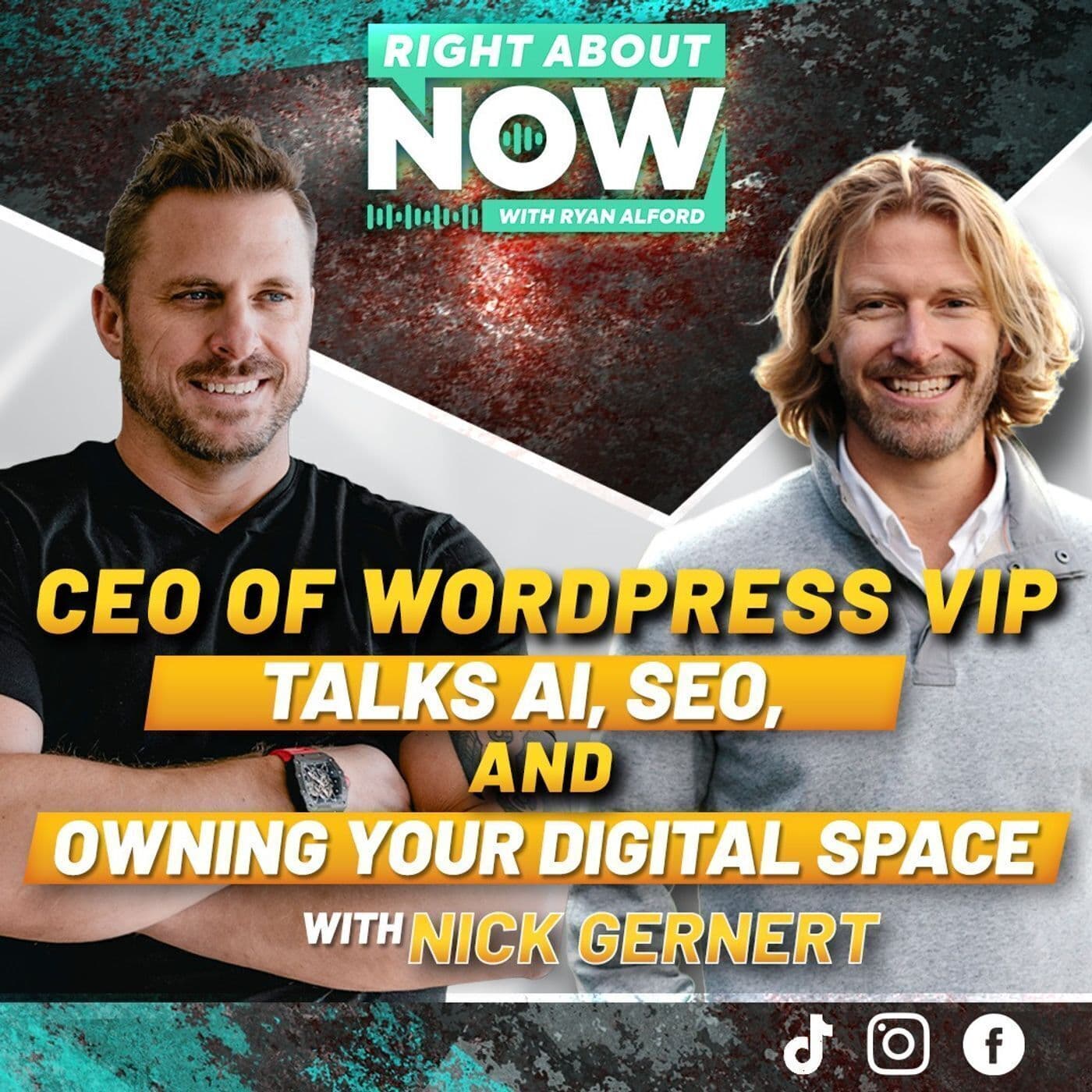
Nick Gernert, CEO of WordPress VIP, talks AI, SEO, and Owning Your Digital Space
WordPress VIP CEO Nick Gernert joins Ryan Alford to discuss WordPress's 43% market share, AI-powered backlinking, Google referral data, and owning your
- WordPress powers 43% of the top 10 million websites, with the next closest CMS in single-digit market share.
- Winning enterprise adoption started with the "food, shelter, water" basics: security, compliance, and reliability for high-stakes traffic moments like election night.
- Nick estimates enterprise digital success is roughly 70% people and 30% technology, and the real win is turning six internal publishers into hundreds.
- Don't rebuild solved problems like CRM integrations, auth systems, or your own CMS; those aren't value-generating activities.
- Treat AI as human-directed assistance for tasks nobody enjoys, like alt text and image descriptions, taxonomy, and translation.
- WordPress VIP surveyed users earlier in 2024: about half had experimented with AI, but only about 10% were using it consistently.
- Their most exciting AI-SEO feature pulls Google Search Console data in, finds your highest-authority existing content at publish time, and walks you through inserting links to the new post across an entire network of sites.
- Across a few hundred million daily visitors, Google referral traffic was still increasing in aggregate, but larger organizations with dedicated SEO teams are capturing more of it than smaller ones.
- More than half of people say they want information from a non-social source, yet still get it from social more than half the time, because owned experiences have been neglected.
43% of 40, 10 million websites are powered by WordPress technology. You know, in the next close this during the single digits, so it's like, it's not even close in terms of market share.
as much as I want to have say software is the solution to everything, really, I think 70% of its people
You don't need the complexity for complexity's sake.
43% of the top 10 million websites are powered by WordPress technology fees. You know, in the next, it's close to us during the single digits. You know, it's like it's not even close in terms of market share. This is right about now with Ryan Alford, a Radcast Network production. We are the number one business show on the planet with over 1 million downloads a month. We've been working in the BS out of business for over six years and over 400 episodes. You ready to start snapping necks and cash and checks? Well, it starts right about now. What's up guys? Welcome to right about now. We're always talking about now. We're always getting right here today. Kind of, you know, sometimes Nick, we have people on and
they're doing some amazing things and they doing things with brands that you've never heard of, technologies you've never heard of. But there's a word that I think I would guess 97% of our audience probably knowing my, I think we know our audience pretty well. They know it. It's WordPress. He's a CEO of WordPress VIP. Nick, Ernerd, what's up, Nick? Hey, well, hello, how are you? Great, man. Thanks for joining us here. Yeah, man, I, you say the word WordPress. Yeah, you know, it's like people don't know what WordPress is. They, they know websites. You don't have to, if I don't have the, especially if you're talking to marketing people or, or digital or just somewhat in the landscape, I think we've heard of WordPress. So, uh, carrying the brand for 11 plus years.
Good job. Thanks. I don't know if I can take all the credit. All right. You know, I'll take you right now. Yeah, you can give it to you. We'll, we'll, we'll assign it to you. That's fine. Thanks. I appreciate that. Oh, man, uh, Nick, I appreciate you joining us. I'm excited to talk all things WordPress and you, let's set the table for our audience. Let's give them a little bit of who Nick is, both, uh, beyond WordPress and maybe otherwise, you know, a little bit of your background. Oh, man. All right. How much time we got? Thank you. Thank you. So, uh, yeah. So it's great to be here. Thank you, Ryan. It's always fun to talk big fan of yours and, uh, and what you've done over the years
as well. So congrats on this. Yeah. So as you mentioned, I'm the CEO of WordPress VIP, um, which is a business that's within a much broader ecosystem that is the WordPress ecosystem that kind of what you know that I'm very happy. If 90 plus percent of your audience has a media recognition of WordPress, um, you know, my, uh, my background prior to, you know, the 11 years you just gave me credit for, uh, in this was, um, all digital agency, Homs, et cetera, on the practitioner side. So, um, pretty much for my entire career leading up to this moment, I was working in digital agency at some level of it as a starting as a car as a freelancer, uh, all the way up into working into an, uh, one of, um, the Homs brands, uh, there.
And so have a, uh, a deep love of the application of technology in general, but, um, also I'm a product of, um, kind of growing up in the 90s when the web was, um, in its infancy and it was something that, um, I got access to, uh, really, it's imperial knowledge in my life and have been fortunate to build a career around helping folks navigate the web. Um, so a lot of my work, um, on the agency side leading up to bringing me into VIP just happened to be with, um, really large brands sort of as I was, um, kind of in the final years of my agency side and, um, there's this really interesting dynamic that, um, some really large brands that were more daring in how they were trying to engage with their
customers. So think of this as like a time when social media marketing and things like this were still really trying to, um, brands were trying to wrap their head around it. So we were working with really ambitious brands on how they could engage with their customers in a new and exciting way and, uh, there was a lot of WordPress, uh, that we ended up recommending that customers use. Um, and so, um, WordPress, this big open source community movement, um, I'm part of a company that was started by the creator of WordPress, the guy named Matt, um, this company Automatic, that I'm part of as WordPress VIP, um, was, uh, started to really help support the broader open source ecosystem, but, um, you know, 11 or so years ago Automatic didn't really have, um,
this business that was focused on some of the largest customers that can really serve some of the, you know, the biggest use cases, um, biggest brands, um, large thorny public sector roll outs and things like this that you might do. Um, and yet I was already having, we were doing that as part of, you know, my work when I was at OmniCom and things like this. So 11 or so years ago, like, just got, I had some discussions with Matt, others at Automatic and said, you know, like, there's a whole market out here that WordPress, um, already exists in some capacity, it could just be a lot bigger. Um, we should really try to build, you know, if you wanted to build a business around that. And I think the response at the time was like, yeah, that sounds interesting. Maybe we
should build, you know, let's, if, uh, we can try to explore something like that. And so can join Automatic on a pretty loose charter to try to look at like, how could you take something like WordPress? There was known for blogging and personal websites and a million other things across the web and say, now as maybe some of the base brands in the world, you could, you could trust this as well. Um, so that started 11 years ago and they kept me around at least this long, so, uh, feel like we're doing some things right, having a lot of fun. So, um, and now it's challenging. So, um, that gets us over simplifying views today. Yeah. And, you know, Nick, I think I do think our audience knows the name WordPress. And it's, I think it's interesting as you
think about the history of websites that you think about the, I don't know why and I've been in digital, you know, I'm a traditional, traditional digital guy like, you know, but they call us something like, uh, I'm not a native digital. I was probably a native analog, but now, you know, a lot of my adult career in digital, uh, you know, both sides of it, but had a, but definitely always been on the, I think the forefront of digital and innovation and technology because even the client that I had working at big agencies were all in that space. And, and technology, the, the, what we were selling was technology and watching the evolution of WordPress and from the blogging platform to really the go to CMS for most definitely mid market agencies and clients to all the way up to like what
you're talking about corporate level as the sort of transition and evolution from that. I don't know, I think of almost like my space, you know, back, I guess the, as the, as the, yeah, the evolution though, is like if my space had made it into the booming company that WordPress did, like because they evolved the right way or something, you know, WordPress went from the blogger to the small, you know, every day person to what become became and still for even us as an agency are go to kind of CMS for, for clients that need functionality, but something that's workable for a mid-level market, you know, client. It's been fascinating to sort of watch that evolution of the company, you know, and I'm sure you've been had a seat right at the table. Yeah, yeah, I see right at the table and
I think I mean, WordPress started in 2003. So, like, just think about like what devices were we using in 2003? You know, it's crappy PC or shiny Mac, you know, these are cool. Yeah, I think of an aqua Mac, but I don't know if that was that age on the IMAC. This time, Macs came out like 2000, I don't know, five ish, maybe I think. Yeah, we go around. Yeah, the ones that are cool that swiveled, like the, you know, make me feel old, but you know, to think about where we were there and then where we are today and WordPress has been this has been along through that and continue to grow, market share still, like inches up against, it's harder with the, like once you reach certain
scale, like, I mean, that number, that's a big number. You keep moving up. Yeah, what, let's go and tell it, Dick, that's a good one. What is it? What percent? 43% of 40, 10 million websites are powered by WordPress technology. You know, in the next close this during the single digits, so it's like, it's not even close in terms of market share. We call that a category king.
Yeah, you know, I'll pick it. You're the, you know, you're the, you're the, you're the agency guy. So, you know, workshops. Exactly. Category king, WordPress. It is obviously of CMS's and it's known for that. And so you guys have worked hard for that. It's, what's that? Talk about working for a company that has, you know, that market share and then bringing to life, sort of even a new cat, not new category, but it is a new category for y'all, like, you know, dominant CMS overall, but again, bringing to life the brand for corporate to kind of go direct to because that way that, that transition is kind of what I was kind of building to all this, the my space and all that is, you're at this level and everybody respects you, you're getting it, but then trying to be the
corporate, you know, king, so to speak, or go to, I mean, was that a hard transition to get people to make mentally? Yes. So, you know, the corporate kings and queens, we're like, this, this transition for us, I mean, that, that was the opportunity as coming into the business because as ubiquitous as WordPress is on web, it's not in that corporate sense. It was, there was niche adoption of WordPress from a, like, oh, we use it to the corporate blog. Like, one of these examples was like, you know, I had like, Randy's blog. This was like a pilot named Randy. He was blogging or averaged WordPress, but it was in no way like the corporate homepage or anything, like, you know, that was core to business operations. It was like, yeah, that's fine as a side
project. And really, the whole vision was like, how would you legitimize this thing? So it's not just playing a second or tertiary role in the enterprise. It's playing like a primary business aligned role at the center. And, and so a big challenge for us is like, how do you take something that is as ubiquitous as WordPress, but also ubiquitously known for its blogging and maybe more consumer and small business and up to mid market. But then there's a mental model that says like, it's good to a point, but not for this point sort of thing. Yeah. And so a lot of where we end up focusing in that transition and where we focused as a business was like, I'll talk about it like food shelter water of like the hierarchy of needs of enterprises is like at that base, you have to
be able to speak affordatively around security, compliance, reliability, etc. like last night. I think it was a big night for a lot of web traffic here. And not to I know that folks will view this, but we're chatting here today after last night was election night here in America. There's a lot of organizations that rely on our platform through a night like that. It's like, how do we reassure them that we are ready to go from traffic and everything else that's going to come in sort of that critical moment that you don't get back? It's like that moment goes past. You can't rewind the tape and then all right, we fixed it. Let's try again. It's scorned. So we had to invest heavily and just have foundation there. And then there's everything you know about
like working with large organizations that's the intangibles of like, how do you show up as an account team? How do you show up as like understanding their business needs, their objectives, their like how do you then meet them there so that whatever software we're providing. And as much as I want to have say software is the solution to everything, really, I think 70% of its people and that's actually one of the strengths of WordPress is that it's so centered around people and creating access for people that the 30% actually the technology impacts in the organization we do really well. And so, but how do we really bring people together because so much of actual success and digital and everything else is like, can you access the tools, can you access your
audience, can you access your customers, et cetera. And so much of the existing market for my perspective prevents that actually doesn't enable that. So we're like, how can we open that up? How do we focus on opening that up? So that our transition is really like, how do you take something that the web at large has accepted and said this thing's great fit for purpose, but enterprises have a bit of skepticism around that. We've, you know, been spending 11 years and we'll continue to spend many, many, many more years trying to really help serve that market and adapt as, you know, who knows what happens in the next 20 years of WordPress story. Yeah. And it's interesting. I can say this being on the agency side and I've worked to
some of the large agencies in the world and now own my own boutique shop. Like, sometimes we try to make things complicated. Like, it seems like some of these platforms and CMSs that I think are starting to wind down. I hope they are. God, they're so complex. And so like, I feel like, I don't know this, but I've always been skeptical like they, they're complex for complex sake. You know, that's like, it's always been what I loved about WordPress is, yeah, you got to learn it and get your way around it. But it's meant to be easy, but robust. You know, like, it's way better than like your off-the-shelf platform as far as you need to get to talk with this code or this plug in and all the stuff that it can do. But it's manageable.
But I feel like these corporate, you know, because we've worked with some corporate clients. They bring us in there using this platform. I'm like, why in God's Earth are we? What are we on? And why? And it's like, everything is like pulling teeth. Is it? Is that like just to protect the agency or why the hell is it got to be so hard, Nick? You know what I'm talking about. I'm going to name any names, but you know, it's just like, oh, yeah, we're on a corporate CMS. It's insert name here. And it's like, you get behind the hood and it's like, Jesus, like, yeah. Jesus, like, it's like digital transformation and all these things were all-contective in a ways to create massive budgets to extract a bunch from an organization that
was looking forward a solution to a problem that they really didn't understand, like, you know, what the root causes were in the first place. And so I definitely will imagine, I think like, as you know, going back and being the product of someone who came up in the earlier states of the web, there's actually like a beautiful simplicity behind how the web actually works. That when you fast forward to today and look at all the layers that now have been created in the stack, I just like completely sympathize and empathize with markers and others that have to think about, how do I? What is the MarTech stack? What is the web stack that I bring together? My developers are telling me we need to do this thing and use these technologies. My executives are telling me
these analysts are recommending this highly complex and enterprise level solution. And usually, when we say enterprise level, it's like they're overly complex, heavy-handed, massive suites of things that you don't end up using. And that's the status quo. And from my perspective, it's like that beautiful simplicity. You're like preaching to the choir here on from a WordPress perspective is like, how can we? That's how we show up differently. It's just, we'll come into an organization of a couple hundred thousand people. And they'll say our existing technology, six people know how to update our digital properties at a 200,000. We got six people internally that can touch this thing. And our goal is, how do we open that up? How do we turn six into hundreds or thousands? Because the reality for marketers and organizations is if you're trying to connect
with your customers and you're trying to catch attention, you have to be doing this in a way where you're able to move quickly and you're able to engage authentically and directly and usually the best way to do that is not through like six gatekeepers and the organization. And so that's what you think actually like WordPress and WordPress, I feel like brings a superpower into these big companies because it's like, give the rest of the stuff out of the way. You don't need the complexity for complexity's sake. And so that gives me plenty of stuff to work on for the next, I don't know, decades because I feel like it's ingrained in these large companies that we need complex platforms and actually like the simplest solutions or the best solutions. So yeah. And in today's
world, like, it's like I just need to throw a landing page up, you know, like, can we get the communication out there, you know, like, how fast does this have to, and you know, you've seen technologies like Canva and other things that have tried to, you know, democratize, you know, content development and landing page. And that's what I always liked about WordPress is that you could do things quickly using and having and to open this, you know, having the open source side and then all the plugins. So we're, you know, it's a wonderful thing when you guys, the way you guys are willing to work with so many other partners because so many other things need to talk to things. And that's what the great thing, like, when a client comes to me and they do have maybe
some complexity or whatever, that's why I'm always, you know, WordPress is top of mind because I'm like, okay, it's the fastest to integrate. It has a plug in for that plug in for this. And some people get like their hair like in a mess over all that, but like, that's what I've always liked about WordPress is the willing to sort of partner with anyone to bring these integration to life and seemingly do it in an open way. Yeah. And then you get to focus on actually solving new challenges. Like the most frustrating thing to me is like when you've like come up with 10 different ways to integrate with whatever CRM you're using. Yeah. And like in reality, like you're like thousands of other organizations that have also needed to integrate with that CRM or that digital asset
management platform or an ad platform or analytics or any number of things. And so why spend the time recreating these elements? And then actually spend the time on like what actually, what are your business challenges? What are your business opportunities? How do you focus on those? Because, you know, authentication systems and CRMs are not value generating activities. CMS creating your own CMS is not creating more value for your organization. So how do you let this ecosystem and our organization help with solved problems? So you really just focus on business strategy and execution and your customers or your audiences, new problems. That's way more engaging anyway. And doing that. So yeah, that's the whole Nick Gernert. He is the CEO of WordPress VIP. Nick, you know,
the elephant in the room whenever you're talking about content, AI, artificial intelligence, what's been the general, you know, WordPress slash WordPress VIP slash automatic sort of corporate position on AI in general and even your own sort of position on how it's been coming to unfold the last couple of years. Yeah. So I mean, I think our position is there's a lot that's exciting in this. And you know, we're really on it. I'm also the person that wants to be really pragmatic on what are new, what are new approaches and technologies, et cetera, bringing to the work we need to do. And how do we actually stay focused on the value of that and not just necessarily chasing trends? Because a lot of the complexity we were just talking about comes from the temptation
to maybe chase trends and throw things in there and hope they actually make things better. So but I think like with AI, this is something that and particularly generative AI, this idea that machines can generate text and images and video, et cetera, in ways that we've just not been able to do historically, it is exciting, especially when you think about, you know, our role as a content management system. So we're the source of record and creation for a lot of these things. So our position is like, what is the best of those two things coming together? Because like anything, you want to focus, you want to focus your people time on the most valuable activities and let the machines do like what they're well suited to do. This has been like the, I mean, this is
the history of technology in general is that we see a big technology shift and then we wonder if the status quo is forever changed. And really we can look at like how it adapts into the future because like, you know, the role of a CMS has been called into question many times over the years in terms of different waves of technology evolution. And we're still here and we're still very critical as part of this. So I think from our perspective, it's like, how do we make humans more, it's that, how do we give them superpowers in this moment here in doing this? We don't see it, I don't see it, and I don't see it anytime near where there's a strategy where it's just like,
we just let them machines now run our content strategies, our content creation, everything in that. Our approach in our view is very much like there's a human in the loop. This is human directed and then it's aided through a lot of these technologies here that actually help take care of a lot of things that historically have been time-consuming or just not even done well. So you can think of like overly simplified things like image descriptions for accessibility, all tags, things like this that we've had to do in my technology. Like nobody likes to do that. And then we have like certain parts of our audience suffering when it's not well taken care of. Like those kinds of things are absolutely accelerated. The categorization and taxonomy around our content way
easier and way more streamlined with the help of things like what we're seeing in AI right now. Translations and the acceleration of things like translation said, this is, again, these are things that there's solutions for. We don't even have to build them all as like automatic or WordPress VIP. There's great organizations out there building these kinds of solutions today and like anything with WordPress is like, oh, it just easily snaps into what I'm already doing. So we actually view ourselves as kind of a platform by which a lot of folks will just experience AI and maybe not even fully realize their experiencing AI. It's just like, wow, the tool just works really well on these tasks that I need to do around it. Something we're doing uniquely like we as WordPress VIP,
we sit on, we have a lot of analytics data that we have access to by virtuous products that we provide. And so we're looking at how do we help our own customers take their analytics, their content performance, what has worked, etc. And how do we actually feed that into the content that is generated through AI. So if you're looking at like, I want headlines or titles that perform better, we can actually help say based on historical performance, we'll write headlines in your tone of voice or your business tone, you know, based on your performance. And we will recommend things. And so we're looking at this as a way to say we can start to get predictive on how to help customers understand what has worked historically and apply that to the future. And so
we're looking at that as saying that how do we take our unique assets? We have this organization, which is a lot of data that otherwise you don't necessarily have access to. And how do we apply that to things that get generated? So I think there's the other side of this is we actually went out to the market earlier this year and just said like, hey, how are you applying AI in your workflow? And, you know, there was, the response was, you know, about half of folks, and this is like just a couple months ago, about half of folks responded, we've experimented with AI in some way. So, and then about 10% are saying I'm using it consistently. So we're still in this moment from an AI adoption standpoint where folks are, it's still very recent on the consistent
adoption and application of it. And so I think, again, part of how we're thinking about this is how do we just incorporate this into our product that supercharges an editor's experience, a content creators experience in a way where they might not even really realize they're working with AI necessarily. It's just helping them do their jobs that much more effectively. That's definitely going to be our focus for years to come here, rather than thinking that suddenly this shift makes the CNS irrelevant or the content creator irrelevant or anything else. It's just going to make us more effective, like any other technology shift we've seen in, you know, recent decades. Yeah. It's interesting, as you're talking, thinking like the evolution that you've witnessed, being there 11 years with like mobile down the smartphone. And because I was thinking, okay,
WordPress says this envelope or, you know, the carrier of content, you know, the, and it carries the content. And when that was a desktop experience, that was one thing. And it's still, you still have these experience. I've laptops and we're working on, you know, desktop experiences where that even if it's mobile, but then you've got the mobile phone and education versus entertainment and the role of WordPress as the carrier of that. Like a lot of bacteria in my brain just started to go down this rabbit hole, Nick, like going, Nick's seen a lot through the evolution, you know, of how the web gets used and the device that it's on, right? Yeah. Yeah. And like, so your mobile example is a great one because you know, in the earliest days of mobile, like we carved off
specific teams that focused on the mobile experience for like, look, you're the mobile team. Yeah. Are the carrier taker of this new paradigm, this, and it wasn't big on lock for oriented to think about like, okay, now I can reach an audience in a whole new place and a whole new way, etc. So you focused on that. And now we don't have a mobile team anymore. Like mobile is just part of what we think about as part of like, well, we don't have the audiences at least going to be coming from a mobile device. So we need to make sure it works great in that context, in that new case. AI is going to be a similar thing here. It's like, wait, you know what we do have AI
teams carved off right now. We're saying like, hey, go focus on this sort of new thing. But, you know, give it a few years. This will just, when we will settle into an understanding of like, all right, there's where the value is really accruing and generated in this. And it's just part of the work we do. It's not an end or us like another lane. It's just another part of this paradigm. So to your point, like these fundamentals, this evolution, the more you just have like the very broad foundations that WordPress is built on, it helps you adapt and say like, okay, something new is here. We're going to focus on that for now. And then it just becomes part of the common platform over time. And then we'll be ready for the next thing and adapt to that. Ideally. Yeah.
You guys are the FedEx of, you know, you're the delivery system in a way. You know, like, but no matter what it is, I mean, I don't know, like it comes through, you know, I get this package analogy. I told you my brain works. It's like the content delivered when you want it where you want it without you having to think about necessary. Like the best thing that FedEx can do is make you not know they exist because it's so ubiquitous. So there's no issues, right? We only worry. Only about this issue is when the package doesn't get there. So if I'd never talk or think about FedEx, that means FedEx does their job. Same thing almost with WordPress, because no matter what you're trying to get at the content, whether it's entertainment, education,
you know, whether it's the brochure or the TV show that's encapsulated video and encapsulated on the site, you know, no one needs to know you exist. You know, the least, you know, other than the corporate person that you work with, but the user experience, you know, so that's a fascinating kind of analogy, right? Totally agree with everything you're saying there. And our job is, well done, when we kind of just fade into the, you know, the back. And we, and as long as we're enabling folks to do their jobs, and as long as people can get what they need when they need it, everything like that's the job. Well done. And it's not about us like having a visible spot somewhere in that stack. So that's what you said AI built in, not you might not even know it,
because you don't need to know it. You guys are leveraging the technology, bringing a better experience to life without actually, you know, again, it's like, we don't have to package these things and call it AI. We just call it a company using technology in a good way to make your experience better. Yeah. Right. Sometimes we market things, you know, like, and I'm a marketing guy, you know, I love putting monocles on things. Well, I know that's the audience we're talking to right now, and that's part of our own, I mean, that's part of our own challenge, honestly, is like, look, folks want to know about AI right now, and folks want to know what your product is doing. I don't think it's as much about AI. It's like, folks want to know, like, what are you doing to
keep up with the pace of change? And like, please talk to me about how you're shifting with change. And so AI is that lens we deal with through right now, but it's like, how adaptable are you really? And so, so you're right. And we, it's like, you need to talk about it. We need to talk about it through the lens by what people are viewing things. And also, I don't want to overstate that somehow this is an entirely new product. This becomes something that actually takes something you've already been doing and improves upon it in ways that are like really exciting and haven't been transformed this way in many years. So just an exciting shift in the work. How do you think? Because when I go, I start thinking websites and WordPress and my mind gets pretty fast,
probably being a digital agency guy, like SEO. And I think not only like, okay, within WordPress optimization of SEO that could be done with, you know, machine learning and AI and all that sort of thing, but also the user experience for how people are searching today. It's kind of like twofold. And how are you guys, how do you guys think about SEO within the landscape of the product and just overall with everything happening with AI? Yeah. So, I mean, further, the foundation is, WordPress has had an SEO sort of its course since its earliest days that in most cases, we'll see folks migrate into the platform and immediately see a traumatic SEO improvement just because of all the care and attention that's gone into how documents get structured and delivered. So it's very
SEO-friendly way. Most exciting thing we're working on as a business right now that's AI-related is related to back linking. So one of the things that drives a 40 from an SEO, and you know this, is what points to what and what authority, how can you take high authority things and point them to something so that it also then gets more authority. So one of the things we've actually been working on from an SEO standpoint is how do we take, so you can do like, we do Google Search Console integrations into our products. So our customers can start to feed Google Search Console data into our platform. So immediately, we start to already mail like a lot of the insights around SEO. And what we're then doing, at the time of something being published, so you go out, you're
going to publish our interview here today and you're like, I've got, what I want to do is I want to get this thing ranking well for AI and content or something like this. And I know I posted some things years ago about CMS or whatever. And what we'll quickly do is go into your archives, we'll match up your highest authority existing content and say you need to insert links to this new thing in this content and we'll walk you through a workflow by which you can go about and do that. And then at the global enterprise scale, we're actually then saying, hey, we'll actually go do that across a network of sites. So you might have one dot com here, but actually you probably want a hundred websites with us. So we'll actually go through your entire catalog and
say, how can you relate across your entire catalog of content to these new things? And so, and that is that this the accuracy and the efficacy of this has been unlocked in a new way, thanks to AI and just how quickly you can do this and how accurately you can do this, that for me, it's probably the most exciting. Like, yes, we're also doing things. It's like generating me an SEO friendly or headline and things like this from a document constructions standpoint. That's great. This just like supercharges it in a new way that I at least I'm not seeing anyone else right now is able to really do this kind of thing. So that's definitely one of the things that has me most excited about. Yeah, I read my head around that the moment you said it,
like, yeah, like that, that's big. And that is, I have not heard of anyone else connecting those dots. And it does, I mean, backlinking for SEO value for anyone listening, like there's an SEO specialist like your SEO, where you follow in those search rankings are driven by a lot of things, but two really the most important things, the content and the relevance of that content and the keywords that are used that are highly searched when people are looking for that. And then the sometimes lesser known is the backlinking from authoritative sites that have high domain authority that are leaking back to your content and your website raises your SEO value. And what Nick is saying is they're making that a lot fucking easier with, uh, uh, uh, uh, uh, uh, uh, uh, uh, uh, uh,
practical use. Yeah. And hopefully an improved user experience too. So if I land on one of your old pieces of content, I'm like, Oh, great. Actually, there's an updated thing on this as well. So not all it's not it's SEO and ideally an improved user experience as well on the way. So, uh, thank you for validating us on the like that you think is this also potentially valuable. That is very valuable for the right people. And if it isn't valuable to them, it means they don't know or understand how valuable it is. And I'm not being harsh. I'm just direct people.
This is an opinion show on some level. So you're going to get mine. Uh, if you don't know that's valuable, call me. Nick and I look you up. Oh, I'll get to Nick Gerner. He's the CEO of WordPress VIP. Who doesn't want to be a VIP? Very important. I like being a VIP. The, uh, Nick, you know, staying down that search train just a little bit with with AI. It's interesting, you know, chat GPT and, you know, asking things. Are you guys seeing or you have data that support? I mean, you guys have so much data. I can't even imagine how much data like information you guys have. It makes my head won't explode. But that's why the computer is getting to do it for us.
But, but think, but like user, how much use it, it goes like to almost like the, you know, people googling or chat GPT. Like do you guys seeing those kind of trends and that data and reacting in any way to it? Yeah. So I mean, there are a few things here. I mean, like, I think on one end, um, what's informing these models tends to be a lot of the content that's been created and exist across the web. And so I think there's, we've been helping folks navigate attention of like, what's fair use of my content. So, and we're trying to help at a platform level. Like, look, if you want to restrict certain things or whatever, like we want to help you there and make sure you've
got those types of things. And I think, you know, when the web, the website and web in general, will have a significant role to play for the foreseeable future and what informs the responses and what is considered fact and opinion, et cetera, comes from these sources. So yes, there's a certain amount of training models against those things, but I don't see it usurping the importance of the sources anytime soon. So, but we're helping folks navigate like fair use of their content. And then your point on what are we seeing from a trans standpoint in terms of consumption? Like, is, you know, we were asking ourselves over the summer that was the introduction of AI summaries on Google. Was that leading to a decline in Google referral traffic to our customer websites
with people searching? They got the answer in that synopsis and then they never actually clicked the blue link anymore. I think that's the big fear that folks are worried about at the moment. That's the most kind of pressing concern is, where is that? We're going into a bunch of data around this and overall, but right now we're actually seeing referral traffic from Google to the websites that we look at, which we're looking across a couple hundred million visitors every day. So it's significant amount of traffic. Google referral traffic is actually increasing right now. So in aggregate. And then if you've got to kind of do that back, the there's a disparity though between the size of the organization. What we're seeing is like the bigger you are as an organization,
kind of to your point, the better you are at navigating SEO, relevancy, etc. So you might have teams you can dedicate to this more than the smaller players. And so we are seeing a bit of a, it's not as evenly distributed from big to smaller in that spread. So that gives us more of an impetus to say, how do we help folks navigate this? Just find whether or not they have massive teams that can stay on top of these things or not. So what we're seeing is like, look, if you're able to engage and build great content, backlink get related, do all the things that help you, you're maintaining it at least or even a growing audience right now. And so we're going to continue
to monitor this and watch this and just help folks navigate what may or may not change in this. I think there's a healthy, there's a well earned healthy amount of skepticism towards Google at the moment. And how much should I rely on them for traffic? And as a platform that directs people to me, I think that's fair. They are a very important source of traffic though. And I think it's both like leveraging that and also thinking about like how do you, how do you have a strategy that doesn't make you overly dependent on anyone particular technology? Because is, I mean, you know, this better than I was like the over dependency on anyone's social platform or search or chat GPT or anything else might help you in a, you know, six to 12 month time horizon and may really hurt you
on a multi year trajectory if you're trying to think long term. So same rules still apply. How do you have like a well? How do you hedge against over dependence on anyone particular company to drive your business? We're trying to help folks navigate that because we think we as WordPress and something that is open. We're not a platform that owns your data or you or anything else. You actually own all of these things. We're here to help you kind of navigate that and and have a stronger own depressions on the web. Yeah, that's you know the word there at the end, but I was going to go is like rented versus own land. And I've always seen WordPress because I'll say this to people, you know, whether it's social media or other entities, you know, YouTube even and look,
you got to look, take advantage of the platforms. I'm not a hater on the wall gardens, you know, but just know that's rented land and not own land. And WordPress may sell products and services, but they are part of the good guy own land territory. And I've always coached that that your website needs to be your own property, your newsletter, your website, your content. You've got to own it and have places that it lives and sort of your yard and not your neighbors. Oh, yeah. The one that the beach house you're renting down the street can go away at any time.
One gets thrown away from God. So yeah, Nick, as we close out here, you know, what are you seeing? We've talked about, you know, the trends with AI pragmatically improving, you know, experiences on the web, things that WordPress are doing. Maybe for our listeners, what are like maybe some practical things that you're seeing in corporate business, website, like go-to-market strategies these days or just like what are some trends or things that are real that are using your pragmatic approach that you think people should be thinking about as they maybe embark on a new site or a new project within a web experience, those kind of things. Anything top of mind is sort of some actionable things. So yeah, I mean, I think look, I think we're in a moment here where it's a great opportunity to
reassess just what are you investing in those in your own channels right now. And so I think actually one of the challenges is our folks even embarking on this journey that you're describing, which is am I looking at these own channels? Am I investing in them, whether that is in microsites for a particular audience or like our broader digital presence? Because I think, you know, there's never been a better time to really think about your investments in your own space of web and digital. And you're naming all these things for newsletter because no one can own how you distribute it into somebody's inbox to web and website. There's a reason these things have had a resurgent in recent years because we've seen really the dynamics of platforms and who controls
what in terms of an audience really get called into question. And as a large organization, it's highly dependent on these connections to your customers and your audiences. It's chilling to think that that can easily be cut off. And so the trend and the thing that we're seeing folks, I think it's just how do I invest more in this? Because one of the trends that we see and that we've heard from people is like like more than half of folks want to get their information from a source that's not a social platform. But yet interestingly, those same folks are saying like more than half the time I'm just going to social and getting this information. And I think a lot of that is due to the fact that the experiences on the own side have been neglected
and are not nearly as robust or as engaging as some of these other platforms and things like this. And that's not to say that everyone needs to recreate the platforms, but you need to be investing in experiences for your own customers that actually are generating positive customer experiences. And you can do this in your own channels. And you can do this there. But folks, so that is for me the thing that I would just encourage everyone to be revisiting right now is how much are you investing in that? Because there's long-term returns on that. And some of our most successful customers on the enterprise side are the ones that five years ago, even pre-pandemic, we're like we're making a big investment in the channels. We own and the content we drive to those channels. We're going
to own more of a relationship with our customers. And those were the folks that navigated like the you know a shutdown to entire digital and you know in early 2020 and then emerging from that now have navigated from that the best and the strongest. So it's like the best time to plan a tree was 20 years ago, best times today or second best times today. It's the same sort of thing I think like that the time to invest in your own strategy would have been five years ago but you know start today. I think when you start a new campaign there's no political affiliation here at all but you'll get where I'm going here. Let's make websites great again. You know like I'm just saying like
I know that that conjures up like a feeling no matter where you fall politically. But I'm serious though Nick like there it's sort of like it's as you were talking I'm sitting here going once the last time I went into a website and really was surprised and delighted. It's been a while and it's time to like surprise and delight again on the web. The web is a wonderful and beautiful weird place where you can do these really creative and event things that no one necessarily gets to control those bounds. And I think we've lost some of that in more of a homogenized experience. It could cut or you know you're reading those old gardens and you've got your profile and people are learning about you but you can't bring your brand completely to life. Yeah and maybe
we'll start a site. I mean we just start a site and it's like highlighting really great things that folks are doing with the web right now because there are some really great examples of great experiences that folks are investing in and building. So maybe you're giving me an idea of like we need some inspiration. We need some inspiration Nick. That's what it is. Let's inspire. That's what this is about. It's part of that greatness on your own branded properties. Let's do it. Gerner and WordPress VIP Nick has been a pleasure brother. Where can I keep up with everything you're doing? Learn more about WordPress VIP, etc. Yeah you can find us wpvip.com. You can find me on just about any channel. My name Nick Gerner. You'll find me who are there
or we're WordPress VIP all over the typical network she'd look at as well. So find us all there. And I really appreciate the time this has been a ton of fun. Yeah we're very aligned on many of the things that you know could be great here. So I think there should be some partnership or something on this. Love to have you back on the show regularly. Hey guys you don't find us Ryan is right.com. We're bringing it together all the best all in business and marketing here on the show. Nick everything to do an over WordPress look don't be on the rented land. You got to get that own land where it needs to be. Go check out WordPress VIP. We'll have the show notes where we link to all the content from today. Nick's information and WordPress VIP. You
can follow me on that all the social channels that Ryan offered. You'll see that blue check before you can buy it. We'll see you next time. I'm right about now. This has been right about now with Ryan Alfred a Radcast Network production. Visit Ryan is right.com for full audio and video versions of the show or to inquire about sponsorship opportunities. Thanks for listening.

Hiring Is a Marketing Problem: Nicole Feenstra
Nicole Feenstra of The DNA Agency tells Ryan Alford why job descriptions fail, how to market the trades, and how geofencing and storytelling win

Jason Brown on Options Trading, Risk and Rebuilding
Jason Brown turned a $10K student loan into six figures, lost $250K on one trade, and rebuilt. He shares his options, risk and wealth roadmap with Ryan

Earned Media and AI Search with Brett Farmiloe
Featured.com CEO Brett Farmiloe joins Ryan Alford on earned media, digital PR, AI search visibility, and the relaunch of Help a Reporter Out.