
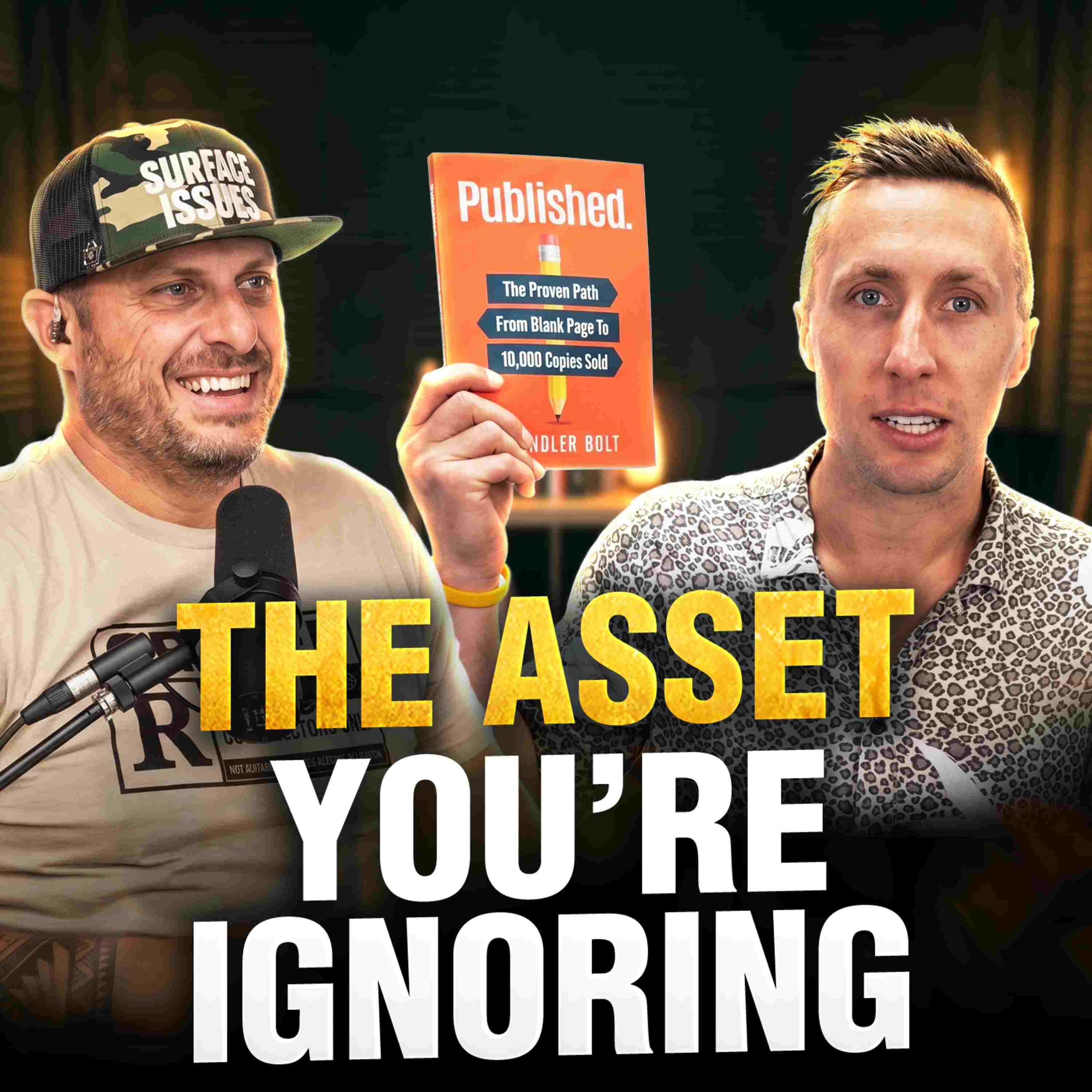
How One Book Generated $7M in Sales | Selfpublishing.com with Chandler Bolt
Chandler Bolt of SelfPublishing.com breaks down publishing costs, the eight milestones, the four Ps, and how a book drives leads, sales and referrals.
- A study cited by Chandler says 81% of people want to write a book while less than 1% actually do, which makes publishing an automatic differentiator.
- Chandler's 2021 book generated roughly $7 million in business sales in the last 12 calendar months, five years after publication.
- Doing a book the right way costs a minimum of about $10,000; working with SelfPublishing.com typically runs $10,000 to $25,000, more for ghostwriting.
- The MORE writing method covers the first four of eight milestones: mind map, outline, rough draft, edit, then cover, formatting and launch follow.
- Finishing the rough draft is the point where most authors either quit or make it, so keep all focus there before worrying about titles or marketing plans.
- Position the book with the four Ps: person (one real reader you know), pain, promise and prize, before writing a word.
- For business owners, the bestseller list is irrelevant; measure the book on more leads, more sales and more referrals.
- Reverse engineer ROI before you start: estimate clients the book will bring in year one times customer value, and expect a 4X or better on a $25,000 investment.
- Arm your best customers with free copies to give to ideal prospects, and use the book in onboarding, training and sales to buy back time for you and your team.
- Print and ebook are both worth publishing, but print carries more authority.
If you're trying to grow your business using a book, there's nothing less important than the bestseller list. It's a joke. It doesn't matter.
I can't think of another asset that I have in my business that I created five years ago that's still bringing millions of dollars of sales a year.
And so that was a great reminder for me that there is nothing less relevant than my opinion on our market.
81% of people say they want to write a book. Less than 1% actually do it. My guest today built an entire business around changing that. Chandler Bolt is the founder of selfpublishing.com, has helped publish thousands of books, and says one of his own books generated roughly $7 million in business sales in the last 12 months. Today, we're talking about why traditional publishing is broken, how to turn what you know into an asset that actually makes money, and why the book sitting in your head could be worth a hell of a lot more than you think. Chandler Bolt, welcome to Write About Now. If you're trying to grow your business using a book, there's nothing less important than the bestseller list. It's a joke. It doesn't matter.
Tying it to outcomes. The book is going to help me get more leads, more sales, and more referrals. The book is going to help you get more leads, more sales, more referrals. So more leads, these are people who hear about your business because of your book. That's integrating the book into the sales process that you probably already have. And you watch all of your core metrics go up and then more referrals. That's making it easy for your best customers to bring you more best customers by just arming them with books that they can give to ideal customers.
You don't win by following the playbook. You win by rewriting it. 700 episodes deep with the people who actually built something real. No theory, no fluff, no shortcuts. This is Right About Now with Ryan Alford. What's up, Chandler? Welcome to Right About Now. What's happening, brother? Great to be here. Thank you for having me, Ryan. Hey, man, I just learned this, but I'm going to act like I didn't. I'm transparent, if nothing else. Surface issues are real. Had to have a boy from Wahala on the show. I've done 800 interviews. I don't have many that come to me from Austin, Texas that are from Wahala. I can't think of one. I definitely have more people know about Easley South Carolina than Wahala South Carolina, that's for sure.
Maybe. Barely. But... They barely know about Greenville. Oh, yeah, for sure. Selfpublishing.com. Talk to me, man. You've been building this thing. You got offered to sell it. You've kept it. You've grown it. It's self-descriptive. We're going to publish. We're going to write a book. Explain to me exactly what it is beyond what I think it is. And then I got a couple of zingers for you. It's... The future of publishing. We believe that traditional publishing is dead. It's a joke. There's a reason why people aren't doing it anymore. And if they are, it's few and far between is just because it's a broken model. Self-publishing is entrepreneurial publishing. It's betting on yourself. It's keeping the upside. We help facilitate that at selfpublishing.com. We coach people through the process.
We do some of the hard work alongside them and then help them write a better book that is a bigger needle mover in their business. We've published 7,000 books over the last decade. We publish about two to five books a day, zero to 80 million in sales in that time period and landed me on Forbes 30 Under 30. It just gets scaled. Why is because it works and we create results for our authors. That's kind of the question right there at the end of the day. The results matter. It's one thing to do something. There's so many parallels to this with content. It is content. It's like the original, one of the original forms of content, the written word, and it's still so powerful. I still firm believer in writing, whether AI assisted, whether you have help, but telling stories and the written word still has both meaning on a two layers, one, the power of it.
But then to the meaning of it with the authority building, I always ask like, okay, is everybody writing a book now? And if everybody's writing a book, but everybody does social media, I kind of answer my own question, but Chandler hit me why it's not oversaturated. It's funny. People think, oh, everybody's doing it, but then you, then you don't realize that it's just people in our circles. It's the ultimate differentiator. There's a study that says 81% of people want to write a book. We know less than 1% do. If you become a published author, you become part of the 1% of people who have done it. So it's an automatic differentiator, but not only that, I mean, it's, the ultimate leverage that you can create in your business.
You do work once you create this thing that exists forever. And so that's why you even see what you mentioned social media. It's even the people who are big on social media, the new medium, well, they've gone to the old medium, whether it's Cody Sanchez, Dan Martel, Alex Hermosi. I mean, I could go on and on and on. Those people are using books to blow up their business. There's a reason why Gary Vaynerchuk back in the day, still a little bit today, launched a book every two years because it's a way to get back in front of everyone in your audience. It's a way to turn browsers into buyers and to stake a claim on a new content format or a new concept that you want to go out and talk about and be on podcasts and all that stuff.
So it's an ultimate differentiator and a core part of the ecosystem if you're trying to scale a business. Sometimes headlines lie. What do I mean by that? Word of mouth can even lie a little bit. Well, everybody's doing a book. And even I started to think that. But you're right. The people that execute is everything. Whether we have tools that help us do it faster or frame ideas better or assist the process, the reality is most people stop before they get there. probably just a bad rumor slash perception that everybody actually ends up doing it so that's kind of eye-opening to me i mean you're saying and i'm like i know this to be true about everything else it's kind of like i go on other podcasts how are you successful because i fucking do shit you get it done there's a difference between what people think and what actually is to your point a lot of you think oh everybody's got a book is what is this even a differentiator at this point and then the stats the math
just doesn't lie. Most people don't. And not only that, because to saying, oh, well, everybody published a video on YouTube or everybody ran a conference or everybody started a podcast or whatever else. And you say, well, okay, but how long ago? Like, yeah, just because they maybe did it five years ago, a decade ago, doesn't mean it's not one of the best, highest leveraged things that you can do to grow. That's the thing that is just so crazy to me is people waste time on so many things in their business. dozens of hours, hundreds of hours on stupid stuff that doesn't move the needle. You're telling people, Hey, what if you just spent like a couple hundred hours? I don't know a few hundred hours on a book.
And then that book is an asset that exists forever that brings lead sales and referrals to your business. I mean, I published this book in 2021 in the last 12 calendar months, it's brought in about $7 million in sales for the business. I can't think of another asset that I have in my business that I created five years ago that's still bringing millions of dollars of sales a year. I mean, so that's just what's so crazy to me is it's kind of like that Dan Sullivan quote where he said, you get tired of your marketing way before your customers do. It's like people think, oh, you know, this is old or this doesn't work anymore. No, it still works. There's just most people aren't doing it.
It's so funny you say that. How old? I've never heard of Dan Sullivan. How old is he? Old. Older than me? I don't know. 70? Okay. Because I think I made it up. I have told myself I made it up. I've been saying it so long. I've been in the business 25 years. I'm older than I look. I'm not 70. Far from it. But I called it, you know, because I'm in the ad agency business and presented creative, a hybrid creative strategist account guy. It was a weird balance in the agency world. Anyone listening to those agency worlds like, what the hell is that? Especially in my last 10 years of owning an agency and actually spreading my wings, so to speak. It's called boardroom dust.
The boardroom gets tired of it before the boardroom represents the company, represents kind of what you were saying. But it's funny. I didn't know there was one else that said that same thing. Maybe I heard it from him when I was 21 and now I give myself credit. I will put that footnote on it, but I'm pretty sure I made that up. I like that, that the boardroom does. It's not real. It's not real. Because here's what people, they forget this fact. The reality is we get tired of things way faster than the community or users. And there's a reason you see the same commercials or you used to when it was TV only. Now you see the same social messages. You see them over and over again because it has to repeat, it has to set.
Also, most people don't see it. That's interesting thing, right? You think about, oh, well, I've already posted this before. Okay. 3% of your followers saw it. Oh, I've already sent that email. Cool. 20% of those people even opened the email. Hey, I've already talked about this thing. Okay. Nobody's listening. It's a very small fraction. If you find your core message and just hammer and repeat that message and you find a core ad or creative, I'll never forget when we had this ad creative that we hated and it was just this awesome. black and white woman with a quill pen. And then something about writing your book. That sucker beat everything we had for at least a year or two. And I mean, we threw the kitchen sink at it because we hated it.
We were like, this ad sucks. It looks bad, but it just kept converting. And so that was a great reminder for me that there is nothing less relevant than my opinion on our market. Don't forget to replay your greatest hits. Yeah, that's the key. There's a reason it's the greatest hits. You might be tired of it, but not everybody else is. And there's a reason it got to number one. It probably didn't magically overnight become not a hit. Whether it's nostalgia or whether it's just still relevant, there's a reason for it. Talk to me, Chandler, nuts and bolts. I'm someone listening. I want to get real practical here. Practical value here on Right About Now. That's what we're about. Action and value. What is this process?
We've talked a little bit about why you should do it. What is this process? What do I have to commit? All of that. What's the how of all of this? There's eight core milestones on your journey to writing and publishing a book. The first four are what we do. We call it the more writing method. So you mind map, you outline it, you rough draft it, you edit it. That's where we start with everybody. Because if you don't have a rough draft done, nothing else matters. You can talk about the title. You can talk about your marketing plan. You can talk about all these things. But the reason most people don't publish is because A, they never start. But then B, they never finish the rough draft.
That's the big demarcation point where we've seen it. I mean, literally with thousands of authors. We just see, it sounds so obvious, but if people get their rough drafts done, they start to see the light at the end of the tunnel. They start, it goes from this thing that I'm thinking about to hold up. This is actually happening and this is going to happen. We focus everything on making sure that people get that done. When they're working with our coach, when they're going through our training, when they're whatever, we're keeping them laser focused on that part, which are the first four milestones. There's technically a couple editing milestones total. And then you move into the cover, the formatting and the line. At a glance, that's kind of the eight milestones that we walk through people through.
There's obviously a lot of nuance to it, but those are the steps that it takes. Interesting. I've written the outline of probably like nine books. I'm all the way, Chandler. I'm getting frameworks anyway. That's where my brain works. It's usually like the easiest part. And then it's like, I know the middle parts, but it's like getting it all down and the sub chapters and all that stuff. How and what does self-publishing do that helps this process? We coach people through the process. We do some of the final mile of publishing, editing, cover design, formatting, ISBN, upload, all that stuff. The biggest things that we do is we coach on the front end and on the back end, which there's a lot of stuff in between.
And that's where, yeah, we've got good accountability mechanisms. We've got frameworks, templates, all kinds of stuff. Our goal is to save people hundreds of hours in the process. thousands of dollars in the process and then help them write a better book that actually moves the needle. But where people need the most help, the first part is not where they think it is, which is when they're just getting started. We call it the four Ps. We got to really refine the messaging and who you're writing to, what you're writing about, because so many people screw that up. And then they come to us with a finished manuscript because they think, oh, that's when you can start helping me. And we say, hey, sorry, you're going to have to rewrite this whole thing because it's just not going to.
land. It's on the front end, but then on the back end, as long as you got that dialed in, I think the back end is way more important because that's how do you market it? How do you launch it? How do you use it to drive a massive amount of revenue in your business? That's what we're best at. And so that's where we really coach and walk people through that process. That's important. We're going to hammer on that. I like to make some assumptions. I'm more right than I'm wrong. It's ryanisright.com, so hopefully I'm not just talking to myself. There is a little bit of perspective here. I think, and you're going to keep me honest, a lot of people think they know what people want to read or what they want to hear.
Oh, I wrote it already. It's great. Not as an arrogance per se, but they think they've got it. And the reality is, it's the same thing. It's like everybody's had to create a great ad or nobody's had to write a headline. They don't. There's a lot of things that go into that. And I think with a book that your knowledge and your company's knowledge and what you guys help with is about dialing in, maximizing YouTube. YouTube's a pain in the ass, but there's a formula for it. You gotta have a hook, you gotta have a story, you gotta pay it off. And I'm not saying that because that's the formula for the book, but I'm just saying there's formulas that grab attention, that keep attention, that are relevant, that occupy their mind and their imagination.
And I would think that there's a lot of people listening that think, yeah, man, this is great. I've been writing this book, I got it down. Talk to me about that reality. It doesn't matter what you think people are gonna like or what you think should be in the book. It matters what the reader thinks. And so that's why we reverse engineer everything based on that. And we've got the framework called the four Ps, which is person, pain, promise, prize. We always say, find the person that you're writing this to. That should be one person that you actually know. What's the pain that they have, that they know that they have, because if there's no pain within them, they don't care. And then what's the promise that you're making in the book?
And now the best people have... coached people through that thing or done that thing a bunch of times. So they're not guessing because they say, oh yeah, I've had dozens, hundreds of conversations. So I know when people's ears perk up and when people zone out. Great. Well, then you've got a distilled ear for that. At the end of the day, you've got to write to the reader. The whole notion that, yeah, just write what you want, or it's like the Rick Rubin kind of, yeah, just follow your muse and meditate in the corner and just write whatever comes to you. For most people, that's just really dumb because if it's not connected to a reader, well then they don't care. And so you got to write to what is most helpful for the reader.
I'd spell that R-I-G-H-T Chandler, write to the reader. It actually works because that's what you're saying. When you write, write. It is right. Sometimes I'm clever and sometimes I'm not. I'm not sure which one. It's always a guess. Talking with Chandler Bolt. He is selfpublishing.com. It's all about writing that book, baby. And I want you to dive a little bit more, Chandler, into that headspace that you would think. We've got a fluid audience. Let's get into that headspace our listeners are in listening to this. You probably coach a lot. You get on with the calls, probably sales calls or what, you know, pre post all that. What's our audience thinking right now and how do we close this gap for them? One of the big things people are thinking is, hey, do I have time to write this?
Is the timing right? And what's the ROI? So the way I think about it, when someone's thinking about writing a book, you either got more time than money or you got more money than time. And so if you got more time than money, you're going to try to chase every kernel of information on the internet. But if you got more money than time, you should just write a check, go who not how, which is one of my favorite concepts, find the person who's done it and then either learn from them or have them do it for you. And when you do that, It's an obvious concept, but sometimes when it comes to a book, people just don't really think about it that way. You and I both grew up kind of blue collar backgrounds.
Those frugal roots run deep. My parents met at work and I shifted a factory clipping coupons. And so there's some times where I make the cheap decision, which actually becomes the most expensive decision, which is I try to cut corners or not invest in just having somebody, an expert who's done the thing, help me do the thing. As I end up spending a lot more time than money, which at this stage of the game is my most expensive thing that I have, is wasting time on stupid stuff that's not above the line for me, which is at least $500 or $1,000 an hour kind of tasks. Any time that I'm spending on that is actually the most expensive time and the most expensive decision I can make.
If people treated their time like they do their money, the world would be a different place. We don't value our time enough because it's the only finite resource. Believe it or not, there's always more money to be made. There's no more time to be had. We all have a clock. It's ticking. And we all sit there and go, oh, yeah, I'll get to that. No, you might not. You might not be around tomorrow. That's not to be morbid. It's not to be depressing. It's just a reality of how are you taking advantage of the moment. And I'll never get tired of reminding people of that. And I think it's why if they've ever had the thought, the vision, the ideas, they feel like they could help others.
Because look, books are the greatest gift that you give to other people. Because you're putting on record your experience, your knowledge. And there's always an audience for that. Sometimes I tell people, don't do content for you. Do it for everybody else. My kids will be able to go watch a million, whether they love it or not. They'll go, they can watch dad till they die because of how much content I put on the record the last 10 years. There's deeper meaning to it, but it's helping others. You got to make the time, but recognize time is valuable. And I love the who, not how, if you've got the money. Let's shortcut this thing. Let's get it done. ROI, Chandler. That's a big one. What are we spending?
What's this cost to do it right? What can we expect if we do it right? Whether people work with us or somebody else, you can expect to spend a minimum of about 10 grand to do a book the right way. You can certainly spend a lot more than that, but that's kind of the lower limit that we tell people, if you wanna do it the right way. Working with us, typically somewhere between 10 to 25 grand. You can certainly spend a lot more than that if you want us to ghostwrite it or stuff like that. I like to connect it to outcomes and ROI and start there. And a lot of people run from that. I run to it because it's the best argument I got for why business owners should do it.
We've got this thing called the one page book launch plan. We've got a whole video and template and stuff on our YouTube channel. What we do is just break it down. And I was doing this with, gosh, Pace Morby and a bunch of other folks just saying, Hey, let's reverse engineer your outcomes in your business. Over year one, how many clients do you think this book's going to bring in for you? 100, maybe 10 on the very low end. Okay. He said 100. Well, he said a lot more than that. And I said, let's just lower it, lower it, lower it, keep lowering the goal. He said, yeah, let's double that. Let's double that. I said, no, let's strip it down. You would be an absolute moron if you didn't hit this.
And okay, 100. And I said, all right, what's the customer worth? 10 grand. Okay, that's a million bucks. That's an extreme outcome for most people. Maybe it's 10 clients at 10 grand a piece. That's a hundred grand. Either way, you reverse engineer that math. Let's say it's a hundred grand over year one, which by the way, like I mentioned earlier, this sucker's five years in still printing millions of dollars a year in revenue for the business. A hundred grand. Well, if you invest 25 grand into the book, it's 4X. You're spending money on ads. You're spending money on other marketing where you'd be pumped to get a 4X return. And that's just 4X year one. You got to be strategic. If you're just publishing a book and you're like, Hey, this is just for my kids and grandkids.
Awesome. Don't tie an ROI number to it. I would say that ROI is dang near infinity because how do you put a price tag on that? But if you're actually saying, hey, I want a business outcome with this book, tie it to the business outcome with how you map and invest. And then also tie it to the business with how you write it and integrate it and all that stuff. And if you do it well, it will be the best asset that you've ever created for your business.
Talk to me how we connect the dots to the revenue. That's where it probably falls apart sometimes. And on that same Chandler Duel part there, it might sound disconnected, but it's actually related. Bestsellers list. All the bullshit that we know is bought and not earned. but still probably has some amount of influence. I'm not saying that. Talk to me about those two things. How do we connect the dots on revenue? And what are the things that matter as far as marketing goes? If you're trying to grow your business using a book, there's nothing less important than the bestseller list. It's a joke. It doesn't matter. Tying it to outcomes. The book is going to help me get more leads, more sales, and more referrals. My book is going to help you get more leads, more sales, more referrals.
So more leads. These are people who hear about your business because of your book. More sales that's integrating the book into the sales process that you probably already have. And you watch all of your core metrics go up and then more referrals. That's making it easy for your best customers to bring you more best customers by just arming them with books that they can give to ideal customers. And so watch your referrals go through the roof. That's how I think about it. And then you just got to be intentional and integrate it in there. Whether it's your ads, your marketing, your speaking, give it away for free, get a ton of leads, integrate it into your sales process, integrate it into your customer experience. And then not only will you end up with a lot more customers, a lot more referrals.
Well, now all of a sudden you're buying back so much time for you, for your employees, because you use it in the training of new customers, the onboarding of new customers, the training of your team. You use it in the sales process, answer questions for you. with you. And so I just look at it, we call it leveraged impact. It's the ultimate asset that brings leverage to the impact that you're trying to make. I'm going to summarize what I think I just heard you say, Chandler, and I want you to correct me if I'm wrong. There's maybe a misperception that the book brings the leads in the door. What I think I just heard you say is the book closes the leads. It can bring them in, but that's a marketing thing.
And whether it's distribution, whatever that might be, but I'm hearing more. It's not the get them in the door. It's shut the damn door. I still believe in the purchase funnel. It's awareness, consideration, intent, and then purchase. It can help with awareness if you got distribution or you blow it out there or do whatever you do on the marketing side. On the heavier spin side, I would assume awareness is expensive. But then it's more taking them from consideration to intent to purchase because they go, holy shit, this is the expert. I agree. It's both. I've got a buddy, Brian Lubin. Yeah. Funny I know Brian. Yes. I don't know him personally. I see him on my feet. I must follow him. He's grown a social media following, pretty similar to you, maybe in follower count, and then has a mastermind on the back end.
And then he worked with us, wrote a book. It's called From Passive to Passive. passionate. And you talk about bringing leads in the door, he'll post a story that says, Hey, I wrote this book and it's helping all these people DM me or comment and I'll give it to you for free. And then he'll get 2000 leads off of that and give away a ton of copies. Now there's all this demand that gets created. And then yes, exactly. Like you said, it'll help shut the door and close the deals on the backend because they read the book and they say, oh my gosh, I got to join Action Academy. I got to work with Brian. And so it does the distribution and the bringing or attracting customers and then closing customers on the back end.
Chandler, as we close out here, talk to me, true nuts and bolts about next steps, as people have heard and gotten teased on this. First step, go to selfpublishing.com forward slash write about now. So selfpublishing.com forward slash write about now. Book a call with the team. You'll talk with one of the experts on my team. Consultation. We'll put a plan together. Customize the plan to you. Then we pair you up with a coach. Then you get into the curriculum or systems or tools that are going to save you a ton of time and accelerate the process. And then we're off to the races. We coach you through the process. We do a lot of the final mile of publishing. We help you be more successful with the book.
Finally, Chandler, the million dollar question for me. Is an e-book just as good, Chandler? Or do I have to print it? I'd say so, yeah. That was my easily accent for you. You know, I've heard it my whole life. Can't they just do an e-book, Chandler? I mean, it's great. I love it all. More is more and you should publish in all formats. But printing's better, right? Oh, 100%. Just more authority, more everything. Yes. Chandler, I appreciate your time, man. When you come to Wall Hall, I'll stop in and easily. Oh, easy, easy. I'll see you next time. We'll rip some packs and talk some business. He is Chandler Bolt. I am Ryan Offord. And this is Right About Now, selfpublishing.com. Go check it out.
Look, it's time. You've been waiting. You've been thinking. If you even had a light bulb or a sizzle in your head while you heard this, tomorrow isn't guaranteed. Today is when you make it happen. We'll see you next time. Right About Now. Here's the truth. Information doesn't change your life. Execution does. So don't just listen to this episode and move on. Take the idea. Make the call. Launch the thing. Fix the problem. Build what you keep talking about building. For more, follow Ryan Alford on Instagram, at Ryan Alford. And watch or listen to every episode at ryanisright.com. This is Right About Now. Now quit waiting. Go win.
The AI Skills Gap and the Death of Entry-Level Jobs
Ryan Lufkin of Instructure on the AI skills gap, why entry-level jobs are vanishing, and how certificates and human skills keep workers competitive.
Robin Alex on Replacing Your Business Tech Stack
GoHighLevel co-founder Robin Alex joins Ryan Alford on AI hype, speed to lead, white-labeling for agencies, and scaling a 2,500-person remote company.
Hiring Is a Marketing Problem: Nicole Feenstra
Nicole Feenstra of The DNA Agency tells Ryan Alford why job descriptions fail, how to market the trades, and how geofencing and storytelling win