
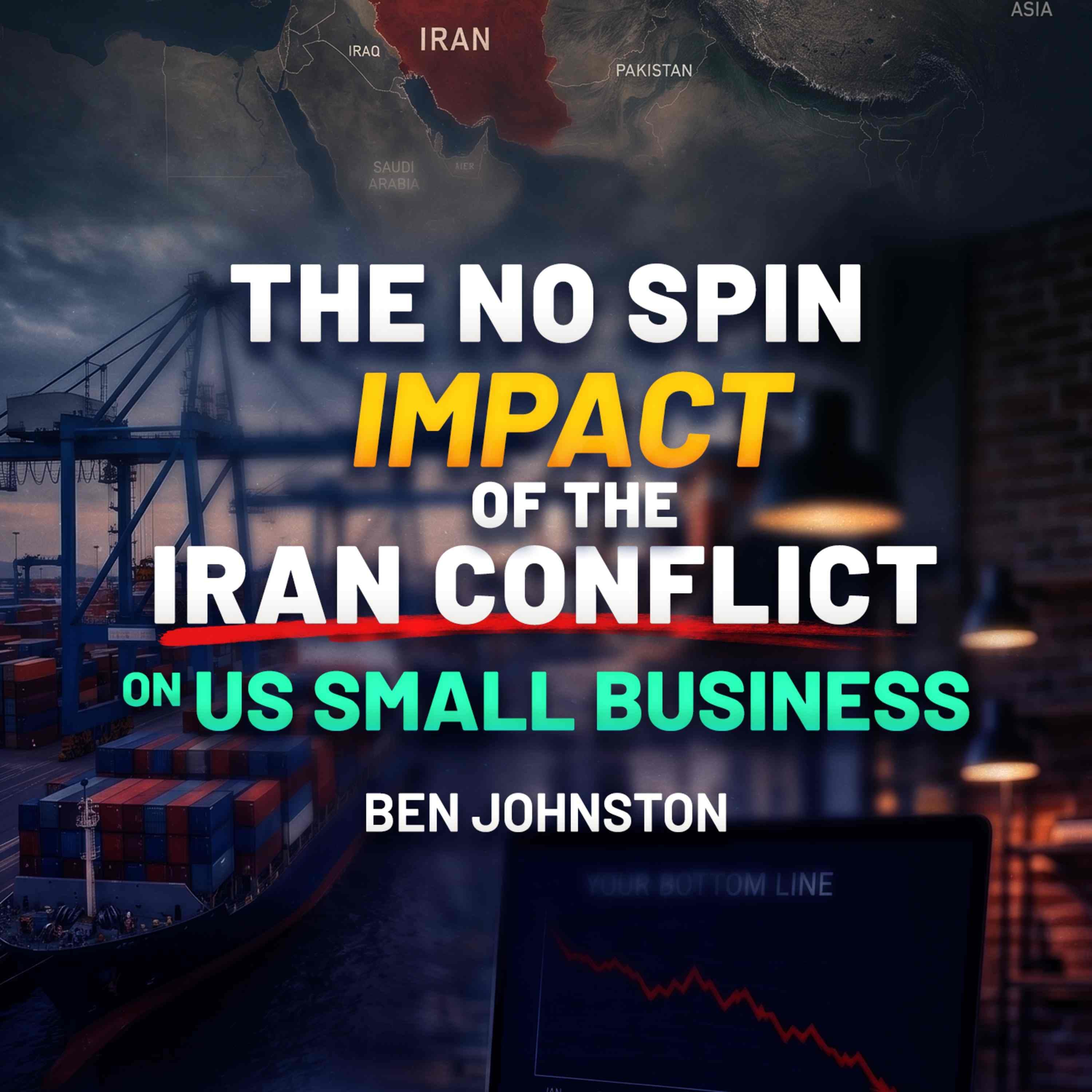
What Second-Order Effects From the Iran War and AI Mean for Your Business | Ben Johnston with Kaptus
Kapitus COO Ben Johnston breaks down how the Iran conflict, energy costs, labor shortages and AI are reshaping conditions for small businesses right now.
- Energy shocks show up unevenly: gasoline prices up 30%+, natural gas up 10%, and fertilizer up 30-50% or more for farmers, which hits fleets and agricultural customers hardest.
- The immediate supply chain looks fine because ships out of the Strait of Hormuz are still landing; the risk is the second-order effect six months out when goods can't be manufactured abroad.
- The US is comparatively insulated as a net energy exporter that can outbid others for scarce raw materials, but countries in Africa and Asia that import fossil fuels face real dislocation.
- Higher shipping and oil costs change the math on offshoring, which Ben expects to accelerate domestic and near-shore manufacturing beyond what the CHIPS Act started.
- In construction, AI's first impact is on billing, accounting, targeted marketing and account management, with humanoid robotics for low-skill site work plausibly a decade out.
- Entry-level legal work is already vulnerable to AI while senior strategic legal judgment isn't, so skilled trades like plumbing and HVAC may pay off faster than a generic professional track.
- Federal spending of $1.7 to $2 trillion above revenue is the main reason consumer spending has stayed stable and the economy hasn't entered recession, per Ben.
- Practical steps for owners: watch operating margins closely, validate demand before borrowing for a new project, and keep non-bank lenders on the shelf for fast capital even though they cost more.
It always gives me hope when there's so much uncertainty.
That potential disruption, I don't think we understand the second order effects of what may come as a result of that.
AI will come for the lawyers first or in many cases that already has.
Right now, I don't see AI making huge changes in the construction industry just yet. Where I see it taking effect first will be maybe in the automation of billing and the automation of accounting services. Maybe the ability to target market more effectively to prospective customers or manage accounts, take it away some of the office busy work. In the not too distant future, you could really see robotics start to come into the picture. This is right about now with Ryan Alford, a Radcast Network production. We are the number one business show on the planet with over 1 million downloads a month. Taking the BS out of business for over six years and over 400 episodes. You ready to start snapping necks and cash and checks? Well, it starts right about now.
There's a lot of noise right now around the US conflict with Iran. But the real question is what it actually means for businesses here in the US. We're seeing rising energy costs, supply, chain pressure, AI and a lot of uncertainty around things and where they go next. Ben Johnston is the chief operating officer at Capitas and he has a front row seat. Now businesses are reacting in real time. Ben, welcome, right about now. When we look at what's happening with the US and Iran, what actually matters economically? What's overblown? What's real? What's happening here that we need to be informing our listeners about? Even before the war, it was already sort of a challenging time for the economy, for small businesses in particular, which is what Capitas is focusing on every single day.
We had a pretty volatile tariff strategy going on for the last year. Those changes were happening throughout the year and then big changes this spring as well is still a lot of uncertainty around that. Then you're operating in an environment with somewhat elevated inflation rates, but certainly elevated interest rates rather relative to where we had been a few years ago. You're in a slowly rising unemployment area where unemployment has risen about a hundred basis points from its lows of a couple of years ago. That's all leading up to the war in Iran, which now is really causing disruption and spikes in obviously in energy prices. Gasoline prices are up 30 plus percent. Natural gas prices are up 10 percent. And if you're a farmer, your fertilizer prices are up 30 to 50 percent.
Maybe more for certain types of fertilizers. There's a lot of additional stress that's now being dumped onto the American consumer and the American small business owner that they have to grapple with. Both leading up to this conflict and now that the conflict has taken place. When you guys analyze this, is it strictly from the small business perspective? What has happened thus far? The impact is X. Do you guys do any kind of prognostication of the future effects or where it looks like it's headed, gases up, all those things you said are true. What gives you hope and what gives you not hope about where this is headed? It always gives me hope when there's so much uncertainty. Let's be honest, ever since COVID, the last five years we've been living through a tremendous
amount of economic uncertainty, small businesses have had to react to that. I have found small business owners to be some of the most creative and resilient people that you could imagine. They're constantly changing their business models to take advantage of a need in the market, changing their pricing strategies to adjust to changes in demand. They have proven to be incredibly resilient, incredibly creative. People think that oil prices are going to be high for a long period of time. That's going to change consumer behavior. Our small businesses can react to that, start putting lower cost products into the market, thinking about where the customer is headed, finding more energy-efficient solutions, things like that. That makes me very optimistic. On the pessimistic side, I am worried that there's another shoe to drop in this Iran conflict,
in that we have been living in a world where the supply chain has remained largely intact ever since the start of the war. A lot of the goods that were shipped out of the state of Harmuz are still in route. This week and next week, most of those ships are landing in their ports where they were expected to land. After they land, they're really not going to be more ships coming in large numbers out of the state of Harmuz until we find some solution to this problem. What that potentially means is that a lot of the countries that depend more heavily on petroleum products but other products manufactured there to keep their economies afloat and produce goods that we need here in the United States six months from now, when they are manufactured and
exported to us, some of those goods may not be able to be manufactured. Some of those people may not be able to live the lives that they have been set up to live. That potential disruption, I don't think we understand the second order effects of what may come as a result of that. That's something we need to be prepared for. This has been going on for multiple weeks now. The trickle down like you don't feel the water leaking in your roof until it gets through four layers of wood, but then it drops to bomb on you. Are we at a stage where if this thing gets wrapped up over the next few weeks to a month where that GD could go back in the bottle a bit where you'll
have effects but if things can get rolling, we'll have a short-term impact but potentially still a great year. Yeah, the stock market certainly thinks so. You took your words out of my mouth and I was kind of headed there. I've been absolutely amazed at how the markets seem to view this as a secondary effect, maybe not a primary effect on the US economy, that may have something to do with the fact that the United States is probably in a better position to whether this crisis than almost anyone else out there because we are net energy exporters and we are able to produce not only oil and gas, but we're able to secure a decent amount of fertilizer and other important raw materials. When there's a limited amount of goods in the market, we are able to pay top dollar
to secure our access to those goods. The rest of the world doesn't necessarily have those luxuries. I'm specifically worried about a lot of countries in Africa and Asia who need to import most of their fossil fuels in order to operate their economies and are heavily pendant on some of the raw materials that come out of the Gulf in order to manufacture their products. Feels to me like the US economy is continuing to charge along under the expectation that we will be able to meet our needs even if they cost more and that maybe some other impacts from advances in AI and other technology innovations are actually driving the stock market more than the underlying economic conditions that the average American is living through is driving the stock market. I do have a lot of concern
about what will happen to the rest of the world if there's dislocation in chaos in the rest of the world. How that will come back to roost here at the United States over time. Ultimately. We hear a lot of this America first. Personally, I agree with that, but I also know that we don't live in a vacuum. It's a global economy now. It does trickle down to us whether we want it to or not because there's just a ton of businesses that rely on imports, exports, worldwide selling, buying and all those things, disruption in the world does impact the US economy at some point. Absolutely. We've been noticing repatriation of manufacturing back into the United States for some time now. What that really is, it's a growth in the US manufacturing base. I'm not sure
that on a relative basis we're actually taking more share of the global manufacturing, but we are doing more and more of it here in the United States. I would imagine that our access to fossil fuels, our access to certain raw materials that others are going to struggle to procure for themselves will accelerate that trend that we're seeing. The higher the cost of oil is, the more expensive it is to import and ship across vast oceans, goods that we have been sourcing from Asia and other parts of the world. That just starts to change the dollar cost continuum as to how much you really saving by producing overseas if it costs you far more now to ship those goods back to the United States. If you're going to experience supply chain disruptions along the way, this could produce
and help enhance a movement toward greater domestic or near-shore manufacturing here in the United States, which could be a silver lining to some of this. Yeah, I grew with that pin. We actually need some of that back here. Not only like the core, not being dependent outside of our own country, hard parcel with this, and key, but it does unlock other things when that returns to, I don't want to say the glory days, but most people, if they're being honest, we threw the baby out with the bathwater a little bit with manufacturing, and we need to get the baby back. There are critical elements to our supply chain and our ability to manufacture core products or national security reasons that we have allowed to escape our sphere of influence and be controlled by those that
are not always our friends. That is a position that we can afford to be in for the long run, and we need to work to get those types of critical manufacturing capabilities back here in the United States. There was a recognition of that back a few years ago when we passed the CHIPS Act. Silicon chips are only one aspect of the manufacturing base that we need to be able to control. We are starting to see movement toward that. It takes some government support in order to make sure that we're bringing critical industries back. We're seeing some of that right now, but it also probably helps to have an economic imperative that's inciting all kinds of producers to repatriate manufacturing. We've seen that with some of the tariffs that have been put in place.
I don't think it was the intention of this war to drive that change. Some of the second order effects of this war will likely propel more manufacturing back in the United States. Talking with Ben Johnston, he is the chief operating officer at Capitas. Second order effects. I like that. I usually say unintended consequences. I would use that. It sounds more sophisticated. Ben, can we talk AI? What's that impact on small business? Maybe just give me a state of affairs that relates to AI observations from Capitas. AI is something that everyone is trying to figure out right now from small businesses to large businesses. Large businesses have big budgets, people inside whose only job it is to figure out how people are using AI, how we can incorporate that into what
we're doing, how to make things more efficient. Some of the stock market reaction that we're seeing right now is actually really focused on some of the efficiency gains that large publicly traded companies are expected to be inking right now through those efforts. On the small business side, small business owners are really trying to figure out how they can adopt some of these technologies to automate a lot of their busy work. They're thinking about how could these technologies ultimately allow me to reduce costs and potentially reduce headcount in the long run. How will small businesses actually become a little bit smaller from a headcount standpoint over time? A lot of the small businesses that we back are very people intensive. A third of the small businesses
that we back have something to do with the construction industry. Right now, I don't see AI making huge changes in the construction industry just yet. Where I see it taking effect first will be maybe in the automation of billing and the automation of accounting services, maybe the ability to target market more effectively to prospective customers or manage accounts, take it away some of the office busy work. In the not too distant future, you could really see robotics start to come into the picture and if you could have an actual humanoid robot that was programmed to do some of the work, even if it's just cleaning up and carrying things back and forth from the truck, doing the busy work that you hire low level less skilled people to do, that I could see 10 years from
now that starting to have a real impact on the service professions. Certainly if you look at the restaurant industry, you could start to see things like that. We have seen some bigger chains in the restaurant industry looking to automate all kinds of kitchen activities that in the past have needed human employees. It's interesting, but it sort of goes hand in hand with something that we're hearing loud and clear from some of our small businesses who are really struggling to find skilled labor in the labor market today. That has to do both with a somewhat tight labor market with a lot of enforcement action that's happened recently around undocumented labor. The reality is that a meaningful percentage of small business labor has historically been made up by the undocumented
community. That labor has in many cases really that labor pool has shrunk quite a bit over the last year. We are hearing from small businesses whether they were hiring undocumented labor or not. They're saying all labor is becoming more scarce, especially in the skilled trades area. The question is can AI step in to fill some of that labor gap and how quickly will that happen? Small businesses are working really hard right now to think through those questions. Skilled labor knowledge work is getting real cheap, skilled labor, maybe considered blue collar in a lot of most ways. It's becoming or will become more expensive in the near term and hey better. If I'm a college kid not just dead set on being a lawyer or something go take a welding class go be the best AC plumber guy. You probably
make six figures a lot faster than anything else. AI will come for the lawyers first or in many cases that already has. That's not to say that senior strategic legal minds are irrelevant. They're absolutely just as relevant as they always have but your summer associates and your first year and second year associates in law firms are definitely vulnerable because a lot of the jobs that they were trained on AI is actually pretty good at. Now finalizing and delivering a cogent legal argument that works in front of a court that's still a human activity but you're absolutely right. Skilled labor the ability to be a great plumber, root out a problem, get in and fix something back in a crawl space somewhere really efficiently and accurately in a way that isn't going to break
in two weeks. There really isn't any AI that's going to solve that problem in the short term. Potentially in the medium to long term they'll figure it out but those are highly important jobs today. Jobs that we are hearing from our small business owners are increasingly difficult to fill. On the AI front I hear the job market and numbers it's going it is and will impact the job market it's already impacting it. I'm putting my head in the sand but I will say I saw something and it made me think I guess it depends on how the unemployment is reported or job cuts. I guess if it's true job if true unemployment is someone has filed for unemployment versus just someone laid off for the quit but AI is unlocking a lot a huge increase in new individual single person small
business applications because I know this firsthand. I mean I had 18 employees three years ago. Some of it by choice and not necessarily economics or how can I get leaner but more just that's I want to manage a lot of people my entire career just didn't want to do it anymore. It was by scale but I can operate with three people what it took 15 to do in my field of marketing business multiple facets of e-commerce and a lot of other things. What I'm getting at Ben is the data can say well we had all these layoffs we had all these things but all those people just becoming solar producers. We've seen a spike in small business creation ever since the pandemic a lot of people
went home during the pandemic were getting some sort of unemployment check or they were just working from home for the first time in their life they started playing around with new business concepts. We saw that a big increase we thought it would come down after the pandemic ended it never really came down we continue to see that growth that very well could be driven by AI the opportunities for people to leverage AI to do new things and create new businesses. I absolutely think that's going to continue here as people get better and better at using AI and as the AI capabilities become better and better but an important trend in terms of the unemployment rate I would imagine that a lot of people are incorporating businesses and playing around I'm not sure how many people
are making a lot of money off these trends just yet it's very possible that someone is not working could be collecting unemployment benefits while they're playing around with their new business idea that hasn't quite taken off yet. We're not stating facts here but we're just making logical deductions. Do you know that the unemployment rate is drifting higher that makes sense when you look at some of the layoffs that we've seen from big corporations saying hey you know we don't necessarily need these people anymore some of that is probably coming from AI we're also seeing the percentage of the potential workforce who is actively seeking employment has also been drifting lower as well. It's why is that drifting lower are they working on their AI projects and they're not
actively seeking an additional employment. Are we headed to this place of sin where people are no longer motivated to work and just they're fine with living somehow they're off savings or off government savings. The long term we'll just have to see how robust the economy continues to be and how much consumer spending there is available to consume all of these new concepts that are being created because at the end of the day small business revenue is made up largely of consumer spending. It's the health of the American consumer that's going to determine the health of America's small businesses. We keep a very close eye on consumer spending inflation rates share of wallet for the American consumer that is truly discretionary spending when we think about
our small business health is going to trend there. As we close out a little bit on all this been how much of that is real versus headlines I know there's impact I know that maybe the way someone spent when they still had covid checks coming in is different now or even three years ago but how much is consumer spending truly changing why do we keep trying to get talked into a recession? Consumer spending has been remarkably stable that's one of the reasons that we're not in recession when you are spending when the government is spending $1.7 to $2 trillion more than they're taking in revenue every single year then you are stimulating the economy to a point where so far you've not let the economy go into a recession we are borrowing a tremendous amount at the federal
government level that money is fueling the economy if we were running a balanced budget we would have slower economic growth it's hard to imagine that you could pull $1.7 trillion worth of spending out of the economy and not experience a recession there doesn't seem to be much will on either side of the aisle to truly grapple with the debt crisis that is looming out there the other complicated factor is there are very very few countries in the world that don't have very similar looking balance sheets to us at least of the large countries that are out there so I'm not sure there are a lot of other countries that are doing this a lot better than we are it does seem to be a trend that
will ultimately need to be grappled with either through inflation or through reduction in overall spending that could hurt the economy that could be a hold on the rip so their defense spending stuff other things I'm like is that really fueling the economy I guess it is but it's not I don't know some of the overspend anyone who's employed by an industry receiving this funds is fueling the economy in some way truly staying here than it is fueling our economy and a lot of it is if I'm a small business listening to this show any guidance any tips any last thoughts keep a very close eye on your operating margins especially in challenging times like this if you're going to start a new project you want to test it out beforehand you want to really know that the
demand is there especially if you're going to borrow money to take on that new project think about who your customer is how your customer is being impacted by what's going on in the market out there small businesses have to pay more at the pump for their fleets their customers have to pay more at the pump to get to work every day keep being a strong understanding of who your customer is what they're able to pay is going to be incredibly important as you think about your product lineup and how you're going to price that product keep a number of different financing options available certainly your primary bank is going to be incredibly important if you need capital quickly to take advantage of an opportunity you may want to look outside of the banking system
as non bank lenders tend to cost a little bit more but move much faster in order to allow you to get the capital you need to grow your business those are by overall pieces of advice to small business owners in an environment like this we love working with our small business customers to make sure that they're able to achieve everything that they want to achieve should they invest in either learning or bringing on people to learn quickly AI or can they turn a blind shoulder to this you want to be learning about it the beautiful thing about AI is that it gives you a tremendous amount of opportunity to learn for yourself a hundred percent if you have someone you trust who really knows the evolution of AI and wants to be your partner you'd be wonderful to bring them on come
up with some amazing new business models and ideas if you're just a naturally curious person that loves to read and do research and play around with things getting a good subscription to Claude and chat GPT and Gemini and plumbing the depths of online knowledge that's going to tell you a tremendous amount as well man drop some details for capitals and yourself where people can follow everything you guys are doing and get in touch or just to have all those details please visit us at capitals.com that's k-a-p-i-t-u-s.com you can learn about all of our products for small businesses from working capital to equipment finance to lines of credit and you can apply right there or get in contact with a customer representative who can help you really think through your capital needs
and what your goals are for growing your business we'd love to talk to you and love to power the American economy through small businesses yeah it's been a pleasure having you on i look forward to doing it again i do too it was a lot of fun thank you very much hey guys you're to find us Ryan is right.com you find all the highlight clips the full episode links to capitals and Ben Johnston who we appreciate for coming on look we're about the facts here not the fear facts over fear it's not about fearing what's happening it's about having the knowledge partners like capitals in here on right about now to keep you informed see you next time on right about now this has been right about now with Ryan Alfred a radcast network production visit
Ryan is right.com for full audio and video versions of the show order one choir about sponsorship opportunities thanks for listening
Anders Hansen: The Mental Blind Spot Costing You Money
Illusionist Anders Hansen shows Ryan Alford how assumptions, self-image and subconscious conditioning shape business results, and how to replace them.
AI, Aging, and the $2.5M Long-Term Care Problem
Waterlily founder Lily Vittayarukskul explains how AI predicts your future long-term care costs, why families aren't prepared, and what AI means for

Real American Beer's Playbook for Breaking Into Big Beer
Chad Bronstein and Terri Francis on building Real American Beer with Hulk Hogan, winning distributors, and outmarketing big beer without big budgets.