
The Mental Performance Framework for High-Pressure Decisions
Mental performance coach Evan Marks joins Ryan Alford to explain emotions as data, aggressive patience, and how to respond instead of react under pressure.
- Treat emotions as data rather than weakness or noise; unacknowledged emotions still show up in your behavior unconsciously.
- Insert deliberate mental space between feeling an emotion and choosing a behavior so you respond instead of react.
- Stop waiting for a feeling to change before you act; at M1 the rule is behavior changes before feelings.
- Use self-exploratory questions in the moment: What am I trying to accomplish right now? Where do I want to be? How do I want to behave?
- Consistency with evidence builds confidence, and you can't tweak inconsistency, so start with one small repeatable practice rather than five gym visits a week.
- Chase momentum, not motivation; Evan calls motivation a fleeting feeling and momentum the thing that carries you across the finish line.
- Practice aggressive patience: lower your heart rate, hold focus, and stay in the pocket for the extra seconds before you act.
- Apply the equation performance equals potential minus interference by reducing unconscious behavior instead of only adding effort.
When you read one self-help book, it's the same as the 900th one if you don't execute on it.
Emotions are just data. We can label negative emotions, positive emotions, but in the end of the day, they're data.
We always say behavior changes before feelings. When I'm happy, I'll do this. When I've made this much money, I'll do this. It doesn't work that way.
What we say at M1 always says that you have to slow down in order to speed up. Slowing down has nothing to do with the gas. It's really the art of intentionality. As you become more intentional with this practice, with repetition, you start to build this foundation that you can leverage. There's the speed up. What we're saying is very intellectual. When you read one self-help book, it's the same as the 900th one if you don't execute on it. And you have to give yourself room to grow. What do they always say? Quit tomorrow. Keep going because you don't know when it starts to click, when it starts to connect. Give yourself a chance.
You don't win by following the playbook. You win by rewriting it. 700 episodes deep with the people who actually built something real. No theory. No fluff. No shortcuts. This is Right About Now with Ryan Alford. Hello and welcome to Right About Now. Always talking about what's happening today. How does it make you get right in business, in marketing, and life? It all works together, people. We know that. So we're talking to the best, the brightest here on Now in 20. We got Evan Marks. He is a mental performance coach, M1 performance group. What's up, Mark? How are you, man? It's a pleasure to be here, Ryan. Hey, pleasure to have you, brother. I like what you're doing. We don't talk enough about mental performance. I host another show called Vibe Science, and we talk a lot about mind, body, energy, and the interconnectedness of it all.
all need a mental coach, brother. I agree with you. Mindset is everything, but there's so many different components of building a strong mindset. I'm an ex-Wall Street guy before I became a coach about eight and a half years ago. And in the world of hedge funds and trading, there's always 90% mental. Everything is 90% mental. You get your head right and you get conscious about your behavior, not void of feelings, by the way. Imagine what you can accomplish. No kidding. What's the biggest blind side? I mean, you're working with enough people. What are people missing? There's usually something that's out of their own perception. And it'd be as you go, well, it's self-awareness. It is that. I'll give you that. But there's something, man. What is it, Evan? It's people try to dismiss emotions.
What happens is when you don't acknowledge emotions, you know what happens? It gets on the field. And what does that mean? They're unconscious. When I train people, we live in the world of responding, not reacting. I coach athletes, business owners, CEOs, and obviously Wall Street professionals. The biggest thing that you need to take away is mental space. Emotions are just data. We can label negative emotions, positive emotions, but in the end of the day, they're data. The question is, how do you put space between an emotion of how you feel and actually how how the hell you want to behave. That is a conscious choice. When you talk about blind spots, when people say, I can't believe I did that again, that is reacting. Imagine if you had the power of choice, the power to say, I can feel whatever I want, but I also have that power to choose a behavior. And what happens, Ryan, is that it starts to form new experiences. And then neurologically at M1, we always say we marriage the why and the how.
Why do I do what I do and how do I get better? Take psychological theory meets the latest research in neuroscience. And what happens is when you start to experience things differently, you really start to build new habits and new networks in your brain. And that soon after repetition, repetition, repetition becomes your default action then. So when you talk about blind spots, it's almost like stop reacting. Give yourself a chance to respond. It's a game changer for anybody. We talked with our kids before we came on and we teach them and in life, we know this too, you know, playing sports and doing what we do, whether you play golf or whatever you do, you got to practice over and over and over again to be good at something. And repetition creates muscle memory. And then it's less thinking and more doing and having success from it. And we know this. We're smart people. Most people listening to this show are smart people.
But for whatever reason, though, we don't apply that same principle or a lot of people don't. I didn't. I do now. You don't apply this principle of this muscle memory and knowing how the right way to respond and taking coaching and taking learning and taking feedback to then apply the same way in business and in life. People need to get their head around that opportunity or you're always living within limits. You know what we say at M1 always is that you have to slow down in order to speed up. Slowing down has nothing to do with the gas. It's really the art of intentionality. As you become more intentional with this practice, with repetition, you start to build this foundation that you can leverage. There's the speed up.
What we're saying is very intellectual. When you read one self-help book, it's the same as the 900th one if you don't execute on it. And you have to give yourself room to grow. What do they always say? Quit tomorrow. Keep going because you don't know when it starts to click, when it starts to connect. Give yourself a chance. When we talk about things intellectually, there's such an emotional component about that. If you're able to acknowledge that and tolerate it long enough, the doors of opportunity swing wide open. One of the most important, give yourself a chance. Quit tomorrow. Hang in an extra day. You will be massively, pleasantly surprised.
What are some of the techniques that you guys do at M1? What's the mental exercises, the coaching exercises, the things that people can do? The highest performers, did they come by this by nature or nurture? It's always fascinating to me, the 0.01%. Did they just learn what you teach? Were they just ahead of the curve or were they built that way? Two parts there, how you help people. I'll start with the last one. You know, nature or nurture. I believe anybody can do this. Now, listen, I'm not 6'5", 290 pounds, so I'm not going to try out for the offensive line of the Cowboys. There are certain limitations. We don't live in the positive psychology camp. We live in the opportunistically reality camp. I like it. When we talk about mental resilience, perseverance, anybody can do this. So why did the Kobe's of the world, the NJ's of the world, the Tom Brady's of the world, obviously some of them were gifted. There's no doubt about it. But you cannot take away the resilience of these superstars. Kobe Bryant's working out after winning an NBA championship at four in the morning. This guy didn't make teams. NJ didn't make teams. Tom Brady was whatever. They missed their relevance.
Anybody can do this. It really is giving yourself the opportunity to go and see what's possible. We always talk about emotions. Emotions are important. Without emotions, you can't make decisions. Why are emotions the enemy? They're not. They're actually just data. If I said to you, Ryan, I give you permission to feel whatever you want. All right, so almost like let go of the rope. Now let's put mental space. Take a breath, a pause. Then we have a chance to choose how we want to behave. I can't guarantee results, but I can guarantee you will experience something different. Now, if we put down the word consistently, we always say consistency with evidence builds confidence. If we are intentional about that one sole practice, it puts you in a different lane. If you're able to give yourself space, we call it mental space to choose confidence.
something to choose a behavior that serves you, it's game over. Because then you start to what? You start to trust yourself that you are not a slave to people's emotions, actions. We have the power to choose. And who would not want to have that in their mental arsenal? Yeah, you would. You would choose every time. Yeah. And what's interesting is we're coached, especially as men growing up, we're sort of built to hide the emotion to kind of sink it away. I don't even know if it's always intentionally coached into us. It's just sort of the way it is. And I think for good, bad or indifferent, men are pretty good at swallowing the emotional side of it. Let's flip that script. Say, you know what, Ryan, you're entirely feel disappointed, embarrassed, judged,
You can have fear of rejection, failure, whatever it may be. And if I say that's not a weakness, I go, you know what the real weakness is? Is when you react. When you have an adult tantrum and all of a sudden you wish you could have taken that back. Let's flip this. You feel whatever you want. You have to. We're human beings. We live this human experience. Allow it. Acknowledge it. We always say behavior changes before feelings. When I'm happy, I'll do this. When I've made this much money, I'll do this. It doesn't work that way. Because what happens is as behavior changes and we start moving down the field, eventually feelings change. But if we're going to wait for a feeling to change, I'm like, I don't want to be this way. I don't want to feel this way. We're still at the five-yard line. We could have been on the opposing team's 20 already. It's all about conscious behavior. And how do you get that? That's mental. Giving yourself this mental space is a game.
And how do you get there? It's repetition. It's reminding yourself to take a pause, reminding yourself to ask a question. What am I trying to accomplish right now? Where do I want to be? How do I want to behave? And when you ask yourself questions. We call them self-exploratory. You know what it does? It puts you in the seat of influence. Talking with Evan Marks, he is a mental performance coach with M1 Performance Group, is saying a lot of times we're fire, aim, ready as men. And what you just crystallized for me was let's get back to ready, aim, and then fire. Because if you do it the other way around, you're not hitting the target. I'm a move fast guy. I am. I can admit it. And it's worked for me on the whole, but I've also realized the pitfalls that it can have when you don't stop to kind of ask these important questions and that you don't truly get ready. Because a good friend of mine named Christopher Lockhead, one of the smartest guys I know in marketing, and he says, we need to think more about thinking. That's called metacognition. Amen. It's true. You've had success. When we get curious, like imagine if
What this kid from M1 Performance Group is saying is true. What could it have looked like? But what could it look like now? I'm not a motivational guy, even though I'm a New Yorker and I speak with a lot of passion. I'm all about momentum. Motivation is a fleeting feeling. It's the momentum that takes you across the finish line but it's really putting yourself in that seat of what if what if i slow down and that's nothing to do with speed then we don't have to go back you can't tweak inconsistency you really get consistent with your behavior name a door it's going to open and that's how you get better If you've got other things figured out and then you unlock that, it truly becomes the world as your oyster. You can take that proverbial step back and get that internal footing and take that breath. What do I need to do now? What do they say? Wait, what's important now? That's seconds. But it puts you in a different state. We talk a lot about when we talk with clients about aggressive patience. Patience sounds very passive. Just be patient. Aggressive patience.
It's almost like a Jaguar in the rough where you know the heart rate is going down. The intentionality is there. The focus is there. So when you said ready, aim, fire, that's what aggressive patience is. How long can you sit in the pocket? Think about like Tom Brady's as Edelman's coming through the middle. Everybody's coming on. He can feel it, but he has that composure. He has that breath. He's slowing things down. Imagine thinking about that as a practice, how much more effective you could be. We're talking seconds. Time can be an ally, but time can be a nemesis as well. How is time an ally? We're talking about repetition. Because we know stacking. Days, weeks, months stack. And when you look up five months from now, time is an ally. How did I get here so quickly? It's a nemesis also. Because nothing changes if nothing changes. We...
aren't intentional about improvement, about understanding our minds and our behaviors and our emotions, time doesn't work for us because all of a sudden it's Jan 26. Wow, nothing's changed. Intentionality, that's the key word that I keep coming back to and locking in. There's a lot of motion and there's a lot of activity that lacks intention. It's seeking intention. It's not taken with intention. We do things because we're seeking to find the intent. I've done this. I'm I'm going to stack all these things up. An intention will manifest itself. No, intention's on the front end. That's the key here. That's what I keep coming back to in everything you talk about. What am I trying to accomplish? What you're saying is extremely from the past. We don't need validation. We don't validate ourselves. Should we start stacks? Procrastination isn't the lack of effort. It's the fear.
this and this and we know nothing gets done. I'm gonna go to the gym, I'm gonna go five times a week, you don't even go once. Start small. We always talk about money compounding, but behavior compounds the same way. Trust me, two and two and four means nothing. Four and four and eight, eight whatever, eight and eight, 16, nothing. But as you go up this megaphone, there is a threshold you go through. And then you're like, wow, I am so glad that I was aggressively patient with myself to give myself the opportunity for this.
Performance equals potential minus interferences. If we're able to minimize interferences, which is a lot of unconscious behavior, the equation explodes. The calmness comes down. We can focus on potential and what we need to do. Performance goes. Evan, we're going to learn more about what you're doing and how to take performance to a higher level. We have an awesome website my team has put together over the course of a couple of years now. It's m1performancegroup.com. We put out four posts a week on all social medias, which is LinkedIn, Evan Marks. Instagram's emark72. We're on Twitter. I think it's emark72 as well. I should know that, but I don't. Our website has a lot of articles, a lot of insight, and we have a lot of podcasts that we've been on. And we have a discovery button. If this is something that you want to take your game to a different level, I'm here.
I love it, brother. You're doing some great things. I really like your approach and just your overall vibe, man. Thanks, Ryan. I appreciate that. Hey, guys, you're here to find us. RyanIsWrite.com. We're going to have all the links to Evan's stuff in one performance group. Go check that out. I cannot understate, overstate. I can't put enough emphasis on how important it is to get your mind right, to unlock ultimate potential in business, in life, in relationships. Guys like Evan will help you. We'll see you next time on Write About Now. Here's the truth. Information doesn't change your life. Execution does. So don't just listen to this episode and move on. Take the idea. Make the call. Launch the thing. Fix the problem. Build what you keep talking about building. For more, follow Ryan Alford on Instagram, at Ryan Alford. And watch or listen to every episode at RyanIsRight.com. This is Right About Now. Now quit waiting. Go win.
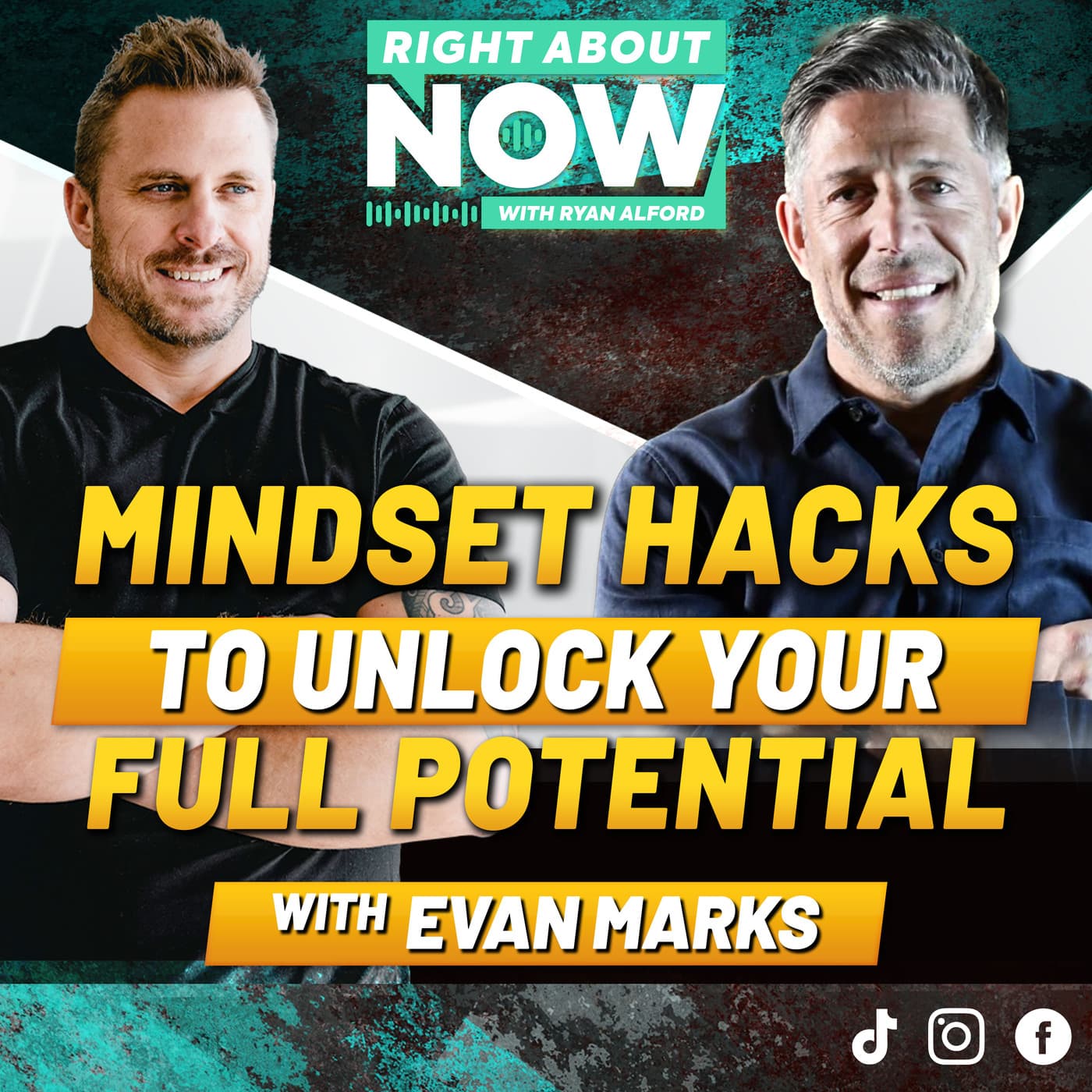
Evan Marks on Mindset Hacks to Unlock Your Potential
Mental performance coach Evan Marks joins Ryan Alford to explain emotions as data, aggressive patience, and the formula Potential minus Interference.

Why Most Businesses Should Never Raise Venture Capital
Loud Capital co-founder Navin Goyal tells Ryan Alford why under 2% of companies need VC, how active capital closes the execution gap, and where AI fits.

Legal Tax Moves That Help the Rich Get Richer
Tax attorney Mark J. Kohler shows Ryan Alford how side hustles, family payroll, Roth IRAs and better bookkeeping legally cut what you owe the IRS.