
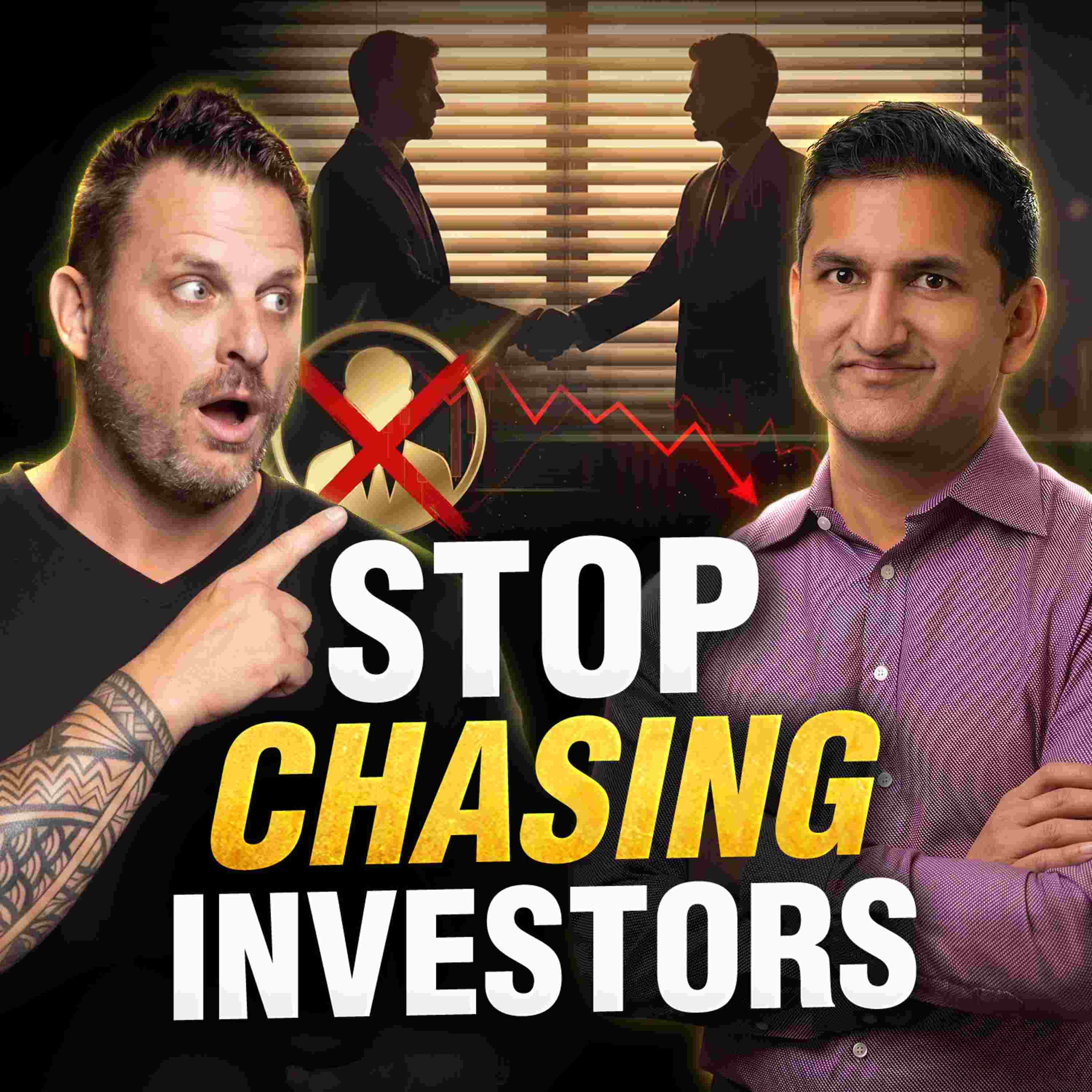
Most Businesses Should Never Raise Venture Capital | Navin Goyal
Loud Capital co-founder Navin Goyal tells Ryan Alford why under 2% of companies need VC, how active capital closes the execution gap, and where AI fits.
- Fewer than 2% of companies actually need venture capital; Navin actively discourages most founders from taking money from a fund and suggests staying scrappy or using in-kind services instead.
- Treat capital as more than money. Loud Capital was named 'loud' because they act as strategic, active investors rather than silent ones, closing what Navin calls a much bigger execution gap than he expected.
- Bringing experienced executives in-house through the investor can reduce how much money a company needs to raise, cut wasted experimentation, and reduce how much equity the founder gives away.
- Before accepting a round, interrogate the use of funds: if the million dollars is earmarked for hires the investor can supply, the actual capital requirement may be far smaller.
- Loud Capital reviews decisions and spend roughly monthly with founders, asking whether they're getting bang for the buck, and holds itself accountable in the same review.
- The ideal venture-backed founder is ambitious and humble, willing to be outgrown by their own company and managed alongside executives who may be more experienced.
- Use AI for utility, not just as an investment thesis. Aggregating a company's own curated private data can surface the small sliver of activities actually building value out of the hundred things a leader is doing.
- A 50-page consultant report doesn't help a busy leader; the value is in digestible knowledge paired with execution power.
you can have discipline or you can have regret. One way is a lot more than the other.
we're talking about less than 2% of companies. Most companies do not need venture.
I blatantly tell people, you actually shouldn't be taking money from a fund.
use a lot of AI integrations. We're looking at new technologies, not really for investment, but for utility. Some of that is the accountability that we have for businesses where we do an assessment and we say, hey, this is what your company is right now based on all the data within that company, which is curated private data of that company, which many times a leadership team can't really even see. But to aggregate it in a way where you can understand it and then start making decisions on how you can build the most value.
You don't win by following the playbook. You win by rewriting it. 700 episodes deep with the people who actually built something real. No theory. No fluff. No shortcuts. This is Right About Now with Ryan Alford. What's up, guys? Welcome to Right About Now. We're always talking about how to get you right in business, in life, in marketing now. Not what you needed to do six years ago, not what you need to do next month. We're not prognosticating. We're telling you how to get right now. That's why I got the good doctor here today, Dr. Naveen Goyal. What's up, brother? Not much, man. Great to be here. Thanks for having me. Yeah, man. Co-founder of Loud Capital. We're going to talk about how to get money fast.
in the right way. I know that sounds sleazy talk. My radio jockey voice can sometimes straight up things sound like I'm hard selling, but look, capital is a complicated thing for business owners. And speaking from experience, it takes too fucking long. It's crazy. And I know you experienced that yourself and hey, you should put people to sleep. And I'm telling you, you've got the good doctor here. He's wide ranging. You're a talented dude. Thanks, man. I represent a lot of people behind me. That's the difference. I love to do these kind of conversations and interviews, but in the end, there's so many people that have helped me out. What made you you, man? You're a doctor. I know what it takes. It's legit to do what you did. And then now to own multiple companies. Before we get into the nitty gritty of capital, I always like to know what are those ingredients for you, man? What made you you? When I reflect on that, it's discipline. And I am that person who will grind every day if I believe in something.
Not for a long time, but I will form habits every day. I wanted to be a physician and I wasn't the smartest student in the class. I worked my tail off at every stage. When I was practicing for a while after 13 years, I was getting bored. Learning curve was flat. And I said, what else can I learn? That habit of learning flipped into entrepreneurship. Then I was like, oh my gosh, what's over here? Like Kid and Candy Store. I started reading, listening to podcasts. I started becoming advisors locally. And I just drank the Kool-Aid, man. Discipline is probably the habit or the trait that has gotten me to different places. I read a comment. This isn't new. You may have heard it before. It said, you can have discipline or you can have regret. One way is a lot more than the other. It's the truth. And in a lot of ways, it carries over. Talk to me, man. You go from being a doctor to building the mobile anesthesia. You still got to be in a clinical study. They're not necessarily residents within the hospital or something. In a more simpler way, as an anesthesiologist, I worked in a hospital and most of the care I did was in an operating room. If I was in
OB, I was in laboring rooms putting in epidurals. Okay. That's the core of anesthesia. Basically, we go and we bring those anesthesia services to offices. So you're a dental office and you have kids that need teeth extractions. They usually need to go to a surgery center or a hospital to get that done only because of the anesthesia, not because they need a sterile operating room, which is very high cost, not accessible, et cetera. We bring an anesthesiologist, nurse, paramedic, our equipment, medications, everything to do the anesthesia in the office. That service is essentially replacing the need to go to a surgery center. So that's what mobile anesthesia is. It's becoming more common, but there's a lot of hoops to jump through, especially in this country, to take care of a patient.
We started Loud Capital and startup investment firm. And I teed this off at the beginning for a lot of people starting their business or they've got a big idea, they're a second idea, a second company. Capital raising is complicated. No matter how many people have tried to tell me it's not, it can be. I know that you guys are simplifying and speeding up that process, but talk to me about what Loud Capital is doing. Allowed Capital is an early stage, initially started out as investing in very early stage companies, pre-seed, no specific industry. And over the last decade, we've slowly shifted into deeper into healthcare. A little bit later, seed series A. As we've learned that our sweet spot is to be able to help companies that are established,
Probably have some customers and clients already and we can accelerate their growth. We really want to be strategic investors. We called it loud to be loud and active and not silent investors because there's a lot of investors who put in money into opportunity or a startup. The thing is, we focus so much on raising money, but then what we tend to do with it is so important. but many times overlooked. And so to be a strategic investor is to say, I believe in this. However, these are learnings and wisdom and people that can help go to the next level and help you execute. Because that execution gap is a lot bigger than I ever thought. Loud Capital is nowadays raising capital and investing in healthcare ventures, ones that get us excited. And there's many different traits that occur. Okay.
Active capital, you're providing both the money, but then the resource, knowledge, information to assist in the execution. It's one thing to have an idea. It's one thing to expand. But how are you going to get there? And do you have the resources, not just the money, but the knowledge and resources to get there? That's the gap you're filling. Exactly. And it's planning for the change. You want these companies to grow. And as they do, you all grow people, you all grow capability. You bring people who've been to the North Star of where you want to go and you bring them into your company. Executives, and whether it's flexible executives or even full-time, we now have that under the Lab Collective. It's not just a couple of workshops. It's not just strategic discussions. It's not just business development, which we do all of those. It's now bringing in people and it's working really well at
There's a couple of things. Number one, you accelerate the growth, accelerate the timeline. Number two, you tend to need significantly much less money because you're not wasting it, throwing it out and experimenting as much. Because people and talent, that's a big cost and it tends to take a lot of time and energy and burn. If you can reduce that, reduce the amount that the owner founder has to give away and you can show success earlier. And we're seeing that in multiple situations. And so that's something I would love to tell my younger self in the journey of a couple of ventures I have. So if I'm someone that's thinking about this and hearing this, if I get venture capital and let's just keep it simple, round numbers, I need a million dollars and here's the prospectus or whatever it is that drives that.
And if you're offering both capital and resource and people, you just nailed it. That's time and money. How does that get factored into the equation of return? Because it's one thing if you loan me a million dollars, but if you loan me a million dollars, a CMO, a CFO and a CIO, they probably don't cost the same. Let's just talk in that general category of a million dollars. And the use of funds is what? Okay, I need to hire people for sales. I need to do this. I need to do that. And what if we say, okay, we actually have that. We're going to allocate some budget to that, but we're not taking as much risk because this is in-house. And now the founder and the company we invest in, it has to mutual agreement. It's not like we're forcing this upon.
But if we know busy founders and business owners and stressed out ones, especially, that's really helpful. Because if I don't need to look far or spend a lot of time looking for the right people to fill the gaps that I have, then that's really helpful. It's usually received with a really positive tone, which is, hey, I'm raising this capital. Number one, do you need a million dollars or do you need actually this? And then we're actually saving a lot of money just by bringing this in-house. And by the way, we just did this with this company. And you can see and you can talk to them. That's how that works. And again, we're seeing results because they're growing fast. And we're holding each other accountable, including ourselves. We're looking at every couple, every month, technically, and saying, we made these decisions. We spent this money. Are we getting our bank for a buck?
Everyone looks in the mirror. Yeah, it's interesting because it's then it's not borrowing and it sort of is, but isn't. You're giving away equity typically. But it's interesting when you're loaning the money or giving the money for a return and you've got your resources in it. You got a lot of skin in the game. It's also interesting because then if it don't work, then I guess you're all just in it together ultimately because no one wins. Yeah, exactly. That's the venture game, man. And by the way, we're talking about less than 2% of companies. Most companies do not need venture. Most companies probably can go down other various routes. And that's another thing I learned about being a VC. I actually encourage most not to take VC, not just because they aren't the right candidate for it, because I've been through it as well. And plenty of not so great things have happened and plenty of great things have happened. But I have that empathy. I blatantly tell people, you actually shouldn't be taking money from a fund.
You actually should consider being a little bit more scrappy and potentially getting some of this funding down the line or in-kind services because they offer this. I actually don't think venture capital is for most, even though a lot of people feel like that is the option. And it's exciting, by the way. It's a credibility stamp of I got venture. I don't feel that way anymore because the pressure to grow that are many times unrealistic with the great opportunity ahead as a business is. there's a mismatch there. I've been on both sides. I've been on the receiver founder side and I've been on the investor side, which I understand. Okay, we got to do this. Trying to be better as a venture investor and trying to be better as a founder and scrappy here to say, do we need to take money from people
who might not understand or have the love for our business like we do. Yeah. Talking with Dr. Naveen Goyal, co-founder of Loud Capital. Is it former anesthesiologist? I have the capability of putting everyone to sleep at any time in my life. Except on this show. Does that ever go away? Do you have to keep getting, do you still practice? Yeah, I do. Some shifts here and there. I took a long break from it. And then with the evolution of myself and really appreciating all the work I've done to become one, I practice once in a while. You do have to keep up your licensing, your credentialing, your continuing education. It's not something to take lightly, nothing in the medical line. It really is straightforward or a quick checkbox. Exactly. Well, I guess it shouldn't be on some levels, but I think we make it harder than it might need to be. You'd probably agree with that. Talk to me. Who's the perfect target then? Who is the perfect model avatar for this type of VC?
Ambitious and humble. Really have a big vision. Really humble to understand this process. It is extremely humbling. That's what I would tell my younger self. You get questioned all the time. Decision you make, that's great. Awesome. It's forgotten yesterday. You have new executives that many times are more experienced or smarter than you. You need to manage that. You need to manage your own self that you might have been outgrown by the company. That happens in companies. That understanding, which takes a little bit of time to spend time with that person, not just the idea and the vision and the existing company. It's really the ability to be molded. As investors, we also want to be more plastic as well, more flexible and fluid, because what we think today could be very different 10 days from now. And we've really learned how to be moldable as well, but we really expect that from our peers.
And in healthcare, we're investing in a lot of therapeutics, logistics and high level. We want our fund is investing in companies where if you invest in a great therapeutics company, awesome. But can we ensure that that can get to patients? And what do we need for that? Do we need education? Do we need logistical? Do we need operations? How do we get that medication to the patient as quick as as fast as possible? Yeah. Holistically, that's why I'm in the venture space. Our team is because we care from the innovation itself and how that benefits patients.
It's kind of a one-off, but that's so topical now. How's AI impacting anything that you guys are doing? Maybe even on the capital side or even in the medical field, you've got to be seeing some changes and different things. I'd love to, and there's such a buzzword now, I'd love to know if it's impacting what you guys are doing. Oh, absolutely. Use a lot of AI integrations. We're looking at new technologies, not really for investment, but for utility. Some of that is, remember I was telling you about the accountability that we have for businesses where we do an assessment and we say, Hey, this is what your company is right now based on all the data within that company, which is curated private data of that company, which many times a leadership team can't really even see. But to aggregate it in a way where you can understand it and then start making decisions...
on how you can build the most value. The biggest gap is the hundred things we're doing as a business owner. We think those hundred things are so important to the value of the company, but it's just a lot smaller. So that sliver, we need to understand what that is and let's double down on it because the value you're building for yourself, for your employees, for your future stakeholders, we care about that. We use AI to integrate that data and to consistently be efficient on how we execute on that. Because if I'm a consultant and I'm providing a 50-page report, that doesn't help a busy leader who has many gaps in execution on their leadership team or with themselves. But if you can bring that knowledge that's easier to digest as well as execution power,
How valuable is that? And that's what we're doing within our own companies that we turn out as well as the companies that we're helping. Steve Jobs called that signals and noise. And he was a master of pulling out the signals and getting rid of the noise. And that's what you're defining is with all this data, what is it telling me versus what is the noise? What can I ignore? And it's both like the tasks too. What are these things that I'm doing that are signals that are driving business forward? And then what's noise? That's powerful stuff, man. Thank you. And that's a great analogy, by the way. I love that. Where can everybody learn more about what you guys are doing, how to keep up with loud capital and hey, everything mobile anesthesiology. I'm just fascinated by that. It makes all the sense in the world. We need to make that happen universally. Yeah. Thank you. I'm on LinkedIn a lot, man. And I have all the companies there and the websites and everything like that. I post a lot on LinkedIn. I try to share a lot of things that aren't your normal. Let's just cheer on for this big accomplishment, but talk more about the stuff
that isn't going well or that many of us don't want to share kind of the vulnerability aspect that's really opened up my world. Love to talk about it. Love it, man. Appreciate you for coming on. Thank you so much. Thanks for doing these, man. I love real conversations and this is definitely real. Yeah, man. I appreciate that. That's the highest compliment I have gotten in a long time and it is what we're trying to do here. You know where to find us guys, ryanisright.com. You'll find highlight clips, the full episode links to YouTube. Got to see the good doctor in person. He looks good. He sounds good. He is good. loud capital go check him out we appreciate him for coming on we appreciate you for making us number one we'll see you next time right about now here's the truth information doesn't change your life execution does so don't just listen to this episode and move on take the idea make the call launch the thing fix the problem
Build what you keep talking about building. For more, follow Ryan Alford on Instagram, at Ryan Alford. And watch or listen to every episode at RyanIsRight.com. This is Right About Now. Now quit waiting. Go win.

Evan Marks on Mental Performance Under Pressure
Mental performance coach Evan Marks joins Ryan Alford to explain emotions as data, aggressive patience, and how to respond instead of react under pressure.

Legal Tax Moves That Help the Rich Get Richer
Tax attorney Mark J. Kohler shows Ryan Alford how side hustles, family payroll, Roth IRAs and better bookkeeping legally cut what you owe the IRS.

The Social Media Goldmine Brands Ignore | Matthew McGrory
Arwen.ai CEO Matthew McGrory on AI moderation, brand safety, and the buying signals hiding in your comment section — plus where social commerce goes next.