
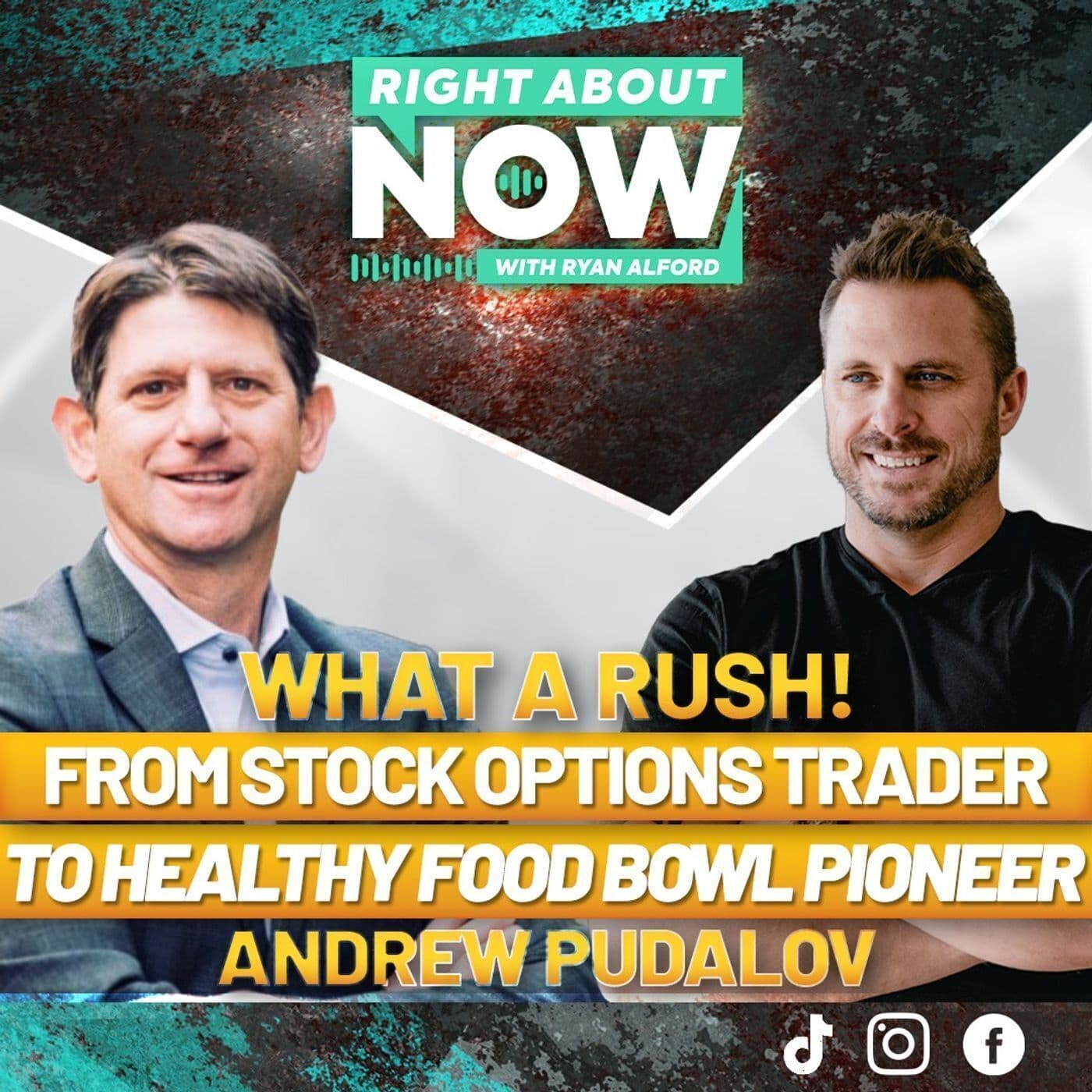
What A Rush! From Stock Options Trader to Healthy Food Bowl Pioneer | Andrew Pudalov
Andrew Pudalov left derivatives trading after 9/11 to launch Rush Bowls in Boulder. He talks franchising, real-fruit bowls and going national.
- Nine food companies control roughly 99% of the food people eat, so breaking into retail shelf space means paying slotting fees and heavy costs that Andrew calls "not for the faint of heart."
- Rush Bowls blends whole fruit with your choice of base instead of using flavored scoopable sorbet, which Andrew says cuts sugar and gums, tastes better, and holds together for delivery and catering because fruit and veggies are fibrous.
- Andrew deliberately launched in Boulder, a college town, because he believed college students would adopt a brand-new food category faster than older generations.
- Employees are trained so every bowl and smoothie goes out in under two minutes, which is why product and process design matter as much as recipes.
- Rush Bowls went national early rather than saturating one region, because Andrew's wholesale background taught him distribution and he saw no one doing bowls well nationally.
- Andrew says he would never build a food business from scratch again: mom-and-pop cost of goods can run about 40% higher than a franchise's, on top of trademarks and organizational build-out.
- In their experience, coupons, in-store promotions and happy hours drive more store traffic than social media posts, though Andrew treats it as a combination rather than one or the other.
- Rush Bowls is owner-operated with no private equity, and senior leaders (CMO, head of sales, head of operations) were all promoted from store manager roles.
What people don't realize is nine food companies basically control 99% of the food you eat.
So to put it in layman's terms is I was a professional gambler for the banks.
And I wanted to do something I had zero knowledge about and build it from scratch.
What people don't realize is nine food companies basically control 99% of the food you eat. So to break into these areas costs a lot of money and to break into shelf space, there's sliding fees, there's all sorts of stuff. It's not for the faint of heart. This is right about now with Ryan Alford, a Radcast Network production.
We are the number one business show on the planet with over 1 million downloads a month. Taking the BS out of business for over six years and over 400 episodes. You ready to start snapping necks and cash and checks? Well, it starts right about now. What's up guys? Welcome to right about now. We're always right and we're always right now. Hey, speaking of now, what's in these days is at least an attempt to eat healthy. You know, I'm attempting it daily, you know, trying to, you know, I think we're all conscientious of it, but we just don't have all the options that we want. And that's why I really admire what this guy is doing. He's the founder of Rush Bulls Andrew. Who love? What's up brother? How are you Andrew?
Great. Thank you for having me on the podcast. Yeah. You know, if it's radical, we cover it. And you know, I'm always in a hurry. So, you know, Rush Bulls kind of, it hits me on all levels, Andrew. I'm like, I'm in a hurry. I'm trying to eat good. When the hell's it coming to Greenville, South Carolina? As soon as possible. Certainly I can tell we need to get one there. Yes. We be your biggest advocate. It's a booming area. It's probably like the perfect market for you guys too, because it's like not too big. So real estate's probably not like, you know, in outer space, like the big markets are, but a fluid enough that it would be a good market. So we'll have to
talk about that for sure. Man, let's set the table for everyone. You know, I've teed up a little bit of a teaser for what Rush Bulls is. You know, you are the first like derivative specialist we've had on right now. You know, it's just not, you know, when I get my show notes and I'm learning about my guests and like some, you know, what attracted me to your brand and you doesn't always like equate to like something I have first hand knowledge to, you know, derivatives. It was not like my specialty. So we'll dig into that. But let's talk a little about who the hell is Andrew? Who love? Sure. Again, thanks for having me on. So I'm pretty financially driven guy, math guy, honestly, and I'm from New York. And obviously at a young age, when I graduated
college, I went right to work in finance, started my career at Bear Stearns, and then spent a lot of time at Morgan Stanley, Credit Lane A, and Global Head for National Australia Bank all basically started in the derivative trading environment, institutional. So to put it in layman's terms is I was a professional gambler for the banks. I'm taking decisions on behalf of the banks. I'm glad you're probably a bit, but you at least admitted Jay Drake, because that's what I tried to tell people, you're doing a stock market. Yeah, it really is just like legal gambling. And banks are the number one betters. It's a house. Really, if you want to think about it, too, right? They're the house and the gamblers too. Are they? Are they going to play it on both fish balls?
Whatever side wins, they're on pretty much. Yeah, exactly. But yeah. So basically, I started my career right away, and then I went into CMOs, cloudized mortgage obligation, then got recruited to Morgan Stanley to start trading derivatives institutional. So smallest trade ever done was 25 million. So these are big trades. And it's a tough job. It was a job that very few had. And then you were treated like a king. You were treated really well by the bank because you're generating significant revenue. At some point during this, I was moving ahead, moving up, up, up. And then 9-11 really happens. And I'm living in New York City during 9-11, and it was pretty catastrophic for myself and my wife. My wife was in the tower in 93. Everyone forgets that they bombed the tower in 93.
And then 9-11, it was her first day back from maternity. I'm in Midtown. She's in the 20s, and she literally saw the plane crash in. And a good friend of mine ends up jumping. So I kind of, I think, reassessed my life. And to be fair, I was reassessing it at the time because you can't do with this forever. The job is just incredibly stressful. And even if you're really good at it. And it's just not, it wasn't that fulfilling for me, right? After a while, the highs are lower and the lows are lower. So you become numb to it all. And I wanted to do something I had zero knowledge about and build it from scratch. And I wanted to move to Boulder. So hence, I moved to Boulder in 2004 and started a bull business 20 years ago. So way ahead of
anyone else doing bulls. Yeah. But I think you know, Paul's there, Andrew. I think the big aha for me, one main glad you made it out alive, you and your wife. And you know, I hated y'all, I had to go through that. I lived in Manhattan in 2008 as the, you know, freedom towers, you know, we're being built. And so you, even then you could still feel like it was palpable, like, I don't know, the impact, you know, seven years later. But I think, you know, the real unlock for you is like, and for a lot of people, you know, listening to our show, it's like trying to get off the snide and the balance of like, you know, doing what you love to do, what you enjoy doing versus what you're good at with
this combination of passion and desire. And you know, a lot of people don't take that leap. And so congrats to you for taking the leap. I know there's a lot more to the story. But I think that's a big unlock for some people was kind of, you know, it does sometimes take those moments in life where you look in the mirror and you go, all right, what are we doing here? And, and you know, I just hate it was that sort of experience for you though. Yeah. And you know, and in this life, you not rewarded for making those leaps. You are, if it's successful, but as people making those leaps, it's, it's, it's, you know, I was lucky I had the capital to do this for previous successes.
But, you know, I really encourage people to take leaps of faith because it may not work out the first time, but it will put you in a position that it may the second or third. And, and as well, you know, you know, sometimes it's not the first shot that's successful. I was lucky or the most, but, you know, it's, it's, it's, it's really kind of nice to change things up. At least it was that. Yeah. And I think, you know, it's, failure is not fatal. And, you know, it, and you, you know, you were one of the rare ones to get it. I mean, I've fallen on my face more times than I can count. I didn't get it right the first time. But you learn from that. And you also
learn that, I don't know, the scars from that do make you stronger, even if in the moment, it doesn't feel that way. And so, but you have to, like, I always, it's always a cliche, interview, but like that saying, you know, and people say, you have one life to live. But it's like, it's so fucking true. Because it's like, we have one fucking life to live. Like, and, you know, you could play it safe. And you can, and there's nothing wrong with that. If you're comfortable, but I don't know, man, I want to, uh, yeah, the success rewards, the risk takers. Yeah. And, and reward could be a lot of ways too, you know, like, you know, it doesn't have to just be monetarily either. You know, there's a lot of rewards and, and doing things, uh,
it for yourself and everything. And just knowing you built something, um, that's widely popular now. It's a kind of a reward too. Yeah. So way ahead of your time with the bowl, what, um, where did we go? We went to Boulder. Yeah, Boulder's kind of a nice town for it, because it's, you know, when I, when I started the company, I wanted to start in like a college town, because I figured the college atmosphere would, they'd be more apt to adapt quickly. You know, and I even laughed at my, my father when I started the business, he's like, why would sworn eat this, you know, but, uh, but it was a different generation. You know, he was, you know, a world, world were too bad, you know, like, they didn't get it. Um, but the college kids
got it pretty quickly. And for me, it's about texture. It's about a meal. I didn't want to be a smoothie place. I wanted to be a meal to go, um, with very interesting textures. I remember a back and then no one was putting granola mixed with head or fruit or fresh fruit or honey was really not being thought of that way. And we, as a company had a very diverse and very pallid flavor. So from green tea to, you know, apple pie, to peach, to very tropical, to Asahi, obviously. Um, so we were very narrow focused in bulls and smoothies, but we were very, very diverse flavor set to accommodate everyone's needs. Um, and that's just, we were very dietary friendly. So right away in, in this business model, when I structured it, it was to be extremely
dietary friendly for people with allergies. So we were way ahead on that too. And, and, you know, that was even before they gluten-free craze or whatever it was at the time. I think when most people, you myself included, you know, your hair bowls and, and again, we have, we get recency bias because, you know, we're talking, you know, when you started 20 years ago, 2004, five, six, or, you know, like, but now speaking now, I think when people hear this, you think to Asahi, I think my, my mind goes there like immediately. And, you know, like, there's, there's guys around here, even that have things similar to this, but the more I've kind of dove into a lot of what you guys are doing in your ingredients. There is some differences, but,
you know, maybe, maybe to lineate there for what most people might think of when they think of this and maybe what you guys are doing. Yeah, that's, you know, and that's one thing I think we, as a company, can even do a better job of making, making that case. What we do is way different. We don't use surveys. We don't use, you know, we make the base in front of you. So, you know, our ingredients are pure. So there's this actual fruit. We grind our own peanut butter and make our own jam for our peanut butter and jelly bowl. So a lot of companies out there, I would say most, because it's a simpler way of processing it, use a scoopable sorbet, a flavored sorbet,
which has tons of sugar and has gums and junk in it. We don't do any of that. We actually take the fruit without it, whatever base, whether it's almond milk, oat milk, whatever milks you want, whatever 100% pure juices you want, we take the fruits and blend it and then add in, you know, pure acai, so not a sorbet or anything like that. And the reason obviously other companies do that is a, the sorbet is way cheaper. It's more of a dessert, opposed to a meal. And I would say that the, it's way easier to surf, right? So we actually do a lot of training on our employees to make sure every bowl and smoothie gets out with under two minutes. So if you have a scoopable
something to throw it in, what people and businesses don't realize is when you use real fruit and we do such a big delivery business and catering business, it stays together much more because the fruit or the veggies are very fibrous. So not using a sorbet like that, a, it tastes better, b, it's much more nutritious and doesn't have the sugar content and c, it holds together way better and it's a better mouth feel and better experience across the board. So that's only really proud about and having an extremely diverse flavor set. So we have something called Power Bowl has tons of way protein in it. Then we also have super smoothie that has our fresh ground peanut butter, 40 grams of protein and it is all nutritious foods kale in it to go. So
we're really proud except, you know, we're not preachy about it. You know, you want new tell on top, put new tell on top here. We're not judging. We just want to provide you with really good nutritious food and if you want fresh ground peanut butter on top and jam and it's an assay bowl, which by the way is an awesome combination, fresh ground peanut butter and an assay um, fantastic, you know, I, you know, I never wanted to need before this. So I'm hungry and like dreaming, daydreaming of that peanut butter jelly bowl. But number two, don't judge me if I bring cookie dough and peanut butter cup to the, to the table. Can I throw those in there for my dessert? And it's, you know, it's customer support. We're not the ones to judge, right?
We just want to start at a base. It gives you the healthiest option. And like I said, we have new teller. We have chocolate, you know, chips to put on. We have stuff that's more of indulgency. We have a chocolate covered strawberry bowl, which, you know, again, it's fulfilled the needs, but we're starting at a very healthy place. If I fall out of my seat while you're talking, Andrew, it's just because I'm, you know, hungry. Good sound delicious. It sounds delicious talking with Andrew. Well, he's a founder of Rush Bulls. So Andrew, talk about, all right, what do we learn? I know you said you're lucky enough that it, uh, you know, you made it on the first try. But I bet you got a few bottle scars, you know, in those first few years. Yeah, you know,
nothing's easy. So anyone, you know, you always say it's like this, no, it's up down, up down, up down, hopefully it's higher highs. Um, and certainly we launched a wholesale company in 2010 that, um, that went to 2016 when I started franchising. And that was really an interesting experience. And, and the one thing I love about this business is a retail store. It's very different from franchising, which is very different from wholesale, which other than sharing a name is three dynamically different businesses. Um, and I love that, you know, I like a lot of stuff going on. So I appreciate the, the different actions of the different businesses. But the wholesale was an interesting thing. And when I say wholesale, we were in 40 states with
whole foods. We're in a Costco as a frozen form of a Rush Bull. Um, and way ahead, actually almost too far ahead because people didn't even know what bowls were at the time. Um, and this was created because I was trying to get people in and out of my store fast. So I started freezing and I'm like, hey, this is a good line. Now we dealt with co-packers to make it and then distribution through Unify, which is a big distributor for wholesale products. But that's a game until itself. And, and, you know, what people don't realize is nine food companies basically control 99% of the food you eat. So to break into these areas costs a lot of money and to break into shelf space,
there's, you know, sliding fees. There's all sorts of stuff. Um, it's not for the faint of heart, honestly. It's, it's, it's a dynamic, interesting business, but it's a tough business being, uh, you know, uh, not a major player. Are you still doing the wholesale? No, my co-packer, and this is one of the challenges. My head, my co-packer actually shut down overnight and he was co-packing seven brands and we couldn't even get our stuff out of there. So I plan to relaunch it at some point in the future, um, with our 50 plus stores and 75 in development. It's something that we're gonna probably have in stores to take out module, but also, um, we're gonna explore again, relaunching it in, you know, other institutions. So it's something I'm pretty passionate about. I think it's a
really interesting way to get nutritious food to people in arenas or whatever else that may have dietary issues that want something that tastes awesome. So, you know, uh, I'm, I'm very helpful to get going on that at some point in the near future. What's the, uh, maybe, like you said, three unique things, retail, wholesale and franchisees. You know, franchise, open it, you know, as you, I'm sure you knew it going in on some level, but it's one thing when you own your own store and you're doing your thing and every kind of input and output is sort of on you. What you got franchisees, you know, they're, they're kind of like your babies in a way, right? They're, uh, you're the mothership and, you know, they're getting the blueprint from you,
but how was it suddenly having to serve other store owners and, you know, because I think, you know, people listening might be in franchise, might be considering franchise or learning about it, you know, but there's a, I would imagine a learning curve there and, and sort of, I'm sure you've got lessons from what it takes to kind of keep them satisfied. Talking about scars, you know, for sure. You know, listen, people buy a franchise because you want to fall, it's paint by numbers, right? We know what works and really do it. And the key is to get those partners and their partners, there's a marriage that, that one of follow rules and follow follow partnership where it comes to foul and where you have more challenges if they start, hey, I want to do tuna fish sandwiches
in store. Well, that's not the business model. And we know, and I exaggerating with tuna fish that seemed much, but I'm sure there's some oddballs though. I'm sure I guarantee you that what you get to store is like, you've had some oddball things happen. Yeah, and that's the challenge, because we really do know what works. And not only that, we have the data of what works, and we do share a lot of that with the franchisees. And just finding the ones that are going to find the path and then, you know, you know, be open proper hours, have customer service, and sometimes to be fair, even on a franchisee level, you're as good as your worst employee, and an employee has a bad day and gets attitude, well, that doesn't help anybody, right? So, you know, it's, it's, it's not easy,
it's not an easy business, ours is as easy as you come, because there's no food spoilage, everything comes in, flash frozen, and fresh toppings don't obviously, but there's no food waste, smaller square footage, very narrow kind of set menu, opposed to a broad like salad paninis, that nothing tastes good. A lot of competitors out there will do a salad panini this and that, and nothing, you can't do anything right, right? In a way, so it's really being a focused kiss, keep it as simple, right? And that's actually why I started the business is I didn't have a clue about this stuff, right? Like I came in from my new finance, but I didn't know how to, you know, a lot of the food running a food business, so it's been rewarding and challenging at the same time,
but I think it's really making sure you pick the right partners, and that's a different partner when you're starting out from zero to 10 stores, 10 to 20, 30 to 40, and then say 50 to a thousand, like there are different incremental partners also, and the partners are more and more experienced than that too. So that makes sense? It makes a lot of sense, and you know, I think there's lessons, I mean, I can totally see like the types, you know, and it's like, it's just weird dichotomy, though, for me, because people that, by franchises, they do have an entrepreneurial gene to them, right? So it's the balance of, hey, you've given them the blueprint, because that's what they wanted, with them wanting things to be their way, and sort of the, you know, I don't know,
well, maybe not the tuna fish sandwich extreme, but like I could totally see like, okay, and then balancing, well, you know, I told you so, when they changed their hours or do something or filter, right? And to be fair, I would never start a business other than a franchise, again, like if I was to do this, I would only buy a franchise, because to create a business from scratch, it is hard. Like, you know, I was lucky I did it, and I was capless to do it, and with trademarks and everything, organizationally, how to do this, to just blindly do it as a mompa, A, your cost of goods are way higher, like 40% higher, like not a little higher, but B, it's really hard to create something from scratch. And for me, if I say, you know, hey, I want to
do something different, I would buy a franchise, because I, it's, it's all there. And if you follow the rules, you follow not just rules, but if you follow the game plan, you know, there's a great chance for success, much higher than just starting your own business, like incredibly hard. Yeah, talk to me about like your marketing philosophy, as you grew, you know, like your franchises and in general, the brand and stuff. I mean, normally when I talk to guys like you on the finance side, it's, you know, data, numbers and all that, and there's art and science to marketing. What's, what's been your philosophy? Well, I'm kind of unique skill set. I'm not only a finance guy, but I'm also a professional gambler, right? So, but I'm also finding it. I think
the, you know, I, there was two sets of this, A, A, what's a bowl? Like, and you never want to get into the education business, but early on, that's, that was our business, like get it in people's mouths. Yeah. And we also took a different track, like most companies that start franchising, starting a particular region, which is an easier way to do the business. You're in a particular say, I'm going to only own the state of Colorado, because you got distribution and distributions in a huge part of this. And you know that what we did is we went national kind of early on. So we're in 22, 23 states. I don't remember off the top of my head, but because I understood distribution from the wholesale. So I was able to facilitate that distribution
carefully in the states that we're in. So we could take a more national approach, because honestly, within the bowl arena, I don't think anyone is doing it well national. And I think there's a need to fill it out. And you know, the winner will fill it, whether it's us or someone else. You know, hopefully it's us, because we do have a superior product. And we're very focused on it. But you know, I think having that broad spectrum when when the whole landscape is open is a different approach. And it, and I think it will be successful for us, but it's somewhat of a gamble. The, what's interesting, you know, category creation is a big thing like for a lot of people is like, okay, and that's really what you've done. I mean, you were kind of the pioneer in the
space and category creation. And when you create the category, you have to evangelize the what you're doing. You have to do a lot of education, you know, you gotta evangelize the bowl and like a lot of the process. And with in the theory being, and I do believe in this theory theory that when you evangelize your category that's new and it has clear differentiation and problems that it solves, you do win when you, but even though it may seem like, you know, you're propping up the entire category. But when you have 50 locations and you have the cost structure, you know, you win that bet, right? When you talk to your category and prop it up.
And most of these companies that are our size is private equity or this other people involved, that's not us, right? I own everything. So we're, we do it a little bit. We're personal and for us a little bit, right? Like we try and make it as lean of an operation for everybody. A lot of my employees, my CMO is my manager of my store 20 years ago. My head of sales was a manager of my actual store 10 years ago. The head of operations is worth the store about eight years ago. And then obviously we have a lot more people than that. But it's personal, you know, and I think that's almost some of the best, right? Because they really care. They care for our success,
they care about the franchisees, our partners, and they care about the brand most importantly. They love the brand. So you get buy in from the team and then that really spreads itself out to the whole network. What role has social media played for you guys, you know, you're starting in 2004 and now being in 2024, you know, you've kind of come through the whole ring there of start to finish, of not start to finish, but start to, you know, how big it is today. I mean, does it play a role for your growth, the brand and stores? I would imagine. I think it plays a role for the growth in different states, in different areas of the country. I will tell you in an old school about this. I knew it was coming. That's why I teach
Japan, Johnny. No one like you like social media. That's not true. I think in place, there's a lot of positives negatives to it, honestly. And I think it's, listen, these podcasts, right? I think it's incredibly valuable. I think you learn a ton of stuff from them.
Knowing that Suzy went out on Tuesday night and you were invited to that crew when you're a young kid, I don't think that's productive, honestly. No, no. I meant more of your brand and marketing and propering up, you know, like how delicious things are and telling your story. I think this ability wise, I think it's a big help. Like getting out to people that never may have known it or seen it. But if you tell me what's going to drive people in a store, I would say coupons, I would say, you know, promotion in that particular store, not every day, but certain promotions, happy hour, whatever it is, that will drive more people in than a social media post. And I don't know if that's because we're not 1,000 stores or 10,000 stores,
but that's our experience. Not to say, I think it's a combination of things and I don't think you should be dependent on one or the other. And they both kind of come together. But I don't don't underestimate, you know, talking to people in the store, finding, hey, you work at this company, you guys cater. Like I think that stuff still goes a long way. But again, it's everyone's learning on how this is going to play out, especially with AI. I go to conferences and like a lot of companies say, hey, we're using AI and everyone's using it to, whether or where or not, using a certain degree, but no one really knows how to use it well. Yeah. And I think that's going to be the next generation of things. And we'll see how that goes.
Yeah, exactly. Is like when you think about the brand of rush bowls and like, what's, what's like, and this isn't meant to be like a creative question, which is like strategy, like, you know, give me your elevator pitch. Like, what's, what is the brush bowls brand? What's it stand for? Yeah. And certainly for us, it's a lifestyle, right? It's a chosen lifestyle that eat healthy, eat food you love, and love to be around the people, right? So it's having cool stuff, having cool clothing, having, having, you know, great food, having fun, hiking. We're in bolder for a reason, right? Like the outdoors, you know, try and joy life a little bit and try and really know what goes into your body. And honestly, in the bold business, that's been
distorted a lot as I explained earlier, like we're nutritious, we're healthy food, and you don't want people that do super bowls or surveys. You don't want that because that's not nutritious. It kind of goes against that healthy lifestyle thing. But that would be the elevator pitch. It's a lifestyle choice, and it's a fun, inviting lifestyle to everyone, no matter what you're doing. Is what's I, this is just like your ass, I think it's interesting for you to listen to. It's like, what's like the, the, and imagine it's probably different per market, but like the demo, like, who is your, describe to me like your, your, your, your average customer? It's, it's funny. It is, it's changed over time too. So we were really early on when I opened
it. It was a very, it's college kids and younger almost. It was a very young demo. That's 20 years ago, but our demo is 20s to 40s, I would say, and overall. So young families, young people getting out, you know, hiking, whatever it is, or more food conscious. And then there's this certain sector of food allergies, right, that might even skew younger. So my daughter can have gluten, do you have gluten free? My daughter can't have dairy, like our product can be gluten free, dairy free vegan, whatever you want her desires, because we're making it from scratch. So you know, our new slogan is make it yours, right? So really focus on what makes you happy the way you want it to be. So think of McDonald's, think of Burger King, have it your way. We've always had it,
make it yours. So you want to tweak and change. And the reason we can do that is we're making everything fresh in front of it. Yeah, exactly. And you know, like, I think that's always like the layer of like the health aspect is always kind of like that ribbon running through the middle. And I think it gets lost a little bit, because you do have the competition, you know, the Torbae places, like you said, like there's sort of this crossing of industries now. And I'm sure there's probably constant education, you know, or reminders going on that this is the healthy alternative. Yeah. And I think it's really people have to be really conscious of that, because there's a big difference, a big flavor difference, too. You know, where's everything headed? Where's everything
headed, Andrew? Like, you know, what's your crystal ball? It's like mixed with, you know, your gambling man. And a mix of goals, crystal ball and the gambles and the bets you're making. Yeah. No, I mean, but I'm like, we're a lifestyle brand. So does that, you know, we're looking to expand within the lifestyle brand. That might be acquisition. Constantly being creative, we're going to be launching a couple of new things actually with new flavors. I think spices is an area that I want to explore more. Jan comes also, by the way, we're experimenting with all like another layer of texture within the bowl. So whether it's a spicy mango texture within a, you know, strawberry smoothie or strawberry bowl or whatever, you know, or whatever it may be. I'm just throwing it, but we're working a lot
with another layer of texture, another layer of flavor. And then, you know, we're lean and mean, because there's not like, I'm not in this to, hey, I'm going to build it every three years. I'm selling it to a different private equities. So we're built to last in a very cost-efficient basis. And then, you know, this is a way for people to own their own business. This is something that I'm proud of because if you were in a situation like myself or wanted to do something different, this is another avenue to easily own a small business that doesn't have the same stresses. Now listen, there's stresses you got to be open every day, other than holidays, and then, you know, it's, there's, there's other stresses of running your own business. But
in the food dynamic, it's as simple as, as you can really have, no hoods and stuff like that. So easy build out. Working here may learn more about rush bowls and everything you have going on. Sure, you can go to rush bowls.com. That's r-u-s-h-b-o-w-l-s.com. And then on that, there's, you know, whether you want to franchise this franchise, all right, we do, we have our internal sales division. Like I said, everyone's really experienced and knows what it takes and knows the challenges so that we don't, we're really proud about that, that your experience, talking to really experienced people. And also, unfortunately, for my employees, I came from the trading background that you answer your phone 24-7, 70-s weeks. So we have a team that really responds to not only the franchisees,
but everyone. So we really like to, you know, get on it and talk to people and really show them what we're so proud of. Hey, that old-fashioned customer service goes a long way. And being available should never be apologized for in my book. I love it, Andrew. It's been a very layered discussion. So I appreciate you coming on today. Hey, guys, you know, to find us, Ryan is right.com. You can find all the highlight clips. You can learn more about Rust Bulls. We'll have to link there. And we really appreciate Andrew coming on in the final words, Andrew. Check this out. Tastes the difference. And thank you so much for having me on. It's been fun. My pleasure. It's been a lot of fun. Go make it yours, folks. We'll see you next time on Right About Now.
This has been Right About Now with Ryan Alford, a Radcast Network production. Visit RyanisRight.com for full audio and video versions of the show, or to inquire about sponsorship opportunities. Thanks for listening. Warning, the following Zipper Cruder radio spot you are about to hear is going to be filled with F words. When you're hiring, we at Zipper Cruder know you can feel frustrated for Lauren even. Like your efforts are futile. And you can spend a fortune trying to find fabulous people only to get flooded with candidates who are just fine. Fortunately, Zipper Cruder figured out how to fix all that. And right now, you can try Zipper Cruder for free at zippercruder.com slash zip. With Zipper Cruder, you can forget your frustrations because we find the right people for your roles
fast, which is our absolute favorite effort. In fact, four out of five employers who post on Zipper Cruder get a quality candidate within the first day. Fantastic. So whether you need to hire four, 40, or 400 people, get ready to meet first rate talent. Just go to zippercruder.com slash zip to try Zipper Cruder for free. Don't forget that's zippercruder.com slash zip. Finally, Zipper Cruder.com slash zip.
Zipper Cruder.

Justin Brennan on Multifamily and Other People's Money
Real estate investor Justin Brennan explains syndication, check equity vs. sweat equity, bonus depreciation, and how to buy apartments without your own

Jason Brown on Options Trading, Risk and Rebuilding
Jason Brown turned a $10K student loan into six figures, lost $250K on one trade, and rebuilt. He shares his options, risk and wealth roadmap with Ryan

Earned Media and AI Search with Brett Farmiloe
Featured.com CEO Brett Farmiloe joins Ryan Alford on earned media, digital PR, AI search visibility, and the relaunch of Help a Reporter Out.