
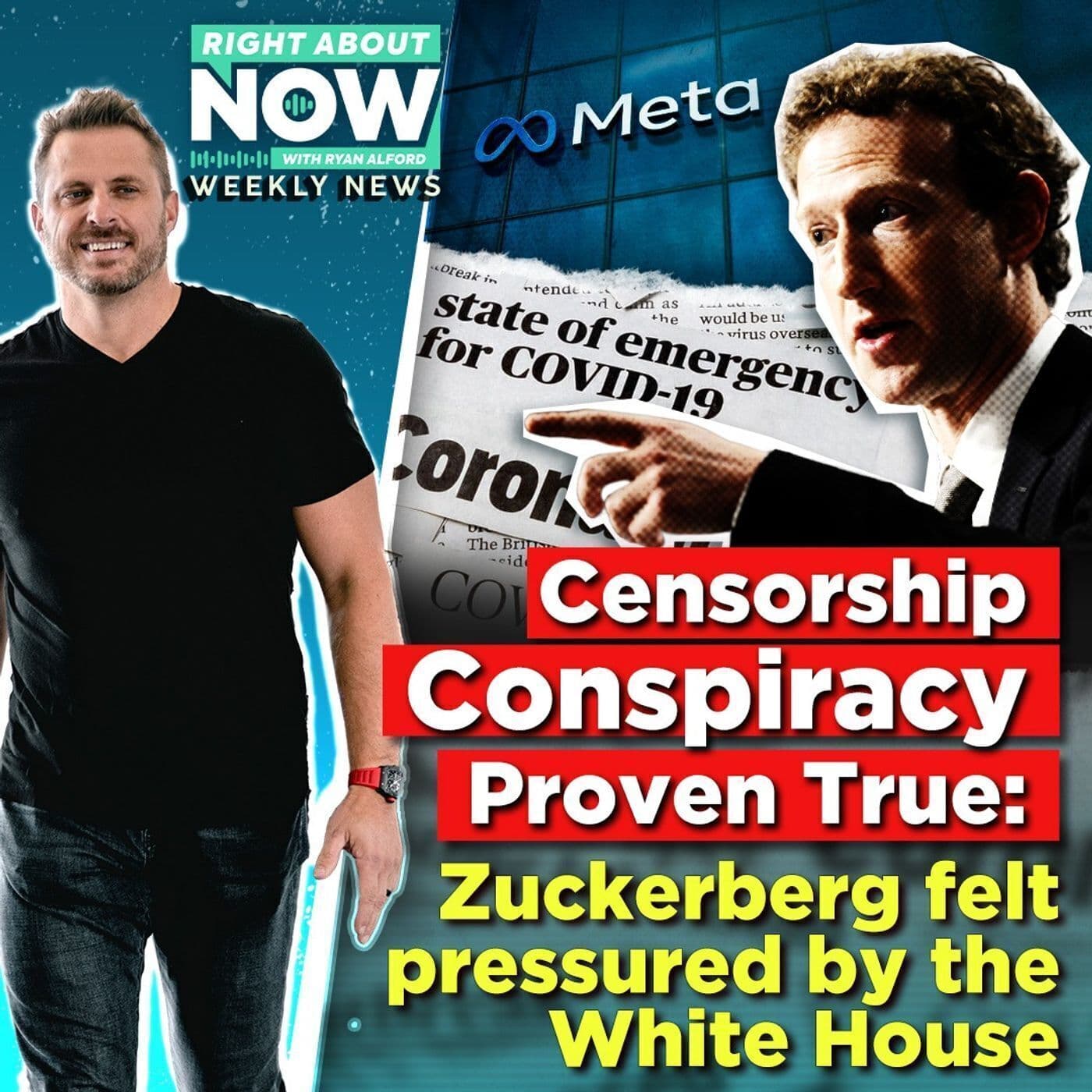
Weekly Business News for Aug 30 | Censorship Conspiracy Proven True: Zuckerberg felt pressured by the White House
Zuckerberg admits pressure to censor content, plus record home deal cancellations and Gen Z sick days on Ryan Alford's Aug 30 business news roundup.
- Treat social platforms as rented land: build an owned newsletter and website because reach, ads and content can be censored or pulled at any time.
- Zuckerberg's two-page letter confirms Meta was pressured to suppress COVID-19 content and the Hunter Biden laptop story — a business risk for anyone running ads or organic content on Facebook and Instagram.
- Name, image and likeness money is reshaping college football; Ryan argues players deserve to profit but the system needs regulation, and programs are now hiring de facto general managers.
- Housing data for July: about 60,000 U.S. home deals were canceled, pending sales hit their lowest level since April 2020, 30-year rates eased to 6.5%, median price rose 4% to $439,000, and supply climbed 14%.
- Ryan's Greenville house sold for $495,000 in January 2014 and resold last week for $1.3 million with zero upgrades — a 264% jump he calls a warning sign, not progress.
- Affordability is now an employer problem: Brianna argues a household needs to push $200,000 a year to buy a home without existing equity, which undercuts retention and employee happiness.
- Chris reports Miami's higher-priced inventory is stalling, with new high rises, condos and single-family developments already in foreclosure.
- Gen Z averages 14.36 sick days a year versus 8.9 for baby boomers; Ryan argues unlimited PTO plus real flexibility reduces the need for fake sick days.
- When inflation squeezes payroll, rent and materials, incentives and commissions are the first thing cut — which then kills the drive employers are complaining about.
Social media is rented land. It means you don't own it. So you need to have them on your newsletter that you control in your own website.
Like if it's that easy to get our top people to lie, to cover Hunter's ass, really. Like what else are you lying about?
No, it's rage abating. It's all emotional terrorism. Just keep people as divided as possible. Keep the infighting. Because realistically, we're all more like than we think.
This is right about now with Ryan Alfred, a Radcast Network production. We are the number one business show on the planet with over 1 million downloads a month. Taking the BS out of business for over six years and over 400 episodes. You ready to start snapping next and cash and checks? Well, it starts right about now. What's up guys? Welcome to right about now. It's our weekly business news of the week here on August 30th, 2024. We have the lovely Brianna Hall here in studio. What's up, Brianna? Hey, of course. Oh, Christopher Hanson down in Miami. What's up, Chris? What's up, y'all? How you doing? Hey, it's Friday. Yay. That's what we say. Me and the boys is always the first one. Like it's like an internal game.
The first one to say just say Friday. Like it means because it's like I've told the boys like hey, we need me in good mood. It's Friday. You know, you should be in good mood. So the first person to say Friday kind of gets dibs like you know, cred for the weekend. So it's Friday. There we go. There you have it. Who got it today? Who won it today? Absolutely me. I win it about eight out ten times. I like good morning boys. It's Friday. And they go, oh, man. It's like a game. That's how you walk in the room. And Clayton or Hudson would go Friday. Like they got me. But keep me on my toes. So we'll see how it goes for next week.
And I'm just excited. My distractions are back from all of the political bullshit and everything else going on. College football officially starts this weekend. You know, I'm not counting that Georgia Tech Florida State game last week, which went down about like I expected as Florida State got beat. But I might be eating humble pie that quickly. You know, Clemson where I went to school and is I've been a long, long fan gets to play Georgia. It's been the number one team like the last three or four years and not even been close. So I would either be really excited next week or I'll still be excited because I don't really expect. I'm a reasonable fan that, you know, we're a 13-point underdog. So and Clemson hasn't been like a double-digit
underdog in a long time. Like so I'm like, okay, I got to take the orange coat of glasses off and go reality says that we could win but we probably won't. But nonetheless, I'm just excited to have some football. And you know, maybe it's an escapism and I can admit it. You know, we're all human beings. But watch the footballs about the only sport that I can watch. I can watch my aim of Ohio and Connecticut on Tuesday night. And I'd rather watch that than probably about any other thing. And so I'm happy football seasons back. My soul escapism is content goes, I think. So. Clemson fans are crazy. Yeah. I don't know if I'm, I don't, I know those people. And I don't know.
I don't know. I know them. But I don't know if I wanted them. Yeah. But who knows? I got told. And so my son is having a birthday party this weekend. And I got told by people that I was inviting. They're like, oh, well, you should probably plan around the Clemson game. Like you saw people are not kind of going to come to his birthday party. That's because they'll be watching the game. That's funny. Welcome to South Carolina, Brianna. South Carolina. SEC. Maybe we take college football serious down in the South. So college football is here in a fell starts the following week. And so. Go Niners. You will hear us talk about it a little bit. Hey, it's big business. I mean, we talked about business on the show.
I mean, it's billion dollar business. I mean, the players get played paid now. I mean, it's college football is the wild, wild west. Like Clemson's getting beat out for some recruits from like nowhere'sville teams that are outbidding them essentially. It is kind of crazy. Like what do you think about the business of being able to pay college football players when that wasn't the case in the past? Oh, I personally believe you should be able to make money on your name, image and likeness. Two things can be true at the same time. I can believe that. And I can also believe that it's changing the game in not it the most positive way. So two things can be true at the same time. They need some regulation.
Because even coaches are coming out saying like tell your agency stop calling me or the season starting, you know, because the NFL is at least somewhat organized around it. They have like these times for negotiations and all that. You can always have a player to holding out. It's the contract. But it's not the whole team or it's not. Yeah. But the college coaches have the higher specialists now. GM's pretty much general managers that are managing all this. Yeah. It's crazy. And it's fine. It's just an evolution. But I think they got to get their hands around it. They kind of unleashed this without really thinking through all the implications. And, you know, I have a lot of connections at Clemson. I had a lot of football players on my boat weekend before last.
Like half the starting line, offensive line, start two of the like all American defensive ends, like big players. And they even talk about how it's the games. It's just different, you know, and like, and they're not a negative way, but just navigating it all and managing it. Because they're looking, they want to look out for their own best interests. They all have agents, but they recognize that it's not as organized as it should be either. So it's fascinating. Yep. Change is the only constant we have. Yes. So set your TVs accordingly. All you football fans out there. We know it's football fans out there. You went to Central Florida, right, Chris? Yeah, baby. Go Knights. I think that has changed conferences. I don't know. Maybe I'm.
They don't know that. Not a big football school. Yeah. No. But we're better basketball team, honestly. They've been okay in football here recently. Yeah, they're doing all right. They're doing all right. We just need to be in a better conference. Yeah. I think that you just changed conferences, but I can't keep up. There's so many changes like frigging Stanford. So, you know, Clemson's in the ACC. Stanford on the West Coast is now in the ACC. Like, and California. Call and Stanford. The Atlantic Coast Conference. Go figure that one out. They got desperate. Clemson to Florida State are probably leaving the ACC anyway. And that's, uh, there's lawsuits going on and everything else. So we will see. But shout out to my boys. They Clemson go get it done.
I think we're going to have a good year, but it may not just start exactly right. So just because you know, if you're not number one, doesn't mean you're not going to have a bad, uh, not going to have a good year. It just means your only one team can be number one. So we'll see how that goes. But in other news, you know, right out of gate here, it's, it's really getting hard. We talked about this pre episode to separate conspiracy theory from reality. And not get caught up in it. You know, it's like the stories come out. And you don't want to believe some of the sensationalism went out. I mean, like, you, you also don't want to be naive. And so like, there's this fine line of cynicism with naivety with, you know, chasing conspiracy theories.
We can all admit that. And if you're not, then you're drinking too much of whatever party cool aid you're drinking on. But this week, Mark Zuckerberg came out and released a two-page letter essentially confirming what a lot of conspiracy theorists at the time, that's what they were labeled, not really conspiracy theory when they were claiming what they were claiming when it turns out to be true. And essentially, Zuckerberg said that he had been pressured to censor both COVID-19 related content, as well as the whole Biden Sun's laptop story. Free speech or not? Like, it raises a ton of questions. And a lot of people deny that it was happening, just like they deny the laptop and all this. And I give Mark Zuckerberg credit. I don't love everything about him personally or everything he's ever said and done.
But putting that to the side to come out and release this and be honest about it and say, you know, we won't do it again. Maybe, I don't know if I, you know, maybe. I just, it just sort of, it's real easy in the news cycle. And this is what I hate about it. That this stuff gets sort of, it's a headline one day, and then three days later, we act like, it happened. Do we really pause to reflect what he's saying happened? And what the hell that means? Huge, massive. I remember being livid during COVID when all the censorship on Twitter, Facebook, everywhere, right? And you have the little fact checker stuff where it's like me being in the medical business, kind of with a different perspective, the most the population.
Questioning a lot. I remember this being in stuff that I knew to be true being censored, right? Stuff from my own experiences from scientific stuff we were doing. But I think for, you're right, people understand, put yourself back in 2020, 2021. When this information could have been extremely valuable to millions and millions of people. And now we have, you know, the, and even people are like, oh, it was Zuckerberg's conspiracy theorist. How he was in charge of meta and the entire company here in this time. So if he's admitting that this happened, clearly it happened. And now we're living to repercussions of that censorship. Biden, the whole election was going on when this laptop thing came, because remember it came out like two months. And so, and so for it to get, if you remember, it was right at the lecture time.
It was like October, it was like this time four years ago. And if you censored that and which all of it pretty much came to be true. It was exactly what was on the laptop was, was on the laptop. You, it very might have swayed the election. The fact that it wasn't allowed to have the impact that it probably should have had. Because it's just fact. I mean, I'm not saying, look, I have four boys. I'm raising them as good as I can, but at a certain point they become men. Do I want their every move to be a reflection of me? Not necessarily, but they are my kids in its reality. And it has an impact, especially when you're in the power position that Joe Biden's been in in politics as a VP.
And previously it matters. And so for Mark to come out and say pressured. And then it didn't then you're pretty much acknowledging that it could have swayed the whole fucking election. And what kind of pressure are they putting on, right? If you're going to decide to lie to hundreds of millions of people, what do they have on you? How does the government have so much control over meta where they can pressure him, right? Unless Zuckerberg in the last few years has had some turnabout of his beliefs and what he thinks is morally right. I don't know. Exactly right. And I saw, you know, there's a clip where Elon Musk was talking about, you know, X in censorship. And he was talking with Don Lemon. And, you know, he was getting the best of Don Lemon's like, he's like, so essentially he must said, you really like censorship.
You really love it. You want to have, you want to make sweet love with, he was like kind of fucking with him. And he goes, no, I don't know censorship. I just think you have a responsibility. That's how it gets, you have a responsibility for what, you know, whether because you smile, it was about hate speech. And Musk said, look, if it breaks a law, a clear law in whatever country it's in, we will remove it. But if you don't like it, that doesn't make it, whether you like it or not, and whether you think it's responsible or not, that's censorship. No matter what it is, and this is, I mean, this isn't hate speech. We can all agree, we don't agree with that for the most part, for most human beings, the three of us included.
But talking about news that's just factual about a candidate's son and censoring it, when it all turned out to be true. And having 40 intelligence officials sign off saying the laptop was fake news. I worry about those upstanding 40 intelligence officials of the US government. Like if it's that easy to get our top people to lie, to cover Hunter's ass, really. Like what else are you lying about? And all that COVID stuff that, again, 80% or 90% of that ended up being true as well, that the COVID, the shot was at best partially effective. And that herd immunity was always probably going to be the only and best way for this to get, you know, and no one's denying it's a shitty disease. I've had it.
Even if you spoke on natural immunity, it was censored, where it's like, natural immunity is what we've known for all of history of how viruses work and replicate. Like science is science. And I just don't know how these continual releases of this stuff. And again, it's only one side that paints the other so extreme, right? It's the left that paints this, the right extreme, you know, Trump's extreme. There's people with extreme, magas extreme. But yet all this stuff comes out that sort of it validates most of what is being said. So it's like, how you can't at least acknowledge that this makes it real fucking difficult to believe everything that you're told from the news. Wake up. Right. It's insane because even think about COVID like when COVID first came out, Trump was calling it the China virus.
And he was saying like this came from China. This came from a Chinese lab. It came from Wuhan. And everybody was like, oh, Trump's a racist. Trump this, Trump that. And then it came out as true. And then they're like, don't, don't worry about that. Well, you're right. They shoved it down in the news cycle when it did come out that it was true and they investigated. There's still people that don't even know that. Yeah. I mean, you have people still lining up for booster shots. Do you ever have combat come out and say the news is censoring me? Yeah. Never. Not once. Not once. Not once. You know why? Because it doesn't get censored on that side. Nothing. I can say Russian collusion, anything, say whatever they want.
Nothing gets like that same level scrutiny. They own her. Yeah. And so again, put all of my own personal politics out of this. You just look at the facts of this stuff happening. And you don't see it on the other side. You don't see Kamala Harrison screams about being censored about this. Nothing, you know, Kamala's upset, like, or Biden. It never goes the other way. Right? That I'm aware I like to know if it does. It doesn't believe me, man. And it's a fire me up in 2020. It never goes the other way. Never. And if it did, we can at least go. It kind of works out both directions. You know, like, when you think about, like, look and people talk about this. Look, that all shakes.
Like when everything's really even, I believe that the forces of Yin and Yang tend to like balance things out. Like the earth. But like, but in this stuff, it's so stacked one direction. It doesn't even make sense either. Like that's what's so confusing. And like where it's hard to find like a good middle ground. Because it doesn't make sense. Like why it's happening. You know, and they always say it was our responsibility to only, you know, put factual information out there. But then they'll put something crazy about like, you know, I don't even want to, you know, I don't want to offend anybody. But, you know, a different side of you or abortion rights or access to women's health care or LGBTQ. And it doesn't matter whether that's factual or not,
they'll just put it out there and it's not censored in any way. No, it's rage abating. It's all emotional terrorism. Just keep people as divided as possible. Keep the infighting. Because realistically, we're all more like than we think. Oh, yeah. I mean, everyone wants financial freedom to be able to put food on the table. But you're right. It, it, people need to realize this is literally us versus them. This is the government and these people censoring and controlling whatever reason it is and lying facts from you, truth from you. And it's not in your best interest. And that's as simple as this is you have one group that controls all the media, all the pharmaceutical companies, all the food companies versus us, right? And I think you'd be fair to say most podcasts, independent journalism,
are probably more right leaning, right? And then you've got the media now where it's kind of us little guys versus the media. The problem is even we could get censored at any time. Oh, yeah. I, I, I, I feel like coming around the corner. Hi. I've already been censored on, on Instagram for, for posting up to second amendment. Yeah. And even the, the rap at meta, she even said to me, she goes, I don't disagree with you, but this is out of my control. Because I said, there's nothing in your guys' policies about US Constitution and the Bill of Rights or our amendments. Why is this being censored? I'm not selling items, right? Talking about firearms and our freedoms. But it just shows you, like, these tech companies have a lot of power, even when I had to
remove the post. Like, I had to delete it. And I held my ground for a long time. And I'm like, oh, fuck, what are you going to do, you know? The algorithms find against you now. Yeah. It's a very weird position to be. When every major mass media TV station is liberal today. And magazine cover, yeah, said, why process foods aren't as bad as you think? Oh, God. Really? Talk about gaslighting. Yeah. So how can you determine what, like, back to Don Limon's statement? Because I think this is such the characteristic. And, you know, some messages I had back and forth with a friend this weekend. Their side is the responsible side because it's what they believe in what they think to be true. So that's the responsible blanket that we all need to wrap ourselves in of what's responsible
and what's not. What was it responsible that Biden's son had a laptop with all this stuff on it that all was that responsible? Were we being irresponsible, like, to claim that when it was 100% true, or was it irresponsible to claim that Trump was colluding with Russia when it wasn't? When you have video of Biden colluding with Ukraine, like, and you have emails of Hunter colluding with Ukraine in many other foreign countries, China, where there was obviously a lot of money getting moved to the Biden family. And it doesn't take a genius to figure that out. This is all public court records now, but the media doesn't cover it. And, okay, we're a business show. So like, what does this have to do with business?
When news is censored, and when Facebook, a social channel where a lot of business gets transacted, a lot of ads are run by clients. And they don't think something you're doing is responsible. Air quotes. If you're watching on YouTube, what you should be, you'd see them. It will have an impact on your business and them choosing, picking and choosing and censoring at will. And so just know that and be aware of it and proceed accordingly. Social media is rented land. It means you don't own it. So you need to have them on your newsletter that you control in your own website. And that's your business advice today, because this is all rented land that can be pulled out from under you at any time. So just be aware, not much less that it can be censored or changed or altered at the
whim of the government or anyone else. So just be aware. All right, record number of home deals collapsed in July amid high prices and election uncertainty. There are 60,000 Americans canceled home deals in July due to high prices and election uncertainties. There was a slight increase of 0.6 months to month, but down 2% year-over-year for existing home sales, pending sales fell to the lowest level since April of 2020. Average 30-year mortgage rates decreased to 6.5%, but buyers are hesitant waiting for further drops. Indian sale prices rose 4% year-over-year to $439,000, the median average sales price. Some buyers are delaying purchases due to uncertainty about the upcoming U.S. presidential election. Home supply increased by 14% in July, offering more options to negotiating power for buyers. I put this up over the weekend.
I think I've talked about on this show before, but I'll mention again since it's related to this article, I literally put it up. I sold a house in Google South Carolina. Love it. Yeah, that grain will come see us. We love you. We promote a wonderful place to live. Sold it for $495,000 in January of 2014, $495, 500 grand. That house sold last week for 1.3 with no upgrades, no additions, nothing new. 264% increase in 10 years. Oh. Hello. That's right. And I wrote progress or problem. Question mark. I look, hey, I wish I'd just kept, I wish I'd just kept it. I like to sold it for 1.3 today and I've done a nice little game. But I'll put that to the side and even being, look, let's just say this.
I talk about these things. Ryan Alford's economics are fine. But I know that this isn't good for us as a community as a whole, you know? And that's why I raised a point. Like I've got real no property. I've got stuff like, you know, not immune, but it doesn't change the fact that I scratch my head and just go, is that a good thing? That house, it's exactly the same, the landscaping, no additions, nothing. It's just the exact same house from 10 years ago. And look, it really states a great investment. I'm happy that investors can make some money. But 300% in 10 years in Greenville, South Carolina, sorry, something smells wrong. It's not a good thing, especially in business and especially like all of us know, like having
employees and wanting your employees to be able to be happy and fruitful and be able to buy a home and stay for longevity because they're comfortable and they have a home to live in. That's a big problem. Like we need to be able to have, you know, people that work for us who make, you know, decent money be able to buy a home because right now to buy a home anywhere in the United States, you're put, if you have like to save up a down payment and it's not handed to you and you don't have equity in a current home, you have to be pushing $200,000 a year as a combined household to afford to buy a home anywhere. Yeah, it's crazy. I talked to a buddy, I've got a lot of friends in the mortgage business.
It's all cash refinancing, no one's buying people are pulling cash out and I know you've been down here in Miami, you know, I was doing some research this weekend. There's so many new developments going up that are in foreclosure. I'm talking huge, you know, high rises, apartments, condos, even the single family homes. You've got people, okay, put it this way for your more financially, like 400,000 markets still okay because people are still coming to Florida, put some of these higher price to million in up, they're not moving and some of these houses I'm not getting horrible part of town bars on the windows, a million dollars. Like it's completely out of control and that's where they're saying there's the collapse is coming. There's too much money in the market.
You have too much new housing going up and who's going to fill the demand. I think it's more going to be the condo and apartment markets than the single family that's going to hit the most. Kamala came out and said today she's going to put up three million, I think she's going to do like three million new housing units if she gets elected, build three million new houses. Yeah, cool Kamala. Sounds like something that a district attorney would be really good at, constructing houses. Why? I don't think we have a shortage of housing. Yeah, Harris campaign releases ad with plans to build three million homes. We have a shortage of affordable housing. Affordable housing. Affordable housing. What you just said, how many of our friends can even afford to go buy a house now, you
know? Yeah, I don't know. Half of them. Like even in my circle probably. Yeah. So I spent most of them walked already in, but they, but if, if, luckily, they bought houses, you know, seven, eight years ago, ten years ago, and, but if they had to go buy today, they couldn't afford it. If they didn't already have equity in one or something, so like it's, yeah, like if, like let's say the same, I think that house I sold has been sold three or four times now, but say one person bought it for $4.95 and now we're sitting in it. And they're like, oh, look at all this equity we got. But if they wanted to live in the same zip code or two in Greenville, you're not, they're
not. They're going to go get lesser of the same house because everything else costs more. Well, on interest rates are so high, so we're paying more. And so I was trying to think, I was thinking about this and again, taking myself out of it, like, because I'm an entrepreneur in multiple companies and I'm not sort of like an salary position. But that house has gone up 262 percent. Has everyone that lives on that streets, has their income gone up 262 percent? No. And our dollar value has gone down, right? Yeah. So that has to give somewhere at some point, right? Okay. Well, you can say, well, new people living in, old people moving out, that's just, it's progress. That's just the way it works. And there's some, there's some truth to that.
I believe in capitalism. I'm not hating on anybody that's making the money on it. I'm just sitting here though. Again, we take the BS out of business, just trying to like talk about what these things mean. Well, I just paused to go, it just doesn't seem like that's a good thing. If it was 30 years, fine. But 300 percent too is, or 10 is a lot. Well, one thing that I think we should really bring up, sorry Chris, I didn't mean to cut you off. Is China buying up land and buying up housing and housing units? I was talking to somebody in the construction industry recently in Greenville who said that they sold a huge residential plot to a Chinese company. So why are Chinese companies coming to Greenville, South Carolina and buying up residential plots
of land? Well, and also you could say BlackRock, right? Like the World Economic Forum, Cloud Schwab, they've been saying, you know, nothing you'll be happy. This is the bigger thing they're trying to do is you make owning anything a house that are so unaffordable that everyone's a renter. And then you're easily controlled. You make buying a house so unaffordable. And that's what happened during, you know, the real estate boom 2020, 2021, member Zilla was going in and buying whole neighborhoods to boost evaluations of the houses. So you had private equity going in buying whole neighborhoods, inflating the costs, and now you have these neighborhoods with no tenants and maybe three people that actually live there who are, I guess, benefiting off the appreciation. But I think you have all this empty inventory.
And to the Chinese point, I don't know, it's concerning when you hear about the Chinese buying huge plots of land near our military bases, like that's insane to me. I know that was happening in Texas. Why? Why are we selling the Chinese government land right next to our military bases? That seems utterly, ridiculously stupid. Yeah, I agree, I don't know. And they need, you know what it is? They need food. China is running out of food. They need our farmland to grow food for their own country too. Yeah. Well, what about our people, our food? America first, baby. You know? I just want to feed us that process. Yeah. I don't want to go into them. Time's pushing it today. So that mac and cheese.
I saw this. It's a good debate. Sorry, sorry, you're yet to weigh in on this. Can I think you're the only, are you a Gen Zier? Sorry. Right on the cutoff. Right on the cutoff. Gen Z and, all right. Gen Z workers are twice as likely to call and sick them boomers.
Interesting. Gen Z workers average 14.36 days per year. Baby boomers 8.9 Gen Z is perceived to feel more entitled to sick leave compared to older generations who may be less likely to take off. It's. I don't know. Maybe some of that's because of COVID too. People got all weird about being sick. I think it has a lot to do with COVID because I'll tell you this. Being in the workforce prior to COVID, I would go to work sick all the time. Like because I didn't have enough sick time or because I just didn't, I had deadlines or whatever. I would show up and be like, yeah, I'm sick and I'll feel good. And people wouldn't bat an eye. They'd be like, okay, whatever. You're still at your desk.
They're not worried about it. After COVID, it's like God forbid you even come within 20 feet of somebody with a sniff hole. Yeah. It's like, yo, are you sniffling? Get away from me. Yeah. I think I'm more of like the, that's where, like, we have just paid time off. Like, it doesn't matter how you take it. And then, and then I'm more of the type of, if you give people flexibility, they won't feel like they need to take fake sick days. Like, hey, you don't feel bad because we work hybrid anyway and we're flexible. If you don't have to be somewhere, then I choose, I choose to believe that people will work even if they feel a little under the weather if they've got flexibility when and
how they do it. So I think that might be, and then I don't know if like, you know, this is speaking to I think more people that have to be in offices or at places, you know, physically no matter what. This is the averages and like some of the stuff. I think there's like a totally different, you know, thing between the type of work that we do and being able to work anywhere from your computer and have that flexibility and like, you know, having to be in a business, working, whether, you know, you're the lunch lady at a school or your teacher or whatever it is, you know, there's going to be where you have to take more time off work than somebody who has the flexibility of working remote.
I was totally, and I do think there's this in my generation and ones before it. I think there was sort of, it may have been imbalanced. I'm not saying it was the exact way it should have been. This isn't me like the way that we came up is better, the way it is now, it's not, it's more, but here's the thing, there was a pride of hard work at the company and devotion to the company. And that was part of your identity is, and I think, hey, I, to say 25, not 20, 10 years ago, 15 years ago, 17 years ago, to say I work at Google and, you know, pulled it all weekend or was the source of pride, working at a cool company, you had a lot of pride in
that company and you worked your ass off and it was cool and I take pride in my identity in that work. Yeah. It's not that way today. I don't think I feel the same like it's, and it's not just the work life balance. I get that we've evolved as human beings and we put more, I do too. I have more work, I believe in it, but even putting the work life balance over here, the pride and sort of the identity being in your work is definitely less than when I came up. Yeah. I think it's a culture shift because I think even when I was in college, the hustle culture right, Gary Vee, that, that whole movement and even, and I think some of its company
culture, the company I went to work for had a great culture where I was like, I was bought in, right? This is my first medical sales job. I was getting up at four in the morning, driving three hours, grinding, and I remember being sick many times, popping mucinets in the car, walking in doctors, whatever, which looking back, it's like post-COVID, you would never do that, you never walk sick into your doctor's office, right? But at the time, I was like, I need to prove myself, the company and give a shit, like they don't give a shit if you're taking sick days, it's sales, and it was a commission guy. Yeah. But you're right, the younger generation seems a lot more about the balance in self-care
and give myself grace, but I think a lot, for me, looking from my own experience, it was the companies I was working for, and I think you hear this a lot where people don't feel companies care as much for them now as maybe 30 years ago, right? You could work 40 years at Ford and get stock options and retire. The loyalty is in there with the individual companies anymore. People aren't staying as long, their identity, I think, is not as revolved around the company or their job as them as an individual. I think it's a whole shift happening. Yeah, and I don't know if it's chicken or the egg, because I would, I've been on all sides of that, because I worked for, before I started my own companies, I worked for 15 years
for other people. Yeah. I'm not a lifelong entrepreneur. 15 years for four different companies. So I've been on both sides of the fence, and I don't know if the employers shifted first or the employees did. I don't know the answer to that to your point, Chris, of saying, well, employers don't care as much, you know, or if the employees started becoming less loyal and the employers will like, well, fuck it. Then if that's the way it's going to be, then we're going to shift our, yeah, I don't know which one of those came first, or if it was just a natural thing, I do think work life balance is important. And let's be real. You have all these influencers, right? How many videos have you seen?
I work at Facebook. This is a day in the life of my life, and it's like vacation, right? You're a Google where you can go take a nap in the nap pod for an hour, and you're getting catered every meal where it's like, that's also not realistic. And I think that's what people were seeing. Well, no, like you're having a minute or one of the other founders like came out and said, you know, he didn't work there anymore, and he's like, we stopped caring about winning and started caring about employee health and culture, and we've suffered because of it. Right. Like the culture used to be about winning and being first and being best, and then it became about, okay, nap pods and, and, you know, free lunch.
And he wasn't suggesting that there shouldn't be a balance of those two things, but the Dependulum had swung a little too far. Yeah, definitely. I think that the Pendulum has swung too far, and to the point of like, you know, there are sometimes situations where people, you know, they really want to be incentivized to do more, and, you know, realizing that the incentive, like the incentive to do more should come when you do more. Yeah. Well, and I think incentives have dropped, too, in general. Right. Like, yeah, I'm going to ask you my experience with some companies, say they cut the commissions where you're, all right, well, I'm going to make less money. That makes it a lot harder to be excited in where I'm going to go to war for these people
when they're cutting your pay, you know? I think the instincts are also different because like, my instincts for growth and sniffing out things, I didn't need validation. I didn't need to know exactly what I was going to get for what I did. I just had a nose to know that if I did positive things, I think this is going to work out and it did. And now that might have been blind on some level and you go, well, that's not smart, but I don't think that sort of, and I'm not blanketing everyone into the same cloth, but I just don't think there's that instinctual drive like that as much. Well, I think, too, the other thing I would say from an inflation standpoint is businesses
are in such a bind with inflation being as high as it is, right? Like you're trying to make payroll, you're trying to give people, you know, quarter, not quarterly yearly raises and you're trying to deal with supply issues and, you know, a material is costing more and the rent on your building costing more and inflation of goods and services. So then, of course, your incentives are going to be the first thing to go. Yeah. It's a complex thing. You thought you wanted to throw it on on the sawyer as the lone jinsier. No, I think all those things are true, especially people being disillusioned with their companies and not feeling like they're going to be picking care of long term, like amongst, I don't know, like retirement and stuff isn't the same as it used to be.
Those security isn't what it used to be. Good points, complex subjects. I don't think we're following on one side together other than, hey, there's evolution and change and you got to be aware of the new mindsets and things with how you manage people. Uh, I think that's all for today. You found a words, Brianna, Chris, go Tigers, hey, there, hey, I like it already. Hey, you're figuring it out quick. I don't even know when they're playing, but I'll still show them love. Speaking of showing them love, go check out our sponsor, brand of bills.com. Get that custom boarder button up in the top right. Get that custom gear, telling you hoody sweatshirt, tees, all the best merchandise with your logo on it. That design team is kick ass, they'll make your land logo and your brand.
Look amazing. Go to brand of bills.com, the official merch sponsor of right about now. Go to Ryan is right.com, find the highlight clips, everything from today. Leave us a review. Hey, tell a friend, tell a friend, tell if you enjoy the show, tell somebody about it. That's how this works. We appreciate you. We love you. We'll see you next time. All right about now. This has been right about now with Ryan Alford, a Radcast network production. Visit Ryanisright.com for full audio and video versions of the show, order one choir about sponsorship opportunities. Thanks for listening.

Justin Brennan on Multifamily and Other People's Money
Real estate investor Justin Brennan explains syndication, check equity vs. sweat equity, bonus depreciation, and how to buy apartments without your own
Hiring Is a Marketing Problem: Nicole Feenstra
Nicole Feenstra of The DNA Agency tells Ryan Alford why job descriptions fail, how to market the trades, and how geofencing and storytelling win
Jason Brown on Options Trading, Risk and Rebuilding
Jason Brown turned a $10K student loan into six figures, lost $250K on one trade, and rebuilt. He shares his options, risk and wealth roadmap with Ryan