
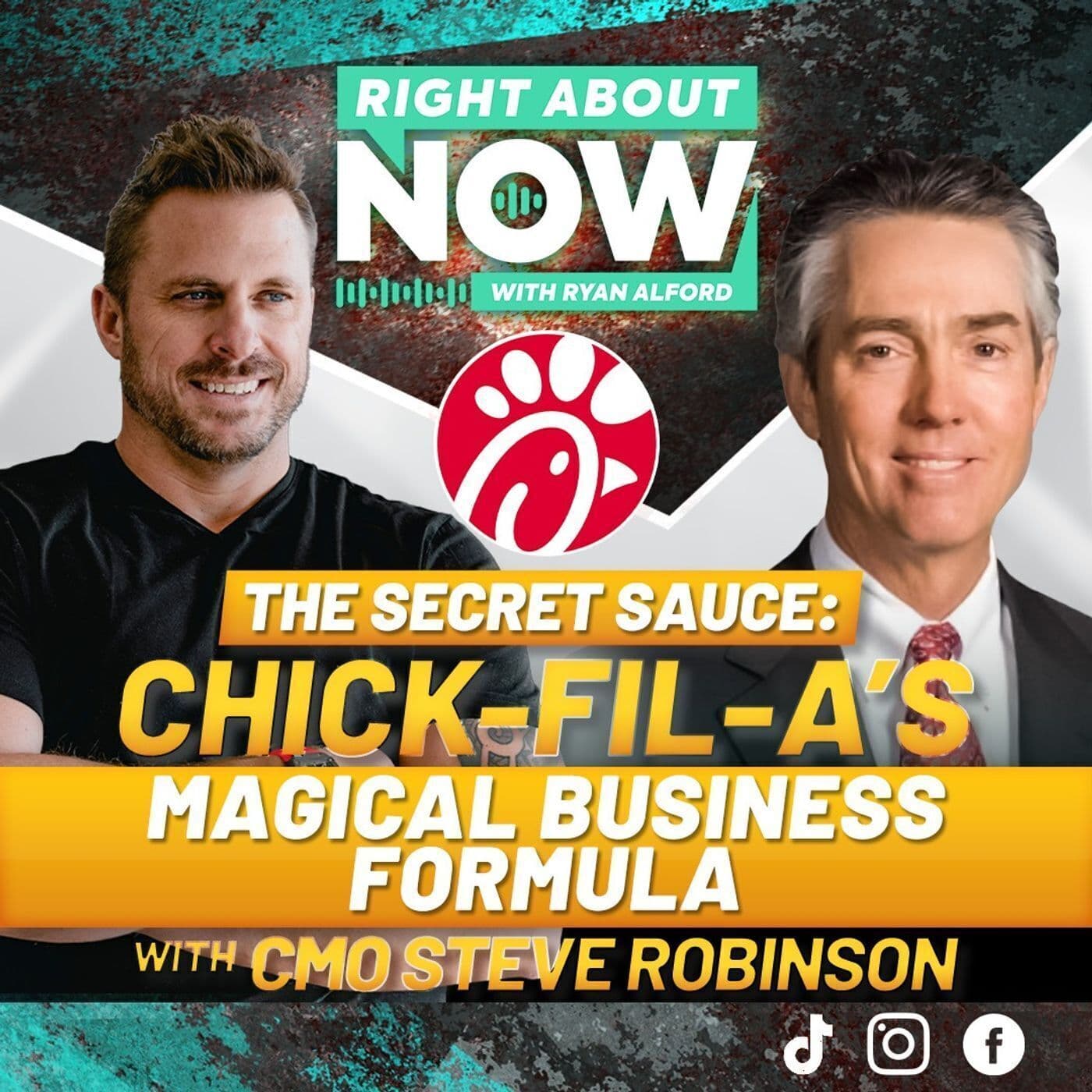
The Secret Sauce: Chick Fil A's Magical Business Formula with CMO Steve Robinson
Former Chick-fil-A CMO Steve Robinson on culture, the operator model, 'where good meets gracious,' and why competitors can't copy the playbook.
- Define culture in four parts: a clear purpose for why the business exists, non-negotiable values, an explicit brand promise, and the strategies that fulfill them.
- Chick-fil-A's purpose statement, written over two and a half days during the 1982 financial crisis, has never changed by a single word, which is what lets decisions be made close to the customer instead of pushed up the chain.
- Hire for who someone is before what they can do; Truett Cathy told Steve the company would only invite him in if they thought they could trust him and have fun together, and assumed he would never leave.
- Hospitality has to be institutionalized like a menu item: Chick-fil-A took roughly seven years to design, train, and measure 'my pleasure,' refilling drinks, and carrying large orders to cars.
- Recruit people who already have a natural bent toward hospitality, because they attract more people like themselves and it becomes contagious across a restaurant.
- The operator model is the flywheel: Chick-fil-A owns and equips the restaurant, the operator puts up $10,000 in earnest money, must actually run the business, and splits net pretax profit 50/50, with operators now averaging close to $700,000 a year.
- Competitors don't copy the model for two reasons Steve names bluntly: it's too generous and it's ingenious, and Chick-fil-A has never renegotiated the operator deal the way sales organizations reconfigure commissions.
- Invert the usual priority order: customer first, then operators, then staff, then owners, and use every channel including the app and social media to serve the brand promise rather than chase transactions.
Great brands only grow in great culture and great culture only happens when leaders define it and cultivate the soil.
but you need to understand the most important decision we make here is who we invite to join the organization.
And this performance oriented marketing is nothing more than code for a financial priority versus a customer priority.
This is the story of the one. As a custodial supervisor at a high school, he knows that during cold and flu season, germs spread fast. It's why he partners with Granger to stay fully stocked on the products and supplies he needs, from tissues to disinfectants to floor scrubbers, also that he can help students, staff and teachers stay healthy and focused. Call 1-800-Ranger, click Granger.com or just stop by. Granger, for the ones who get it done.
Great brands only grow in great culture and great culture only happens when leaders define it and cultivate the soil. This is right about now with Ryan Alfred, a Radcast Network production. We are the number one business show on the planet with over 1 million downloads a month. Taking the BS out of business for over six years and over 400 episodes. You ready to start snapping necks and caching checks? Well, it starts right about now. What's up guys, welcome to right about now. I'm Ryan Alfred, your host. And you know, we like to say we always try to be right and we're definitely right now. And you know, I grew up, I had this conversation with our current guest, just a moment ago, loving a certain brand.
I was being nostalgic thinking of an old mall that is now shuttered here in Greenville, South Carolina, where we do our episodes and was having room in missing on playing on the playground within this mall and having a certain food item that you in the US probably might be a little aware of. I'm really excited to have Steve Robinson. He's the former chief marketing officer and the author of covert cows and Chick-fil-A. Steve, what a pleasure to have you. Good to be here, Ryan. Thank you. Yes, I know. I was in that mall that you talked about, Dream Shopping in there. Yeah, I go because I started there in 1981. I know. Yeah. And I grew up eating the nuggets and the Chick-fil- the Chick-fil- the Chick-fil-N-Out,
and I'm pretty sure it still tastes the same. I don't know. It might have been the same. Small tweaks, but a little known in 1985 when I was going to Greenville mall. It was a pretty well-kept secret, except in the malls. That's right. But thanks to Steve, it became, what is one of the most iconic brands in US history? Yeah. It was great. It was a great trip. Yeah, I know you've done a lot and have enjoyed getting through parts of the book. Steve got booked. I want to be honest, I have read and listened to excerpts of this book, lots of which, and a lot of them found, you know, fundamental beliefs that I have in brands and things, but Steve has done a number here with this book.
I'm excited to talk about it. You know, it's so funny. I talk about when people go left, you need to go right and marketing sometimes. But sometimes it's just doing the right thing. Yeah. And when I think about Chick-fil- and what you've done, there's this moral thread through it, and then there's just the right way to get things done. And I think if I was simplifying, you know, the take, I was like, if we really simplified this, this is how business should be done. It is. Well, I went, I went to work for them in 1981. Prior to that, I was a director of marketing for Six Flags over Georgia, which back then was a hot brand, well-run business. It had a great, and real nostalgic Steve.
I think it's Six Flags and Chick-fil-A going up. There's a good vibe here. But I actually met them trying to convince them to build a restaurant inside the park as a way to build their brand and trial because back then, I was in the early in malls, and mostly just southeast from states. So the footprint of Six Flags kind of matched theirs. But I joined them in 1981 because their founder and their COO, Jimmy Collins, the founder was Truett Kathy. They both came to me and said, look, we don't have a marketing department. And your name keeps coming up on our search because we need one. Would you have an interest in talking to us? And Ryan, when Jimmy called me with that question, and in the back of my mind, I started laughing.
And I said, well, I know you don't have a marketing department. Or you would have done that deal with me two years earlier to put a restaurant in the park. Yes. But I already knew a lot about them because of that experience. And Six Flags and Gallantura transition, where they'd been bought by Penn Central and out of that bankruptcy that you may remember, they became part of Pinco. And suddenly, this very brand guest focus company was starting in my opinion to kind of drift a little bit of short term transactional focus. And so when I get that call from Jimmy, I said, you know, I'd love to talk to you. I figured I interviewed with Six Flags for a full day and had the job offer at the end of the day.
What the heck, three or four days maybe? If nothing else, I'll learn more about Six Flags and Jimmy and Drew and Kathy. Well, five and a half months later, I was still interviewing with them because that phone call came on August of 80 and they eventually invited me to join them. I think an important point, an important story that's part of that. It really demonstrates the culture underneath Chick-fil-A. Was I was sitting in Truist, Kathy's office, early December, still interviewing. I'm doing it stealth. I finally looked at him and said, Truit, what are you looking for in the idea of marketing candidate? Because this is starting to get a little cumbersome. Yeah. And he paused and he looked at me and says, I have absolutely no idea.
All I know is whatever it is, I don't want to do it. Okay. That caught me low off guard. Yeah, I would not have expected that. But then he paused and he said, but you need to understand the most important decision we make here is who we invite to join the organization. And we're only going to ask you to join us if we think we're going to have fun together that we can trust you. And I'm trusting you and others to figure out if you can do the job. Now, think about that answer. Most people, most organizations, it's all about competency. But he was telling me in a very quick answer, I'm more concerned about who you are. Yeah. Now, what I didn't know as their attitude was
if I come there, he's never going to leave. So we better be good with this decision. And you may say, well, that's just because they were interviewing you to be a director of marketing. The reality is they approached every selection that way. Staff and Chick-fil-A operator. The attitude being, if we invite this person to join us, we don't expect them to leave. And so we better make a good choice. We better do our homework. And so I get a lot of questions about why do people have such great people interactions in Chick-fil-A restaurants? It really goes back to that, that fundamental experience I had and that last interview with Truitt, you pick the right people. They're going to attract more of the kind that you want in the business.
And the Chick-fil-A operator deal, which we can talk about a little bit, is very unique. And if they pick the right operator for that restaurant, in turn, those operators pick the right talent for the restaurant. And guess they're four have a better experience. So I learned a lot about the culture, just in the process of that patient five and a half months of interviewing. And I never thought when I joined them, it would be a 35-year career, but it turned out pretty good. Yeah, dead. Talked with Steve Robinson, former Chief Barkies, Haustler, Chick-fil-A. Steve, I think a lot of people hear the culture word now and today and they like to... Ah, yeah, it matters. It matters. But I think you got to delete the butt.
It just matters, right? That's exactly right. It's like, especially, it matters probably in any business, but certainly the behemoth that Chick-fil-A was going to become or had the potential. I mean, your headroom might be in any business, it's okay, headroom, I think, of opportunity, right? Right. Where Chick-fil-A has gone and where you helped take it to, just the headroom would have never been there without that culture. That's correct. I talked about it in the book, Ryan. It wasn't until I was nearly into my career that I really began to put words to what I had experienced. Around the culture. And here's the sentence I have in there. Great brands only grow in great culture and great culture only happens when leaders define it and cultivate the soil.
And so it's in that well-defined and well-cultivated soil that great brands grow and thrive. And that's what truth, Kathy and Jimmy Collins are still focused on it. And so when people say, well, what's in culture? I think it can be very clear about culture. For us, we defined it in basically four key components. One was a very clear purpose. And why does the business exist? What do you mean by purpose? Why do you exist? Why does the business exist? And as an individual involved in the business, why do I exist in this business? So for Chick-fil-A in 1982, we had a major financial crisis. Their culture reflected the values of truth, Kathy, but nothing had ever been put in writing. And we went off as a leadership team for three days.
And even though we had major financial issues, it was interesting well within a day of the three-day meeting. We shifted finances and marketing into, okay, let's get clear about why we exist, because people need to understand how we're looking at this crisis. What are the filters? I won't bore you with the next two and a half days of what we did, but we worked on nothing but defining why Chick-fil-A exists. And we came out with one sentence to glorify God by being a faithful steward of all that is entrusted to us and have a positive influence on all the common contact with Chick-fil-A. Now, when you dissect that sentence, which took two and a half days to write, which, quite frankly, my opinion was a miracle.
There's basically three big ideas. True it wanted a business that would glorify God, not because it was a platform to preach, but by the very experience of interacting with the brain, have a positive influence on people who came in contact with business, whether they're within the business or as an outsider interacting with the business. But for him, it all hinged on great stewardship. He saw the business as a gift. Right up there, right behind his salvation experience with Christ, he saw that silly little sandwich and what it was becoming as a center of a brand, as a gift, and he wanted to steward well. And his philosophy in that meeting was very clear. If we steward it well, we'll likely survive if we don't steward it well, we won't.
So number one element of a culture of clear clarity around why you exist. Number two, what are the fundamental values that you're going to use to make decisions? For us, we can call them values, but I call them non-negotiables. One of the things you've got to fall on a sword over that gives clarity for leaders to make more decisions on their own rather than running up to their boss. So we came out with six very clear values. Stewardship, we're going to have fun, integrity, honesty, which we distinguished, excellence, and what was the sixth one? Great talent, great talent, known for great talent. So first principle in culture is why you exist. Secondly, what are the things you've got to fall on a sword over? Suddenly when you look at honoring God, stewardship,
and influence, and those six non-negotiables, it starts to become easier to decide how you're going to invest time and money, you see? Third big element was what does the brand stand for? So we literally design that around the question, what is our brand promise? There's a lot of customer research over decades. That one can evolve. When I left, the brand promise was where good meets gracious. The truthful experience is a lot more than just food. It's the interaction with every guest, personal eye contact, unexpected graciousness, and oh yeah, everything is good. Food, environment, et cetera. And then the final piece of your culture is, in fact, your strategies. What are you going to do to fulfill those first three? So I think going back to your question,
I think a lot of times culture is, yeah, that's important, but it's because leadership has not made the effort to define what their culture is. There should be no question about what an organization's culture is. But when you have, as you and I were discussing before we went on the air, if you have constant turnover in leadership, CEO, CEO, CEO, CMO, very difficult to, number one, define those key components of culture and then live about long term. Because turnover comes, well, I want to put my fingerprint on the business and I want the culture to reflect me. The beauty of working for Chick-fil-A was it was privately owned. It's still privately owned. That corporate purpose statement has not changed, not one word of it. Those six priority non-negotiables have not changed.
And what that in turn drives is the ability to empower a very large organization to make more and more decisions closer to the guests, closer to the customer and not having to constantly go vertical with decision-making. Because everybody understands, okay, I'm about to make a major decision for the business. In some form, then matter what's food, marketing, strategy, or technology, whatever, is it going to complement those values and that purpose, that brand promise or not? And in fact, my last three years there, the entire business plan, strategic plan, was built around where good meets gracious. Every major initiative in the business was evaluated on whether it would help fulfill that promise. So that's how you create, you know, across three, four, five thousand restaurants are between three and four thousand now.
That's how you create continuity of the brand experience and the cultural experience, the people experience. A lot to unpack there, Steve. That's why I wrote the book. I wanted to say number one, the full playbook for how to create a magical brand is in covert cows, covert cows and chick flake. But what Steve just did might be the most impactful six minutes of how to build a company the right way from the bottom to the top. And we're going to make that a YouTube alone clip right there. Literally, because I'm just telling you that is magic and just hearing you talk and knowing. But you know what, I was doing two things. I understand it took me 35 years to see that evolve. I know, but that's why you're here, Steve, because you have that knowledge and others don't.
But what, you know, I want to make a couple points. Number one, as you were talking, I was thinking about chick flake experience. And short of maybe like one out of about a thousand visits I've ever made to chick flake. So 99.9% of the time it may be the cash register was having a bad day. And then I pretty much got that. I was just thinking every experience of ladders back up to what you just described. We're good, makes great. We're good, makes gracious. Right. Every, every, I mean, every experience. And so that's the proof in the pudding right there. Well, the underlying, the underlying message in terms of corporate communications and training all the way to every team member is. What does, what does that mean?
Everything about the brain should be good. Ingredients, food, environment, service, cleanliness. We're good meets. I meet you. I connect with you. We actually showed dignity and respect by saying hello. We're glad you're here. Yeah. You say thank you. We see my pleasure. Okay. We're good meets gracious. You actually experience grace. You experience experience hospitality. You experience what the word restaurant actually means. It means a place of rest. And the first word means where, wherever you interact with the brand. Not only in the restaurant, but in the drive through or at an event or even in your interaction with the Chick-fil-A app. And the options you have to choose that best serve you. You get to choose where you want to interact with Chick-fil-A, but wherever that is, that's the experience we want you to have.
You're met. It's good. And it has a flavor of gracious hospitality. Yes. And it does. That's why everybody says, you know, no way does it like to play. So what does that mean? Why did we pursue that? Because my first 10 or 15 years of Chick-fil-A was all focused on the food experience. Yeah. And we got pretty good at that. I mean, we even applied principles from companies like Lexus zero defects that were really perfect. A consistent food restaurant experience. Part of the transition to the brand was, okay, how do we go beyond being maybe the best of a bad lot. The fast food category. Yeah. And become something that no one else in the fast food category can be. And a lot of that was driven by true Kathy when he hadn't experienced it.
It's called them around the whole issue of my pleasure. He brought it back to us. And he just kept pressuring us and pressuring us and pressures. How do we instill a my pleasure experience into the restaurants? At the time we had about 50,000 team members. They now have over 200,000. That's a big challenge. It meant we had to institutionalize hospitality, just like we'd institutionalize the menu experience. And that challenge was harder than the menu. Yeah, I'm sure. Yeah. Because I unpacked how we did it in the book. And hospitality, it's an interesting word. Yeah. Because if you're listening right now, you're like me going hospitality and fast food. It sounds like an oxymoron. It does. Yeah. But if anyone has gotten there, it's tick-fl-a. You know, because you do feel like, you know what?
I'll be darn Steve. I feel like those cashews should mean it when they say with pleasure. They're doing it. I know. Yeah. Because sometimes I'm cynical by nature. Probably makes me a good marketer and like all that. But like it's curiosity and like, you know. But I'll be darn, man. I mean, I'll be the fast. I'm like, she's probably had a rough day. And she just said, that's my pleasure. And I think she meant it. Right. I'm like, how did she mean that? Yeah. And I think she meant it. Well, he meant it. Part of what we discovered. And we we've missed a lot of other brand retail brand experiences that consistently delivered great service and great hospitality. Including high in restaurants like Danny Meyer restaurants in New York.
Ritz Carlin hotels, et cetera. But part of what we discovered is if you want to deliver hospitality, you need to bring people into the business that actually have that gift. I mean, that's actually a gift that's identified in the Bible among the gifts of the spirit. And when you bring in someone that has natural bent of hospitality, what happens? They track more people just like them. And even if the restaurant operator doesn't have that gift, they can still attract leaders and team members that do. Yeah. And it becomes contagious. And that's what true it initially experienced in the Ritz Carlin was that the contagious effect of saying my pleasure and every interaction with their guests. That's what he wanted in our business took a seven years to figure out how to institutionalize it, design it, train it, and then measure it.
I mean, we're going to have two pickles and every sandwich. We measure that. How do you measure my pleasure? How do you measure refreshing every drink? How do you measure carrying out large orders to the car without being asked, et cetera, et cetera. We had to figure all that out. This show is sponsored by BetterHelp. We talk about social media a lot on this show. And the reality is it can be really detrimental to your mindset. We compare ourselves to others when we don't really know what's happening behind the scenes. We see all the best stuff and comparison can really be the thief of joy. I've seen it firsthand. I've felt it myself and we really need to think about social media is not always being reality.
That's why I really want to talk about why therapy can help you focus on what you want instead of what others have. This will really lead to you living your best life. I've had friends and family members that I have watched firsthand benefit from therapy. It's been life changing. Really the changes that you can see when you work one-on-one with someone that is qualified to really help you dig underneath some of those challenges. If you're thinking of starting therapy, give BetterHelp a try. It's entirely online. It's designed to be convenient, flexible, and suited to your schedule. All you have to do is still out of brief questionnaire. You get matched with a licensed therapist and you can switch therapists anytime. Stop comparing and start focusing with BetterHelp.
Visit BetterHelp.com. Slash right about now. You'll get 10% off your first month. That's BetterHelpHELP.com. Slash right about now. Talking with Steve Robinson, former chief marketing officer at Chick-fil-A. Steve, you said something earlier that I want to go down a road, transactional versus building brand. In today's world, performance marketing has become the term of the century. It's probably the last 10 years, especially with digital and everything else. You know this. I don't have to tell you this. You are a rare breed being in a company for as long as you are, especially as a CMO. Knowing the short leash that all employees and leadership seem to get. The demand for sales today right now, dammit. What's your perspective? How do you build brand today? Why have we gotten so short termism?
It's a disease. Next 90 days. What I joined Chick-fil-A, they were actually operating in that paradigm. They thought fast food. We are fast food, so we must have to market like fast food. And they were doing that. They were doing coupons and discounts and price features. They were only in malls where the mall was a building medium, in a sense. Didn't really need to be doing it, but they were doing it. I grabbed a trip right into it too when I got there. I think I mentioned it. I was actually involved in a promotion in 1982 that was focused on deals. It blew up. It was too successful. Financially it hurt us. And that actually became a catalyst for me and my team. And my team then was maybe six of us just sitting and saying, we don't need to market Chick-fil-A like this.
This is crazy. We got to figure out another way. We work for a guy who has no intentions of selling the business. Why are we chasing short term transactions with deals? And operators were hooked on it like drugs. You know, they're running coupons and stuff like that. So all that to say, that's what I started in. A crisis made us step back and say, we don't want to be like that. So what I am packing that book is a 30 plus year journey of being a brand focused on the experience. The value building an emotional relationship with the customer. That's what drove the development of the cow campaign was the emotional connections. How do we focus on emotional connections in every interaction? The food, the service, the drive-through, the advertising, events.
And we're well into that journey. My last 10 years a book comes out called Blue Ocean Strategy. I read that book. This sounds like we're trying, this is what we're trying to do. And it actually added some really good third party credibility to take to not only staff, but all the operators say, look, this is this is not only will work. It is working. We need to put the pedal to the metal. And that added catalyst to developing the second mile service strategy that really took the brand to another level. It added credibility to why we use cows instead of showing food and price. Because we are building emotional engagement that people liked and remembered and people don't remember pictures and price points. So that's a bit of a long answer, but it all was possible because we had private ownership that was focused on the long term.
Truth Kathy was not focused on how much money am I going to make. He was focused on having a healthy business, a healthy balance sheet, a long term, healthy brand that he could pass on to the next generation of not only his family, but Chick-fil-A operators. And what I joined Chick-fil-A, I think average, average store volume was probably around 400 to $500,000 in a mile. The last year the average store volume for Chick-fil-A was nine million. And we can talk about it, but one of the major catalysts in the other reason we were able to do that is because of the operator model. You want to answer? You want me to unpack that? Because I want you to answer this, Steve. I'm going to touch heat up. Why the heck hasn't anyway?
Everyone knows Chick-fil-A is the king, the icon amongst a lot of, yeah, I didn't want to call him B players, deep, not fast food. Yeah, other category brands, right? And other category brands. And you give away the playbook. We share. You share. You know, like, you don't give away your best people, but you give away the playbook because in the book is right here. But Burger King hadn't done a McDonald's hasn't done it. Hardies. I mean, the list goes on and on. Why? Okay. Well, one, I just touched on the first one. You have long term focused ownership. Well, that's a big hurdle, right? That is. That's a big starting point. Number two, you have a culture that is focused on more than just profits.
And I already unpacked some of that. It is, but yet it's the most profitable one. I just have to call these ironies for you. If you're not paying attention, the punchline and all of this is, they're not chasing it. But they're delivering it. And it really reflects, which I talked about in the book, true its favorite Bible verse, which is problems 221, a great name is to be more value than silver and gold. Okay. So at principle being, you take care of your name, you take care of your reputation. And in his case, one that glorifies God. And in faith, you're trusting God that he'll provide, okay, well, that's obviously happened. So long term ownership. An environment where culture is clear, people are empowered. They can make decisions.
They know the box top of what decisions are appropriate. Okay. But then you got to have an organizational structure that him, that him empowers that. As Colin said, makes that flywheel. Those first that flywheel work. Chick-fil-A is the operator model. It's the leadership model of every restaurant. Here's the top line. Chick-fil-A owns every restaurant. They find the site. They build the restaurant, doesn't matter what kind of location it is. They equip it. They even put the first inventory in the restaurant. They go out and find recruit and train an independent contractor. They call them an operator. They're protected by franchise laws, but they're not equity investors. They put up $10,000 earners' money for the deal. But their commitment is they must actually run that business.
They're not a passive investor. Like many franchise operators are. Their income from the restaurant is based upon half net pretext operating profits. They have to pay for all the expenses, including the team members, the talent, the team members work for the operator, not for Chick-fil-A. They're part of their rent, goes against, comes back to Chick-fil-A, all sent the investment Chick-fil-A is made in that site. And there's usually a cap to how high that rent can go. Okay. So they're paying a percentage off the top. They're paying rent. After all their expenses, pretext profits are split 50-50. So for Chick-fil-A operator, every incremental customer, every incremental sales dollar, every incremental there for net pretext dollar, half of its mine. So what happens? You have a leader in every restaurant.
A Chick-fil-A that's highly vested in the success of that individual location. And as a result, they attract better people. They train them. They keep them longer. They empower them. I mean, the average Chick-fil-A operator now has probably got seven to ten full-time salary leaders in their business. And they're focusing, growing a healthy, profitable, managed the P&L bottom line. And our job at the home office was to do what the operator could not do for themselves. What is that? Create and manage the brand, everything that makes up the brand, every guest interaction with the brand. Generating demand. Creating demand, creating value through the brand. And then obviously building infrastructure, the stores, supply chain, accounting services, IT support, building infrastructure to support them. Jimmy Collins, who was a former CEO, used to tell staff, home office staff all the time.
If you're not supporting somebody who's selling chicken, supporting the Chick-fil-A brand, then you're not doing your job. We don't sell any cash registers at the home office. And it's very true. But that again, that's that cultural focus of the most important people in the business. Starts with a customer. And the second group is the Chick-fil-A operator family. The next group is the staff. The last group is the owners. Many organizations have the other way. They're all about ownership, return on investment, return on my real estate investment, building my real estate portfolio. None of that was important to truth. I know it was important, but that wasn't true at Kathy's priority. His priority was the guest experience, how am I going to give a great guest experience?
I'm going to recreate myself in every restaurant. We call them Chick-fil-A operators. I'm going to have them highly incentivized to make decisions, take care of the customer every day, all the time. And then I'm going to build staff to support them. And as a result, my family and I will probably be okay. Well, they're doing quite fine. Well, they're doing quite fine. They're doing quite well. Probably one of the most valuable ones in the world. The priority that I describe, and I talk about in the book, but the priority I just described is inverted in many organizations. Yes, it is. They're focused on owners. They're focused on operational priorities, conveniences, systems. Customers might be the third audience, the constituent that they really pay attention to.
But they're making decisions in a completely different priority of what, how Chick-fil-A was organized. And it's basically built around those three big buckets, long-term ownership, clear culture, and leadership's focused on managing it, and an operating model that creates, that makes that whole system run, and that operating model is operated, Chick-fil-A operator focused. Are these other entities just to intertwine now to go that direction? No, I think the right organization could do it. If you had a board of trustees, even if they're public, if you had a board of trustees that were willing and empowered leadership to take a long term, we went a long-term healthy brand. Yeah. We're going to pull back a little bit on this, this bean counter focus on every 90 days,
what's happened. And this performance oriented marketing is nothing more than code for a financial priority versus a customer priority. It is. Exactly right. And I think it's one of the most unhealthy things that have crept into the business acumen in America. Yeah. But you got to have, you got to have a board, you got to, that's willing to empower others. A private board or a public board, that's willing to empower leadership to take a long-term focus. We're going to focus on the customer, we're going to focus on a long-term healthy brand that people fall in love with. I don't care if it's fast food or car or shoes, the principles are the same. So it can be done, but it's got to start it literally.
It's, it sounds like a cliche, but it has to start at the top. Now, specific to Chick-fil-A, I think the reason you haven't seen many people in our category or other retail categories pursue it, it's two basic reasons. It's incredibly generous. The average Chick-fil-A operator now is making pushing $700,000 a year. You think of McDonald's store managers making that kind of money? No. Now, you got, you got some franchise owner who's got multiple stores and a real estate portfolio who's probably doing okay, but he's not focused on the, he's not focused on the restaurant experience. No. The Chick-fil-A operator is. Yeah. So, number one is they would have completely restructure their operational priority to the, to lead in the restaurant and that one of the hang-ups there is, well, the Chick-fil-A model is too generous.
But the other part is, which I've already described, is the Chick-fil-A model. I think it's pretty ingenious. The operator model has never changed, not, it hasn't changed. One I owe to. And the reason I haven't changed is true it. And Jimmy, one of the operators will be able to trust Chick-fil-A that they're not going to change the deal. Now, how many sales organizations, sales, salespeople start making too much money and they, they've, they've fangled out, they've reconfigured the commission structure. Yeah. Chick-fil-A operator deals never change. Half net profit, being, that's it. So when I've heard it cost a million dollars to, or two million to owner friend, a Chick-fil-A, is that even I care it? No, no. I mean, the Chick-fil-A operator, their cash investment is $10,000.
Yeah. How are you getting in line for that? Yeah. It's a long line. They have about 10,000 applicants a year. Wow. And they're selected anywhere from 150 to 200 operators a year. So it's a long line and it's a long wait. And they're more focused on the same things that, when they interviewed me, they're more focused on the, the character of that person, their ability to attract and keep great talent. Their ability to really run, run a large enterprise. I mean, the average Chick-fil-A restaurant's employing about 120 to 150 team members now. And the ability of someone who can do the hard work of running that kind of business, 24 six, 24 hours, six days a week. And it's hard, it's hard work to run a Chick-fil-A restaurant.
You know, it's thinking of the six. I mean, you know, I, I mean, I know, I grew up in the South, Southern bad, this raised. I know, you know, they have rest. Yeah. But as a business, I mean, how much blowback and discussion has there been of, I mean, not because it's internally Chick-fil-A didn't care. Not internally. They could care less, right? I mean, the proof's been putting and it's a moral thing, but the people talk about it because it's unique to the brand. Yeah. What's your perspective? There are several pieces to it. We could say they don't make jokes about it, but I'll tell you the factual side of it. True it opened his first restaurant in 1946. It was a little diner in the South Side of Atlanta called the Dwarf Grill.
And it's because it was small. I mean, it had four booths and I think ten stools. So we called it the name. Yeah. Yeah. Yeah. He and his brother opened it. They thought that we were going to be open 24, seven. Yeah. Last week they get to Saturday night, it's late. They literally said, you know what? We're not going to open tomorrow. We're not going to. And true it was, it was highly, highly motivated by true it. He said, I'm not going to ask people to do what I'm not willing to do. I do not want to work on something. I want to be rest. I want to be able to go to church with my family, but I don't want to be out of the restaurant.
So he made the decision. They made the decision in that first little diner, we're not going to open on Sunday. And his attitude was, if I can't be successful in six days, I'm in the wrong business. So I'm not going to open on Sunday no matter what happens to Chick-fil-A. Any blowback is primarily from the outside, you know, retail developers, strip center developers that want the traffic, they want the business on Sunday. And for the, in the early years of the brand, it was a real challenge because some mall developers simply said, no, you're going to open on Sunday and we're not going to come in and Chick-fil-A say, okay, we're not going to come. But then as they built, they got stores open, they built a track record.
Their average sales per square foot beat everybody else in the mall. And the word got around pretty quick. They're going to pay you, they're not only going to pay their rent, they're going to pay your rent overage. And so six day a week is just fine. I mean, now we have stores on university campuses, airports, stadiums, and they're all closed on Sunday. That's part of the deal. That's Chick-fil-A is. And I think Trent would, he would joke, he would often say, I don't want customers to think that we don't love them, we do love them. But I actually want competitors to be able to have one day when we're not competing with them. Oh, man, you know, the competition is going to be appreciated. The competition is good, it also helps keep us sharp, but we want the competition,
we want them to survive too. That's the greatest javvy he could do. You know, he would also observe, and he's right, that it helps operators select and keep good people, because everybody knows they've got to day off. Yeah. And I've got to be asked to come in on Sunday. You think that ever changes? No. No, as long as the business retains stays in the Kathy family, it won't change. Now with that change. I mean, what's the business worth? I don't have any. How many? Billions. I'm sure. Yeah. These are lineage that where you never, they're into the third and fourth generation of family now who are involved in the business. Some of them running stores, some of them are on staff. They love the business.
It's all they know. It's their platform for ministry. It generates incredible cash that they use to support things that they love. Ministries they care about. Yeah. They don't want to walk away from that. So no, I don't, I don't see it ever. And if it ever did go public, anybody who bought it would want to open on Sunday and they want to, they want to, you know, ramp, ramp that operator deal down. And probably in three or four years, the brand would lose an issue, yeah, be over. Because you'd be unwinding some of the things I've already described that really make that thing hum. Yeah. I boil it down to two issues. It's too generous and it's ingenious. And a part of the being ingenious is that they've not changed anything that's crucial
in the business. And that things like Sunday, the operator agreement, the Chick-fil-A recipe, the commitment to every restaurant is a restaurant. They're making food in those restaurants. They got, they got big kitchens that actually produce food fresh. I mean, there's fundamental principles that have not changed. And I think as long as they, you know, stay true to those that the brand can just continue to grow. Talking with Steve Robinson, he's the fourth former chief marketing officer, Chick-fil-A and the author of covert cows and Chick-fil-A. Steve, want to pivot a little bit to, you know, your perspective, marketing, branding, at a more global level and like, you know, we've talked pretty episode. You got, you know, you're having this extended tenure for one company, you saw these things
that rise in the change of marketing, traditional TV, radio, out of home, social media comes into play. Digital marketing comes into play and even up until your final day, I mean, it was a transition. What's your perspective on how the mediums, you know, obviously that we've been talking very tactical strategy, which is, hey, the most important part, but the tactics, you know, the social media aspect, the digital aspect, was sort of just your overall perspective of how it's changed and how many different channels there are and how you can't just run a TV ad anymore. Right. Because not everyone's watching TV, but just general perspective on the landscape of marketing and media. I have two or three, I would say principles that during that transition, my team and I
adopted part of the blue ocean strategies is fundamentally, fundamentally being willing to step back and say, okay, every brand interaction, no matter what that touch point is for us, how do we use it to deliver where good meets gracious? Okay. Well, that automatically means we're not focused on using every interaction to drive transactions. Yeah. Right. We want to figure out how to make how to make the brand more meaningful. We're good meets gracious in that interaction. So how are you going to use not only traditional media, I mean, we started with billboards and TV with the cows, the bill of emotional connections. How do you take the cows into those other platforms? How do you use those platforms to tell stories that reflect where good meets gracious?
Not what is the latest product and price point at Chick-fil-A this week? How do you use technology to make the guest experience still more convenient while also still being personal? So we were working on the Chick-fil-A app long before I left and it has continued to evolve. But some of the guiding principles going in is we want the Chick-fil-A app to make the guest experience convenient. But we do not want it to pull them away from our people, our team members. We want it to make it a better experience with our team members. So okay, what are we going to do in the drive-through? Where we're going to get rid of, we got all this technology. We're going to get rid of this little metal speaker boxes.
Thank the Lord. Okay. So we got to put it into place where we're going to let them use the app to pre-order. When they show up, we're going to have people standing outside. How's that? We're not a box. Real people. They're going to have, in their hands, an iPad that's interfacing with registers on the Chick-fil-A computer system in the back through high powered Wi-Fi, okay, we're using all this stuff. And when that customer comes in, if they pre-order, we already know that, by the way, the app will give us a GPS alert that they've hit the property. So it'll verify they're on the property, their order is ready, and they have the option they can go to the drive-through and pick it up or they can go to the curb and we'll bring
it to the car. Those are just illustrations. So when I left Chick-fil-A drive-through was roughly a third of their business, it's over 60% now. Wow. Heavily influenced by the app. But every one of those transactions still has a human contact. Yes, it does. So my point is, doesn't matter what those evolution is with media and technology and digital, you've got to make a decision about what do you want the brand experience to be and how you use those. And we have a high value on the team members and the restaurants. So part of the social media, for example, the evolution, we're going to use social media principally to tell stories about guest experiences and the restaurants. And we're not going to tell the stories from the home office.
We're going to let the operators, the team members, and the customers tell the stories. But we're going to create the platform on Facebook and Twitter and other platforms where it's easy for them to do it. But my preference was that the stories be genuine and from as close to the customers possible because I didn't want them to come off as narcissistic. Yeah. And I think when stories start coming out of the home office, that's the risk you want. cows coming on home office is okay, we're just making people laugh. But guest experience stories, I think need to be, need to be generated as close to that customer and that store as possible. So that's, that's an example of how we chose to use social media.
So but it goes back to what do you want your brand to be? What do you want the guest experience to be with the brand? And then you translate it into those, the various platforms. I led the witness a little bit here. So I'm going to just admit something to our audience. I didn't know for sure, but I knew Steve was going to go there. The tactics don't matter. The strategy and the brand and carrying it through wherever you're doing it is what matters. And that's where you went. And there might even be certain platforms out there that don't fit your brand. You got to make a decision. We're not going to use it. Yeah. We don't want to be there. That's right. And we're not going to carry on dialogue on platforms that put the brand at risk.
Yeah. So for example, we, we, we had a clear policy. We're not going to discuss social and political issues on the platform, whether it's the store level or the corporate level. Yeah. Um, that's an interesting one there, Steve. I want you to go down that road because everyone's gotten into this. Okay. We're a purpose based brand. And look, I mean, you could argue and a lot of things we thought about this. Well, Chick-fil-A kind of is, but it is, but it's not, you know, like it's purpose. It has, it has clear purpose, but it's an inward, it's sort of an inward belief in purpose and not this cause or that cause or getting on this soapbox or that soapbox. Chick-fil-A, remember, I told you the purpose core values, the brand promise.
Yeah. I mean, it's gracious. That's all about us personally delivering a guest experience that quite frankly in the fast food category is unexpected. Okay. Yes. It's a, it's a blue ocean, clearly a blue ocean strategy. Well, you don't want to say anything that, that all of a sudden create some sort of emotional barrier that gets in the way of that promise. Because you pick a social or political topic, no matter which one you pick, half of them agree, then half of them don't. Yeah. Especially today. So don't put the brand in that position. And for us, don't put, you know, don't put over 2000 Chick-fil-A operators in that position where they have to start dealing with that instead of focusing on the guest experience. Yeah.
It becomes a fine line though with faith and, you know, glory to God and, you know, the very clear things that that entails with choices. Well, the truth was very clear, I don't want to use the business, I'm not going to put scripture on packaging and I don't want to use the business to quote evangelize. I want people to notice something unique and difference about Chick-fil-A and if they want to ask us why, we'll answer their question. Yeah. We'll tell them what we see as the purpose of the business. Yeah. We'll tell them what motivated Church Catholic to get up every morning, go to work. Yeah. We don't mind talking about that. Yeah. I mean, he saw the business as a gift. He wanted to steward it well.
The most important book he ever read was the Bible and he tried to live what he understood, you know? There's no problem with that. No. But we try to earn the right to answer somebody's question. Yeah. Not lead with what do we think? Yeah. Good gracious. And now that might change, that's the operator, that's the environment which I got to operate. Yeah. It's a slippery slope though, the whole purpose driven, you know, like and take a stand. Yeah. You know, I don't want to go, I don't want to go real deep with you, but when you, when you look at the life of Christ, he never did any of that. He washed people's feet. Yeah. You know, he healed people. He fed thousands. Um, he, he always earned the right to be heard under, have a relationship with somebody.
Um, it's, it's really, it's really, it's really, it's really, it's really, it's really a service, a servant, it's a servant attitude that's rooted in biblical principles at Chipotle, which I happen to agree with, obviously, it's one of the reason, one of the many reasons I stayed 35 years. And um, you know, God says, God says in Proverbs, my, my word will not return void. If you apply my word, it will not return void. Now you may not know how it's going to return, right? But if you apply my word, I will honor it. And I truly believe that, I believe that, um, so when that happens, people kind of scratch your head and say, what's, what's different about this business? Yeah. And if they ask and you get a chance to tell them, and I think a lot of the, uh, purpose
base take a stand becomes about the person in the company, like saying it, like, for the attention of it versus the right reasons, you know, they actually, the actual belief that they have sometimes, well, understand that, and I think you can see that everything I've described, you, you're dealing with a company that is customer first focused. Yes. I mean, I, I described that for you, customers first, then the operators and the home office and then ownership. Well, if you have a customer first or focused organization, in a, in a biblical context, we've got us, we want to serve every customer well. Yeah. And in a marketing perspective, a brand perspective, and we want to do it so well, we earn brand loyalty.
Well, you can't be out here advocating political or, or social agendas and do that. No, it really is that simple, but if you have leadership at the top, it suddenly think, Oh, we're going to, we're going to, we think we can change the world about something we say.
I think we've seen many case studies where that's proven to be wrong. We could sit here and, we could sit here and name some up. Yes. As we wind down, Steve, uh, what are you up to today? Well, obviously I still love to talk about the book and the Chick-fil-A story. Uh, I do some, uh, I do some consulting, but not much. And I, and I only, I don't work, by the way, I don't work with public companies. I find that way too frustrating and challenging. Yeah. I work with mostly privately owned companies. Yeah, I was put in Diane and, and I'm husband to Diane, I have two grown children. I have four grandchildren. Uh, I still do some speaking, but, uh, yeah, right now my life is mostly focused on my
sweet wife, Jean. I've been married 52 years next week. Diane's here in the studio. She was in the studio. She stepped out, but, uh, here was Steve, uh, man, what a legacy of marriage. And, uh, I love that. Well, and we love spending time with our children and their kids. So, yeah, yeah, it's, uh, I'm very thankful. Yeah, it land as home. It was, we just sold our house a last, last year. Oh, and, uh, so now we live, uh, about half the year in Highlands, North Carolina, and the other half in south with Florida and kids come see us or we'll get on our plane and go see them. Yes. Highlands is lovely. We love it. Yeah, it's a beautiful place. And it's, it's not that far from the land.
So we can drop down and visit family. What do you want your legacy to be, Steve? Uh, people ask me that question and, uh, I know that makes you think, well, the opposite of what everything we've discussed, which is like sort of this outward, you know, verse, I'm actually walled down to very simple. Um, he loved Christ. He loved his family and it showed that simple. That is simple. Yeah. And, uh, those are my priorities. If someone was listening, starting a business, young entrepreneur, uh, we've given them, and this book gives them a lot of principles. What, what's the, uh, one or two things you'd say to them? Well, I, I think it would be things I've already touched on. I would, number one, I would be very clear on why you think your business exists.
And when I consult and I have three or four active clients now, that leads to you as the owner need to be very clear on why you just, what is your, what is your purpose, personal purpose? Um, and does your personal purpose line up with what you're trying to do with this business? The second main question is, does that purpose, in fact, motivate team members? You're going to leaders. You're going to attract to want to get up in the morning, come work with you. Are you going to be the kind of leader with a purpose that will create fellowship?
Um, the second thing I would tell them is, are you going to be focused on making money? Are you going to be focused on serving others? My experience is if you serve others well, money will likely follow. You'll, you'll be okay. Um, I, I just, I think our culture right now is entirely too self focused as opposed to others focused. Chick-fil-A is another, others focused business. I mean, I'm not bragging on it, but it is. Um, and I, I think what made America strong was more other focus than me focus.
So that's what I would, that's what I talk about with young entrepreneurs. You got to decide am I going to have another, what's my purpose and am I going to have another, others focused business or is it all about me? If it's all about me, you probably don't want to work with me as a consultant because that has no appeal to me. If you're trying to run for office.
Oh my goodness, in this environment, can you imagine that? Oh, um, I think it might be refreshing, you know, and it might be the Chick-fil-A way to the office. Well, you're, you're very kind. We really appreciate Steve Robinson for coming on and look, go get the book, cover cows, and Chick-fil-A right here. We've got it. He's going to sign up before he leaves, and you're going to see this on all of our show notes. Everything we have, we have links to the book, links to Steve's profiles, and Steve, I really appreciate you coming. Well, Rhino was honored to ask. It was great. It was great to drive in the greenful and spend time with you. Yes, yeah. You know to find us, Ryan is right.com.
We have people like Steve on the show that make us number one. We'll see you next time on Right About Now. This has been right about now with Ryan Alford, a Radcast Network production. Visit RyanisRight.com for full audio and video versions of the show, or to inquire about sponsorship opportunities. Thanks for listening.
Hiring Is a Marketing Problem: Nicole Feenstra
Nicole Feenstra of The DNA Agency tells Ryan Alford why job descriptions fail, how to market the trades, and how geofencing and storytelling win

Jason Brown on Options Trading, Risk and Rebuilding
Jason Brown turned a $10K student loan into six figures, lost $250K on one trade, and rebuilt. He shares his options, risk and wealth roadmap with Ryan
Earned Media and AI Search with Brett Farmiloe
Featured.com CEO Brett Farmiloe joins Ryan Alford on earned media, digital PR, AI search visibility, and the relaunch of Help a Reporter Out.