
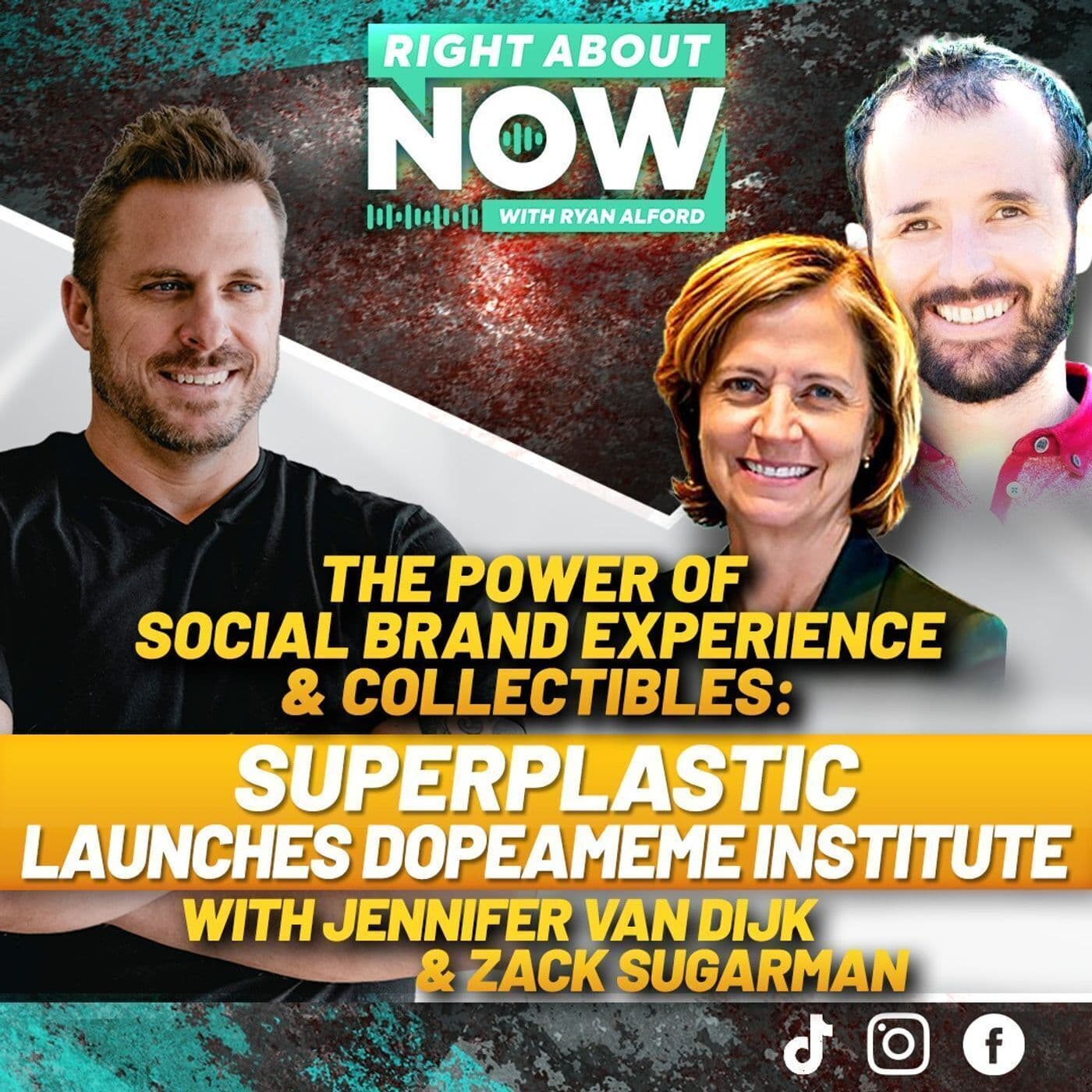
The Power of Social Brand Experience & Collectibles: Superplastic Launches Dopeameme Institute
Superplastic's Jennifer Van Dijk and Zach Sugarman on character-driven IP, staged toy drops, collector psychology and the new Dopeameme Institute in Vegas.
- Build one 3D character rig and reuse it across Maya content, Unreal Engine, Fortnite and AI-assisted output so a single idea can be amortized across every channel.
- Superplastic grew to 22 million social followers with characters who never spoke a word; voice was only added later for the Amazon TV show and experiential product, and it raises the bar because now the writing has to be funny.
- Treat a mass audience as overlapping segments — gaming, art, fashion, music, adult comedy, anime — then choose which angle you speak with rather than trying to be everything to everyone.
- Collector growth is not concentric; the whales and core collectors pull the fringe audience inward, so satisfying the smallest, most avid group is what expands reach.
- Stage a product drop in scarcity tiers — an extremely limited run, a mid tier, then a larger one — so buyers who miss the first still have a shot and the hype compounds.
- Seed collectibles with credible community figures instead of buying reach: the Ganga drop went to LeBron James, Anthony Davis, Carlos Alcaraz and Vinicius Jr., generating photo content that reached new audiences.
- Time drops to where the community already is — Art Basel Miami for a mural artist, LA game weekends for a tattoo artist working with pro athletes.
- Accept toys as a brand investment, not a revenue engine; Jennifer's stated ambition is for toys to become Superplastic's smallest revenue channel.
- Brand partnerships work better as co-created IP than logo placement: the Mercedes collab produced a new character, a wood figure, a capsule collection, a New York event and content, and became Mercedes' best performing campaign for people under 35 that year.
- Physical retail can double as an acquisition channel — Area 15 draws about 3 million visitors a year, so most people entering the Dopeameme Institute are brand new to Superplastic.
personally, I would love it if Toys was our smallest revenue channel because it would mean we've succeeded as a brand to be able to, you know, make the core collector happy with the best stuff, but also make a business out of the other revenue that we have in our, you know, in our platform.
this is a game of chess with a lot of players playing checkers.
So it doesn't work where it's like a concentric circle outward. It works where the whales or your biggest collectors, you know, bring in kind of the fringe.
Personally, I would love to, if Toys was our smallest revenue channel, because it would mean we've succeeded as a brand to be able to, you know, make the core collector happy with the best stuff, but also make a business out of the other revenue that we have in our platform. This is right about now with Ryan Allford, a Radcast Network production. We are the number one business show on the planet with over 1 million downloads a month. Taking the BS out of business for over six years and over 400 episodes. You ready to start snapping necks and cash and checks? Well, it starts right about now. What's up guys? Welcome to right about now. We're always getting right. We're always fucking now. So what's happening?
We got Jennifer Van Dyke, Zach Sugarman. We're from Super Plastic. It's a badass media company and we're going to talk about storytelling, the future retail, and just, hey, you're in for a surprise today. What's up guys? Welcome. Hey. What's cooking? So much. So much cooking. We are cooking with Chris go right now, just lots of new location in Vegas. Yeah, it's cooking. Yeah, man. You guys got your hands in a lot and anybody named Super Plastic gets my attention. Look out. Yeah. I gotta start there. Where did the, where did they come from? I wish we had a better story for it. It was really quite a random combination that our founder Paul Budnitz created. He was the founder of Kid Robot and when he was ready to start a new company, more character
and IP driven, he wanted it to be super and somehow he landed on Super Plastic. Yeah. And I guess the obscurity sometimes with which names come from, you just never know. It's just, it just lands certain places. You guys get the name, what, what was it called, the something of Disney, the, the, Demented Disney. Demented Disney. There we go. Yeah. I like it. I love it because we, we talked a little pre episode and we're going to talk about some names, different things like that. My head gets exactly where the space is, sometimes where, you know, words are powerful. Demented Disney. Yes. What, what makes it Demented Disney ultimately? The, the reality is that we were born of TikTok and we're born on the internet.
Our two main characters, Janky and Gugimon are the ultimate schemers. Janky's sort of the levable idiot. Gugimon is the, you know, semi-lovable and always interesting, you know, and it's a combination for the ages that really just locked into the core of what Gen Z on TikTok was wanted to see and wanted to be and we have taken their storylines and their dynamics and grown their character galaxy in a way that has fuckery at the core, that's just who we are. You used to, that was the earlier top, the modern day Tom and Jerry. And if you go, what, if you remember, I remember watching Tom and Jerry, I mean, constant fucking with one another. Like, it's all it was. What's it? Austin. And it's funny and that's exactly what this is, you know, and no matter what the adventure
is, and then they became playable skins in Fortnite and the audience really just took to it because they could actually now help create the fuckery. Yes, I love it. The, I mean, animation, when I think back to the days of animation and the days now, how's it changed? I mean, I know that I'm leading the witness a little bit, but I just, I'm curious. You know, it's like a kid growing up and then all the stages though, I know it's changed, but I think for audience, be interesting kind of here to some of the evolution. For sure. I mean, you know, back in the original days, the stuff we probably watched as kids, a lot of it was hand painted, hand drawn, et cetera. So fast forward through into kind of where we sit today.
We actually sit at a really interesting moment where animation is undergoing an incredible evolution. The, the sort of last couple decades have been dominated by very high-end professional tools, Maya and those types of things and they create beautiful professional level, you know, the met or theatrical level animation that takes a lot of time and a lot of money. And then the emergence of the dominance of video game worlds and especially massive multiplayer worlds has started to push a new kind of animation from a different direction. And that's really based in platforms like Unreal Engine or Unity. Things where you can actually world build, not just sort of character sketch, right? And these things are colliding in a really interesting way. Frankly, we're sitting right at the middle of it because we produce a lot of content
in Maya and equally have a whole pipeline built on Unreal Engine where we can use our characters and those things. It gives us a different level of flexibility because the reality is you're publishing content now across so many different types of platforms that sometimes you need a little bit about the high-end and the, you know, the sort of medium. But then we're sitting on this precipice of where it's going to go in AI. That is I think really, really exciting as well. Yeah, I definitely want to get down that AI road. But one thing that I'm real quick, Ryan, with the tech too, like into where Jennifer was going, like, once you make a rig, a 3D rig of an animated character, you can then apply
it to all these different places. So when we're thinking about our IP, while yes, it is predominantly TikTok and YouTube content, Instagram, we are making things, you know, in Unreal for a Fortnite game. We can apply that in other areas as well. So when people want to consume in different ways now with new animation and technology, you got that core rig setup that then allows you, and especially with AI, to then capitalize on creating a lot more outputs more frequently and easier and nimbler without having to like hand draw everything neck new. So you really can kind of amortize an idea or spread out an idea or piece of content across all these channels kind of once you get that core rig setup. Yeah. It's interesting because I think about, you know, I was going down the road of like the
importing of the writing with animation and how smart the dialogue has gotten and, you know, the more in the talking animation shows. And then I was just thinking like, Tom and Jerry, they didn't say a damn thing and storytelling, right? What's their voice sound like? Yeah. And I'm like, because I'm like, damn, the writing today is so clever on the best animation including yours and like in the story arc. And I mean, when I talk about writing, I think of it, you know, being a creative guy like I think through the, you know, what you're seeing and the script combined with the dialogue and all those things. I mean, maybe talk about that from you guys perspective for how you bring stories to life. It's so true though, the layeredness of it all.
I mean, our characters actually garnered 22 million social followers never saying a word. And so they were Tom and Jerry in that way, right? Yeah. And it was really in the development of our TV show with Amazon and in the development of our experiential that we've started to figure out, well, what do these guys sound like? What would they say? And how does that add three more layers to it? And you know, there is something very precious to about the voice of a character that I think we have the flexibility to play with. So for example, you know, if you think Renn and Stimpy's voice is, if you hear something that doesn't sound just like them, you feel up, that's something to come out for us.
We have a little bit of the flexibility to play with what these characters may sound like, you know, again, the sort of, are we messing with you or are we being serious? So we've been experimenting with a lot of different types of voice models and different things. And again, the ability to create these things cheaply and scalably, AI is a natural solution for us in a lot of that. But it just opens up six more levels when you start adding voice, but you've got to be funny then. You've got to be like, that's so funny. Different threshold, doesn't it? And it's so interesting because I think about a comment you just said Jennifer, like with the way it feels like stuff has scripted the best stuff today, like with the way it draws
the audience in, is it's kind of like that wink and the nod, right? Like you're in on this, you know, we all know that we're re-ruising you a little bit, but you're in on it or you're not, right? It's kind of that interplay of letting you in, but are you really in? Is it something about that? We believe in that deeply in every platform, right? I mean, we just published a TikTok post for Thanksgiving that was one of our better performing posts of the whole year. And like if you know who our characters are, it's edgy, funny, but you get it. If you have no idea who our characters are, you might be like, what did I just watch? Right? Yeah. So it is like if you know, you know.
Yeah, exactly. Zach, being on the strategy end with the company, you know, what's your role? Yeah. So really my role kind of, you know, on the strategy side of things is looking at all of the ways, you know, our fans and consumers kind of interact with the brand and then strategically thinking like, how can we serve them better? How can we do more of what's working? How can we bring in other partners that are missing to add a new element? How can we tweak things, you know, based on what we're seeing with our own fans, but also what's in the marketplace? And that kind of spans across the demented Disney analogy. So that's everything from our content and the channels to like product itself. So we're known for our vinyl art toy figures behind me, you know, what are other ones
that are going to resonate or they're different ways of selling them, you know, live selling on the floor, like a sports card collectible, are there different partners from an individual artist or brand that are really going to excite our fans that we want to bring to the table? Are there different things that we haven't done before, such as like creating our own Fortnite map game, which we did back in the summer based on the popularity of our character skins as some new way we can engage our fans with our IP. And then from an in real life, like with our experiential dopamine and then Vegas, you know, again, what is going to keep fans happy, what's going to keep them coming back, talking about it with their friends?
How can we take advantage of a physical space strategically, not just for people to interact, have fun with the experience by product, but it's a third space venue in Vegas where there are major events going on all the time. So like for example, like when F1 was there last weekend, you know, we did a deal with a brand partner that's a big sponsor of one of F1 racing teams to just host, you know, 100 of their kind of VIPs at area 15 in dopamine and have shut down the space, have them go through it themselves, get them a little swag bag and kind of entertain them there and give them that full white gut treatment. So it is across all of those, it's staying on the leading edge of kind of those trends.
So I'm also the chief collector and the coordinator here who grew up, I think had robot toys, sports cards, comics, everything since the 90s. So I'll participate a lot directly in our fans and discord. We got a live unboxing video with one of our influencers later in the week that I'll be doing too. So I'm trying to just be the voice of the customer or listen to them, but also look at all the date and the tea leaves and kind of see like what makes sense and the beauty about our company and what Jennifer and with Paul and kind of how we've set it up is, you know, I mean, we literally talk about ourselves as a divented Disney. We say our style is fuckery.
So we want to have fun. It's okay if it's not for everyone. We want to do strategically what makes the most, you know, since for us as a company and for those who get it and those being kind of our fans and those consumers. Yeah. I mean, I cater to your fans, like it'd be all things to all people, you know? Now, it gets tricky, I'm sure Jennifer is CEO, like you're looking at numbers, like there's probably temptations to get outside the box sometimes, you know, but it's like keeping that narrow path, right? It is. There's temptations all around that could really mess the business model, right? And at the same time, investors and everybody else demand growth and we want the IP to touch as many people as possible.
So balancing those things is a really interesting opportunity. But like any audience today, no matter how big it is, it's really composed of segments of smaller audiences and ours is a perfect plate in that sense. In that, our big audience is actually composed of subgroups of people that are really into gaming, into art, into fashion and music, different parts of pop culture, not definitely part of pop culture, you know, but certain segments, adult comedy and anime fans, even, you know, and that also, when you look at it as a grouping of smaller, you know, segmented audiences that have this beautiful Venn diagram of overlap, then you start to add in geography, gender, age, at the core of it is a Gen Z or young millennial
consumer, that if you watch our content is equally split, gender, male, female, if you buy our toys, you're probably more likely male, slightly, you know, slightly on the older side of Gen Z, but really what we try to do in what Zach does so brilliantly is help identify who we're speaking to with what angle because our company can also at the same time be so many things. Smart. First word to come on, I get it, I'm meeting it, I'm meeting it for lunch, dinner, everything has a, as a marketer, as a brand guy, it's at least smart, yeah, talk to me about bringing personifying animated characters in a way, you know, like, you've got social media, you've got all these things, I hope that makes sense, but like, you have to sort
of make them real, I mean, they are real in their own way, but is that a challenge? Is it fun? Is it all the above? Yes, yes, yes, you know, they, what's so interesting is that if you, if you, if you think about what's happening in the world today, you know, there are avatars that all of us play in games or on social media and things like that, there's, there's characters that we all love in, you know, from different parts of our lives, we've talked about a few today. This idea of a character is really strong in our culture and in, in our world today, but in so many ways, a lot of them are thin as a cracker in that, you know, like, sure,
there's a ton of characters, but what do you really feel? What do you really expand of and what makes that difference? And that's something we spend a lot of time thinking about, which is like, okay, janky and gugimon and their galaxy of characters, daisy and the little helpers and everything else, people know them, we've achieved that mission, but now the mission is to get people to really know and love them. And that tracks in a couple ways for us. That kind of any good plot, right? You're either ever always developing character or advancing narrative. We've developed character with this group and now we're going to advance narrative. And that's why things like dopamine, institute for pleasure, research are so fun because you're physically part of a scheme.
You're part of an adventure to develop narrative with our characters. Meanwhile, we're back in the factory developing new characters too, you know, that will eventually be ready with audiences to go out for more adventures, but we kind of think of it that way. Yeah. How do you really become a fan of something? I mean, Zach and I both spend so much time in this sports business, we love fandom and we just apply it here. Yeah. And you're doing a good job with it. What struck me in, I mean, this wasn't my natural space, like, but researching you guys for this and looking at it, what struck me is the loyalty of the audience, you know, like the core audience and how loyalty are and how vested, you know, people are in this
world and in these characters and in the art and all that stuff because the collectible, the interplay of the animation with the physical art, with collectibles and all that, there's a ton of like synergy with with those two things and that mindset is really brilliant. I talked to me about like what those art releases are like and what that world, you know, entails.
Yeah. So art releases though, you know, they can vary of course with everything that we got going on. But in general, right, like we want to create this hype moment, we want to create a sense of urgency where people are excited and know what's coming and an idea we were selling out pretty quickly after the drop, right? So it starts with kind of teasing what's coming up, you know, can we play off of some previous references, you know, that the artist is known for maybe we've already collaborated with them. We do have our own kind of super fam kind of our own loyalty group and so we do give them early access to what that drop is going to be, you know, it's part of them being so in
grain kind of with our brand of being loyal to it. And then how can we show up the story in the lore like behind the drop itself, like what we're going into it and how can we create a larger conversation around it with maybe kind of, you know, partners or fans of that artist itself and they do bring. So like we had an amazing drop over the summer with an artist who's not known as like a big time art artist, but he's huge in the tattoo space for professional athletes by a name of gang guys based out of Los Angeles and he literally does all the tattoos for LeBron on James Anthony Davis, Carlos Alcarez, the entire Brazilian soccer national team. And so we did this awesome toy drop and those three versions based off of one of his
iconic characters and we had a super, super limited run, then we had a mid here and then we had a larger one. We kind of staged the drops to create excitement, right? People that missed out on the first super limited one had a chance for the other ones. But what we did with gang and what he did a great job of was we seeded these two LeBron two Anthony Davis, two Carlos Alcarez, two Vinny Jr. But we have all these amazing photos of the toys. So we used that to help amplify. And so that would be one of bringing us into new audiences. We have another one coming up, you know, with a Atlanta based mural artist called Greg Mike. It's actually dropping late this week where, you know, he's very much into the core arts
scene. He has an amazing space in Atlanta. He's doing stuff at art basil this week in Miami. And so with those, it is deeper into that art space. Can we do a very cool curated wall mural? Can we have, you know, potentially a live art experience with the drop at art basil because we know that community is already going to be there doing things. So we do try and like customize these, these artist product drops to kind of align with what we feel the fans are going to be into and what the artist is known for. And so when something like a Greg Mike's going to be at art basil, that makes sense. And some like gang is going to be in LA and you have the Brazilian soccer team in for
a soccer game or book on James, let's see them product and capture a lot of content around it. And then there's stuff in between. But we do want to bring our heart is very close to our fans and then really have it be more of a partnership where they're involved with the drop and pushing it versus just licensing something and selling it and then where manufacturing. That is not what we do. It's super plastic at all. It really is that kind of blend of the IP. And so that comes with how we bring it to market and how we sell it and really talk to and engage with our fans. So shameless plug for the YouTube channel because our YouTube channel is blowing up. So we got it.
You got to be watching this to get the full experience. If you're listening right now, we love you. We know we love you. We love you for making this number one. But look, you have to watch us on YouTube because Jennifer was just holding it up one of these characters. Did I want you to hold hold them up again and tell me who that is? Who is? Okay. This is one of the three that we did with Ganga, the artist that Zach just mentioned. And what's interesting is this is actually a perfect illustration of a combination between a series of toy that we do called a choppy. That's like the sort of eye and mask thing. But also with an astronaut, which was the integration with Ganga's character that he is drawn,
which is more of a sort of astronaut type character. It was a perfect combination. And as Zach said, we did three different versions of it. One that we did in extremely limited quantities that sold out immediately. The other two in slightly less limited quantities, but still small. Those also sold out pretty fast. Yeah. How? Yeah. That was going to be where I was getting. Like, how rare are we talking about now? How's evaluation on these pieces, these going? So, you know, and that is the ultimate, I think, spreadsheet project is, you know, how rare is rare enough. And to be honest, it is some, you know, magical equation between the size of your audience and quantities that you should make. We have, you know, history done a lot of different experiments with scarcity.
Zach and I have, in the past year, really started to change the approach to be, though, to go more and more rare for these types of toys because they are so valuable when they're in the smaller quantities, both for us in our business, but as well as for buyers and, you know, the secondary market, which is a really interesting and thriving opportunity for everybody. Yeah. And it's a really interesting point, Jennifer, because I think about it like as a CEO, is this a brand player or revenue play, right? Because it's like, hey, I can sell, am I going to sell a million of these? Or am I going to do a hundred of them or a thousand? And that's bread because the hundred or a thousand is probably brand because it's probably
not a ton of revenue, but it elevates the brand value and the character value. That's an interesting, interesting interplay, I'm sure, in the decision process. It's a fantastic question because it is the core of why we call ourselves an IP or a media company because that is our asset, that is our value and that is our goal is to be larger than kind of anyone tool to bring that to fans. And toys and our high-end collectibles are unequivocally a fantastic brand opportunity to connect deeply with a community. We would argue the same is true for our experiential space in Vegas, for our game on Fortnite, for, you know, our social media content, and our longer format stuff. All of those things become, you know, very important tools for how we grow and expand
the IP that we build and, you know, want fans to love. It's like that. It is unequivocally brand. Yes. Yeah. I'm sure. But I want our audience. You know, we have a very fluid marketing and business and executives to the startup crowd, but they need to understand this interplay because we've gotten conditioned in this world of very cheap performance marketing stuff. Sell, sell, sell, sell. And that's great. We all got to make the cash register ring a certain point, Jennifer. I know you've probably held, you know, some, some level of your evaluation. I'm sure it's monetarily driven. However, you can't, the high tide raises all ships and when you elevate the brand, you are elevating the IP to a level of evaluation that it would not have without that investment.
And that investment pays over time. Unequivocally. And there's really kind of two components that, you know, we balance in our business. The first is really this how do collectors work, right? What is the way that a core collector base grows a brand? And I learned this when I was in the NFT space at Dapper Labs, the biggest collectors, your most avid collectors are actually the ones that attract the most, you know, attention and others to your brand. So it doesn't work where it's like a concentric circle outward. It works where the whales or your biggest collectors, you know, bring in kind of the fringe. So it's almost like from the furthest out is attracted in by your core collector group. And so it is incredibly important for us and Zach articulated this too to keep that
core collector satisfied and happy and intrigued. That's one dynamic in our brand. And that also has, you know, the scarcity and the revenue limitation to it. At the same time, our mass reach and our collection of, you know, targeted segments that make a mass on social media platforms and other larger format vehicles is equally important to us because that also brings new people into the funnel and gives us, if you will, the currency to be able to spread that IP through other channels that will make us revenue, right? Like personally, I would love it if Toys was our smallest revenue channel because it would mean we've succeeded as a brand to be able to, you know, make the core collector happy with the best stuff, but also make a business out of the other revenue that we have in our,
you know, in our platform. Smart. Really fucking smart. I've got two smarts out of you, Ryan. I love it. Yes. Yeah. Because you play it. This is the Ryan offer brand playbook. I grew up on the, I've been in this for 20-something years and watched, you know, some of the brand, the innovative brand approaches you road. And this is a game of chess with a lot of players playing checkers. And I see that in a value it. So I want to give you props for that. Appreciate that. Zach, talk to me, you know, as a collector and as someone that, you know, you're, you're a, you're a consumer and working on the brand, do I, do me and my kids need to get in on
this? Well, what, well, happily send you some so the kids can have some fun. I mean, the answer is yes. So I, I have a near 13 year old and my wife definitely enables us and it's supported a big way. But yeah, I mean, he got back into collecting toys, also sports cards, comic cards. When there are local card shows in town, buy a table for him and his friends to put up, you know, their collections and sell and then it's a little business for him. So depending on your kids are, you could turn them into the, what's the value of the secondary market? You know, how do you buy love? Sell high? What a track. What not to? He's up. I mean, isn't the number one thing kids want to do when they're later being influencers?
So he's put some business mind behind him. So there's not just any. Oh, yeah. It's like, Hey, I'm going to be influencer, but I have a $30,000 a year side business on e-day and I'm 14, like I'd rather see that on the resume. So I've got my kid into it. We have four boys, 15, 13, 12 and eight and the, what I do with the boys, I coach their sports teams and then we have these little collectibles that we do together. So this might fit in there a little bit. You like where brother from another mother on different coast? Yeah. I am our coach of soccer and flag football and then do the same and then we'll have all those things. They're great. Your older boys will love our content.
Your eight year old should not watch it. Yeah. Well, he can grow into it over time, but I do need a core collector because I, I mean, the passion comes through the work of an age like it's very authentic and natural for me because I literally did grow up in San Diego, bringing my box of comics down to the San Diego Comic Con back when you could sell and buy comics. You know, this is in the late 80s, early 90s, and now it's the most amazing entertainment vehicle extravaganza ever, but like no one buys herself comics there. Yet it's called Comic Con. It's really just a pop culture best. But then to now and so when we're engaging these people, like I understand the nostalgia
feel, I understand the, you know, how you want to display like I'm not in my family cave which has all the toys and the cards and so on the garage, but like it's fun to have out. We have things around the house people love asking questions about it and then you can explain. So I'm more of an extroverted collector. We have some that are introverted that may not want to talk about it, but you know, behind that door, that's where they get validation because they have all their toy set up, but that's more of an introverted collector and maybe they just want, you know, you to send them stuff, but they don't want it to be loud and broadcast, whereas others like, yeah, here are photos of my collection, we're running something right now called Deck the Halls
over the holiday campaign where we're asking everyone to show off their super plastic collection. And we're having submissions come in online and then we're sharing them on social and rewarding our favorites and other toys and like people have the most amazing setups ever with how they display our figures on their house and so it's very cool. But then because of that, it's like, well, this doesn't just have to be collectibles. These kind of look just amazing in a lobby. Like why don't hotels have this or bathrooms or consult again, you see, like these are great gifts. Instead of your boring corporate holiday gift, why don't we do some custom paint and art figures and even if they're not a collector, just give them something cool and different.
So it's fun to play in the collector angle, but then, you know, understand that everyone doesn't have to collect it. At the end of the day, it just looks cool to go, and that's okay. If they just want to say it looks cool and have no other connection there, that's fine with us. I want to talk about Vegas and the future retail, but before we go, before we make that turn, talk to me about how your sports background has influenced like what you've done here, you know, what's the influences for both of you really? Like I think it's pretty obvious for me, but I think for the audience, you know, what you've done in the past and how that's sort of influencing what you're doing at super
plastics. Yeah, let's start and then go ahead. Yeah, you can land on top. And so my background in sports was kind of always around monetizing communities, mostly more in the right-tolder side. So I worked a lot with teams, leagues, right-tolder, sponsorship strategy, merchandise sales, ticket sales, media rights, but the core of it was really like, okay, what are these fans into? How do we give them more of that? How do we monetize them in a channel in a authentic way? So that applies to NBA, that applies to global soccer, that could apply to a premier league lacrosse team, that could apply to a esports team. So from big to niche, it was still always around monetizing communities and understanding that people consume differently, they want to be met on different channels, they want to
be told different messages, and how can we personalize that to them? So applying that mentality, just bringing it over into the collectible world, it really is about monetizing our community. We have our core base of fans, they are really into the vinyl art toys. We can grow more fans by engaging them with our content, with experience. We can monetize across all those channels individually, but also collectively. And how do we do that while staying authentic to our brand, which we're not trying to be everyone, everything to everyone, and so we're making choices. So like, for me, it's a very economic mindset of, you know, what resources do we have? What's the best use of them for our in-game, and would always do that in applying into
the sports world teams, and so applying it in here, and then there's just a parallel of just fandom. Like, fandom is very similar. People love our characters and brand, kind of like they would do a sports team. There are, you know, why things they can go to now with Vegas, there are products that they have and display and collect in the niche content that they're consuming. So I kind of look at it in that lens, but I know, Jayne, you got some other ones to do. I want to ask one thing there's, so when you guys monetize, I mean, thinking to the lens that you just said, and are you guys working with brands that then are paying to come to life within your worlds with these characters?
Like, are y'all selling? That's one way. Yeah, we're not a white label like animation factory, but absolutely like we, I mean, we pursue all brand partnerships to hit across all three of our tent poles being kind of content IP, being the first product, being the second in real life experience, being the third. So yeah, so like, absolutely, there are things we delivered that are viewed as sponsorship that they're paying us. They're also thinking we're making together, whether that's product or new IP, where there's a path to revenue for both sides, and everything in between. So we do look at partnerships in a truly partnership way, but yeah, absolutely. We're bringing a lot of eyeballs, a lot of fans consume us the table, there's a value
in that. If we're putting additional animation resources and making a new IP, and then taking it to market, there's a value in that, and that's very different than, hey, we made a toy together. Here's how many we sold. Here's your royalty. But that also was included while we do. So Jake, you might be drinking a Red Bull and chronic placement, like, here we go, that far. Or something. Is that a little warning with a brand, right? We've done, here's an example. We did something with Mercedes, where they had an amazing new car release coming out, and they wanted to collab around a new character in new products. We actually came together and created a new character called a super tackle, which is kind of like an handmade dog, but then we made this awesome limited edition wood figure.
We had some apparel that was part of a capsule collection, was available when they released the car, and then we did a big, in real life event in New York, also as tight to it. We then made a lot of content with Superbackle, and kind of pushed that out there, and that was all integrated in one overall partnership. So it's more around that than just like the, hey, here's a Red Bull drink it. We would like to have more fun. We would want to get a bowl that maybe is red and involved. You know, does it lead to F1 and Vegas, where maybe they have to drink to kind of stay up a wait for 48 hours and go to all events? Does it culminate with Red Bull VIPs at dopamine?
Like I'm riffing here off the spot, but that's what I would kind of think of that partnership. Oh, yeah. And I guess I'm going to take it to the lens of like roadblocks, like, you know, within the janky, yeah, Guggy Mons world, these experiences coming to life, the brand experiences in there, we're old, you know? Yeah. So in our Fortnite Mac game, like we're doing that, we have two partnerships that just close where we're integrating virtual goods. So like they, there will be one is a beverage company where if you find it and get it, it makes you graffiti faster, you have power ups in the game. There may be a billboard or a branded vending machine that's in there that you can just interact
with. And so yeah, we're putting the brands literally in our words in those ways. Absolutely. Cool. Brian, you asked if it hurts the brand. I think the question is who's brand because we're only going to do it in our fun style. Yeah. And, you know, and if it works, I mean, the Mercedes example, if you look at the content, the content is actually a story of turning a standard sort of dashboard bobbing dog into a cool kid. And that's because janky and Guggy Mons take them to the stars, you know, and kind of make him cool. It's really a transitional story as well. By the way, that was Mercedes's best performing campaign for people under 35 that year. So, you know, it's balancing the edge with the audience.
They did a glam up of the dog. People loved it. Yeah. Got to have a story there. Jennifer, talk to me about Vegas. You know, we've talked, you know, for the episode, you know, retails struggled, you know, with what they need to do to bring people back into the stores and keep people, you know, interested in shopping again, talk to me about the vision and what you're doing in Vegas. Yeah. The so Vegas is really the start of a whole new level or chapter for super plastic with this idea was incubated about a year ago when we discovered a partner called area 15 in Las Vegas. And area 15 is, I think they have 100 acres of property, about 25 acres are developed into sort of a burning man meets mall experiential location.
And it's great because it's just off the strip and it is literally an oasis of all these types of different experiential venues that you can go spend time in and engage with. What it became for us was the perfect way for us literally to take our characters in our worlds that were born of social media and bring them to audiences and fans in real life to continue those narratives. So we've opened what we call the Dope A Meam Institute for pleasure research at area 15 in Las Vegas, opened a week ago. It is part incredible retail store with our toys as well as with our, you know, Vegas specific Dope A Meam specific product. But what it is is also a ticketed experience that where you become part of the action.
You become part of Janking Googie Month's latest scheme, which is to suck your Dope A Meam out and sell it back to you. That is their next get rich quick scheme. So when you step inside, you are immediately transported to sort of a back alley in Queens. Just where we all want to be, right? And the, you know, the location is authentic graffiti. It looks like an off track bedding location. If you remember what those look like, that's sort of where you start. You go into a room that looks, then you go into a room that looks like the DMV even worse and you're like, where am I? And all of it is to get you into the scheme of theirs where you are a test subject, that
they are putting you through different trials for how you elicit Dope A Meam so that they can, you know, quote capture it and sell it back to you. How do you elicit Dope A Meam, exercise, dancing, telling the truth or lying, being creative. So we have different rooms. And by the way, you go through this experience with a group of friends from start to finish, it's kind of all pulsed through and you end up in this really funny story where you have to do certain physical things to engage with it. But then you, the, the scam is in the last room and you end up in the control room where they've been monitoring you the whole time. And in that room, we've integrated a whole bunch of cool stuff where you can actually mess
with the groups behind you and you realize that the groups in front of you were messing with you. It's truly interactive and story driven. And we've even integrated some AI characters that where you can talk to our characters for as long as you want, all kinds of different stuff to really bring people into the world. Yeah. I mean, it's, it's, it sounds fun, number one. I'm like, you know, it sounds like a amusement, amusement ride meets storytelling meets, I don't know, anime characters that you love. So it's like, it's a dimension escape room, except we let you out, even if you get the puzzle. Yeah. And when we let you out, it's even better. When we let you out or when you come in, it goes right into our flagship retail store,
which is available to anybody that goes to area 15, they don't have to get a ticket to dopamine. So we have kind of all of our amazing fun art figures from all of our discussions there. We have some dopamine exclusive kind of merchandise, apparel, fun, Vegas items, some things that tie into a pleasure research institute that have nothing to do with final art toys. So it's a vibe and a whole experience that'll be there. And it's great. And we're getting great feedback from, you know, randoms that have known nothing about our brands to those who have been waiting for open that have gone out since it's been open to those that have been in town for other events in Vegas, both on the experience and on the retail side.
Maybe Easter eggs there where it surprises. Lots. Absolutely. You navigate the experience with an RFID wristband in every room. And you end up finding a whole basket of goodies at the end when you download your wristband for the show. That's cool. But the fun part too for us is that area 15 sees about 3 million people a year walk through their doors. So the overwhelming majority of the people that are going to come go through our experience or be in our interactive retail shop is are new to us, right? They may have heard of us, but they don't know us. So I think we've achieved that mission again of satisfying the core fans with something really cool and a new adventure, but also really indoctrinating those who haven't heard
of us yet. At least fun stuff guys. Where are we headed? It sounds like we're living the plan right now with the new Vegas experience and all that. But any future plans we can share? Absolutely. So a variety magazine called us the next Marvel Supreme and Disney combined. And that's the mission, billion dollar platform for the new generation. We've got the characters in the universe. We continue to develop more of them. We have the cool factor of the supreme brand nature. And now, frankly, with the opening of dopamine and the experiential, it's our first step towards Disney. And those are, you know, 100 billion dollar companies. So we see no limit to the IP potential and the ability to continue to engage fans and immerse them into the world along the way.
I mean, you know, Disney's a little syrupy for me. So I like to mint to Disney much better. Right? I'm just twisted enough, you know, this goes in one of my strategy decks. We got it. We're embracing it. I'll let someone say Disney's already pretty demented. We bring it to a whole new level. Maybe. But that's exactly it. Right? Like this is not your father's, you know, amusement park and this is not your father's IP brand. And that's the fun of it. We get to create it. You know, my experience from the sports business was always working with the best IP on the planet and the best IP on the planet comes with guidelines and guidebooks. This thing super plastic doesn't super plastic is a world that we get to create.
You know, what fans want and what we think is is next on the horizon and that's the fun of it. Yep, it is. And, you know, own your different and you're doing just that. Yeah. For sure. Hey guys, we're here by learn more about dopamine. What you guys are doing different ways to get in touch with you and the brand. So the best way is to go to super plastic.co, CEO, products, dopamine, the other aspects are follow our characters, follow us on social. We are at Janky and Gugimon on TikTok. We are at super plastic on YouTube and we do have the character channels at Janky and at Gugimon on Instagram, but at super plastic on Instagram, we'll get you there too. Love it. And then for dopamine specific, we just launched at dopamine 702 on Instagram for all things
from that experience. We'll be pushing a lot of content out there, but you'll see it on all channels. A lot of fun ways to engage. It's been fun, guys. Appreciate you coming here. We got to get you guys as one to get what the boys are into and get this collective story. Yeah. I like to get it. We'll put it up. You know, I could have pretty good following. We'll get you guys some love on there too. For those who are watching us, you can tell they're great zoom backgrounds. Yes. Yeah. It was nice to have podcasts, you know. I did some sitting. I did. Look, I got my props in here. I need some sitting right here. I have. You know. I think so.
What's your finishing move on the wrestling belt? Like, are you kidding me? It's the stinger splash. Stinger splash. That's old school. You know, that's back in the days of wrestling back in the day, but you got to hang your face, the back and white. You do that. Yeah. Exactly. It's scorpion deathlock. You know, if they really want it, but, you know, we'll see, that was my favorite wrestler growing up. So when we do our WWE blind box series, I know where to send you some toys. Yes. For sure. Hey, guys, you know, to find us, Ryan is right.com. We'll have all the highlight links to super plastic dopamine, my favorite word of the year. Maybe. Here's we close out. We appreciate you for making us number one.
Go check out the YouTube channel and give these guys some love. We'll see you next time, right about now.
Robin Alex on Replacing Your Business Tech Stack
GoHighLevel co-founder Robin Alex joins Ryan Alford on AI hype, speed to lead, white-labeling for agencies, and scaling a 2,500-person remote company.
Hiring Is a Marketing Problem: Nicole Feenstra
Nicole Feenstra of The DNA Agency tells Ryan Alford why job descriptions fail, how to market the trades, and how geofencing and storytelling win

Jason Brown on Options Trading, Risk and Rebuilding
Jason Brown turned a $10K student loan into six figures, lost $250K on one trade, and rebuilt. He shares his options, risk and wealth roadmap with Ryan