
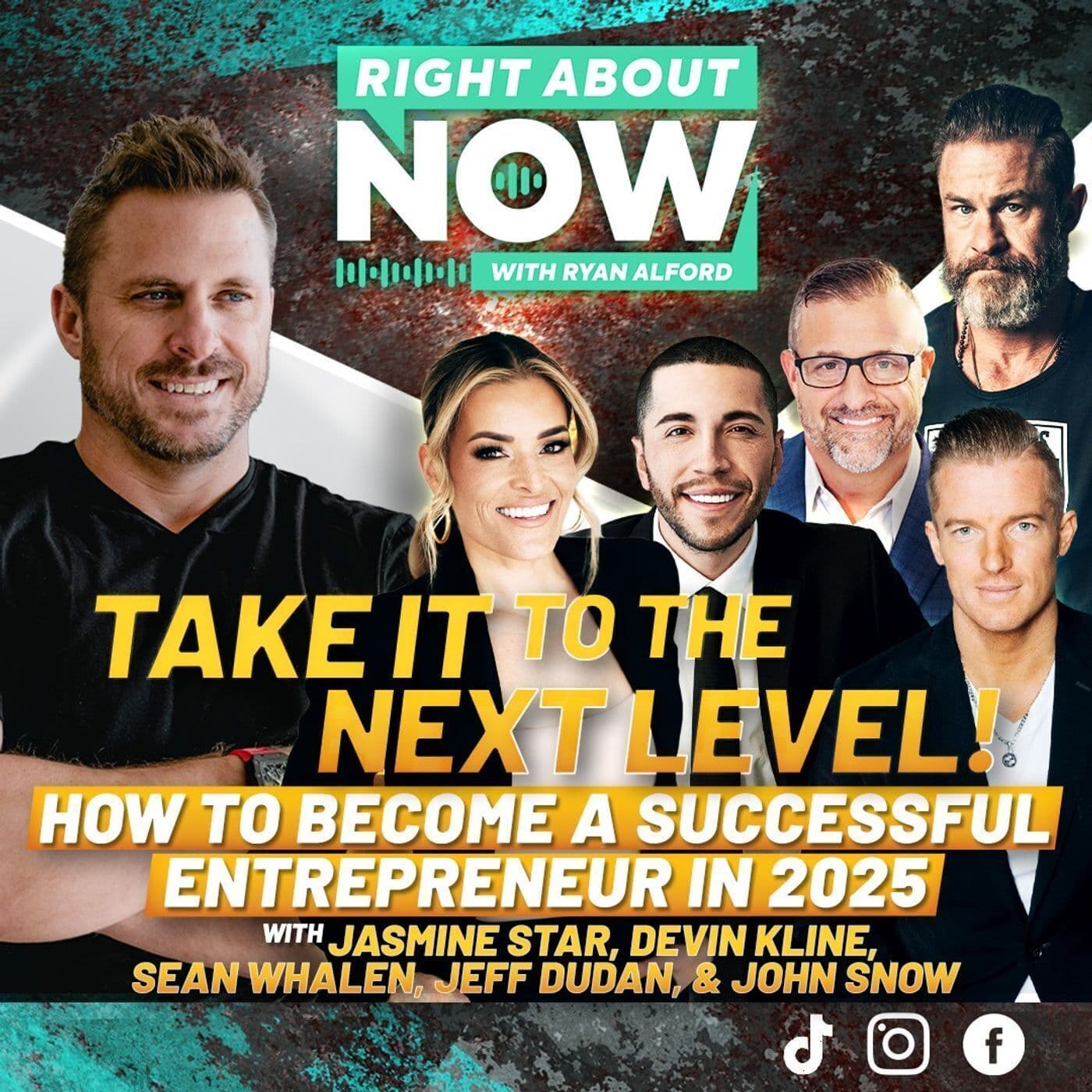
Take it to the Next Level! How to become a successful entrepreneur in 2025
Jasmine Star, Sean Whalen, Jeff Dudan, Josh Snow and Devin Klein share how they built their brands, launched products and scaled without breaking.
- Define your own rubric for winning before you set revenue goals, so you stop moving the goalposts and beating yourself up at year end.
- Treat comparison as the real thing stopping you and name which type it is — mental ("I'm not that person"), emotional ("I'm not capable of that big dream") or visual ("I don't have the house, the car, the resort").
- Stop assuming you know someone else's numbers: a "million dollar launch" may have cost $750,000 in ads, and a $10M business may be mostly affiliate and JV revenue.
- Simplify your messaging — Sean Whalen's test is that if it can't be explained on a whiteboard with crayons, it's too complicated.
- Build capacity before you turn on ads: Lions Not Sheep went from $2,000–$3,000 a month in apparel to $463,000 in a month within about 90 days and ended up roughly 6,000 shirts behind on production.
- You can start franchising with a trademark only applied for, as long as you disclose the application number and filing date in your disclosure documents — and disclose again immediately if it's denied.
- Say yes when there is no reason to say no: Jeff Dudan's Undercover Boss episode reached 7.1 million viewers, drove direct jobs for franchisees, and became a piece of brand content worth roughly $250,000.
- Start narrow and validate before you spend: Snow launched one $95 system on Shopify with Facebook ads, $50,000–$100,000 of first inventory, one or two people on support, and shipping out of a spare bedroom.
- Lean into Amazon rather than avoiding it — over half of online retail searches start there, and antitrust limits keep Amazon's own private label near 47% of revenue, leaving the marketplace open to brands.
- When scaling a franchise, invest ahead of the growth curve and target a two-to-one ratio of investment to year-one revenue (a $500,000 investment producing $1 million in year one).
Everything that you have is on the back of your willingness to do the damn work.
The thing that will stop you from doing the thing that you know you have been called to do is not lack of money, resources or education. It is simply the fact of comparison
I believe that the very best salespeople on planet earth are never selling anything.
Hey guys, Ryan Alford here host of Right About Now. On today's episode, we bring together really a masterclass in entrepreneurship. We've had over 500 episodes at this stage and we really have started to aggregate some of the best business knowledge in the industry. And, you know, you can read books, you can listen to shows, but we want to aggregate what we think is some of the best advice, whether you're an entrepreneur that's just started out or you're in the business for 10 plus years. These are tactics, techniques, actionable advice from some of the best. We've got five of my favorites here. Jasmine Star, Jeff Duden from Homefront Brands, Sean Whalen from Lion's Not Cheap, Josh Snow from Snow Teeth Whitening, and Devon Klein from Burn Boot Camp. These are some of my favorite entrepreneurs giving the best advice. That's what
we do here. We take the BS out of business in this masterclass series on entrepreneurship on Right About Now. This is Right About Now with Ryan Alford, a Radcast Network production. We are the number one business show on the planet with over 1 million downloads a month. Taking the BS out of business for over six years in over 400 episodes. You ready to start snapping necks and caching checks? Well, it starts right about now. What's up guys? Welcome to right about now. Hey, we're always getting right. It's always about now. What makes you keep pushing forward? What got you? Something impacted you? Something made you that was a nature nurture? What was it? Uh, perhaps mix of both. My father is from Mexico. My mom is from Puerto Rico. My
dad came over. It was like 13, 14 and then enlisted the United States Marine Corps and earned his citizenship. So I think that growing up with that perspective as a first generation, let you know, you see your dad being given the golden ticket. And I think that, you know, I won the genetic lottery by being born in this country. But having a father who was drilled into us, we are so incredibly fortunate to live in a country where you don't have barriers to do the thing that you want. It is on the back end of people who have the huts butt and the audacity to do something that they are unqualified to do. And so having that growing up, but then also realizing you're owed nothing. Getting into the country, congrats. Being born into this country,
congrats. You're old jack squat. Everything that you have is on the back of your willingness to do the damn work. And so what it made me gritty knowing I'm owed nothing. I don't just because I start a business doesn't mean my business should be successful. Just because I start a business and it's successful doesn't mean I'm going to be the top 1%. If I go in in my my perspective, just like Simon Sinek says, that this is an infinite game. There's no such thing as winning in business. You can win your own game, but many of us don't even define what the game we're playing is. And so all of a sudden, we play a game in our own mind where we move the goalpost. And so it's just like
all this year, you know, it's like, I'm going to do my 10 million. And the minute we get to 9.5, it's like, no, no, no, I see what I need what I really meant was 11. And then we beat ourselves up one of the year because we didn't do the thing that we wanted to do. What game are you actually playing? Because the minute that we define our rubric of success, because sometimes money isn't always the goal. Sometimes the goal is do I have more time to do the things I want to do with the people I want to do with with it. It's like, what is the point of having a 11 million dollar a year if on the back of it, you miss the people and the things that were the most important
to you? You didn't win. You lost. You just didn't know what game you were playing. So for us to actually have a conversation of like, what makes you greedy? Well, first and foremost, let's talk about what we're owed. Nothing. Let's talk about how we win. Setting some goals and then working like hell to get them, but not at the cost of compromising the thing that's the most important to you. So what makes me greedy? The fact that I have simply chosen, this is the game I want to play. And every time I get punched in the gut because we always do, that's the sport. We're literally playing emotional rugby all day every day. We play rugby in our sleep. I don't know about you. I play rugby missing. I wake up and I'm like, oh my god. Oh my god. This is the game we're
voluntarily playing. We signed up for it. We can't complain about the thing that we want to do to get us to where we want to go. So I just think, what a privilege. What a privilege that I get to wake up, go on a walk in Newport Beach, have breakfast with my daughter, have a conversation with somebody I find intellectually stimulating where we get to help and empower other people. And then I get to go in and do coaching on the inside of social care and then I get to create content. I get to do podcast. What an honor and what a luxury. So if I want both sides of it, the lifestyle, the luxury, I better be able to wake up after my teeth have been knocked out and say, okay, this is the game
I'm playing. I'm chosen this. What an honor and what a privilege. I better show up that way. Man, I love it. I like you. Yeah. Why? Why do, why do some people always think they're owed something? Why are we that way? And I'm not saying me. They always be shit. But like what, what makes is it just Americans being spoiled? And I'm not saying everybody's that way, but we know for being real, a lot of people feel that way, which is why you stand out, like others stand out because you don't, you don't, you work for it. You just keep going, no matter what it looks like. But I don't understand what, but what bits people, I don't know what something, a lot of people that way though, they just they throw it. And I want to be very clear.
I don't want to pretend like I haven't struggled with that or I'm above that. There are times, for instance, I look at business a lot, very similar to parallel lines of working out and going to the gym. There are just some human composition that no matter what I do, I can work equally as hard as somebody else. I might not have the body type, the metabolism, I might not have the jeans to ever look or be like somebody else, right? But we're doing the same work. And so it's natural. It is human condition to say, I'm doing that level of work. Why am I not getting the same results? But the minute you dwell in the land of unknowns, like you ask a dead end question,
right? Like, why is my business not working? That's not really a question that we're really going to quantify right now. But if you ask yourself, how might I get 1% better in this? Now we have a clear path to getting a result. Regardless of if it's a result that you want, at least you can take the next step. And so I don't know if it's as much as entitlement, as in like I deserve to be successful. As much as I see a lot more in the entrepreneurial realm is I'm doing the work, but I'm not getting the results. But the problem with that, and it is a problem, the pandemic of emotions that we in go through is we don't know what's going on behind the scenes.
We have no idea. So when we say I'm doing the same work as that person, you, you know, Jack squat about that other person's business. Like let's just take down all the curtains that people use to hide behind because I see a lot of people being like, oh, I just did a million dollar launch. And that's amazing. I clap it up. But what a lot of people don't know is you ran $750,000 in ads to get that number. So it's like, you know, oh, I did 10 million in business. Great. And a lot of your business, the majority of it is done on affiliates and JD's. So your revenue is not what you're proposing at. You know, we don't know. We have no idea if somebody's business
was inherited. We have no idea how much debt somebody has. We have no idea. The byline of the revenue on their profit and loss statement is taking up 82% of what they're bringing in. We know nothing about other people's businesses. So again, instead of saying, why don't I have if I'm doing the same, I want you to, I want you to come back and say, I don't know how they got there. I applaud the work they've done because they're proving that it is possible to get there. But I'm going to continue to run my own race because even if at the end of the day, my business is smaller than somebody else's, but my profitability is higher and my working cash, my operating revenue is right where I needed to be. I've won. But the only reason why I can say I've
won is because I've already defined it as my personal win. So I get to play my own damn game. I get to find some deep satisfaction. What is I'm doing? But then also put some benchmarks on myself and the team being, how are we going to get to the next level? That's the game for us. We clearly define it. We know we're owed nothing. We don't compare ourselves to somebody else because we don't know what's going on behind the scenes and we show up when we do the damn work. I think the biggest takeaway right there is you got to play your own game. Like it's like, I like to listen to people talking like clients come to me. I'm like a counselor even I'm a marketer, you know, I listen to them talk and then that's like, I boil it down for them.
Like, okay, here's the, let's just get the brass text. You got to play your own damn game. And you know, it's hard because social, the irony of this and the irony what I'm going to say is social media amplifies everything that puts everyone else's game full force in your face. Whether it's fake or real or you know, who knows? Like you said, you don't know all the details behind. There's a lot of show business going on. But the irony of it is the social media amplifies it when you really need to tune it out when it comes down to what you want to do. And I love what you're saying. I have people all time social media is not working, you know, like I'm not it's not doing this and I'm not going to look at it. And I'm like, you've posted four
times in four months. What do you mean it's not working? It's like, you know, how many times are you see this? You have people come to you and like they go this or that or tactic or these things aren't working and you just, you don't have to get under the hood. You like, you like lifted up one inch and there's like oil spilled everywhere. You know, and it's like, come on, man, you know, are you serious? It's like, but you have to play your own game, but you've got to make it, you got to make it tangible. You have to set, oh, it's not working. Okay, well, what's not working? You know, like you got to have seven things that ladder up to one thing. You know, like,
but and you got to measure the seven things. But I don't know what I still comes back to the reflection of what you get to play your own game and learn and absorb from others, but you just can't get into the comparison game at all times. It's just, it's just, it's a road to nowhere. You know, I often discuss that the thing, the sneaky thing that stops most entrepreneurs from getting their business in front of others is comparison. And once we start understanding comparison, so oftentimes whenever I give a presentation or whenever I do a coaching session or a consulting session, I am literally starting there because if I tell you this is on the horizon, when it slaps you across the face, it's not so much a shock. So let me anybody who's listening
right now, let me predict your future. The thing that will stop you from doing the thing that you know you have been called to do is not lack of money, resources or education. It is simply the fact of comparison, but let's break down comparison because of the way I see it. Is it takes on three manifestations? It takes on a mental manifestation. I am not. I am not that person. I am not Ryan. Therefore, I can't get that success. I am too old, too young, too fat, too skinny, too black, too white, too old, too young. We'll say I'm to this. Therefore, I can't do that. So that's an easy way out. The second one is emotional and this one's very, very hard to identify because most of
the time people don't wake up and say I'm not worthy. They don't say I'm not worthy, but it takes on an uglier form. It will say I'm just not sure I'm capable of that big dream. I don't think that that's really going to happen. So we low key keep a subversive thought in our mind that's actually stopping us from doing that thing. And then the third one is going to be a visual. Right? I'm not on the Amathi coast this summer. I don't have a Ferrari. I'm not at that resort. I don't have that perfect house with those perfect kids in that perfect kitchen to do the perfect real that I need. And so we have these visual intellectual emotional things that stop us. But if we were to turn it on its side and simply say you might be too old and you might be too white
and you might be. But there is somebody out there who is just as white and just as old who needs to hear it your way. And in fact, even if even if you were to say that person does it their own way, guess what? You might be saying the same message, but you're a different messenger. Beyond that, even if you are the same, they're in the same message and you have a twin brother or a triplet, guess what? The mechanism. You might be a great podcast host, writer, speaker, you might be great on social. We all do things different ways. And we need to do it in our own way. So the person who needs what we do the way we do it can get it. And for the other thing is
I think that this dream might be too big and I am not sure. Listen, you wouldn't have got the dream if it wasn't in you to succeed. You didn't wake up this morning being like, you want to know what? I'm the next NBA star. No, you're not. Not if you 5'10 and you're 37. Chances start. It's not there, right? So we don't get dreams. We have desires. I love, we love to be an NBA player, but we don't get the dream. You got the dream because something in you deeply believes that you could do it. But if you talk yourself out of it, the only person who's stopping your success is you. And then we go back to the physical things. Well, I don't have that guess what? The vast majority
of people don't. And just because you're at that resort or you're on that vacation or you drive that car doesn't mean that everybody wants to be coached by a service or by a product from that type of person. So we have to say that your Honda Accord living in the Midwest with three kids who are just doing the dang thing in your own way with your $100,000 job and your side hustle of Etsy. Somebody's like, that's what I want. So it's far be it from you to say that the way that you see the desires of the world is how other people do it. And so we can come here and talk all about comparison. So when you're ready to get your business in front of other people, I want you to say,
am I emotionally comparing? Am I physically comparing? What kind of comparison is it? Stop it in its tracks and tell yourself a different story. You get to choose your story. If you would like to fight for your limitations, go right ahead. But if you would like to fight for empowering statements of why somebody needs what it is, I'll clap your head up. When I talk to entrepreneurs at business owners of people, I'm like, dude, you're a better father when you feel better. You're a better mother when you feel better. You're a better everything when you feel better. Lying doesn't feel good. Lying is scary. It's, do they know? Do they know? Do they know? Where you just fucking tell the truth and you got nothing to worry about. So it was like, if this is the recipe for me connecting with people
and me feeling better, then I'm just going to keep doing it. And at the time, five years ago, not that I was the only guy sharing shit on social media, but very few people are talking about real raw shit. And it's just airy, fairy, political things, reshairs of this. And so I just want an admission like, I'm going to share me. And since then, I literally have almost a billion views of my videos, millions of followers. I mean, literally hundreds of millions of engagements on my post from Instagram to Facebook. I mean, still on my videos have reached 150, 160, 170 million views of one video, which is just mind bending to me, right? But that's, that's what I found is my own little kind of recipe. And I felt better. The marketplace plays resonated with it. And I just
kept fucking running it. I love it. I want to get into some nuts and bolts on the back half year on the e-commerce. But I do have one follow up because I feel like no matter how I lost, you may have felt, you know, kind of being what you categorized as a man that everybody wanted you to be and not the real maybe you. Something has shaped Sean Whalen. It's some point in life. Well, well before you got lost or you got found or anything like that, I feel like there has to be these shit, these opinions and these beliefs that kind of formed all of this. Something shaped that either early, whenever I would think. I don't know what he's ever asked you that.
Thinking back and on life, like my parents split up when I was an early teenager. I was actually a really quiet kid. I was really reserved. I was a chubby little kid. I was a pretty good baseball player, but like I wasn't popular. I wasn't the class valedictorian. I was really, really quiet, really reserved. And I think for me when looking back at it, when I went on a Mormon mission, I went on a two year Mormon mission, that was where I really started to kind of find my voice. I mean, you're out basically selling God. We're going door to door, pitching God to people. And it was something I was really passionate about. It was something that like I didn't grow up in the Mormon church, I grew up Catholic and so it was kind of a recent convert to the church and
I just started realizing that people love to connect. People love to talk and I was really good at it. I was good at just talking to people. And I know that sounds really weird, but like there really is an art form of communication. There's an art form being able to not just tell us, so hey, how's your water? Like, why do you like that water? Okay, great. You know, what are like really fucking listening to people and hearing them and knowing what's driving them. And something that I've always been fascinated about and with is what's behind it? You know, this is why headlights and shit. I'm not like bouncing around like every other freaking bulls-o or like, oh my God, oh my God, I'm like, you know, what's talking about? I like to
critically shake. And for me, being able to be in a place where I can ask deeper questions, it's fun for me. And I found all my mission is I was talking about God. God's such a crazy topic for so many people because you have people that are way over here and the people away over here, people have no clue. And so it kind of forced me to really, number one, find my foundation, like what I really believed and how I really felt about life and who I was and purpose and the entire thing. And I found it like, people just love to connect. And so it just become almost a skill set in art form that I've just gotten better and better and better at is communicating with
human beings. But you know, it definitely does it come from my youth. I mean, I was a quiet, freaking kid, man. Well, I've shared some of your stuff with people and they go, oh man, he's pretty hardcore on this and the other. And you know, they care. He's a great community. As I said, you're a great communicator period. I mean, that's talking. I mean, when you when you really give a shit about people, like when you really care, like I think it's it's something that I mean, we're not we're just so busy trying to get, believe me, hear me. This is me. And it's like I really it sounds funny, but if it can't be explained on a whiteboard or like with crayons, it's too complicated. We should not have a tax policy in America that can't be explained on
a fucking whiteboard, right? We should not have foreign policies and that it takes 30,000 page freaking manuals to fucking explain, right? No one's interested in that really. And so we could tie this into the marketing and the business and the whole thing like copy is really important. You know what I mean? Like, what are you telling me? Everybody knows they're being sold something. So we've already got that out of the way, but what are you trying to tell me? What are you trying to communicate with me? Yeah, yeah, nay, nay, like if the answer is simple, no, they just fucking say no, right? But I love being able to look at complex things and I break it down in my brain to just like coloring book kind
of conversations like, yeah, this is what this really is. And it's just more to me. It's more fun that way. I have more connections to stuff that way. You know what I mean? Absolutely. And so let's talk about liasnotsheet.com. I mean, you know, we work, you know, we're at digital agency here and we work a lot of brands and they come to us and they have great products but they have no story, right? And yeah, I will take a company that has a purpose and a story all day because that's it's organic. You know, again, it just becomes about blocking and tackling. It's real hard to figure out the Hill Mary, you know, the message, you know, the blocking and tackling you can do. But let's get to some of that blocking and tackling.
What have been some of those mechanics of, you know, because I've heard you talk about it, you're like, you know, you started the company, you do your cell and t-shirt, you had a message, you had a plan, but something poured gas on the fire, you know, for the tactics and some of the ways with which you sing growth. He's talking about some of that. Yeah, for sure. I, first of all, you know, there's two philosophies, in my opinion, like anybody who's a really, really, really good ad guy or copy guy or whatever, I mean, you can take any product and figure out a way to sell it, right? And there's a lot of people that do that. They take, you know, products from China, they're really good, they figured out the game, the algorithms, they can do that. And then
there's people that that have passion behind something, they live it, they breathe it, they sleep, and it's being to them because their kid has cancer, and they want this product out there, and they want this thing or that thing, and there's a story and a connection behind it. And either, either one of those is phenomenal, right? But I think the people that struggle the most are the ones that they feel like they have that passion, and they feel like everybody's supposed to have that passion. I had to, this shirt is so badass, and this saying, everybody's going to buy the saying and this entire thing, but like, I've found for me that I am body blinds not cheap, it literally was for me. You know what I mean? Like when I wrote my book, which is sold over
half a million copies completely organically, I mean, I didn't even put page numbers in there, we forgot it was so basic and just put out there the marketplace, I wrote a book that I wanted to read, like that I would want to read. And I think a lot of people need to realize like, what do you want to wear? Right? It's easy to come up with slick marketing and slick products and whatever, but if there's no marketplace for it, it does a fucking matter out. Rachel landing pages are this at the other. So you're trying to tie in that story, you know, like, who, why is this relevant to you? Like why do you believe in this? And then I've literally for the last couple of years, I've been talking about why is this cheap? It's become me and people
have watched my journey as a father, as a business owner, as a man, as a divorced guy, as a dating guy, like all of these things have been really transparent. And I think people slide with that. They resonate with it, right? And so for me, why is it not cheap? It, everybody's been telling me, dude, you're in the perfect storm now with the whole political climate and it'll drop because it's like, we're all, you're one or the other, right? You're picking up. I drew the line or you're the sheet, which is great. You know, but, yeah, there's a hundred and seventy-five million people on your side. We're right down the building. Here, it was cool as everybody now wants to jump on that, right? And they ought to plug into
that emotion. They want to plug into the political climate, whatever, whatever. And you really don't have a track record. You don't have a tribe. You don't have any of that. I didn't set out to do that. And I think that's what really makes lions and on a sheet unique. And I think a lot of people need to wrap their head around this. And it's really difficult to do is having the consistency of delivering content and messaging for the long game because now we're in the perfect fucking storm. Now it works thrushy because so much content has been put out there over the last couple of years and it wasn't with the objective of selling t-shirts or selling hats or selling any of that shit. My mom literally, she retired last year and she was bored of shit. I said, Mom,
come help me make t-shirts. And so we had one heat transfer. She was in the office and we'd sell 20 shirts a month, just people stumbling on the website and she'd run down. She'd get the shirts and she'd make them and she'd write a little note, package them all out. And that was really what the apparel brand was until the beginning of this year. But being able to like sit in a story and deliver that to people that they believe without trying to sell them anything is massive. And that's a huge tactic that I don't think very many people understand is I believe that the very best salespeople on planet earth are never selling anything. Like you go to my Instagram or my Facebook, you will never see me selling anything.
Yet I'm literally able to make millions of dollars through coaching and consulting and and other companies that I have. But I'm not selling anything. So how does that work? It's unlimited. I'm breathing it. I'm exuding it, right? And that's, you know, if you're a jeep guy, you want to start a brand around jeeps, right? If you're driving a fucking home in a core good lot, right? You better know the clicks and the algorithms. But it's like some of those dudes are like hardcore jeep guys. They get it. They know what jeep guys talk about. They know what jeep guys want. And they're able to exude that message, right? And people instantly resonate with it. So I really do believe that it's you're in a day to age where we're completely bombarded and slutted
with products and things and ads and messages. And if you want the short game, you better free configure out how to become a really good marketer, a really good calculator and buy ads better than anybody else. But if you want to build a real brand like something that has legs, they will be around for a long time. They resonate with people like, why is it important to you? And you better be fucking living it. If you're in your living it and talking about it, everybody's like, my personal page and my this page that I got, I don't even know how many hundreds of thousands of followers on my personal page have weighed less than my business page. Because I just, I'm always living this talking about it, breathing it, eating it. And
be surprised how many people could plug into that. And now that we're turning on ads and running ads and doing shit like that where I have almost the billions used in my videos, I can now target some of those videos and you know what I'm saying? So, but I've been playing the long game and consistently doing the content consistently talking about it. And people just know like some people will see the shirts. I get messages with like, dude, that's the bearded guy. Like that's the bearded guy. They don't know my name because they recognize my video or a post. They're like, I know that guy. That's his thing, right? And it's it's really cool. What's the vision? I mean, where we're going? You know, I know you're, you're, you're knee deep
in a lot of things. I know this is open doors and yeah, but you know, you're coaching how to make shit happen is the book. Everyone listening, go check it out on Amazon. The Amazon is just your personal site. Yeah, Amazon. But what's where we headed? Where are you going? Well, right now we're trying to put the wheels back on the bus. We got our asses kicked in production. We grew so fast. I turn everything on back in March. What I mean by that is I hired a team to come in and start running ads. I'd never run an ad for it. I'd never put ads out there and we went from that to, you know, we were doing two to three thousand dollars a month of just apparel sales.
Oh, we did four hundred and sixty three thousand dollars last month of apparel sales in basically 90 days. A lot of them. They're shirts and it and it it fucked some things up. And I learned some very valuable expensive lessons on production and being able to keep up and it's kind of a funny story. I mean, I already think since it's just sunshine or roses, but all I keep my kids and their friends work for me. And they were all part of our production team. And so we were doing the heat transfers and all the thing. And I run all the numbers and I've got all the production companies and all the big promotional companies. They're hitting me up. Let us do your share. Let us
do your shit. Long story short, we had ten of them employed as we were just crushing. We went from literally like picking up one box of shirts and screen prints to get the pallets delivered. One of the kids apparently got COVID. And because they're all like my daughter's friends, nine out of the ten kids, their parents made them quit. Their parents made them literally self-quarantine. And so we were doing 350 orders a day, which represents about six to seven hundred shirts. And so we're like, oh, no problem. Get a, you know, a 10 page and see and bring all these people. Well, they fucking takes forever for them to learn and speed and well, they anyways, we got, we got really far behind. We got about six thousand shirts behind. Wow. And
team came in and they're like, bro, we got a problem. And I'm over here like, go, go, go, let's go, let's go. And they're like, hi, I'm proud. We got a fucking problem because even if we work 24 hours a day, we can't get the numbers that we needed. So if that wheel on the bike isn't working, you can't be afraid of it. Because I've got some guys, some dear friends of mine, they're big and he comes face. They do millions of dollars a month. And I've told them this and they all laugh and chuckle because they're like, yeah, dude, like, you know what I'm saying? Like, well, every single person has this happened to him. We have so many of our business owners that we
put in business through event clean that I'm still connected with that are just doing incredible things out there. But the fundamental of what they are doing was all of the things that they learned by being operated within our system. I love that. I want to pivot here shortly to some personal things and experiences you've had the podcast, a little TV show, maybe a few people have heard of. But let's last last kind of question. You mentioned the trademark thing. It made me think like, would you ever if you would you ever start a friend? Can you start a franchise if you don't have a trademark on your name? Like is that just like is that like rule one? Like let's say you're someone that's you've you've built one or two locations and they're super
successful and like, I'm ready to franchise. But you just happen to have a name that you didn't trademark or can't trademark. Do you need it? Do you need to trade get a different name? Yes, so those are two different things. So didn't trademark. Yes, you can start. You would disclose that in your disclosure documents that say we have a trademark applied for. Here is the application number. Here's the date that we filed for it. And now if you get denied on that, then that requires an additional disclosure immediately. So you've got to do that. Now if you went to a trademark attorney and they said, you know, no way. Yeah, you're Smith fitness. Like Smith fitness. And you know, and it's wonderful. You're making millions. You know that it's a everything can be
you know, transition to a successful franchise. But Smith fitness, what you started out with, what you built with just happens to be a non trademark. It's like, well, do I need to change my name? I don't know. It made me think of that when you started. I'm like, damn, how many people I started on this path and they've got an amazing business. But maybe they didn't, you know, think about it or they just pick something too common. Look, right. I learned a long time ago that if I'm going to be broke, I don't want to be tired too. Can you imagine? Like if I'm going to be broke, like I'm going to be comfortably laid up on, you know, catfish and somewhere. You know, in a garbage pick lawn, lawn chair. But like, look, I mean, you build this whole brand
and then the equity is in the name. I mean, when you go to sell your franchise system, a lot of it has to do with what's the equity in the brand? People know the brand. So if you don't own it, I mean, it just you've just kind of built not going to say you built it for nothing, but it would, that would be a non starter if you can't get a trademark. I don't think anyone would do that. Yes, you would have to go through a rebrand and, you know, you would think that in this day and age that every good name is taken, but it's not true. There's all kinds of variations of things you can get. You can make up words, you know, there's get a little creative. Google, Google, Google,
Google's not going to do anything you have 30 years ago or 25. I mean, that long ago, but, Jeff, I know you've had some incredible experiences, you know, through your success and what you've done, let's, let's go right ad undercover boss. I know our audience has probably heard of that. Maybe you've seen you. I made a gun. I recognize that guy. He had to go T and they were trying to put it together. Talk about how that came about and just the overall experience. Yeah, it's still, you know, we had a really good episode. It still plays a lot. It plays overseas. I'll know when it plays in Australia or in Europe somewhere because I'll get a bunch of weird Facebook messages so no, so in 2016, they were, they were filming season A and they had somebody drop out at the
last minute. So one of the things in life is if there's no reason to say no, then you say yes. So they came to us and said, we've got two weeks to do this. We've got seven or eight people that we're talking to. We'd have to fly out from California tomorrow or shoot a sizzle reel, put it together, pitch it to NBC and they would, there was a CBS. I think it was CBS. Pitch it to the CBS. Yeah, yeah, pitch it to CBS and they would have to decide. So we did that and really quick it came back that they were interested in having us on. So then we went through the reams and reams and reams of paperwork and it was, we went out on the show. I mean, we went out on the road maybe
like a month later and it was a surreal experience for those people that haven't been behind the scenes in a, in a production like that. It was really cool. I know I signed a bunch of confidentiality stuff and I really don't want to do anything to, you know, I don't want to say anything that makes it harder for them to do the show, but it just, it seems to me Ryan, like every year the show is canceled. Yeah. And then somehow it comes back for numbers. So what I mean to pull this, it's such a well-known show, but I will tell you the, the way that this is done, there is, it is, it is so, it is done so well and so over the top that you would not think like you, people do like,
is this undercover boss and then as this is going on, they're like, no, it's not, it's clearly not, but it really, but it really is. So, so yeah, it was great. We ended up being on the road for, we had a couple of little hiccups with a couple of things that were going on politically where they, we shot some stuff in North Carolina and then they're like, oh, well, we don't want to shoot North the way to re-shoot stuff. So, I had to fly my family, we did all the family stuff, right? We went, we did the office stuff, we did the b-roll at the office and then we went to the house and, you know, I'm cooking hot dogs on the grill, dogs are swimming in the pool, all that and they're like,
we can't use any of that because there was some political thing going on. So, and it was a, you know, one of those things and so then they, you know, we go on on the road for a week, we film two or three segments, they fly my family to this wonderful resort somewhere in Georgia and we re-shoot all of the family stuff and then we go on the road, so I was on the road for a total of like 16 days and it was a great experience and I will tell you that we had five up, the producer said, we have five episodes that we had to cut one that many shows would have killed to have. I mean, our franchisees were absolutely amazing, they lived the values of our company, they were out there
trying to do the best thing for the customer, they were highly empathetic. I mean, you know, I could have picked it a few things here and there but at the end of the day, we ended up with four great segments, I got busted twice, they showed one of them and but it was really, I think, I think what's interesting about the process is so, you know, we have a, you haven't been here yet, I think you're coming but I don't even been here yet but, you know, we have 22,000 square foot building on a five acre campus, it's kind of got broad shoulders and you know, we would, I would, I coached over 30 seasons of my kids sports and we would do, you know, the, my daughter's basketball team would practice
in our warehouse, we, I lined the side yard as a football field and that's where I coached our P.W. football teams is when the kids, the kids were growing up and people didn't even know I own the business, like that's kind of how we rolls, like we were, we never, we didn't, you know, people had no idea really what we did, the scale of the enterprise, they didn't know that, oh, it's nice, they let you practice here, like stuff and and so like we, we were pretty under the radar and I sat my kids down on the couch in our, in our bonus room and above it is a quote on the wall we put and it has kids pictures of, you know, them doing whatever it is,
they did that, you know, we wanted them to think we were proud of them for and then it at this quote from Jerry Moore, the football coach at Appalachian State, it's had always do more than is expected and then we had our family values up on our, on our little plaque there and stuff and one of the family values is trust yourself to take chances, fail fast and move forward, always do more than is expected, you know, and all of that and it's like, and I said, well, I say, guys, this is going to change things and this is, I mean, it's got, it might change things at your school, I mean, we're given, we're going to be giving away a quarter million dollars worth of
stuff, I mean, people are clearly going to know that, you know, that, that, you know, whatever it is that makes the show, but when you looked at our values, it's like we couldn't say no and they're just like, okay, well, we're willing to take the consequences of it and we did and we ended up having a great show and they all got a little bit of time on it, you know, so that was cool, they got, they got like a flash across the screen. Yeah, they're there, they're 15 seconds of fame, yeah, 15 seconds of fame and then we had, when it showed, with the night that it showed in, in January of 17, we rented out an entire bar, there was 250, oh, and I had my little
little football team was coaching at the time, like they were on it. So that was cool. So we had about 250 people came, kids that I've coached, their families, all the employees, their families, the local news, and we saw it for the first time, along with 7.1 million other people and I'm telling you it was a great show and it did so much for the, for the business and the brand and the franchisees, really just confirming like, you know, really living the values that we had, that we knew that we lived within the four walls of the business, but you know, being able to display it to the world and put the franchisees front and center was just an incredible opportunity. So I always encourage
people to say yes and there's risk because if you watch that show, some of them go very poorly and you have no control and I will tell you, man, they tried to wear me out like early, late, three times a day, an hour in front of the camera asking me probing, you know, you know, kind of questions that would be incendiary, you know, trying to get me to break and I just said, I took the whole position that said, if I don't, they can't, they can't use anything that I don't say. Yeah, that's smart. I've got media training before. That sounds like you did. No, I didn't, but I knew that I had a irresponsibly quick mouth and I needed to put a, you know,
clap a, clap a lock on it. But we did do two questions on that for transition. Like, first, and you mentioned it, it was good for the business. I tell people that they don't completely recognize like when, which things like Shark Tank and things like these things, where you can get your company like out there, like the monetary and brand impact of that awareness that you can't buy, by the way, or you can, or it's just way more than you'd ever spend.
I'm assuming there was some rebound, I mean, I'm like some upshot from that on some level. It was immediate. You know, we ran a call center. We answered 250,000 inbound phone calls for our franchisees and we did it very well. And I mean, there was many, many jobs that said, I saw it. I saw your company on undercover boss and I'm giving you this job for, you know, that they were touched by the episode and franchisees directly got work attributed to it. There wasn't, there wasn't a spike in franchise sales. So, but it wasn't, I mean, it wasn't, it wasn't massive. It was, but also, but being able to use that episode kind of as a piece of content during the process to really exemplify what we stood for, you know, how we rolled.
It tells, I mean, my gosh, it tells the story of our brand. They did an obviously a great job with it and little graphics and little trucks and a map and all like, so you could watch the first four or five minutes of that thing and you get our whole company history and in a high production quality. So, just that, what, you know, it was worth, you know, $250,000. The first 100 million in sales that we generated were entirely bootstrapped. So, the first, the first trance of our lifetime sales came from BigChunk and it was Facebook advertising. So, 2016, 2017, 2018, even 2019. When it was working. When it worked. Yeah, it even before there, right? But if so, it started even earlier. There were Moise Ali from native. He talks about
generating a dollar, $1.50 subscription signups for $12 a month, the order and just like infinite demand. And he sold that business for a hundred million cash in like two years from started. Very successful. It's still very around everywhere. And so, in the beginning, it was, I need to create a product that is different enough that would capture the attention to create a Shopify, Joe Shopify and you Shopify is going to be the platform we're going to build on. I started developing the product by talking to my dentist, my orthodontist, my oral surgeon. What do you sell on office? What products? I went and bought as many products as I could. I analyzed all of the Amazon reviews, negative reviews, focusing on that area so that you can find some pockets.
Then I saw that you have sensitivities, important. The whitening formula had some opportunity to be improved upon the delivery method of being able to plug it into their phone, which we invented that ability to power it by the phone because the very first vision version of snow was 95 bucks and it was a battery powered light. I did not like it very much, but we needed some delivery system for the serum to be able to test it out on the customers. So, I started running ads and it was pretty quickly a success. I set up the first version of the website and I had an agency come in and publish it. So, we got it up on Shopify very quickly. And then those after about six to nine
months of talking to my dentist, reaching out to suppliers of searching who makes toothpaste, who makes this, who makes gel and then getting samples and then tweaking those formulas and then getting some testing. So, that took you know, six to nine months at least, going back and forth, maybe 50 to 100,000 bucks to buy the first order of the system that I had created for snow 1.0, that was 95 bucks. So, we started running ads on there, gave free shipping and the focus was professional level whitening at home without the sensitivity of other systems. So, you know, really designing around the sensitive tooth customer, but also the one who wants to max out whitening. So, it's like, you want to cake and you want to eat it too. You want to preserve your anamol,
but you also have a wedding next week. And it's like, boom, boom, boom. So, we just kept tweaking that formula percentages, whitening agents. What can we do to help with sensitivity? And so, continuing to tweak that then, it became a device business as well with our LED technology, which we now have multiple versions of. We have a wireless version, colors, lilac, special edition. We have a black one limited at Best Buy. I mean, just all kinds of colors and types. And so, at the very beginning, it was one product, which was really a couple products in one. And that's what we now have sold nearly two million times of that system, which is evolved now to wireless, our current wired system today, which is the number one made in America teeth whitening system in the world. And so,
that still our most known product was that original teeth whitening kit all in one. At home, we invented the verbiades, teeth whitening wands, the disease whitening system, just a lot of these verbiages that were a little more seen in professional, but that people could buy a free shipping two days, three days. It's in your hands. So, that was a very, very start. And the goal was, if that works out, then if you walked down the oral car aisle, couldn't snow have a version of everything in there. Flossers, toothpaste, mouthwash, a toothbrush, a water flosser, aligners, all kinds of these products, mints, gums, breath sprays, all those products couldn't snow. I have a version of that if this is successful. And now today, our product portfolio
represents an oral care and personal care portfolio of 30 plus individual skews multiple award winnings award winners with multiple them winning multiple awards across the board. We have the best best whitening strips, best toothbrush, all of these awards that are decorated on the site. And so now that has expanded, but that's, you know, about seven years later. So, in the very beginning, it was Facebook ads, $95 system that we put together or that I put together with help, and then pushed that out once that sold, upgraded every single time that we reordered. The goal was, how do we upgrade the formula? Take the feedback. I was calling customers myself. And now I had built and sold many companies beforehand. I was, you know, independently, you know, wealthy. I could have poured a lot more money into the business, but I was still
ruminating on, is this something that has legs? Is this something that I think it is? Like, am I crazy? And once I started to see that, then it became hiring more products, different versions of the products, more channels to acquire customers. Now we're in CVS, Walgreens, Best Buy, Neiman Marcus, SACs, Macy's. So now we're in, you know, about a dozen premier top retail partners today, when they're very beginning its Facebook ads, Shopify, one system, one person, or two to help on customer support and shipping it out. And I shipped it from my spare bedroom of the house because the inventory I didn't want to get an office yet. I wasn't sure, right? And I was investing at the time. I had just sold a couple of companies. So I want to see kind of,
if this could be my next thing, you know, and sure enough, it certainly did. Is, you know, as you expanded past Facebook and started to get the broader, I mean, Facebook has people I don't think realize how many billion people are on Facebook and how broad you know, the awareness is, but what was the percentage of like US first non-US? We're talking pretty much 95, I mean, majorly US based. And what were the channels that kind of, what were the awareness channels that kind of flowed after Facebook other than just distribution itself? Yeah, so it was, you know, Google, YouTube, sold the whole Google suite, the whole meta-sweet, Amazon, advertising that whole suite, actually retail media networks. So also Spotify, audio, right? So there's every, so retail media is, if we're in Best Buy, we want to buy
web banner ads and we want to be the sponsored on Best Buy for anything teeth-related. And so we're spending inside of the trade marketing to push those things, but they drive awareness top of funnels while on those platforms. And then we're doing everything from YouTube. We're doing a relaunch of TikTok. We've been hiring. We're still are hiring like crazy for TikTok on the snow side. So TikTok is top of funnel. We're really excited about relaunching that. Instagram, Facebook are still very heavy on the front end. We do a lot of affiliate marketing as well. I actually acquired the affiliate marketing.com domain name about a year ago to build more reach in that space because it's a, it's a big portion across all of our brand. All the brands
in my portfolio and all the brands that I've invested in affiliate marketing is a very profitable channel across the board. So affiliate marketing is another area because a lot of these bloggers, Amazon editorial affiliates, they're putting us in front of an audience for the very first time, listicles, things like that. So, you know, about maybe 15% of our sales online come from our online affiliates. And that's 100% non-facebook and Instagram because we don't allow it in the program since we run that internally. So it diversifies it forces the diversification of that traffic. So that's kind of the stack from the top level. And then that, of course, as you mentioned, through distribution, funnels to marketplace, first right marketplace, then to retail actual locations. Then we also sell to professional dermatology dentists, kind of local clinic,
kind of style stuff. So they kind of whittles all the way down and it repeats from the top. But let's say before you went into retail, what was your mix? Like, you know, because everybody hears Amazon, they get scared, like margins and all that stuff. How did you tackle? I mean, you obviously started D to see, which is the smartest place, best margins, all that. What was your balance with taking on Amazon and what's your perspective there with just overall mix and things? So I'll give you a get scared of that. But it's such a behemoth, it's hard to ignore. I was the same way, man, I like 10 years ago told two of my best friends on a tough denial of the mattress company. They have the number one most loved and
most popular on Amazon mattress. And they had a very successful accident and huge success, they bootstrapped it, but they leaned into Amazon back then, I was anti Amazon. You don't know the data. You got to pay them 15 to 20%. You know, everyone gets refunds. No, no, no, no, no, you got to lean into Amazon over 50% of retail searches online start on Amazon and they end there because people go straight there to search for shoes, white sneakers, like they're going directly to search, they're buying there, the conversion rates always going to be higher than your website. It is what it is. I mean, they've invested tens of billions of dollars into infrastructure because just a genius and they know that if they can outsmart logistics and get
the customers hooked on two hour delivery, that that's going to put a lot of pressure on merchants. But I know that Amazon's a public company because they're a public company in the US, there are antitrust laws, which means that Amazon cannot get more than 51% of its revenue or 50% of its revenue from its own products. So all the private label they do, all the kind of things that they're doing, they cannot. I think it's like 47%, 46, you can google it. It's like someone on 47. So they can't scale it much higher. They just keep it go and they got to keep that 51% marketplace revenue, which allows people like us to take advantage of what Amazon built. If they weren't frantic trust, they'd kick us all off. So like I'm not being my guest, right? Like
Amazon, they just make all the products, they copy everybody and they'd be a lot of patent trademark lawsuits, but they'd manage those with all the lawyers, but they'd get it done, right? And I think it's like, look at it, it goes, you know, I last year was our biggest tear down, it's not every year's a great tear down, but last year was a significantly good year for Amazon. So we go, wow, we need to really hire in that direction. We need to really double down our partnerships that direction. We need to really tweak our affiliate marketing efforts net direction. So we went through it and said we want to double down on Amazon and utilize our strengths, utilize our thousands of reviews, utilize our millions on our email and SMS
list, like utilize our assets and our retail placements that are very unique to us in our industry, to be able to show off on Amazon and build that business. So we have a goal for Amazon on its own to be a nine-figure business for us in the next three years, from an Amazon, very focused scale plan, hiring plan, partnership plan that allows us to take advantage of the Amazon platform and marketplaces, Walmart.com, etc. Because what happens in a recession and this is a fact proven, I read this, they said during COVID people went back to what they felt most comfortable and safe and secure with. So they went back to Walmart or Walmart. They went back to Target. They stopped venturing out so much onto all these D to see websites and all these
unknown things, all these unknown subscriptions, recession hits or money gets tight inflation. People are more likely to just, I'm just going to go to targeting it everything. I'm going to go to Walmart and get everything. I'm going to go to this website, Amazon. Let me just, it's convenient, it's cheaper. I'm just going to do an Amazon. So you got to now play in that direction five, 10 years ago, you could get away without having to lead into it. Although I wish I could go back five and 10 years and I would have built an army of team members and partners on our Amazon channel and we would have been totally dominating that channel. So I love it. You do get access to email your customers now. They've got some new things. There's all kinds of stuff, but it's the only
platform that's driven by sales. So you can become the number one in your category, even above the big companies by sales volume. So you can drive, you direct your sales, like if snow directed all of our sales to Amazon today, which is maybe 15 to 20% of our US digital revenues. So let's say we put all of our US digital revenue into Amazon. We would be the number one in every single category above all of the incumbent brands, just because of velocity. But we would give up 15%. You margin based off versus our own. You give up some data. But I got to tell you, there are days where I go, that's not the worst idea, but there's a better way to go about it, build up the Amazon
Presidents and build up the traffic and build up the list. So a large story short, anyone listening, I would like triple down and look up a company called Hero Cosmetics. Look up a company called Zesty Paws by one of my good friends. And they're a half a billion dollar pet supplement brand. The 100% of their sales pretty much for from Amazon. Look up Hero Cosmetics. They have a miracle patch for acne, 20 bucks. They sold for 630 million. I think the beginning of this year in January, 40 million in profit just to Amazon. It was an Amazon driven business. So these Amazon businesses are getting very strong multiples. They're raising money. They're tick-tock friendly. So I would say lean into Amazon harder than you ever have and really figure out how to dominate
that platform in your category. Because it's the only place you can see sales as well. You can literally see an estimate of what everyone's selling. You can go look at snow stuff and they're selling an estimate of this much from this skew. It's a great platform to build on. You take pitching specifically and there's a lot of recovery nuances, a lot of longevity nuances, a lot of we really care about that stuff. Because we couldn't have our product be our differentiator if we weren't focused on longevity. We tell people like this is going to be long hard and difficult and it's going to take consistency and discipline and dedication. You're not going to do in 30, 60, 90 days, likely you're not going to wake up one day and be strong as an ox. It's going to take
five years and are you in for this ride or do you believe that you're worth it? So we have that recovery element built in because what we're telling people is that it's the opposite of what everyone else is saying really in the macro sense of like, hey, come do this fast. Like, oh, you're not okay. That's okay. This is coming anyway. Do it fast. Join in membership. You can lose 30 pounds real quick. It's like, hey, well, that's flat. You get companies that say one day it says they're signed on their building. The next day it says for lease and you're like, why is that happening? So yeah, I think that's, yeah, that's a combination of sounds like you go a little bit of bigger. You do sprinkle a little bit of bigger, faster, stronger in there
from my high school days too. If anybody's ever heard of that program. Oh, yeah, I'm I was sitting here thinking as you were talking. I see our intensity, community, recovery. That is right. That's it in a nutshell. My answer was real long-winded. I simplify for my, for a bit in marketing dialogues. I like acronyms and simplicity. Yeah, but but it's great. I mean, but that sounds like the building blocks of a long-term program and not, like you said, a gimmick because everybody gets that fire, you know, when they're ready to, okay, I need to lose some weight. I've got an event coming up, whatever. I, they get fired in their belly, but then it dies if you don't have the building blocks of something broader. You need the community to kind of keep you in it. You need to recovery
because if you're killing yourself and not recovering at all, then they get down and out, like you said. So I can see and I, all of those are periphery, you know, I've heard I've had people many times need to do burn, whatever, whatever. So I'm going to make a promise to you that I'll go, I'm going to go hit burn up to your Grigville eventually, but what's it been like growing the business man? I mean, go on. I mean, just that kind of scale, you know, is, is incredible. What's, what's that road coaster been like? Definitely one, right? You went at 2015 when we announced that we were going to franchise in all 50 states. You know, we thought hidden, hidden all run might be awarding 10 units in our first year and really getting those stood up and
you were always concerned with unit economics. I'll talk about that in a minute, but I had no idea that we would do 200 in the first 18 months. And, you know, frame data did this article out of franchise and magazine. It was like one of our first, it was one of our first like earned media pieces that was talking about business that I was super proud of. And it said that we're that in the 99th percent of all growth from all franchises of any franchise that entered the market since 2010. And this was like 18 months in. And I'm like, okay, well, we better not screw this up then. So how do we get all of these gyms open, right? We got to focus on we call it ULE's unit level economics. It's, you had a guest on Jeff Dudent
who's from this area. He taught me this actually. He's been a good friend and mentor of mine throughout the years. He taught me validation in franchising. And that's in validation really in any business. It's a sort of franchise particular concept. But it's the stakeholders of your business being happy. It's your death promoter score. How likely are they to recommend this business or doing business with you to somebody else? And number one, number one thing is to to number one box the check if you will is are they making money? And what type of money are they making? So I'm always looking for a this might be this might be something people want to write down because I'll give you like a strategy. What I'm looking for in any business I grow is an investment.
Hey, let's say the investment is at $500,000. I need to make a million dollars in year one in order for that investment to be considered a plus investment for me, right? So it's a two-to-one investment cash to year one revenue ratio. And that's how we that's the how we want to get every location out of the gate. Do all of them do that? No. But what that's really done having that expectation is we've aligned clearly and early with our franchise partners who are really driving the unit level economics. We've learned that when we have that expectation they start higher, you know, they start with more members. They start better off and you know getting getting to that place of having world-class economics and boutique fitness was it was a long road but definitely
a doable one because that was our focus the whole time from the very beginning. So the big what the hell are we going to do moment was when we had 200 and we had like 10 open, you know like in franchising it's the similar it's kind of similar to fitness what we were just talking about like everyone wants to just go fast fast scale scale scale scale it is a vehicle per scale and I love the vehicle per scale but you can also scale yourself right into the ground and you see that happen all the time in this industry particularly the industry that I'm in the boutique fitness franchising industry so yeah it's a I mean think about it it's logical right right I mean like
I care about my people so much like this isn't about money for me this is about my franchise partners who invested their 401k who invested their life savings who you know a liquidated their stocks 10 years before they wanted to sold their house and moved across the state who left their family in North Carolina and moved to Missouri and stayed in the hotel room for three months away from their children so they could go chase their dream this is all about returning in an ROI for them and so you know with that type of mindset that real people first core value you know we're able to take what's in the gym translate that up to a franchise partner network translate that into an HQ culture you know now we're on the east coast who are on the west coast uh by coastal headquarters
uh operating the business that way and we're economics have a better than they've ever been we use annual unit volumes as a measure in franchising how much each individual gym makes on average and we'll be up near the 600s at the end of the year which is you know talk three in our space so people first like people first and that's all I'm going to preach that to the to the day that Morgan and I hang them up which we're in the big leagues now so I'm gonna stay as long as you take care of people they take care of you that's how that's usually uh reciprocation is uh powerful just when you're trying to do the right thing you said to start a lot
I heard licensing in there I've talked to Jeff about this a little bit like licensing versus franchising versus you know like the thought process there and you know you you mentioned it if you aren't serving your franchisees you know then what are you doing you know as hard as going to business because again if you're serving them they're making money they're happy you get more franchisees and you grow um but what's it in life like truly what's been some of the secret sauce to scaling like that like like now that you've done it was there stuff that you would have gone damn I wish I'd done that sooner or you know like what are some of those learning lessons like definitely the number one thing is if you're going to scale your business fast you
want to invest ahead of that growth curve you've got to anticipate that you know I heard 20 robins once say that the anticipation is the ultimate power for any entrepreneur and you're able to see over the hill before anyone else can you can see the horizon when you're you know over the horizon when no one else can while your your your ability to navigate your way there you know is geometrically advanced and so what I always try to do is set big goals uh for the system starting with economic unit economic goals and then set more broad range targets so I stepped on the stage uh at our summit in 2021 and I said we're going to build 10,000 units to the mood and and half my system was like you know because we're a competitive culture they were
like let's go oh they're all pumped up and the other half was like I don't know we can do that like I don't know I got trust you but you know that's a lot of units right it's like how we going to do that the beauty is like I don't need to know how we're going to do it I just need to know that's our big enough fly there's big enough purpose because the people you're impacting in your community are also in other countries and they deserve the same thing they deserve of people first business product and so you know um but we're only going to do that through you guys right how we're going to do that is focus all of our energy on putting more money into your pockets
so that as a franchisee you're able to get those AUVs up and then reinvest into the brand so for us to give you a lay of the landscape like bird brands is like that's bird boot camp and that's the run it that's the front runner that's the spearhead franchising really is about distribution right so now we come in and we have a nutrition business underneath an active wear business underneath a real estate business underneath um an investment company underneath that takes non passive non-controlling states and companies that we're partnered with and you know you start to you know think about secular franchises and other opportunities now that you have the infrastructure in the distribution and it's like that makes the return on investment for the franchisees
even more important right and putting more chips out of basket so our opportunities get bigger as we go forward yeah I'm obsessed with what it is like just freeway listening uh bird boot camp as a brand or bird as a brand the way you grow brand awareness isn't always just advertising when you have 200 400 500 a thousand locations and the signage and thus in market marketing and word of mouth it grows the brand it's reaching frequency at the highest level with that distribution there's a lot of way to grow brand recognition and brand awareness that's not always just advertising in its true sense because every new location that throws up a sign and you know community for bird builds the bird brand right yeah you know I love I love your marketing mind and you know if I
had to pick a if I had to I'm an entrepreneur right but if I had to pick a vertical that I'm most confident and definitely be branding I think as a as a more specific term than marketing and what what I say branding what I really mean is measuring things like brand equity uh pure one imports is a good example pure one imports went out of business and then their logo sold for 50 million and they were they were I mean they were just burning cash right if your real estate portfolio is burning cash unless you have some brand equity is some recognizable logo or something that's going to sustain it it just crashes there's nothing there's no recovery element there so what I think of being you know what I think of the people that are listening to this and they're
all entrepreneurs I mean you know it's obvious that holding your own business right number one of brand or number two real estate portfolio arguably or the one of the two best ways to build the wealth initially and I always put brand equity just slightly ahead because I've got something I've got a logo that means something to people even though the brick and mortars aren't there anymore and you know so for me it's always been about the you know in marketers try to they try to measure this but I think it's just them trying to be smart it's like smoking mirrors and I said try to measure like brand lip it's like well okay yes what you're talking about right is okay all the impressions from the sign it's all the impressions from social media all the impressions
from word of mouth or one time in the mountains when Aunt Susie said something to Uncle Tam and Uncle Tam then takes his family and Seattle Washington like you can't really measure a brand lift unless you isolate variables so so finitely that it disregards all the things that actually create the brand lift so I don't know if anybody has ever confused by brand lift I love the branding expert and I still don't get it but that's what you're talking about is how does the collective touch points or the collective eyeballs on your brand Gary Vee says attention is currency right and he's so right when he's really saying is that brand awareness is your currency and once I got once I got all of the different units of rocking and rolling you'd be surprised
who comes out of the woodwork my buddies from like my junior high baseball team text me a picture of that bill logo it's in my wife just joined so yeah and then you layer the digital paid advertising and organic social media and all the contemporary marketing stuff up of that like we did and I think that's the recipe so you got to have the player over the top you've got to have the the braille list elements and then the hyper local community where you're in the field our fp's are in the field with their team shaken hands kissing babies running for mayor like just making sure that they're vell conversation when it comes to fitness in the town yeah we call it you got to drive brand and demand it's Brandon it's those two things that's what we
freestried clients and sometimes all clients they just want to drive the demand I'm like you got to invest in the brand baby you know that's what's going to pay over time everybody wants sales overnight but brands built over time for taking the BS out of business baby we'll see you next time right about now this has been right about now with Ryan Alfred a radcast network production visit ryanisright.com for full audio and video versions of the show order one choir about sponsorship opportunities thanks for listening
Justin Brennan on Multifamily and Other People's Money
Real estate investor Justin Brennan explains syndication, check equity vs. sweat equity, bonus depreciation, and how to buy apartments without your own
Hiring Is a Marketing Problem: Nicole Feenstra
Nicole Feenstra of The DNA Agency tells Ryan Alford why job descriptions fail, how to market the trades, and how geofencing and storytelling win

Jason Brown on Options Trading, Risk and Rebuilding
Jason Brown turned a $10K student loan into six figures, lost $250K on one trade, and rebuilt. He shares his options, risk and wealth roadmap with Ryan