
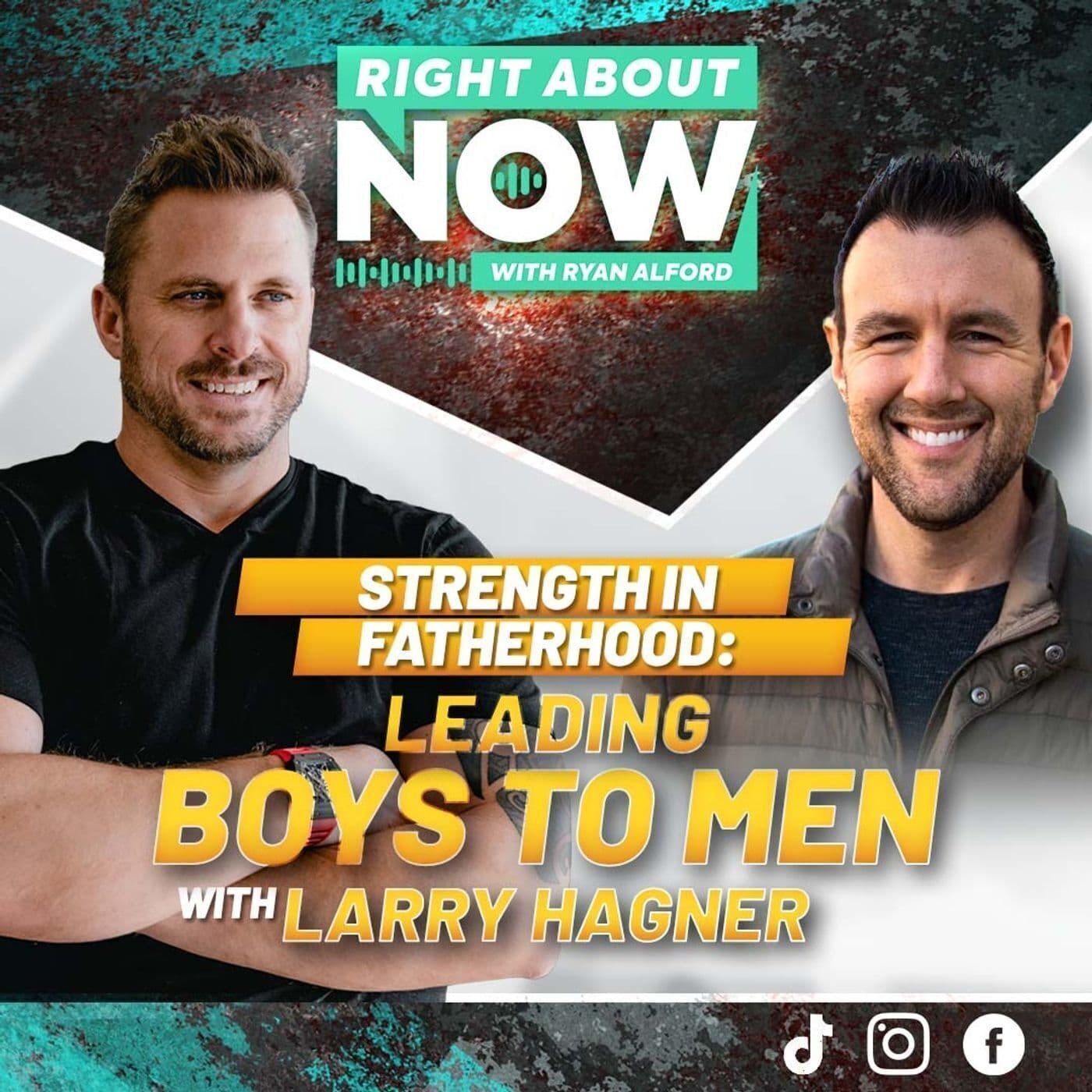
Strength In Fatherhood: Leading Boys To Men With Larry Hagner
Larry Hagner of The Dad Edge joins Ryan Alford to talk fatherhood, the lone wolf lie, the three relationships every man needs, and setting high standards.
- Larry insists the standard in a home is always set by the parents; a "different kid" is a reason to work harder, not to lower the bar.
- Every man needs three relationships: someone he can tell the truth to (the vault), a trusted advisor who calls him forward, and a 3 a.m. friend who will show up in an emergency.
- Larry cites that 62% of men have no one they could call in the middle of the night in an emergency, and that suicide is the second leading cause of death for men aged 25 to 50.
- On marriage: Larry cites 3% of couples describing their relationship as cloud nine, 12% as happy and good, and 85% living with some degree of emotional separation or settling.
- Fatherless-home statistics Larry references: roughly 83% of teen pregnancies and 92% of incarcerated individuals come from fatherless or abusive-father homes.
- Doing hard things on purpose compounds elsewhere: Larry says checking off the six daily 75 Hard promises lifted his confidence, and his health, finances, marriage and kids all improved as a byproduct.
- Parent for the marathon, not the sprint: Larry corrected his eight-year-old's tone with his mother knowing it would upset him, because the goal is a respectful adult, not a comfortable afternoon.
- Give kids one to three doable chores a day even in summer, framed as pulling weight on the family team, so they don't grow into adults who let a spouse do everything.
- Your second shift starts at home: Larry argues most men bring their best energy to work and their leftovers to the family, and the work-to-home transition is the hardest and most important one.
And then I ask them this. But will you live the life you're supposed to live for your family?
You are not going to move the needle in your life by being constantly comfortable, right? It's part of the reason I'm doing 75 hard.
So I think society wants, they want a society of weak men, right? They don't want a society that will stand up for things that they know is evil and wrong.
Good crews don't wait around for help, but the smart ones don't turn it down either. The James Hardy Alliance gives you what actually matters. Training that sharpens your team, resources that keep jobs moving, and leads from interested homeowners. That's the sound of fuel for your business, and it costs nothing to join. Get more from the work you're already doing. Learn more at jameshardy.com slash alliance. If you ask most men, do you care about yourself? Some will say yes and some will be like, no, it's not about me, it's all about my kids. It's all about my family. And it's a very noble thing to say. Well, here's the second question. Would you die for your family? And every guy that I know has been asked that question, like, I would take a bullet for them in a second.
And then I ask them this. But will you live the life you're supposed to live for your family? This is right about now with Ryan Alford, a Radcast Network Production. We are the number one business show on the planet with over 1 million downloads a month. Taking the BS out of business for over six years and over 400 episodes. You ready to start snapping necks and caching checks? Well, it starts right about now. What's up guys? Welcome to right about now. Hey, we're always getting right. And it's always about now. You know, we did an interview with my friend Larry Hager a few months back. We got a little rushed and you know, I think he's going to be a regular anyway. Number one, I like and respect the hell out of him.
He's doing things that matter in the world and with dads specifically. He has to see you of dad's edge and just the hell of a good guy. What's up, Larry? What's up, Brian? And I got to tell you, I'd love to have you back on the dad edge. So one of the reels that we put on Instagram has been one of the most viewed reels we had. And it was it was about you talking about how your kids act in public and how you set the standard. And there were a lot of people that commented on that. And then there's also a lot of people that that threw hate on it as well. And, you know, I'm here to be like. But I already Larry whatever it takes.
Yeah. I'm telling you, man, like I had one lady in particular commented. She's like, yeah, you know, the standard was set with my first two. But, you know, the third came along and, and he's just a different kid and disrupted everything. So it's not always the parents fault. And I did, I never really engaged in that kind of stuff. I commented back. I was like, no, it always is the parents fault. They said, we are the ones that set the standard. We are the leaders. So if we have a kid not following along. Yep. We have to talk more about that on your show. But let me just say this. I have four boys. And let's just say there's one of the very for sure.
I could have like created that excuse for. But we didn't do that. So the standard was set. And it doesn't mean that we don't have to work harder sometimes for a certain one. You know, in certain ways. But the standard was set. And let's just say he's thriving. He's doing great. And, you know, but, you know, he might need more reminding than the others. Right. How's life, brother? You're looking good to do. Yeah, man. Life is going really, really good. You know, and I've got four boys as well. And we're, we are rare breed, man. I don't know many of us out there raising four boys or what I, what I call the drunk fraternity party. But, um, you know, I mean, honestly, man, things could not be going better.
You know, I, I, and I couldn't say that about six to nine months ago. I was in a really, really bad headspace and season and, and, um, but I'm better now. A lot of things have really, really overhauled. I launched my fourth book at the end of May called Spirit of Fatherhood. Um, I'm in day 30 right now, 75 hard. Um, probably been in the best shape that I've been in since I got injured about a year ago. Um, you know, the books doing great. Our community is doing great. Uh, podcast is doing awesome. And, um, but a lot of it, you know, like I said, coming out of a season that was, that was very, very challenging. But I would say, man, we're doing, we're doing very good now.
And I've, I've spoken on more stages in 2024 than I think, uh, probably three years combined, um, before then. So it's been, it's been a busy year. It's been a good year. That's good, man. It did, it did amazing. I mean, let me just say this, let me do this for Larry. I will, I have not done this. So bad respect for, for doing 75 hard. But my, my friend, Annie for solo developed this program. It's also called hell. And, um, it's, uh, so, uh, the fact that, so let me just tell you where Larry's at. Because I've watched my friends go through it. I, I haven't even, like, I, I don't want to say never, never. But I haven't even, you know, taken this under, uh, myself.
But I've watched enough people go through it. It's, um, it will change you. But it's funny how, you know, going through that, like said, if you get yourself in the right place, seems like everything else comes along with it. But Larry's, uh, there's getting to a better place. But, uh, that's a tough program, man. Really tough. You know, it is. But I'm one of those sick twisted individuals that I actually really love it. Like I do. It's my shift time doing it. It's my shift going around doing it. And I do, I just, I like it. Like I like, um, I like living within structure and boundaries and rules. I, I, I thrive there. And the thing is, too, is every time I check off one of those six, you know, promises that I make to myself on a daily basis,
I feel like that level of confidence just, just fractionally goes up and up and up and up and up and up. And because of that, man, financially, like things have gotten better health wise. Obviously, as a byproduct has gotten better, my marriage has gotten better. The rest of my kids have gotten better. Like, um, dude, I like, I had one of my kids friends over last, one of my, one of my kids had his friend over last night. And, um, we all, like me, all the boys in front of, we all jumped in the hot tub. And, and one of my kids friends was like, dude, like your dad is freaking shredded. I cannot believe he's 49 years old. You see all those, dude, you see all of his abs.
And so he told me that after his friend left, I was like, oh, it's nice. And he's like, my son even said he goes, that actually meant a lot to me. I was like, well, why? And he was just kind of like, why would you say that? And he goes, I'm proud of the fact that I have a dad in shape. Like that makes me feel good. Like the fact that I have a dad that spends time with me, that hangs out with me, but it's also in shape. Like that's, I'm not embarrassed by my dad. Like I know some of my friends are. I was like, holy crap. I kind of never really thought of that. Like, yeah. So it was really cool, man.
That is cool. Yeah. For sure. I get the damn, your dad's big. I don't, I don't know. You're right. I'm 65. You know, 270, you know, maybe 280 some days, 260 others. It's always, but always big. So, you know, I take the card, you know, I need to get, uh, I think I have two showing occasionally. I need like, you know, I need some 75 real hard to get, uh, to get there. But that's awesome. You got to size them, man. It's almost like your, your boys friends are probably saying, don't mess around and Mr. Alfred's house. He'll screw us up. Like he's a big guy coming off my top rope right on top of him. That's you got the dude. Hey, you got the belt.
I'm scared. Yeah. I walked home with it. When we hit number one on Apple, I was like, we, uh, we had this made as the, the upper, the most marketing thing. I, I joked at that. I told my boys that Apple sent it to me. Um, I've since corrected that. I was obviously kidding. And, um, but, you know, it was a marketing thing. And, uh, the first day I got it, I walked in the house with it and, you know, didn't say anything. Like I've just, you know, they're halfway paying attention to me anyway. And I'm not saying anything until like I walk in the dead and they're like doing homework or something. And finally, they're like, whoa, what is that? It's like, you know, being wrestling fans, they thought that like I had actually like maybe
one of belt for something. Yeah. Uh, you know, it's marketing, son. So, uh, it's fun. Surprise. Surprise. Yeah. Yeah. Yeah. Yeah. Yeah. Yeah. Yeah. Yeah. Yeah. Yeah. Yeah. Yeah. Yeah. Yeah. Yeah. Yeah. Yeah. Yeah. Yeah. Yeah. Yeah. Yeah. Yeah. Yeah. Yeah. Yeah. Yeah. Yeah. Yeah. Yeah. Yeah. Yeah. Yeah. Yeah. Yeah. Yeah. Yeah. Yeah. Yeah. Yeah. Yeah. Yeah. Yeah. Yeah. Yeah. Yeah. Yeah. Yeah. Yeah. Yeah. Yeah. Yeah. Yeah. Yeah. Yeah. Yeah. Yeah. Yeah. Yeah. Yeah. Yeah. Yeah. Yeah. Yeah. Yeah. Yeah. Yeah. Yeah. Yeah. Yeah. Yeah. Yeah. Yeah. Yeah. Yeah. Yeah. Yeah. Yeah. Yeah. Yeah. Yeah. Yeah. Yeah. Yeah. Yeah. Yeah. Yeah. Yeah. Yeah. Yeah. Yeah. Do every day working with dads, improving dads, helping dads sort of be their best self in a lot of ways.
As fathers, I thought it would be interesting, you know, to just talk about some of the work again that you're doing. Some of the latest things that you're seeing. You know, from my perspective, as I was open with you, you know, I've gotten more open in my talk. You know, just at least with my beliefs from a policy perspective. of the impact that some of the, the things that are happening, you know, that are sort of being normalized in the US, especially as it relates to families and fathers and the conditioning that I feel like that is happening. And I stopped short of the conspiracy theory stuff. I really do. But it's more whether it's conspiracy or not. I just think it's unhealthy in a lot of ways for where
whether it's called a business, call it the moral fiber of America, you know, all these things. And I think it's really sort of degrading the family dynamic within the US. So I really just first wanted to, you know, kind of key it up a little bit from that perspective while, you know, I think some of the things and the principles that you're working on with fathers could really have an impact on, you know, creating the family, the dynamic and making dads as best they can be, which then translates to business, the bottom line, the morality of the US and things going on. So I'd love for you just to talk a little bit about some of the things you're up to. You know, so you're going to open me up here on, you know, this topic really triggers me.
And it's not a topic that, you know, I do like shotgun blasts to the face on social media. I know we've got a lot of guys who do that. But, you know, I'm definitely open to talking about this topic because it definitely fires me up. And maybe it fires me up because I was one of those guys who is asleep, you know, and I was a victim. And, you know, my job's got me overwhelmed. You know, I'm stressed out about that. That's why I'm not patient with my kids. You know, I'm not at home because I'm working so hard to provide for my family, you know, and I just don't have the time, you know, to do date nights with my wife and stuff like that. And, you know, all the decisions
around, you know, the management of the home is going to follow my wife. I'm not going to lead in that way. I'm going to be the nice guy. And, you know, she's going to do all that. And, you know, and, you know, after a hard day's work, I'm going to come home and crack open a beer and watch Netflix. You know, I've done my job. And that's that used to be my line of thinking over a decade ago. And I've, and I think that the good news is this, though, I'm seeing more men in this day and age. And maybe it's because of social media, right? Because we get to see it versus like, I wonder if it's out there, but we actually have to see it. We would see more men
now who are raising their hand and they're like, not on my watch. Nope. This is not happening. I didn't come from the best childhood. And I think a lot of guys could say that. And they're like, you know what? Not on my watch. This is not happening. I want more as a father. I want more as a husband. And I'm going to learn. I'm going to be better. And I'm going to do it, right? Or it's the opposite. I had a great childhood. And you know what? I want to make my kids childhood and my marriage even better than what I had. But I think society wants to, I think you said beta sizes. Or would you say beta like make a bunch of beta males, right? And I think that that is true.
There's so much comfort out there, like just seeking comfort. And it just drives me absolutely insane. You are not going to move the needle in your life by being constantly comfortable, right? It's part of the reason I'm doing 75 hard. Like I had a good friend of mine. Actually, coachman is like, dude, there's a fifth time you're doing this. Why are you doing this? I was like, because I want a battle right now. I want something to go out and win. I want a fight right now, right? To keep me sharp, because I don't want to get comfortable. And I don't want to fall back asleep. And I think a lot of, there's a lot of men out there that buy into like this lone wolf
thing, right? That buy into this, I can take life on all by myself. And which by the way, if you really get to the heart of those men, they crumble. Over time, they might come out, they might be able to take on the world all by themselves for a little bit of time, but over time, it will get to you and it'll crumble. Look at the suicide rates. Second, suicide is the second leading cause of death for men between 25 and 50, right? So what I can tell you, let's look at the stats for marriage. These are brand new stats that I just read. Three percent of marriages, three percent can identify their relationship, their marriage, as this is freaking awesome. And I'm talking cloud nine. When she walks in the room,
my heart still skips a beat. And same goes for her. 12 percent of marriages identify their relationship is, hey, we're happy. We're good. You know, it's not cloud nine, but we're good. I'm not going to change a whole lot. 85 percent of marriages have some degree of absolute emotional separation or settling or we're just settling or we're just friends, we're roommates, whatever and everything in between. And that is just too bad. But I think if more of us woke up, right? And more of us took action and didn't seek comfort in those areas. The world, and I think the US in particular would be a much better place. 100 percent. It's so funny. The, well, we were talking before the episode, the, the whole motion of being awake.
I think, and I think comfort is the right word, but it's like we've been lulled to sleep in a lot of ways. I think lulled to some about, you know, with what happened with COVID, with free money being in the market, like some things that have sort of been made comfortable that weren't always comfortable. The, the notion of earning versus deserving, there's a lot of, I mean, that is a big one. It's like, and that's, that is one that's been in my heartstrings a lot. It's like, I was trying to like crystallize it. And it's like, we've got this, this culture of deservedness. It's sort of, I think it started with the participation trophies. It started with that. And now it's sort of like manifesting itself at even the higher level, the deserved versus earned.
And I think, again, like I told you, I still have the conspiracy theories, but if I didn't know I would think it was intentional to break down not only the family, but sort of our own guiding principles of what true work and truly earning what we get is. And I think fathers in particular, you know, I think take the brunt of this on sort of like thinking their job starts and stops it like, you know, like one end of the spectrum or the other and sort of knowing and understanding and taking on their role in full and understanding like how much impact and how much influence they have on their children, their spouse, etc. So when you start to make fathers comfortable and accepting sort of this mass behavior, we get into a really bad place.
And I think it's not doom and gloom. I 100% agree to that. And I think, you know, you mentioned a lot there, which stereotypically, right, you know, if you really look at what a man, like I think it's really our perception, right, as men. And I think our society has really done a good job of leading us to a perception that is absolutely incorrect. And what I mean by that is if you can't shoulder everything all by yourself, well, then you're weak. You know, you're not enough, right? And I'm not saying you need co-dependent relationships in your life or I can't be successful without somebody. That's not what I'm saying. But what I am saying is there's a lot of men, the most miserable men that I know are the ones that lone wolf it, right? It's really exciting
in the beginning. And then it gets you over time, right? So human beings by default and by nature, we are tribal human beings. We are community beings. We do not live in isolation. In fact, if you really want to drive someone to mental illness, put them in isolation, ask any prisoner who has been in jail, the worst thing you can do is put them in the hole in isolation. It is hell on the mind, on the emotions, on the spirit, even physically, it will make you ill to not be around other human beings. But let's just talk about not just surrounding yourself with human beings, but the right ones, the ones who are going to call you forward. I read that a man needs three types
of relationships in his life from other men. And if you really look at this, most of us do not have this, right? And society tells us we really shouldn't, right? So the first one is the one that you can tell the truth to, right? We all harbor something that we're not proud of. We all harbor secrets. We all harbor things that we're ashamed of, right? And those things are like rucksacks to us. They actually hold us back. They hold us down, right? Shame and guilt will not get you anywhere. So you need a friend who's the vault, the one that you can say anything to, right? The one that you can trust more than anything. And after he, after you tell him these things, he's going to listen,
and he's going to help you, right? And that's, that's the second person actually. So you can actually have one on the same, but the trusted advisor, the one who's no bullshit, the one who's going to call you forward, the one who sees you and says, Hey, man, I'm watching you. And I see these things that you're doing. And it's not operating at the level that I know you could be operating at, or the, or the level you want to operate at, right? So it's the, it's the guy who's going to tell you the truth back and call you forward. And then the third one is the 3 a.m. friend. 62% of human beings do not have someone that they can call in the middle of the night in an
emergency. So if you have a heart attack or a stroke or somebody gets hurt, 62% of men do not have someone that could pick up the phone and the other guy on the other end says, I'll be right there. But those are the three relationships you need. And if you don't have those, guess what? You're not ever actually going to feel 100% safe. All of your relationships are going to be shallow. All your relationships are going to be surface. And to be quite honest, if you really want to weaken a man over time, give him those relationships. You want to make a strong man over time. It's the ones, it's the guys that can look you in the face and say, brother, I love you. And I want
better for you because I know you want better for you. And this is what I see. And this is what I think you could be doing, right? So I think society wants, they want a society of weak men, right? They don't want a society that will stand up for things that they know is evil and wrong. And the way to do that is to constantly steer the perception of men is like, well, this is strength and it's not. It is the biggest lie that we've been told. Yeah. And it's sort of, there's like two ends of that spectrum. Like it's like, okay, men need assistance. And we've, but we've also never needed stronger men than we need now. You know, like so there are two ends of the spectrum. So it's recognizing that, you know, men need a support system,
while also recognizing that we need strong men and they need both support and recognition of these things. Because I think it's so funny to me on some levels, it's sort of, again, they're like, Polaris, they fight one other. It's like, okay, we need strong men. But we've also been conditioned that no men don't need sort of that support. I feel like those are almost it odds with one another, right? But one doesn't happen without the other, right? Think of it this way, right? What kind of car do you drive? I have a couple, an Audi and a Range Rover. Okay. So like, those are, those are, those are nice cars. They're dependable cars. They're strong cars. They're not weak cars. What happens if you don't put gas in
it for three weeks? It suddenly is not a great car, right? It's a car that needs fuel, right? Think about it like this, solid relationships, iron sharpens, iron relationships, right? In our lives, it's the fuel source, right? Otherwise, it's just four wheels in your garage, right? You need to put high octane fuel. You actually need premium unleaded in that car, right? In order for it to run at the highest level possible. In order for it to serve its purpose, it needs fuel, right? It needs oil changes. It needs preventative care. Without that, it's going to break down period and anything in life is like that and including the men in our society, right? 100%. Yeah, for sure. But here's the problem. Like to even use a better analogy as
well, we're getting real low grade gas right now, baby. We're getting fed, I don't know, 83 octane, instead of 93, maybe it best. I just can't help but be sort of, you know, told you this at the beginning, like I see the idea of family being eroded a bit, the sort of normalization of non-family dynamics. And I don't know if either I'm not smart enough or just don't, I can't think twisted enough, you know, for why we want this other than people wants, you know, good soldiers in line that are asleep, that are salute and execute or doing nothing as sort of these moral fabrics of business and society sort of get eroded by weak family dynamics. But why do we think this is? What do we think? Is it just they want the zombie nation sort of
saluting and executing? I mean, like, enlighten me, you're one of the smartest guys I know Larry, so tell me why they want to do this? Well, I have a theory around this and I don't necessarily have like hardcore data to like share with you. I've seen statistics and percentages and all that, but I have a theory and this is my theory. If you really, and actually if you look, all you have to do is look at fatherless home statistics, like I did this when I first started data, you know, 10, 12 years ago, and I think it was something crazy. I know it was in the 80s or 90s, but the percentile of, you know, teenage pregnancies, right, take a father out of the equation,
that's about 83%. 92% of incarcerated individuals come from some sort of fatherless home, or apps and father abusive father. If you look at crime, right, or unemployment, there's a fatherless thing in there, right? If you look at people who have been married several times in divorce, well, where did they come from? They probably came from a broken home as well. You take the father and even Meg Meeker, who's a female, right? She wrote strong father, strong daughters, hero. She's written seven books on fatherhood. She's been a pediatrician. She's like, I don't necessarily know fathers, but I know kids in their view of their fathers. And that, my friend is beautiful data, and it's honest data, right? And she's been in practice for 35 years. So she is a firm believer in two different things. You want to break a nation,
get to the father, right? Break the father, and you break that nation. Period. Because what you're doing is you're taking the strength out of the household that you're taking the strength out of the family away. I'm not saying that women don't provide strength. That's not what I'm saying. Don't confuse that. But what I am saying is the father brings that element of strength and a foundation that quite frankly, a mom just can't, can't do. And quite frankly, there are things that a mom does that a dad can't, right? My wife's away for a week. My eight-year-old was crying. I miss mom. When's mom coming home? Oh, my God. That's really hurtful. But you know what? I also know, like, like, from an eight-year-old, like, my role with him is like, I'm a little tough on him. I'm also his big play toy.
I wrestle with him. I tickle him. I mess around with him. Am I loving to him? Yes, I am. But like, does he get that motherly love that's different than mine? Of course. I can't replicate that. But he gets it from her. And when she's not here, man, he feels it, right? And I understand that. Like, I mean, like, I was kidding. I wasn't but her. I expect it. You know, I'm like, yeah, I don't, I can't provide that. I would have been. I get a little bit. My eight-year-old did the same thing. She's like, it's like, when's mommy coming home? He's like, I just wondering, I was just the 17th time that day. I'm like, he's just, I'm out around that.
No, right, right. It's like, yeah, you don't cry for me. But, um, but I, but I honestly think that there, if you want, if you want to break a nation, break a man, break a father, break a husband, right? Weak in that link in the chain. And then you'll see some ripple effects. Now at the same time, when a man stands up and he wakes up, right? And he is fully committed to being a husband, a leader, a provider, someone who protects the family, right? Someone who leads other good young men that he's raising to be good men and operate with character and integrity. It doesn't settle for anything less. And by the way, he also does the same thing with his daughters, right? He raises
strong confident young daughters. A man who embraces the fact that like, if I have a daughter, well, guess what? I'm going to show this daughter of mine. What a good man is all about. A strong, faithful, good-hearted leading man who loves her mom more than anything. Watch this. And then you get to see that girl set the bar so freaking high for these jokers, these other weak beta males that come into her life. And she's like, yeah, not on my watch. Even my boys, this is just a humble brag. But my 16-year-old and 18-year-old, they go to a big high school with a lot of students. And I've had conversations, especially in my 18-year-old, because he was single for a while, my 16-year-olds had a girlfriend for a while. I'm like, dude, I was like, what's up with the girls
of school, man? Aren't you interested in anybody? And this is his response. And this comes from an 18-year-old with raging hormones. He's like, there's a lot of them that are hot. But I have no interest. And I'm like, why? He's like, because they're all just goofballs. They're all dumbasses. Like, he's like, I don't want to say all of them, but they're not my standard. And I know that's one of your favorite things. They're not my standard. I was like, well, what's your standard? He's like, well, if you're going to be beautiful, that's great. But you've got to have a personality too. You have to have a kind heart. You have to be generous. You have to be able to hold a conversation. You have to have your nose out of your phone. That's the standard I have for a woman I want to date.
And I'm like, hell, yeah, man, don't settle for anything less than that, right? But I think that all comes from what type of home and standard are you setting in your house? And if you've been weakened by society or you've allowed that to creep in, here's the biggest message I will tell guys. If you ask most men, do you care about yourself? Some will say, yes, and someone be like, no, it's not about me. It's all about my kids. It's all about my family. I am not important, right? That it's a very noble thing to say. Well, here's the second question. Would you die for your family? And every guy that I know has been asked that question, like, I would take a bullet for them in
a second. And then I ask them this, but will you live the life you're supposed to live for your family? And that one's like, what do you mean? I'm like, are you willing to live in your full integrity, a strong, good-hearted man who leads well, who's confident, who does hard things, who isn't always comfortable? Are you willing to be that guy to show them what it looks like?
And the response you should get is, I haven't thought of it that way. I think we need to start thinking about it that way. And I think, you know, that plays right in to sort of this. There's so many things around us. You have education, education, and air quotes, or, you know, YouTube, like, we're sort of letting our kids be indoctrinated and taught by the surroundings instead of in our nucleus of our home. We're letting the standards. So if you've got a road, I think of roads as like guardrails, right? We're on the road. And those roads are there for a reason because you don't want to go too far. One direction you end up in the woods or in the ocean or wherever it might be. You've got the road. And I think we have all of these inputs now coming from
the world because you have information at a snap of a fingers. YouTube, videos, influence, all those things. And we're sort of letting those guardrails of both normalcy, expectation, and accountability, widen, the acceptability of what we accept. What the standard is is being widened every day. Well, this is okay. Are you just show up? You just participate, you get a trophy. You get, you know, like, we're sort of conditioning and accepting things that are not at a standard of excellence, at a standard of higher levels that we used to sort of account ourselves to because those those guardrails and the roads are widening. And if they don't widen, the widens just slow enough that it puts people to sleep, that we start to sort of we're not
notting off, notting off, you know, this is an ambient. This is like something much more sinister and slow because those roads are just widening and widening and widening for what we accept, what we think to count, what's okay, what's not okay, what defines normalcy in behavior of a man and a woman? And it's just gradual, gradual, gradual, gradual, gradual. And if you aren't doing within your own home, setting those standards, setting that accountable level, getting that road back, at least here, you run into some major problems and it was so funny, listening, not funny, but ironic, listening to you, I have a 15 year old son who's my oldest. And he's, you know, starting, he's older for his age, but he starts high school this year. And
he's not, I mean, he's, he's, you know, that same thing. He's not really interested in girls because he thinks they're silly. And, and I don't know if like, if he, if it's just his personality and like that will all change in a year, but then I don't know if it are the, and I don't have four boys. So I don't, I sort of sit in the loop of ignorance of going, are there a, are the girls being raised differently? Like, not because my boys are perfect, but, but is there like, why are these levels so off? Like, what is, why does he find them silly and sort of uninteresting versus where he's at? And I don't know what that is that I don't pretend to know. I just know that
it's an interesting, just parallel hearing you say that. But again, within your own home, we got to keep some roads and some guard rails. Yeah. So I think a lot of it has to do with, you know, parents are asleep and screens are raising our kids, right? I mean, I, I had a conversation with my tool, this, you know, as, as we were sitting in a restaurant and I said, guys, take a look around. And I think that every single family that was there minus one, they were all on their phones or, or the kids were just in an iPad. And I'm like, whatever, what the hell have ever had in a conversation? Like, you know what I mean? Like, whatever happened and don't, don't be
wrong. I mean, we're not saints with this, right? I mean, we, we put our kids like, if my wife and I haven't had a lot of time to catch up and we're going out to dinner, we did this the other night. My wife and I hadn't seen each other for a week because I had been gone traveling for events. And we had one night together because she just left for a week. So like, when my wife gets home, I will see her one day in 12 days. So we went out to dinner. And that night, I was like, I'm going to be with the littles, you know, the little ones, you know, for the, for the next week. And I'm not going to see you. And we made a decision. I was like, can we give the kids their,
can we give the kids their tablets while we have dinner because I really want to talk to you. And we did. Normally we don't do that. But what I'll tell you is that I think a lot of people are asleep like, oh, it just, you know, we come home, we decompress, we check out. I will tell you, man, that is one of the hardest transitions to go from work mode into family mode, but it is the most important. Your job actually doesn't start with your job. Your job starts when you get home, right? And that's when you clock in for the second time of the day and you better show up and you better be awake, right? Most of us will bring our best energy and behaviors
to our work day. And we, but yet we don't bring that intensity, that tenacity to our home life. And that's where that home life really needs to be. But I'll tell you, I mean, you know, I constantly challenge my kids. Like I constantly keep that, that sword sharp with even them. So I'll give you an example. And my wife, even who, who doesn't ever call me out, because we have an agreement, like we don't call each other out in front of the kids if the other person made a decision. So my eight year old, he looked at my wife. This was right before she left a couple days ago. And he said, hey, get me a few more chicken nuggets. And my wife like got up.
And I looked at him, I was like, excuse me. I go, what did you just say? And he goes, get me some chicken nuggets. I was like, do you talk to your mother like that? You do not talk to your mother like that. He's like, I used a nice voice. I was like, no, no, no. What do you say when you ask of all people, your mom to do something for you? And his eyes just weld up a tear tears and he goes, mom, man, man, please have some more chicken nuggets. Would you mind getting them? And he just like lost it. And my wife looked at me. She's like, God bless Larry. She's like, that was a little harsh. I was like, no, it wasn't. No, it wasn't. I was like,
we did no different than with the other three boys that are her older brothers. And I was like, and they turned out pretty damn good. They have manners. They're respectful. And I was like, and he needs the same. Like, trust me when I say the next time he asks for something, he's going to remember this and he will use nice words, respectful words to his mother. I don't want to see him cry either. But I'm not going to have a son who looks at his mom and says, get me some more chicken nuggets. That's not happening. Because we're not going to raise a man who's going to go into his family as a husband and be like, go get me some more food wife, right? Or look at his kids
and be like, go get me a beer. No, no, no, that's not the way we speak, right? That standard needs to be high. And I understand that people will listen to that and be like, man, that is pretty harsh. Well, you know what? He's not your kid. He's my kid. And I look at this as the marathon, not the sprint. Yes, I upset him in the sprint. But the marathon is how is he going to operate with character integrity manners and being selfless later on in life instead of being selfish and asking for something, demanding something in a way that is really off putting to a lot of people. It's not going to happen. Nope. And you know what? You just describe. It's easy to ignore that.
I had, it's so funny. You and I, we have four kids. We have the same thing. Like, I literally, it almost forbade them six months ago. My eight-year-old, like, it was a similar thing. I was like, I literally pulled him up by the sleeve over something similar. But, but it's hard to do that. That's not easy. You're watching your eight-year-old get upset. Like, that's hard. Like, it's not easy. But that's why people don't do it. And so we were, again, you start where we, you know, in where we start, it's like comfortable condition to comfort. And it's real easy to be a comfortable dad that doesn't call out that sort of thing because, hey, just let it go. Not, not guard rails opening. What's acceptable, you know, what standard is. Up. We just let it, no.
Well, hard. You don't want to see your son cry. But how is he going to learn and understand the respect that he needs to have to lead the life that you want him to live? 100%. It would have been, there was a part of me and do I even fight this battle before I said something, right? Because you're right. The easy thing would have been, like, I don't want an argument and I don't want to see him upset. You know, another really just quick example on this is I had a conversation around how this is hard with my older kids. So it's summer break. My kids are going back to school here in just a few weeks. But, you know, they work really, really hard.
So my oldest is the drum major for his high school marching band. So he's no jokes. But he's in band camp. But he's leading, you know, 130 kids in the high school marching band. He's the leader of that. My son, my 16 year old is the center on the offensive line for varsity football. And he never misses, they never miss anything. We schedule our vacations around their practices and stuff like that. Like he is one of the, they're both the most consistent. And what I'll tell you is this is like, they're really worn out because like they, they go to camps all day. They, they still go to the gym. They train. And then when they come home, I give them chores. And my wife is always like, Larry, it's summer break. Like I give them like one to three chores
a day. And they're easily doable. And she's like, Larry, like they're tired. They want to have downtime. You know, like they've been working. And I'm like, I get it. And you know what? It's also life. Like they need to pull their weight around here. They're not going to like go in their room and zone out on TikTok because they're tired. Like they can do that after their responsibilities are done. And when I, when I tell my kids, like, hey, here are your three things you, you have to do today. And they'll complain about it at first. And I'll look at them and be like, you know what? I bet you probably think that me giving you these things and doing these things, I feel really good about it. And it's actually easy. And maybe I even somewhat enjoy watching
you go through a little bit of pain and discomfort. And I will tell you that's actually the opposite. It sucks. It actually sucks because like there's a part of me as a dad that I just want you to be happy and just comfortable. And you know, everything's just done for you, right? Because I want you to have a better childhood than I do. But you know what? I want you to be a better adult than I am. Which means that you need to balance your responsibility and the things that you are committed to with your downtime. And you're a part of this team too, right? You're a part of our family team, which means you pull weight. You do dishes. You empty the dishwasher. You know, you vacuum the
downstairs. You clean a bathroom. Like those are the things you do because you live here. Period. Right? And it's actually easy for me to just let you go veg out in your room. I don't even have to have his conversation. I don't have to deal with you. It's actually easier for me to just go do it myself. But that's not what I'm interested in. What I'm interested in is making you a high functioning, high achieving successful adult that knows time management that knows I can have enjoyment, but not at the expense of getting things done that I'm responsible for. And I told my wife this to us, like, listen, I was like, we set this standard low now when these kids are husbands, right? And they have their feet propped up on the couch because that's what they've been
accustomed to and their wife is doing everything else. Do you think we did their family any justice? Do you think we did them any good? She's like, no, that's a really good point. So, you know, it's just because, you know, like I'm the dad edge and I'm a very empathetic, compassionate, loving, affectionate dad. But I'll also hold you to the fire to live in your best, in your best constantly. And I will constantly help you challenge the status quo of what your best is. Yeah. And that's why we're going to keep having you on the show, Larry, because I think spreading this word, whether you're out there, this is what this nation needs. And this is what will help us keep what we consider to be a great country. Great. And because it starts with
men that know how to lead, that know how to treat women the right way, that know how to really raise a family in the right way, it doesn't mean we have it all figured out. I don't, I know I don't. It's, but it takes a village, like Larry said, and support around you. And Larry, I do want to let you plug that in what everything you're doing with dad's edge to that end for how people or any of the dads listening could get involved with you. Yeah, for sure. So we, I mean, the podcast, we got 10 years of content, 1,207 episodes, I think, to date. So I'll keep you busy for a while. Everything you can resources, we have a bunch of free resources on on marriage and parenting at the dad edge.com.
If you're interested in our mastermind programs, we've got two of them. One for business owners, one for non business owners. You can find all the information there at the dad edge.com forward slash mastermind, but that is, and the best way to connect with me too is just on social media. I answer all my own DMs. I don't have any, I never thought I'd actually say that. It's actually me. The answer is like, it's just funny. I had a podcast guest say that yesterday, be like, if you DM me on Instagram, it's actually me. I'm like, do you ever think we'd be saying that about anything? And so yeah, it's actually me, the response is tough. Well, if you get enough volume up, I'm sure you do some way. You know, like I do, you know, like what? You know,
you're still doing your own, your own legwork. That's right. That's right. Got to do it. Keep it genuine. So yeah, that's the best way to connect. Larry, really appreciate your brother. I got you. The second of many to come, hope you'll come back again. Come back. I would love to have you back on mine. Hey guys, you know, to find us, Ryan is right.com. We'll have the links to all Larry stuff. And look, if you're dad out there, you need to get in touch with Larry. Get in the community. Go go do the bash remind stronger dads make a stronger country. That's what we're here for. We're taking the BS out of business, baby. We'll see you next time. Right about now. This has been right about now with Ryan Alford, a radcast network production.
Visit Ryan is right.com for full audio and video versions of the show. Order one choir about sponsorship opportunities. Thanks for listening.

Justin Brennan on Multifamily and Other People's Money
Real estate investor Justin Brennan explains syndication, check equity vs. sweat equity, bonus depreciation, and how to buy apartments without your own

Jason Brown on Options Trading, Risk and Rebuilding
Jason Brown turned a $10K student loan into six figures, lost $250K on one trade, and rebuilt. He shares his options, risk and wealth roadmap with Ryan
Why Great Products Still Lose Customers: Lisa Holladay
Mercedes-Benz and Ritz-Carlton veteran Lisa Holladay on brand love, customer journey mapping, and how TIGER 21 keeps ultra-high-net-worth members loyal.