
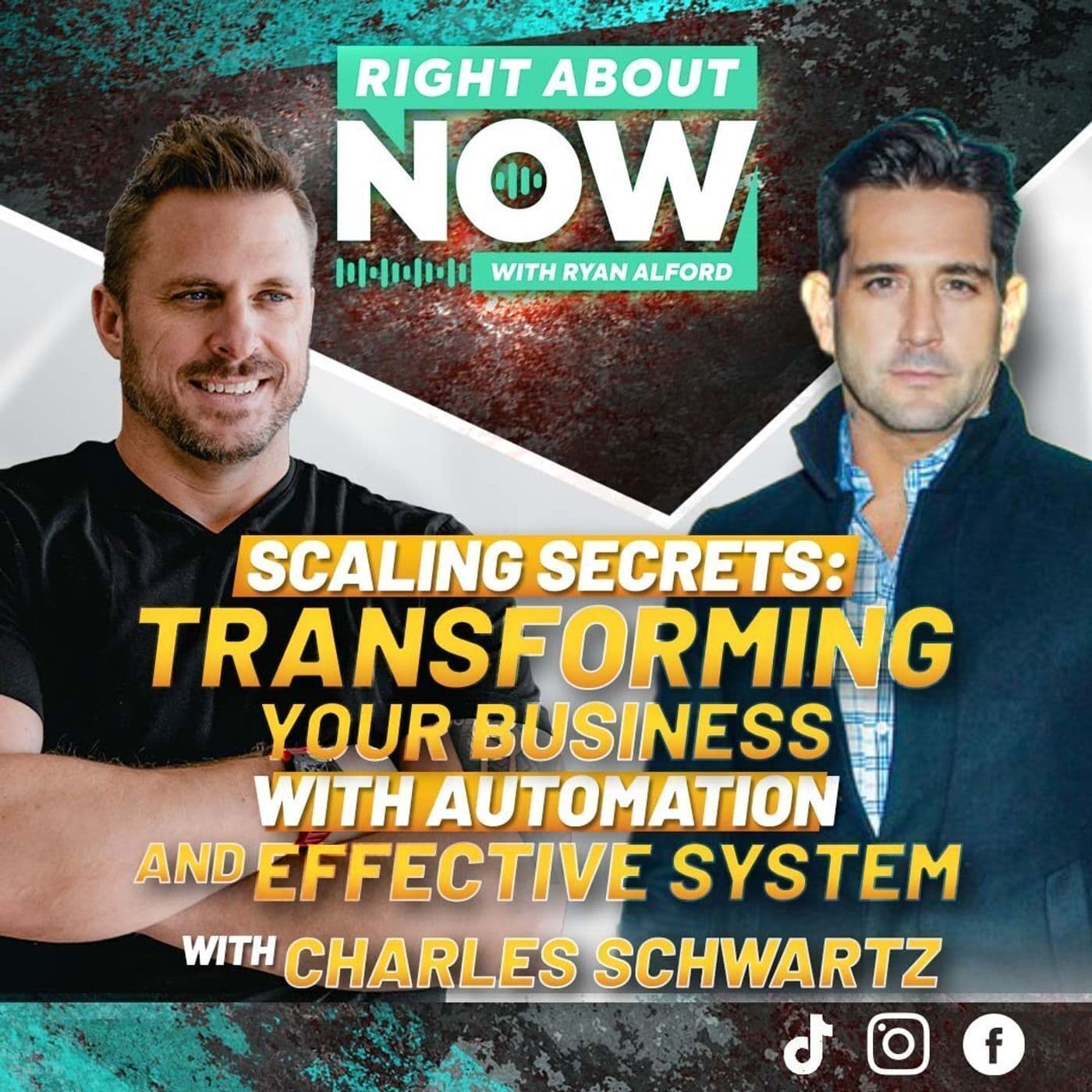
Scaling Secrets: Transforming Your Business with Automation and Effective Systems
Charles Schwartz tells Ryan Alford why the owner's ego is the biggest barrier to scaling, and how systems, automation and buying businesses beat brute
- Run the formula X minus Y equals Z — your income minus the cost of paying someone to do your job — and ask whether you could live the life you want on what's left.
- Map your entire business from acquisition to fulfillment in 15 minutes, then circle in red everywhere you're personally involved; every circle is a bar on your prison.
- A process requires training someone; a system lets you pull someone off the street and have them execute with no one being mission-critical. Only systems scale.
- The owner is the bottleneck — Charles says once he automates founders out of daily operations, the business skyrockets every single time.
- Sell the pain pill, not the vitamin, and keep re-checking whether the market still wants what worked three or four years ago.
- Write down everything you need to do, then pick only the two tasks that will create the most radical change and do those first each morning.
- Rather than start a business, buy an established one — Charles points to exhausted boomers whose kids don't want the company, available for pennies on the dollar, and cites a pickled pigs feet business bought for $100,000 and sold for eight figures.
- If you're near the Dallas–Austin–Houston triangle, Charles says get into manufacturing; nationally, he'd buy and systematize home health agencies serving the elderly.
Um, three things, poverty, death, and laziness.
If you want automated residual income, my job is to fight you.
they haven't built a business. They can't scale that business, they built a prison. And it might be a very nice prison. They might be making $67 million a year, but it's still a prison and it's brutal.
Lowes knows you've got a job to do, and we help get it done. With the My Lowes Pro Rewards program, eligible members save more. With volume discounts on qualifying orders, we're quote of $2,000 or more. Join for free today. Lowes, we help you save. Offer Campy Combined with any other discount contract and or special pricing. Exclusions, more terms and restrictions apply. Details at Lowes.com slash terms. Subject to change. If you made and it's a formula, right? X minus Y equals Z. X is how much you make. Why is it would have cost to pay someone else to do your job? Z is what's left over. Could you have the life you want with Z? This is right about now with Ryan Alford, a Radcast Network Production.
We are the number one business show on the planet with over 1 million downloads a month. Taking the BS out of business for over six years and over 400 episodes. Are you ready to start snapping next and cash and checks? Well, it starts right about now. What's up guys? Welcome to right about now. Hey, we're powered today by exponent. Hey, that's that clean energy. Zero sugar, plant powered, adaptions, new tropics. It's tasty. You know what else is tasty? My friend, Charles Schwartz. What's up, Charles? Hey, man, thanks for having me on. I appreciate it. I want some of that now. Did you send it on over? I guess it was. Hey, we got all the flavors here. I got eclips and blue Nova. So, yes, yes.
We'll save you some. He is the host of scale at lab. He's a Wall Street Journal bestselling author. He's just a cool dude, you know? Like, for those that know him, know him the way I do. Charles, what's happening today, brother? Man, it's been great. Just went through a birthday and it's just been really busy and just really excited to be here. Yeah, man, really appreciate it. Hey, I'm glad we're going to talk scaling it. I've been really impressed with what you've done with your show and I know there might be a name change to come. We'll talk about that. There might be a name change to come, but whatever it's called, it's the substance behind it that's been impressive. So, I know we'll get down that path, but let's set the table for everyone.
Who the hell is Charles Schwartz? So, a lot of what we're talking about here specifically with scale lab is I've been scaling companies for the last 20 years and the whole reason I created scale lab was there was all these secrets, you know, the running joke is Jesus didn't walk on water, you knew where the rocks were. There's always been these rocks. We know where these rocks are and I wanted to get those rocks out to people because every time I go into these corporations and some of it's seven, they want to make eight figures wherever they are, some guy will come in and share this one thing and the entire org changes and all of a sudden profits change and everything gets easier and there's some
very simple rules when it comes to scaling and there's three that they're just constantly getting across the board that we always do, that everyone always breaks and I'll go in them in a second, but I really want to say, hey, there are specific tools and there are specific systems and things you can do and I wanted to be able to give it out to everybody. So, that's why we honestly created scale lab and that's I think how we cut each other's attention. Yeah, for sure. And, you know, I think that and I just, it was like when I found your show and I listened to it, I liked Charles, I liked your cadence the way you do the episodes, like the structure of it in the value, like you said it perfect, because it's like, I don't think you gave
me the analogy, like maybe when you were we were talking before, like, sometimes you listen to shows and you're like, okay, all this is great, but tell me how you did the thing. Whatever that thing is, right? All these podcasts, I don't care what the name of your dog was in high school, I don't care what color your car was, I don't give a damn about anything, I just want to know this one thing. Just shut up and tell me this one thing so I can pull over, write it on my hand, give me actionable steps so that I can do it right now. And all of this started, you know, because the idea of doing a podcast wasn't something I wanted to do in any way, shape or form, but the rules and entrepreneurs are real simple.
If you've been playing about something, you got to bring me two solutions to it. So, I was complaining about it. My buddies were very drunk and they're like, come on, give me two things, that's so bitch. And that's literally how it happened. And we, I mean, it was horrible in the beginning. So, for those of you just finding out about it, the first season, everyone's like, it's a webcam, it's, I have no idea about microphones, I don't have a beautiful stream behind me, I have no idea. You know, we, we jokingly talk about that. I was the Beyonce of podcasts, but in like the 1990s, because she went on Star Trek and she got kicked off. I was like, yeah, that was Beyonce. It was horrible.
It was horrible. It was really bad. I don't know that anybody cares what your dog, what his name was, but something framed your point of view of the world and scaling and business. I mean, what, what did frame like, what were your influences? Like, what, you know, a lot of it's been your real experience for about same age. And so you've done a lot. But what, what kind of guides your view of, of the business role to just in general? Um, three things, poverty, death, and laziness. So, I grew up, I couldn't afford the last three letters of porn. And I then spent eight years in a hospice, time paid for college, watching people die, ran their IT systems, and that'll reset your ego really fast.
And then I realized as an entrepreneur, I was instinctively lazy. And most entrepreneurs have a real hard time, have another people tell us what to do. And that's normal for entrepreneurs. Being instinctively lazy was something that I brought in and I was like, shit, now it's going to be worse. So now I've got this. I don't like being told what to do. And I am lazy. So what is the way that I can get from A to B with the least amount of effort, with the maximum result? And that's really what, you know, got me rocking and rolling because I was sitting down and I was in, I would did IT. I worked with people and the owners of the companies were out on a boat, you know, smoking
cigars, hanging out, making six-figure weekends, why their employers are getting crushed. I was like, time out. This working hard, you know, getting married to the grind, having this hustle-porn idea of getting up at four in the morning, working out five times, having 15 meetings, it's just not the reality I was seeing for most business owners. They were using it and they were using systems and they were scaling in a really effective way because they, you know, they gather on way, they didn't have their ego involved. And that changed a lot of things for me because I really didn't care where the residual income came in. I just wanted automated residual income as quickly as I could with the least amount of effort. So I started hunting, scaling and that's really where it all started.
And you brought up a good, a word there and I think that's big with founders and young Trump, the ego word, you know, like, and your book even, I mean, you know, to go right at it. I mean, it's all about this in some ways. I'll let you talk about that. But, you know, I do think that's what gets in the way of a lot of, it's like, I really almost believe this to a degree. Either your idea is so good that your ego can't get in the way and your execution of it or you figured out how to get it out of your way. And for most of us, you have to figure out the latter, don't you? Yeah, absolutely. And I think when it comes to a business owner, ego is helpful in the beginning because
it's going to be brute force. You're going to pull in the 80 to 100 hour weeks, it's that's brute force. And that'll get you, if you're good, half a million, $750,000, that'll get you there. But, you know, we talk about this with scaling, the biggest problem with scaling bar none is that ego. It's the owner. And that owner, not realizing that there's a huge difference between being an owner and a founder. And being an owner and an owner operator, all that's going to do is tie you up, raise your blood pressure and make you just, you're hate your life, your health's going to fall apart, everything going to fall apart. Until you can step back as that founder and we talk about it being, being like Tarzan,
you know, Tarzan, swimming through the jungle is a good vine to vine. Most found, most owners will hold onto that vine that got him where they were going and then won't let go. So they're meant to instantaneously stops. They think, hey, I've got the connections. I know how to do this. I knew that when this was this, I'm the man, blah, blah, blah, you're not, you're not. So whenever I walk, I work with clients, I always say, you're the problem. My job is to fight. If you want automated residual income, my job is to fight you. So that's the biggest problem with all scaling. It's not, it's not your operation, it's not fulfillment, it's not procedures, it's not SOP. It's none of that crap. It's the owner.
Once I can get the owner out of the way and it's a really simple process that we do this way. It comes down to kind of simple, simple exercise, we walk through them, sorry, here's what you're doing. And you're going to do for the next five years and you're going to pull your 80 plus hours a week because you and I both know that's a light week for most entrepreneurs. And you might double your income or that's option A, option B, you can sell, I don't care, cat dildos, I'm giving them. You make half as much but you'll never answer the phone, which one do you want? And most business owners are like, top option B, I can spend time with my family and my
health. Now, if you're listening right now and you're an option A person, I can't help you. Please stop listening. I just check out now, get you, get you, get you have my, go be a passion project. You're not my people. I mean, as the host of the show, I'd rather end morning, I'll listen times to go up. If you just stay on just for me, then I'd appreciate it. I'll put more answers here. But for most business operators, they get to the point where, you know, they had this idea as you were talking about, they had this beautiful idea and they become their khakis from a white club reference. They'd be like, this is who I am, this is what I do and I've always been this guy.
And I was like, what if I can make it so you don't have to be that guy and you never have to get out of bed anymore if you don't want to? What if I can create that residual and all of a sudden they're like, wait, what, I'm like, what do you can be there and watch your kids grow up? What if you can get into these and that, you know, we can do this and automate your residual income? The game starts changing. So that's the first hurdle that anyone goes into is this tarzan effect, thinking that you're the man holding onto the vine that got you here. It's not going to get you there. You've got to pivot out. You've got to go from being an owner to a founder and it's a massive mindset shift.
And most owners never get to it unless someone either comes in and smacks them upside the head with it or they just have massive burnout and heart of that. Yes. Seeing that a lot is, I keep thinking of, I'm thinking of, you know, someone swings into a jungle making the, oh, you know, they don't move that I meet you. What's the, you know, when you've worked with people, when you've counseled people, where does that like flip, like where's, what does it take to make that switch for that founder? So we talk about it with future focus and we just get really honest. And you know, normally I'm working with them one-on-one and before I work with their sea level individuals and their senior staff, we sit down and say, are you happy?
Is this really what you want? If your last year was what your next five years would look like, is this what you would? And if you've got kids that switch happens fast, they're like, I don't care anymore. I'm exhausted. I've got to deal with, you know, manufacturers and I've got to deal with suppliers and I've got to deal with employees who are always a nightmare and I've got to deal with all of them. I'm just tired. I'm like, cool. If you made, and it's a formula, right, X minus Y equals Z. X is how much you make. Y is what it would cost to pay someone else to do your job. Z is what's left over. Could you have the life you want with Z?
And the minute they lay that out and they see it, they go, oh, yeah, I'm done. I don't need $5 million a year. I can absolutely live on a million or I don't need a million, I can live on half a million. Absolutely. Give me my time back because one of the things that people think when they're tired, like, well, I can't be part of my business anymore, like, you can do whatever you want. And that's the difference. Having that freedom, you know, we were talking about earlier about where to live and where to not live. This is one of the things I love about being an American. We love freedom. And when we realize that we've given up our freedom and our health, most people don't
catch it too. It's too late. And all of a sudden they're like, wow, my kid is going to prom. I thought my kid was just going to kindergarten. What the hell? I don't miss my kid and my wife's a stranger and all of those things, like, wow, my kid. I've got pre-diabetes and all this other stuff. When you start thinking disconnected from the business and I've already shown them how to system it ties and I want to make themselves out, then they're like, all right, clearly on the problem. And the ironic thing is, once we automate them out, the business skyrockets every single time because they are the bottleneck because, you know, we talked about before, ego, got to amount and it's hard for them to see that sometimes.
This, you know, talk with Charles Schwartz, he's the host of Skillet Lab podcast, maybe soon to be the Charles Schwartz show or all about Charles. Charles in charge. What's today? See? There we go. We can get a naming exercise here, the whole naming exercise. It'll work. We'll come up with you guys. What's, what else do we got to do to scale it, man? And what's like, two-par question. Maybe come to, let's, let's focus this one first because I'm really fascinated. Like with your show, what's something with the guests that you've had on, talking about ways to scale and like, again, extracting those secrets or those nuggets, is there anything that's just really surprised you, like, you know, you're a smart guy, you're an intuitive guy, naturally.
I'll say that for you. And so, you know, but is there anything you're like, okay, I didn't know that and that's really interesting. Yeah, so I get really excited about the people who have automated things. And the stuff that surprised me, we had a guy on who did all about AI for sales and he talked about building out these entire funnels and the newsletter campaign and all that. And he literally, you know, he got on with my team and he showed me and within six minutes he did something we would have paid tens of thousands of dollars for and he taught my team how to do it. And I was like, I'm out. How do you do that? And it really goes into kind of that flow.
And one of the things that we do to answer kind of two questions at once, when we work with, when I work with the owners of companies, I say, okay, map out your entire process. Here's a mark. Here's a black marker. Map out. You got 15 minutes. I'm going to go out and probably have it done it because I know we still don't. That's what I'm working because it's the only time I get to have nasty food. Still done it. And I have a map, everything out. And so it looks from acquisition to the client, all the way to fulfillment, just map it out. And they map it out and they go, they do a whole thing and I come back and say, cool. They go, it's not perfect, but 15 minutes close enough for government work.
Give me the pen and the hand will read a red marker. And I said, circle anywhere that you are directly involved where you are that involvement. And the minute that felt of that marker touches that, I throw the other marker at them. My congratulations you made a present. I'm like, you failed. So when I've got guests that come on and they talk about that automation and how to get them out of it so they can automate their residual income, having business owners go, oh my God, I have built a prison for myself. I'm involved. It's something that's so counterintuitive because you know, I both have podcasts. This doesn't work unless I'm physically here, which is absolutely ineffective for when it comes to scaling businesses. But to give value, it is the best way to give value.
And you know, there's certain things you have to be there for. You go to the gym, sorry, you can't outsource them. You can't automate them. That doesn't work. You got to put it in there. You got to grind. That is what it is. I've been an athlete my whole life, you got to grind. But it will come to your business. If you just do an exercise, if you're listening to do an exercise and they map it out and they circle anything that they're directly involved in, they haven't built a business. They can't scale that business, they built a prison. And it might be a very nice prison. They might be making $67 million a year, but it's still a prison and it's brutal. So I think having people come on and they show how they've automated themselves out of
it and how they've used very specific things to do that. That's always made me really excited. But it also because you know, our listeners come out and they're like, hey, I want to strategy or I want this process. That's where they fail. And that's always the third thing we talk about with them is how strategies and your processes are poison. We talk about all the time processes of a poison. And I can go into that, if you want, where we talk about this and talk about McDonald's. So McDonald's very early on in the 80s and 90s, when I used to eat it, but I was a teenager so I could eat tupperware and it just didn't matter. McDonald's was known for hiring people with special needs and they were great for it.
They were just wonderful. And they were in the process of redoing their POS, the point of sale system, which it's the cash register. Nice to do it. They have this grid layout. And one of the guys was sitting there and was working on it. And one of the employees had special needs came over and he was, what is this? What are you doing? Because it looked like a big checkersport. And he goes, well, no, this is our new point of sale. This is our new cash register. And he's like, okay, he goes, well, this is how you order things, how you order drinks. And the guy goes, how would you order a drink? And the guy was like, I don't know, what do you like?
He's like, I like Coke. And he's like, well, you would press here, I don't know what that says. He couldn't read it. And the guy was like, well, time out. How do you know what Coke to get? How do you know how to do this? So the guy, the gentleman with special needs, walk over and point it to the soda dispenser. That's Coke. That's Sprite. That's this. That's that. Because he knew it by the graphic. He knew it by the logo. And he was like, so much. So he went over and he changed on the POS pictures of the coves of the sodas. And he's like, what do you normally get? He's like, I don't know, number three, which was, I can't remember this, it was a double
quarter pot of a cheese and fries. I can't remember, but it's there. And he was, okay, and he showed him the POS, which is great. He was, how would you order it? And he goes, anyway, he was like, where's the number three? And the guy's like, oh my god, I was going through press double quarter pot of a cheese, press fries, presses, press this, press, do this. And so just press number three. The difference between a process and a system is systems will set you free. Processes are designed that if you have to train someone, that is a process. If you can take someone off the street and implement it, like that. And no one is mission critical to the entire thing, that is a system.
And I don't care if it's the most insignificant thing, Henry Ford taught us this, built cars off systems, where people just did it, maybe that one thing over and over again. You can systematize your practice, you can scale it. And when business are running into problems, there's a lot of employees who have as big of an ego, if not more of an ego, than the founders. So when I work with them, I'm like, listen, I'm going to fire a bunch of your staff. And I might fire some people that have been with you for a real long time, because I'm going to automate everything they do. And when the guests come on scale it and they show us these systems that they've created, that's what gets me the most excited.
It turns me off is when people come in and they're like, oh, I want a strategy. God is not going to save you. System will save you. Systems are the only thing I'll ever set you free. And when you go through these three-step processes to get someone to scale, scaling, it's easy. It's unbelievably fast, because you've gotten out of the biggest problem in the environment, which is humans. Get them out of the way. Where's the problem? How do you work with employees? Okay. So obviously, if they can't adapt, you get the power from the owner to fire them or whatever you do. But like, how do you get their buy in and how do you get them to see it differently and to sort of, I mean, on one surface, you'd be like, look how much easier this makes your
life, you know, and standardize things. But you know, it's natural. Just like it is for me, it's the founder. I mean, I can be self-aware ago. Because I think I know best, you know, and I've figured it out. I've done all these things. How do you sort of get buy-in for the ones that aren't toxic and just can't be changed? Right. So it's all human behavior at that point, right? So there's never been an employee that's super duper happy. They're all disgruntled about something. So you build rapport and you have a conversation with them. And one of the first things I bring all together and I go, here's the staff and I've already rehearsed this with the owners. And the owner's come in, am I right, guys, I go, we're going to have a meeting, I go
and I'm going to do something that none of y'all can do. And I turn to the owners and I go, get the hell out of my meeting, go away. And they all go away. I said, all right, go away. And you know, they sit there and we've already established that, whatever anybody says, no one can be fired. And nothing's being recorded. We need to talk it out. You're basically trying to reap. Yeah. That's something. Go away. And they get it. They're very cool. And then we implement, and the military does this really well. The seals do this better than anybody else. It's called decentralized command. We start pushing down command up and down the chain. And we just listen to them. We get to rapport and we talk about it.
And if you have that individual who is just a nightmare, the easiest way to do that is build rapport and over-enabled them. You give them enough rope so that they're just going to hang themselves. There's always that one employee who has a God complex because this is their entire life. I'm like, you know what, you're right. Absolutely. This is, go for it. Run with it. And you're just giving it and then they just burn out and they realize, just, no, I'm just talking about it in effect. Yeah, I didn't work it. And then you sit down and you realize, hey, this can be done this way and this we've done. And you find out what they want and everyone has different human needs, right? Some people want certainty.
Some people want significance. Again, there's all these different human needs that people want. Some people like, oh, I want more money, all right. Cool. You get these marks. I'll make you more money. Some people like, you know what? I just want to be able to work from home. Some people like, I just want to pick up my kids from school. I'm like, all right. How do we do that? How are we getting in that environment? So understanding that each individual person is an individual has different needs. So you come in and seeing them take the power away from the owners, instantaneously. And I normally get a little voter with them and they're like, oh, they walk away. I'm like, go away. You're done. And I have this conversation anymore.
Get in here and let's have a conversation where we can empower them and listening to them because most founders are horrible listeners because they think they know better. And they're just saying, this is what I'm going to do. Here's my plan. I came up with this idea implemented and my job is to fire them. My job is to fire owners. Get out of the way. I'm going to create the residual income you want so you can go live on that boat. And they're going to, this is a cash cow now. And then normally once you start working with the founder and they detach from the emotional attachment to, I'm a widget company or whatever it is that they built up because their grand eddies, grand eddies, whatever, once they get out of that and they start getting married
to this residual income, they then go, how do I exit? What is my exit? What is my three year exit? How do I get out of this? And then one of the things that you're running into now is, how do I then get into an investment group where I can leverage that cash? How can I be in that environment where, hey, I've never invested before in my life? I've got seven figures now because I just exit out of my company. What do I do? So my great, great grandchildren never have to work. And it's a different conversation versus, how do I pay the bills or how do I make this business for I have to, how do I make some of my kids never have to worry about food
ever again and have to suffer? And I think going back to your original question, that's what causes the pivot. It's getting that zooming out a whole lot more versus the everyday just onslaught that people run into. Talking with a really smart guy, Charles Schwartz, host of the skillet lab. And yeah, as you can imagine, a Wall Street Journal bestselling author, go figure. Hey, Charles, I don't know, like I was kind of like, I'm taking notes like mentally while you're going, like because you know, I run multiple companies and you're going, yep, yep, yep, I need to do that. I don't need to do this. And but I do think it is fascinating. You kind of went there at the end of, you kind of almost answered my question without
me asking you. That's how you know, you got somebody smarter on with you, but the some company's scale, like the owner's gotten out of the way, you know, and move the ego. He doesn't want to be involved. He doesn't need to be involved at the high level, vision only, whatever. But there's still opportunity to scale, is that just where you're doubling down on those systems? I mean, like, you know, like, is it more than because if the owner's out of the way, where do you start that sort of scale process? You hunt the market. So you find out, do you, does the, does the market actually want to buy what you're selling? And are you the best option in that? You know, so many people try and sell, and where the analogy is they try and sell vitamins
instead of, instead of add them or, you know, the pain pill. Don't try and fix their health. Get them out of pain first. And there's all these people who sit there and they, they brought their product, product to a market that, hey, it made it even great three years ago, four years ago. It's not great now. The market changes too darn quickly. So are you listening? Are you, you know, are you doing those peer reviews? Are you working with the clients? Are you getting that information back to say, hey, is this the best product that we need to be doing? This is what we need to be selling. You know, I, you're still on an IT company. We were, was known as an MSP, which was a managed service provider.
And we was like, well, you're, I, I key to play with me. And that was our thing. We're here. I key department. I live in South Florida. We at Hurricanes all the time. People don't give a damn about your damn IT department. The only thing they care about is, are my computers never going to go down no matter what? We found a way. And this is back back then, you know, to do VMS. And no one had heard it before and no one was. And a virtual machine basically, you mirror whatever is going on into the cloud. And I would walk in and I was talking to a client and I would say, yeah, they were really worried about it because there's construction going on in the building.
I said, well, I can make it that if a purple dragon shows up at each your whole building and you have no computer that I can ship you off to Rome, you can log into a laptop you've never touched before and you can still do payroll and still be fully operational. And you can do that. I was like, that is no big deal. And they're like, I want that. So all of a sudden, overnight, our business went, we're not an IT company anymore. Well, no, that's not who we are. That's not what the market wants. I can, the markup on this is unreal. So I said, listen, I can do it, but it's going to cost X amount of dollars and then we have to maintain it and all of that.
And it was nothing. And I can say this now because I'm way out of my NDA, but it was the easiest thing we could do. And our markup was seven, eight times what it was, it was ridiculous. My people were just jumping at the door and they were firing their other IT departments. I was like, no, no, keep your IT department. I don't want to be your IT department. I don't care that Suzy doesn't have to put paper in a printer. I'm going to make it so you never go down ever again. So when you're in that and you're running that problem where you're not scaling, it's looking at the market. If you've already sat there and you're like, okay, the owner's out of the way.
You've got people on board, you've got decentralized command. You've already redesigned the culture and you go into that part of that process now. What does the market actually want? Does the market want another, we were talking about this before, does the market want another podcast that's going to tell me all about what you did in high school or does the market want something that's going to be radical value that I can work on and implement right now. There's 3.2 million podcasts, your number one in marketing forever. The reason that happens is because you provide phenomenal value and because you listen to the market. And if you're not doing that, you lose. I don't care how good everything else is. You lose. So you have to constantly readjust to what the market actually wants.
Yep. Pivot at the right time, baby. As much as you can. I mean, pivot is an interesting word though, I think for scaling because I think in today's world with technology and AI and how fast things change, I don't know a business, Amazon may not pivot a ton, but they kind of do. So like, I mean, their core is e-commerce, but, you know, like, damn, let's hear them. Amazon, we had a guy actually on the podcast and he wrote a book called The Bezos Letters or something. Yeah. And the core of Amazon is that he wrote, Jeff, Jeff wrote, we are going to be obsessed about our customers. And that word obsessed changed the ball game. They are obsessed with the customer experience. It's why I pay $150 a year for prime because if I return, they don't have to meet with
them. I've got, you know, right down the street for me is a target. I could literally walk into target and get whatever I wanted. I'll rather wait the 24 hours because I know the return is going to be so simple. And I'm just like, whatever. I can just give this shot. And I've bought so much more because of that. The core of what Amazon does so well is they chose to obsess about customers and that's something the market wasn't doing. And that was their pivot and they've never lost it. You know, it's Costco with the $1.50 hot dogs and the $4.99 or whatever it is chicken. They're like, no, screw you. This is what we're going to do because they know that it, yeah, it might be a loss
leader for them, but it's going to bring people in. So if you're in that situation where you're struggling, really figure out how you're shown up to the market because if you're racing on price, you lose because there's always going to be so and cheaper and there's always going to be so and faster can do it. You know, we talked about technology. I can literally with, there's a program with a high called 11 labs that knows my voice well enough that can do an entire podcast for me automated every single day and I never even have to be involved. So the market's changing so quickly, but is that going to give the value with the audience actually wants? Yeah. It's not. So it's pivoting around in that way.
Very quickly. I love that you brought up Costco. I as a marketing guy, lifelong marketer, I use the, I reference Costco a lot as a, as a point of reference for different things and as a brand that's like figured it out. They, that the hot dogs, that dollar slice of pizza that's still, you know, like eight inches thick. Yeah. The amount of people that go with eat like they're full, you know, a family meal, my family included occasionally like for that, but then I go by, you know, 484 rolls of top paper. Yeah, because that's what we need. We need that much toilet paper in our life. It's over again. We have to hoard the toilet there. 17 cases of mustard. Yeah. Damn. But that hot dog was good.
But the hot, I save money on the hot dog, honey. What the hell? Yeah. I, so it's funny. I literally went to Costco today. I went and got the hot dog, not bright of it. My trainer will kill me. I know I was there. I was like, hey, they have these shrimp cocktail things. There's a thing of shrimp that I got a bunch of those and I got a bunch of them. I walk out of Costco and I'm like, we're $250. I just went in for a damn hot dog. And that's exactly what they charge at the door, I think. I think it's like, that's a minimal now. I can't get out of the door. It's like, go back and shop for more. Just go back.
Get more. With four boys, I'll go in there. I'm like, you know, man, you talk about convincing yourself of like buys, like, you know, damn, I really needed that shirt, you know, that's the most random, like, I got to know who their buyers are. That's, you know, that's, you know, that's behavioral economics, right? Yeah. And they've got it nailed down, you know, my favorite example of behavioral economics is wine. They did the study and the people came in for wine and like, we want you to buy more French wine. We want you to buy more Italian wine because we're just like, we're just going to pay a time music. And the customer has no clue, they're no clue, they're like, I feel like buying a Italian
wine today. Oh, magic. Look at that. Humans are so predictable, so predictable. So it's fun watching them kind of go through that process and not an understanding that all of this has been predefined and you can, you can leverage all of this if you know what you're doing. So like, let's talk about whatever it becomes, but scale a lab today, you know, and what you've built there and you're scaling it. What is it, ultimately, like, you know, you're building a funnel there of sorts of knowledge and information and doing things like, where are you driving people to and how are you helping people? So this isn't exactly what we were talking about before. I had no idea where we were going with it. We had no intent, but the goal was, I want to create something that people pull over and
write stuff on their hands. So we created a lab report. So in other words, if you hear Ron come on the show and talk on the show, we're going to break that down into a 70 page lab report, which is nothing more than a massive work work. Well, you're like, Oh, I could do this and I could do that. I could do this. Okay, that makes sense. But what we found from our listeners that are like, listen, entrepreneurship is isolation. We need to talk to you. How can I sit down and how can I talk to you, Charles? How can I talk to Ryan? How can I talk to your guests? How can I talk to each other where, you know, I, we were talking about this before the
show came on. I have now entered the world of Mac. Sorry, everybody who knows me. I have a Mac now. And I don't really put with it. So I'll just go online and I'll be like, okay, there it is. That's how I do it. But there isn't that for entrepreneurs. We don't have this ability to come together and say, Hey, I'm struggling through this. I have my, my, my newsletter that's acting up. I have my mask on. That's why I got this thing with accounting and taxes and fulfillment and blah, blah, blah. I'm having these issues. We don't have that ability to come together. So we're creating over a scale lab because this is what everyone's demanded from me. They're like, Hey, can we have a community?
Can we come together? Can we have access to your guests? Can we ask some questions live that I'm too embarrassed or too shy, or I just can't get access to them? Because some of our guests are 200,000 dollars a year just to interact with them and work with them as a client. You're not going to talk to them. So to be able to bring people in, it's a, Hey, you know, here's Ryan, he's been doing this for a really long time. He's the best and marketing podcast forever. Getting ahold of him is a smack of God. He's got four boys. He's running multiple business. We're not going to hold them. But in this environment, in this ecosystem, not only going to be able to access to him,
but you're going to have the behind the scenes and you can watch him answer someone else's question live. Everything it scales designed around being practical. How can I use this now? How can I implement this key really? And that's where it's really running towards. And what's interesting is we're finding that the higher end scalers, my normal clients, the seven figures, they want a community as well. They want a fireside chat because what happens at a six figure level is not the same at a seven figure level. It's just not. It's a totally different world. You're going to sit there and go through the minutiae of, oh, you just started a company. Great. Okay. They want us to say, hey, I'm running into this. My distributor out in China is running into issues.
How do I find three more distributors? I've got tax changes. I've got finance changes. I had a lot of money for me. How do we, those are the type of questions that most people in secure, they're not there yet. And they will. They'll get there. They really wanted to have a high end community. So that's the other thing that we found that people really want that very high end community that can come together. That's kind of where we're going with it. Yeah. And you use the word, you know, I was thinking, like, how would I describe Charles? Like, there's this practice, like black and white practice, with you, like, it's like, I'm sure that, you know, you can go watch a funny movie and let your hair down.
But I do think it's like, but I do think Charles, like, he's like, look, I need practice quality here. Like, you know, what are the systems, what's the process? Like, you're clearly, you know, I'm just tactical, I'm just tactical, just tell me exactly what I need to do. And I think it comes from, again, running operations or running computer systems with people dying. I'm like, I don't need fluff. I don't have time for fluff. We did it for finance institutions as well. I was like, listen, they're a high end trading company. If they go down, they're losing tens of thousands of dollars every second. They're down. We don't have this luxury. Tell me what works. We'll talk about how great you are and how pretty you are later.
What's tactical? What can I do now? I don't want to sit there and like, yes, honey, you're very pretty. Shut up. We have stuff to do. And there's a time in a place, but going through there and, you know, everyone, the nickname everyone gives me, the one word everyone describes, it's intense, you're intense. And the goal is get in. Let's execute. And then we can breathe out because, you know, for what I do and for what, you know, I've done for a really long time. I'm not brought in because people are having a good day. I'm brought in because there's a fire. Well, let's put the fire out and then we can talk about something else, but yeah, it's been about very tactical with all of this.
And that's why I hate processes and I hate standard operating procedures. Give me systems. It's the only thing I'll set you free. You got time for a little lightning round QA. Oh, God. Okay. Sure. We're doing some water. I'll miss you. I'll put this list of questions. I was like, you know, I like this a little bit. I'll see what I'll do. You like to. You know, we can always edit it out of it if we don't like it, but I over there. Which is your favorite startup success story? Oh, geez. I don't have, I actually don't have one. No, that's not true. Guy worked for, he was an army guy. He was completely lost. He didn't know what to do. Him and his partner were, you know, he was, one was an Ivy League school grad.
This guy was the other guy. They were just burning out his lawyers. They went in and they bought this company that was, they put a pickled pigs feet and pickled eggs. They bought this company. I was like, what the hell are you doing? Why would you buy this? What's wrong with you? You're an Ivy League school grad. What the hell is wrong with you? And he goes, let me show you my process. Once every two, three weeks, they would put the eggs in the pigs feet, disgusting. In these jars, the entire people to do it, they filled it up with the, whatever, sealed them and then put them on the shelf. I was like, what are you doing? He goes, seven figure business. We're never involved.
Our stuff never goes bad. And it was the first time I ever saw ego being taken out. You got an Ivy League guy who owns a pickling pigs feet, and I was like, you've got to be kidding me. What I love about that was they didn't try and build it. They bought it from Solon, which is this is the greatest opportunity in history where you've got these boomers who are exhausted. Their kids don't want their companies. You can get these companies pennies on a dollar. They're about, I mean, they're nothing to do it. We got a little bit of automation and you can scale it. That's what these guys did 20 years ago. They bought it for $100,000 and they sold it for eight figures.
And like five years. Love it. Got love. The pickles. Pickled. Pickled eggs. Pickled eggs. It was disgusting. Literally a trough of pickles. Oh, Jesus. Look. Hey, you can make them do a lot of different things. That'd be a very example. What's your go-to productivity tool? Writing things down, writing all the things that I want to get done, and then choosing the two things that'll create the most radical change for me and putting those as my first things. Because I think one of the things that we don't do as a system as a society is we don't measure tomorrow the cost of today's decisions. In other words, what is this going to cost me to be lazy? What is this going to cost me to not do this now?
What is the long term cost of that? We just don't do that. So we get messed up and we get caught up in the idea of productive procrastination. I'm going to claim my house. I'm going to shave. I'm going to do this. I'm going to do that. In effect. What are the two things that if you do this will create the most radical change? And those are the first things you do every morning. And sometimes that's your business stuff. Sometimes it's your health stuff. Sometimes it's taking your wife out and taking her to the beach. There's usually different things. But writing everything down and then saying, okay. Part of the two things and you only get two that'll run into each other. Any software back to that AI that you've found or like an actual tool like software thing
that's like changed your world in like the last year. Yeah. My VA's. Yeah. Yeah. There's nothing else. I hire them. I give them the software tools. But everything I do as a system involved. Everything is that. I'm not going to get married to no chap, GPT is amazing. It's amazing. There's a couple things that I've learned on the Mac that are really great. But are they going to change my bottom line? Are they going to give me more freedom? Are they going to give me more residual income? No. The most powerful thing I have is working with my VA. So if there's a software connected to that, so I don't have to talk to them. But no, really, it's just implementing and systematizing my VA's more than getting
married to a specific strategy or piece of software. Who was or has been your most memorable guest on your show? Oh. It's like, I get asked that a lot. It's like, yeah, I've had 500 episodes about to hit that milestone. You're asking me to choose one of my babies. Nah. I think the one that blew my mind the most was Andy, who did the AI. Yeah. That blew my mind. And then Leanne, who gave me the harsh reality of dropshipping and affiliate marketing. She came in and it was one of the first episodes she did and I adore her. She was just raw, authentic, no BS about what affiliate marketing is. And there's a moment with 25 years experience. And I remember when we finished recording.
For those of you who don't record podcasts, there's a whole huge conversation that happens beyond the scenes as soon as you stop recording. As soon as we turned off the mic and the recording, I was like, holy crap. I was like, it was like getting hidden ahead with a baseball bat relentlessly because I had all these preconceived notions about affiliate marketing. She's like, no, no, don't listen to Instagram. It's not true. This is the real way you make money in it. And I remember at the end going, oh my God, it felt like the first time you saw the first scene in Saver Private Ryan where the doors come down, the first road, it gets wiped out at the beach at Normandy. That's what it felt like.
I was like, holy Christ. It was intense. No, it was intense. Finally, if you could start a business and into the industry today, what would it be? Maybe you could even like it. I would never start a business. That's the, I would never start a business. I would go find a service-based business probably in the healthcare industry where I'm taking care of elderly people. And I would probably purchase one of the home health agencies. And I would systematize all those, get those and go in and scale those because that's going to be a huge boom. But I would never start a business. It's probably, you know, it's why I didn't name it, you know, start it. I named it scaling. Starting a business is, I would never recommend it.
It's horrible. I would always recommend purchase something that's already established so you have income and you have cash flow of day one and then go from there. So I'd probably be in the healthcare industry. And then if you're in the Dallas, you know, Austin, Houston area, if you're in that little triangle, jump into manufacturing with everything you have, everything you've got to do. Interesting. Smart man from someone who started five companies. Hi. Good for placement. Good for placement. I, you know, took on way more than, it was, it's not easy. I mean, I've done it too. What's the, I haven't been able to sell them. Was the startup failure rate, you know, over yet brutal. I mean, you have a better chance of surviving a car crash.
So I just, I would never do it. And because it's just ineffective over your time, purchase it, scale it, system, higher people to smarter than you pay them more than what they're worth. Get out of their way. There you have it. Charles, working everybody keep up with everything you've got going on, show, book, life. You know, if you want, if you want the book, it's, it's yours for free. You can give it away. 2019, just go to go on my Instagram. We have a link there just I am Charles Schwartz. I am Charles Schwartz.com goes from there and then scale lab. You know, if you want to get access, we have all the episodes and all the lab reports and all that's there for you.
If you want to listen to the podcast, please, by all means, give feedback. Yes, I know my AV does not work very well. We are working on it. But, you know, perfection is the enemy of execution. I'm working on it. Yeah, that's, that's what they can track me down. I am Charles Schwartz is probably the best on LinkedIn, Facebook and Instagram. I'll say this and you know, partly why Charles is here. You know, I caught his show and then went down the rabbit hole and I'll tell you, as someone that helps, you know, shows scale and grow, the formula that Charles developed that was so clear like the journey from, okay, why is he doing the show? The content of the show, who is, who's it helping?
And the funnel and the flow, I, you know, for me being marketer, knowing it was just crystal clear and it's a blueprint for really, I think, how to build, grow a show, create something of value and then sort of have that leverage and I think you've done a great job, Charles. Man, I really appreciate it. Thank you. Especially from you because you got the whole network over there and you've been doing this a lot. You know what you're doing and, you know, it's marketing and I'm still learning. One thing I was not prepared for was the absolute onslaught of people that are, that are interested. When you, again, you give something of value, they're going to be there. I was not prepared for that. I'm grateful for it.
Yeah. We're working on it. There you go. Charles, we really appreciate you brother. Look forward to following you and obviously collaborating, whatever and however we can. Thank you so much for having me on. I appreciate it. Hey guys, you know, to find us, Ryan is right.com. You find out the highlight clips, the full lips of the audio, the video. So over there on YouTube, watch Charles, pretty boy. You can go see Charles in person. He looks good. He talks good. He is good. We appreciate you. We'll see you next time. All right about now. This has been right about now with Ryan Alford, a Radcast Network production. Visit RyanisRight.com for full audio and video versions of the show, order one choir about sponsorship opportunities. Thanks for listening.

Justin Brennan on Multifamily and Other People's Money
Real estate investor Justin Brennan explains syndication, check equity vs. sweat equity, bonus depreciation, and how to buy apartments without your own
Hiring Is a Marketing Problem: Nicole Feenstra
Nicole Feenstra of The DNA Agency tells Ryan Alford why job descriptions fail, how to market the trades, and how geofencing and storytelling win

Jason Brown on Options Trading, Risk and Rebuilding
Jason Brown turned a $10K student loan into six figures, lost $250K on one trade, and rebuilt. He shares his options, risk and wealth roadmap with Ryan