
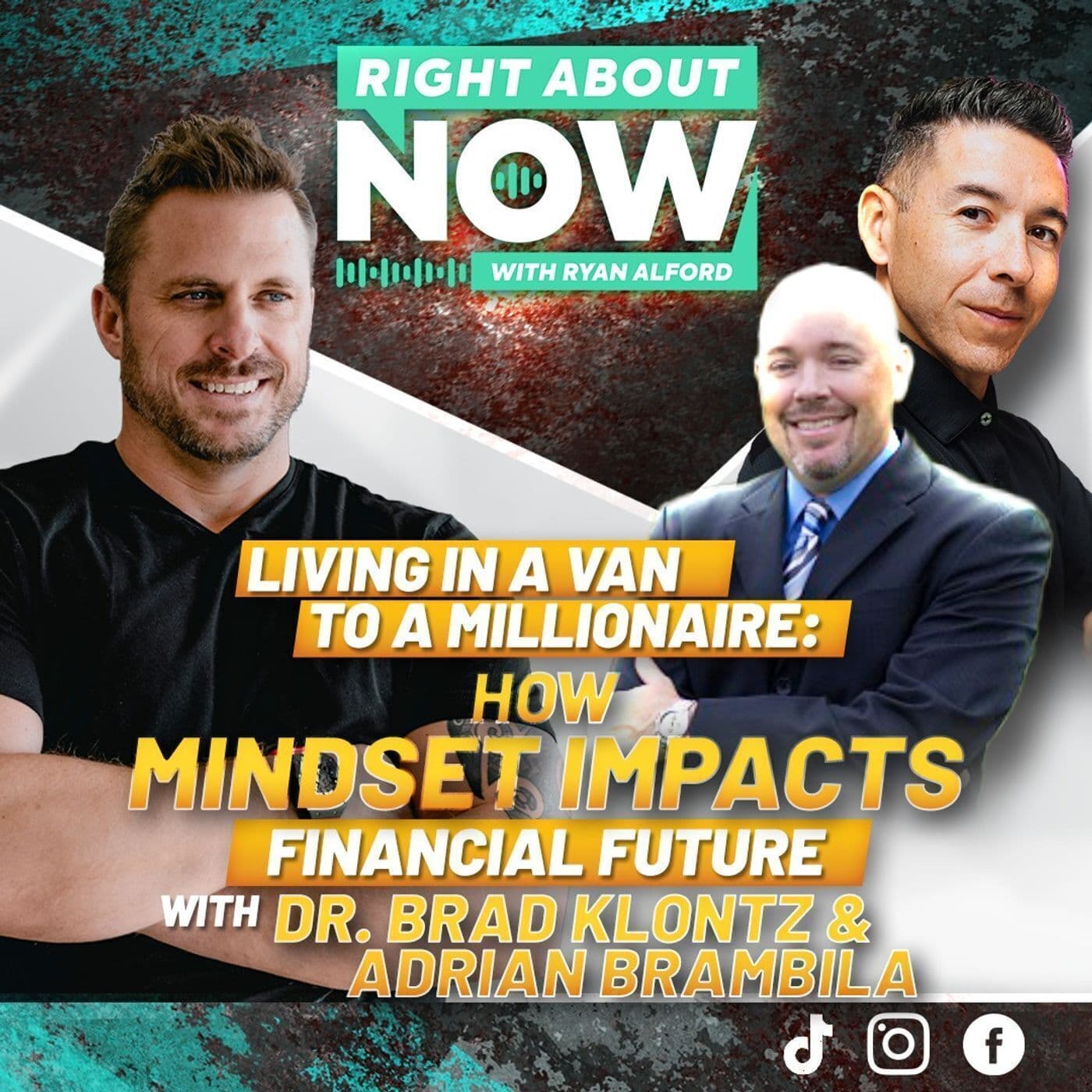
Living in a Van to a Millionaire: How Mindset Impacts Financial Future
Adrian Brambila and Dr. Brad Klontz explain why mindset beats income, the difference between broke and poor, and how to actually keep the money you make.
- Adrian Brambila made $1.7 million the year he lived full time in a van and saved and invested 95% of it, proving wealth is about owning time and investment income rather than visible luxury.
- Separate "broke" from "poor": broke is a temporary state of having no money, while poor is a mindset that can persist even among high earners and lottery winners.
- Roughly 50% of people earning six figures live paycheck to paycheck, so earning more without saving and investing does not create financial freedom.
- Wealth requires all three skills - earning income, living under your means to save, and investing with diversification. The Austin founder who put an entire $13 million exit into Bitcoin is the cautionary case.
- Adopt an internal locus of control: blame yourself for outcomes rather than bankers, politicians or the economy, because self-blame is where control and empowerment come from.
- Beat writer's block by talking instead of typing - record conversations about each chapter, have an editor turn them into drafts, and use AI to summarize and condense ideas.
- Use social media as a research tool: test chapter titles or product ideas publicly and keep the ones that generate the most controversy, engagement and revealing misinformation in the comments.
- Financial freedom does not solve health or lifestyle problems - once money problems are gone, you have to learn how to spend on gifting, impact and experiences and take care of your body.
They think wealth is Lamborghini. They think it's flash. They think it's private jets and cars. And here I'm the opposite. I'm a minimalist.
our essentially our premise here is if you don't have the right mindset, you're never going to have the money.
And it's so empowering to blame yourself. It's so easy to blame other people.
our premise here is if you don't have the right mindset you're never going to have the money. You say money can buy happiness. That's a hot take and we actually agree. We say that. This is right about now with Ryan Alfred, a Radcast Network production.
We are the number one business show on the planet with over 1 million downloads a month. Taking the BS out of business for over six years in over 400 episodes. You ready to start snapping next and cash and checks? Well, it starts right about now. What's up guys? Welcome to right about now. Hey, we're always right. At least we think so. But we're definitely right now. We're always bringing you what you need and sometimes what you want. You know, that's why we put it in that order. Because look, you got to do the things that'll get you where you want to go. And that's where I'm pumped today. We got Dr. Brad Clance and Adrian. Brand Bill. What's up guys? Hey, thanks so much for having us.
Hey, hey, I'm glad you guys are here. You know, they say health is wealth. Well, wealth is wealth. We want to talk about how to build it. I know that's what you guys are talking about. We got an upcoming book. Start thinking rich. If you aren't already thinking about, hey, you know, Jay, say you would come what you think about, right? Literally. And so we need people think about money the right way. Gentlemen, really appreciate you guys coming on the show. Let's set the table for the audience. And I think some of you guys might recognize you from TikTok or something. I don't know. But let's set the table. Who are we, Brad? Who are we, Adrian? Yeah, I think most people that I've heard of me is when I was actually living full time
in a van during the pandemic. And the year before that, I've been creating content a long time since 2010. I actually used to be a pro dancer for tea pain. So my first YouTube channel back in the day was teaching people to dance the robot. But it's when someone knows me from there, I'm like, wow, like you're a long time follower. And I love you for that. But I got like almost two million followers. It felt like overnight when I was documenting van life. And van life wasn't just an SNL skit anymore. It actually became a cool trendy thing. And I just happened to be doing it at the time. But what happened in that process was I've been doing online business for a while.
And I would share, hey, I'm actually a multimillionaire. I live in this van. And I've been documenting every dollar I've made since 2012 my first 45 cents. And the numbers are just hired. And at the van, I'd be like, hey, I just made $100,000 this month. And I live in this van. And so naturally, the response of that was this guy is full of shit. This guy has to be a scam artist. There's no way a millionaire would choose to live in a van. And then that's when my content started to change because I realized that people have this really wrong perception of what wealth is. They think wealth is Lamborghini. They think it's flash. They think it's private jets and cars. And here I'm the opposite. I'm a minimalist. I'm part of this thing called the fire movement,
financial independence retire early. That year I lived in the van and made $1.7 million at that time. It was the most I ever made. And I saved and invested 95% of that, which is crazy to me. And now I don't live in the van. I have a nice home. I have a cyber truck. I have nice things. But I still am like an intentionalist. I'm not this blind consumer. But I started to change my content. I started. I realized that people have this really terrible perception of what becoming rich is. And it's actually not about objects. And in that minimalist perspective, I think the more stuff you own, the more it owns you. And I think if you're wealthy, it's okay to have nice things. But wealthy people, they don't trade their time for it.
They're buying investments and they're living off that investment income. And that's I think a message that I started connecting with Dr. Brad Clon's because even though our backgrounds on paper are totally different, we were talking about the same message that wealth is about owning your time, having financial freedom and having the choice to do what you'd like to do whenever you'd like to do it. I love that. And Dr. I'm going to pause for a little take because I got to say a couple things with Adrian. There's two things. Number one, I need to be taught how to dance. My wife would be really appreciative. If somehow, some way, I don't know if it's like universal. I could use it. I have a big dude 65270. You know,
like, I'm nimble, baby. I jump. I'm athletic. But man, the dancing just never quite got there. Can we make that happen? I think so. You know, I thought over 15 million people had a dance on my stuff. And actually, I would have a couple bodybuilders. You know, you look like a bodybuilder on this podcast. You look really stocking fit. These bodybuilders, when they would go up on stage and they would flex, they would start to do these little robot dancers and flex their muscles. And I think if you, if you feel like you're a bad dancer, the robot's great because you can be stiff. I feel like I can be taught that better rhythm. I don't know. Like I'm, you know, I can play guitar. Like my dad's got a lot of rhythm. Like it's a lot of musical stuff. So I
feel like I could get there. But yeah, I guess it might just have to, you know, get tighter with the muscles. And last thing is when I hear van, all I think is Chris Farley, a van down by the river. That's true. Like living in a van down by the river. Yeah. And I remember that right. Okay. Yeah. I love that. I love that. I would get a lot of trolls. I would comment that. And I love that. I knew it was the joke. And I would say, yeah, it's down by the river, river of gold. Yeah. Hey, the point is you got the last laugh. They might have 11, but nobody's laughing anymore. All right, Doc. What's up, Brad? Tell me what's your store, brother? All right. Well, first of all, I'm Dr. Brad Klantz. I'm a TikTok superstar.
And my side hustle is that I'm a doctor and a professor. And I do all that kind of stuff. But really, my for the last 22 years, I have been obsessed with researching the psychology of wealth. That has been my entire career. Looking at what separates the middle class from the ultra wealthy, what separates the ultra wealthy from billionaires, what separates the poor from the middle class. So that has been my pursuit, my professionals pursuit. And it really comes down to the fact that I grew up poor, just to be blunt with you. That's why I got really curious because being poor sucks, which is actually the intro chapter to our book. And I actually wrote this book and I was super excited to pardon with Adrian around it. We've been friends ever since I was watching his content
living in a van. And he's watching mine. And we're sort of saying the same sort of mindset stuff. Because our audience has a lot of myths about what it takes to become wealthy. The mindset it takes, even the strategies, and then how wealthy people actually live their lives in what they truly value. And social media lies to people about exactly that. And so our entire mission here is to try to give the harsh truth. And we put this together in a way that really resonated on social media with our posts around trying to break through the noise and wake people up around how their thinking really sets the stage for their failures and successes. And then we try to dive real deep into rooting out what are these mindsets that chronically
trip people up? And how can we shift them in the direction of success? So I'm super excited to be chatting with you about it here. I love that. And you know what? The power of the internet, man, like coming together social media, the internet, like the stories, the ways that people come together, you know, we, you know, we all know. And just like we get, I guess, on both sides of this coin, you just gave a really example of how social media lies and does things. And it's a terrible thing in a lot of ways. But at the same time, like it can be used further good so that then you guys can inform, there's a weird dichotomy there. You met on something that's sort of lying to you,
but at the same time, then you can bring the truth. Right? That's great. I love that. It's true. Like, you know, you're a marketer at heart. So am I? These, these are platforms that give you, give you so much scale and the message. And once you realize the power of that, now it's the person behind it. Is that a good person using that loud, you know, platform? And the truth is, not everyone's good. Or if you want to get the benefit of the doubt, everyone has good intentions. But not everyone has a good message. And you know, one of the things about finance back in back, I think when Brad and I really started owning on the finance community on TikTok was really early. And he had all these teenagers that were telling you how to get rich quick from these NFTs and
Bitcoins. And then there was actually a story that went mainstream where a kid who started leveraging on margin on Robinhood, he had racked up like over half a million dollars in like overnight. And then when he woke up that next day, he wrote a suicide note and he killed himself. And so to me, that kid was a product of all the bad messages of how you get rich quick. And so like, it's that tragedy and it's that sorrow. It's also that pain of man, we had to be a good force. We're the good people we have we have if you have a good message, you got a good business, good product, you got to get loud because if that's what's happening to all the other
people who have maybe good intentions, but they're listening to the wrong people. Yeah. And it brings the mind of concept for me and marketing as well that I've always preached, but it's it's been popular or unpopular depending on the time I've been doing this for 20 plus years. So it's like comes and goes performance marketing kind of killed this whole thing branding takes time and short termism is a disease. And what happens is we've become we have so many things social media, Amazon, we have instant gratification on so many levels that we think it applies to everything. And good good things sometimes take time and it's not well being the old man like you just got away, you know, I'm not saying that it's way faster than it was, but we have this disease of
short termism that we think everything's going to come or we can race you the race to the bottom to create a transaction, you know, when it on mark when I think from the marketing side and then the same thing with earning, you know, like it's great that, okay, you're stocked up all often. It's kind of like what I've talked about like housing around it here at Greenville, house I sold for 500,000 like eight years ago went for 1.8, no updates, no changes. Like it's 200, it was like 278% increase with no upgrades. And a nine year, eight year period. And I'm like, is that is I was like, I'm a progress innovator, you know, but I'm like, is that a good thing? I don't know. Anyway, point is short termism is really a problem. And it feels like you guys are kind
of getting it that on some level. Yeah, absolutely. It's a huge problem. And there's a concept in psychology called relative deprivation. And it plays out in social media all the time. And so essentially, we don't know whether we're rich or poor or financially happy or not until we look around at what other people have around us. Like you're in a you're in a real poor village, you got five goats, all your neighbors got one, you're going to feel rich. You're going to have the experience of feeling rich. And one of the tricks with social media, like during the pandemic, this was this was really profound. I know you got kids, I got kids and I'd be sitting back in the pandemic looking at looking at Facebook or looking at Instagram and seeing some dude, you
know, sitting on a couch, sipping coffee, reading a book, you know, and I'm like, damn, I wish I could have some of that experience during the pandemic. Meanwhile, people who were separated from family who weren't in relationships are looking at, you know, a couple, you know, sharing the pandemic together in apartment and they're feeling like, damn, I wish I had somebody. And that is the psychological experience that you got to be aware of on social media is the sense of relative deprivation. And really defining what wealth and success is for you is going to be super important because if we we're talking about it before the show too, if you're like, look, if if there was an object you could buy right now that would give you sustained happiness, I would be promoting it
right now. And I guarantee you, Adrian would be an affiliate for it and he'd be making millions of dollars. But it's just not the case, right? And so if you have this attachment that certainly material items can make your life better. I mean, we all have we all have them, but it's not going to solve those big those big issues for you around like purpose in life and why are we here? And the need to be loved and to love and to throw your time into some sort of passion and pursuit. And so that's, you know, social media is great in some ways. In other ways, it feeds us with this sense that we're missing out the phomo, the deprivation. And so that's a mindset you got to get
straight or any any money coming into your life is going to go right out to a liability and not building up assets and that wealth you really want to build for yourself. Yeah, spot on right there. Talk it with Adrian Brabilla and Dr. Brad Clontz, their authors of the upcoming book start thinking rich guys. Before we get into like maybe some of the building blocks of the book, I'd love to know and it might be interesting to you for the listeners like what was the process? You know, being remote like writing a book together like maybe talk a little bit about that journey. That's interesting. A lot of people that probably think about writing books are doing things, but doing it together or being remote and the way you guys came together or anything interesting
there, I'm sure. Yeah, I think Brad, he's seasoned and I'll leave the more experience because this is a ninth book and he'll tell you it's his favorite and best one. For me, it was my first time creating a book and I was very intimidated. I'm not I'm not a writer, but now I am. I feel like I can I feel good. These are skills that didn't come easy, but I'm I love talking maybe I talked too much. So one thing we did was that to help me because I always felt like if I was going to collaborate with Brad, I'm going to slow down the process and this is I think a great tactical tip and I because I think everyone should make a book. We all should make a
book is if you if writing is intimidating, so you're not staring at a laptop with a dashing cursor on a word doc. Talk about the chapter. Create it like basically like Ryan, you probably I don't know if you've already done this, but I know it's coming like you could turn every single interview and turn all the podcasts into a book. All the knowledge that's in here that we're talking right now like it's it's like that's that's one of the easiest ways and you could you could then digest you could now we have AI that can auto scripted and you can turn the AI into make a summary. This is not to essentially have AI write the book, but it's helped to condense the idea so you
don't get writers block. So if you're better at talking, you can do that and that's one way that we kind of leaned into it. But I think a now marketing approach that you're going to let you really dig and Ryan is is every single chapter title we tested through social media. This is the advantage of creating content you build an audience versus kind of Brad and I thinking hmm, what should what should this chapter be? Nothing was ever like finalized to an instinct. The instinct was like what do you think about this idea? Let's test it. So we would test at we tested hundreds of different chapter titles and the ones we selected had the most controversy, the most engagement and the most kind of comments and stuff. I remember one in particular
was I think one of the worst ones was if you want to be rich, you have to get rid of your poor friends. So this was like out, tough. And when I posted it, what happened like within almost an hour, a thousand comments are reached like 300,000 people and people are saying I'm evil, what an ass. And and then we break down, you know, what we really mean most people if you don't if you don't agree with that, but you agree with you're the average of the five people you're ashamed of by it's the same concept, right? So if you're and poor, we also define is not is a mindset broke is a temporary state of having no money. And we're also never talking about,
you know, poor is not, you know, we're the quality of life is priceless. We're talking about economic value. We talk about like poor and rich, but every single one was tested. So we test a lot of ideas that flopped and the ones we kept ended up being chapters. So every single chapter is almost this like really great headline that's going to elicit an emotional reaction and response and then the chapter itself is in the love part. So it's almost like, you know, we call it harsher truce. Like one of the other ones was like, you're not allowed to use a credit card. If you can't pay off the statement balance for every single month. So again, people like that the comments are like, you're what? Who are you to tell me what to do? No one likes being told what to
do. So again, it's that it's the phrasing of language because you look at every other money book, we could just wrote how to use a credit card at boring. Like how to save an invest at boring, but we, you know, with marketing and data and social media, we created, I think, 21 really great kind of a chapter is from it. Let me ask a question about that. That's really interesting. I'm not now you know, I'm marketing a thing, but I'm, you know, I'm thinking of two things. Never you're using like what were the most popular or the ones that got the most engagement? It was a combination. And one of them had to do with the most delusional comments too, because that's sort of like, oh, whoa, people, like we were shocked and we actually have it in the
book with the whole credit card balance thing. The number of comments on there that were claiming that, oh, you have to keep a balance because of your credit. So I mean, we were so flabbergasted by the misinformation and the lack of understanding around how it worked. That was a big driver for many of our chapters too. And so we, we sketched ideas like we have these like fundamental truths that we run into all the time that people are struggling with. And then it's like how do we frame it in a way? You know, I'm always worried that like my, the dean of my university, which I'm not going to name is going to find one of my TikToks and be like, what the hell are you
doing? You know, because we're trying to reach a message and to an audience. And so you got to frame it in a way that people, the way people up. And so like each one of these chapters like a big old slap in the head. And Adrian and I both have fathers who raised us that way. You know, it's like they're just going to give it to us straight. And for me as a psychologist, right? Like I'm, I'm good with your feelings, Ryan. You know, I'll give you a hug. You know, we can, we can cry it out, brother. You know, and then when the after you're done crying, I'm going to shut the door and I'm going to say, okay, Ryan, right? Here's the real deal. You know, yeah, exactly. And so,
so for me anyway, it's right on brand for me around like, hey, we love, we love the reader so much. We're not going to beat around the bush. We're going to give it to him straight. We know they can take it. And then the chapters themselves are really about why it matters. And frankly, all the research behind it too, like we're not making any of this stuff up. This is all research based. And that's sort of my nerd background around around that. I love the psychology of that. That's why it's a good team here. We got because I mean, marketing is psychology too. You know, I told people a time it's it's 90% you know, instead of human behavior, people think with their head and they bow with
their heart. That's right. And I'll say to the book writing like, hey, look, life is short, you know, and I want to spend the time with the people I love and admire and I learned from. And so for me, Adrian, we're friends before this. And I thought, you know, you know, it would be great. It's me spending a year hanging out with Adrian talking through these ideas. And then we just hit the record button and we sent it to an editor who came back with like a rough draft of the chapter. I mean, don't let writers block stop you from from doing something like this. So we didn't let that stop us. And we spent our time really fleshing out the ideas, not hammering out the exact
sentence structure to begin with because that'll just keep you stuck and never write in a book. Yeah, there's I mean, there's going to be resource now. I got to do I have I have a notes app, you know, the note on your the all iPhone. And I have literally a full page of book titles. And some chapters are already done like I just I got to do it. There's a big resources now. And I'm pretty good writer. So I'm kind of that's kind of my thing. So, but I mean, they're getting help like I can't worry, right? I get I have the concepts already there, you know, like the big ideas, a couple of different, some of them are completely off the some of remarking related some of them aren't. I'll throw one title at you just really quick.
Racing a brand in the world of NIL, what you should do to maximize your child's potential. I like nice. That's awesome. Racing a brand. Oh, my goodness. Better trademark back before he has the phone. You're doing it right now. That's awesome. Yeah. Okay. You guys are really smart. So this is your show about your book, but I just wanted I got a I got a doctor. It's like college is a super smart marketer. Van bound by the river guy that's made more buddy than anybody ever thought they could in the van. So yeah, I appreciate the the feedback. It's got the response I've gotten for most, but you know, there weren't a lot of them. I was not as smart of you guys.
Start thinking rich. Okay. We've talked about the how, the wear a little bit and the why. Let's talk about the what? What what what are we getting here? Obviously, it's, you know, start thinking rich is, you know, somewhat self explanatory, but I love that I think it was you doctor talking about the poor mindset or my I don't know who it was. Adrian or doc part both you are both saying a lot of smart shit, but like it's that poor mindset, you know, start thinking rich. It's not just the money, right? That's my story. My brain was first thing I started to start thinking because thinking rich, I'm not thinking they say the money. I'm thinking the tactics, the strategies, the psychology of rich is where I went. Yeah. So it's it's the whole
package here, but our essentially our premise here is if you don't have the right mindset, you're never going to have the money. And we talk about poor as being a mindset, you know, we're not here to insult poor people. I was poor. I still have aspects of a poor mindset that I'm still trying to eradicate from my brain, but broke is that not having any money and a lot of people have had it and we don't want you to be broke anymore. And the we know people who make a lot of money have a poor mindset, like their stories all over the place. You know, I've worked with many athletes and stars over the overtime musicians are actually terrible with this too. They're artists. They don't want to think about money. And they always think that this hit is the first
of many. And for most of them, it's it's the first and last. I mean, that's what happens statistically. And so if you don't have a rich mindset, that money is going to come into your life and it's going to go right out the door. And so we got we know people making lots of money who have a poor mindset. And so for me, it's you got to have the mindset. And part of that is the specific beliefs that are associated with growing a business, you know, becoming successful. Psychology's done a lot of research on that. And I'll give you one that's probably I think the most profound. And we have a chapters that relate to this. But it's called in psychology, locus of control. And this is such an important critical aspect. By the way,
it's the number one thing I'm trying to give my sons. It's like, if I could give them any psychological mindset. It's this one right here, locus of control means the location in which you attribute the reason why you're getting what you're getting out of life. So you have there's an internal type and there's an external type. The internal type says that like for me, oh, I lost money in the stock market. It's like, okay, it's because I didn't know what I was doing. It's because I was approaching it wrong. It's because I didn't have the right education. I have to blame myself. If I blame greedy bankers, if I blame the economy, if I blame politicians, I am sensing myself to a life of misery and suck. And so that's what you really want to avoid. And so
we lovingly say try to blame yourself for everything. And by the way, every time I say this, my wife is like, yes, Brad, blame yourself for everything. Because I agree. It's your fault. That's what I was thinking, you know, but we're always working on me.
But I was like, there's nothing more miserable than hanging around one of your buddies and they're like bitching about their wife, you know, and what she's doing and what she's not doing in this or that. And if you're a really good friend to that person, you say, dude, shut up. Like, what about you? What are you doing? It is so empowering to blame yourself. So like, if I look at, for example, my wife, Joni, if I look at she's in a real bad mood and she's complaining about something I did or whatever, I could pin that on her. I could actually look at myself and say, well, am I doing what I need to do to connect with her? You know, am I doing some of that stuff I know
that I used to do when we dated to show her that I love her and I'm giving her attention and I'm making her feel special? Or am I just sort of expecting that I deserve it because I'm married to her? That's just an example. And it's so empowering to blame yourself. It's so easy to blame other people. And so when it comes to business, when it comes to finance, when it comes to all of it, I'm success in every area of your life. So by the way, this concept has been studied by psychology for decades. And if you want to have a better life, blame yourself for as much as possible. Bottom line. Oh, man, that's a big one. And you really must have talked with your sons, you know,
like that is because they're so prone to go, you know, but this or that or if I wasn't here or wasn't there, you know, like it's a, I don't know. That is a disease in itself, unfortunately. And I think it is, I don't know if it's nature, but there's a lot of nurture in it. I think like it's, you see it, the, you know, everything around you is sort of because how many people, you know, leaders included around us are really taking it on the chin themselves, right? It's all out, it's, you know, all outward, outward, not inward. That's, that's the key lesson there. Well, that's how you get elected. It's like, I got, if I wanted to run for office, I would tell you
how none of the problems can you solve. It's me. I can solve them. You need me. And so there are peddlers of this disempowerment. There's peddlers of this helplessness feeling and you got to watch out for those people because they will keep you stuck. And we all, and all this to say, the world is entirely unfair and there are so many people out there who are doing the wrong thing and will take advantage of you and whatever. And so that's, that's the challenge because you can always find someone to blame and there they are and they deserve it. And you got to ask yourself, okay, why did I trust them? You know, you got to look, you got to turn it around yourself. Why did I go into business with this person? Was I, was I attracted to the flash and the false
promises? Did I believe things? I shouldn't have believed because I was, I had a scarcity mindset. Now it's worried about being important. You got to dig in there, especially when other people are doing bad things. Yeah, yeah, for sure. And I, I'm a saying's in a, you know, I guess patched the marketing thing, but like a saying's guy, my, my favorite that I'm on right now is you, they're find an excuse or you find a way. I love it. That's like, I'm using that one a lot. There's a lot of my content, but I love that. What else we got? So we've got the, we got to take all the blame ourselves. And I mean, with blame, though, but is empowerment, right? I mean, there's nothing more powerful than, yeah, you go, I got to take all the blame. Well,
guess what? You get all the control too. That's a powerful thing. Absolutely. And I think once you have that, then I think an oversimplification of how to become wealthy is to think of these two skill sets. You have a rich skill set and then you have a wealth skill set. Rich skill set is your ability to earn income. And we have a lot of top income earners. Data will say that 50% of people that make six figures actually live paycheck to paycheck. So a lot of people and I think business podcasts and content, they always focus on this first part of this wealth formula, which is rich skills that make more money, make more money. But it's clear from data that there is no, it doesn't matter how much money you make, you still have
to know about wealth. And that wealth is made up of two parts. From the money that you make, how much do you save? And then this, this is really the, the world we live in today is a consumer-based world where we have to get the bigger, the better, the faster, always upgrading. But living, having a control of your desire is such an underrated thing to say it's not sex at all, but like live under your means. That is how you save. If you're right now, you got to, maybe you're driving a car that's too nice, even if you have I income, because like you could just, I mean, I think the best thing is if you are making a high income and you're in an income
earning a year, and all of a sudden you're spending your time on Zillow, and you're like, hey, I can finally afford a million-dollar house. That's great. So what if, what if you start doubling, tripling or quadrupling your income? You know, instead of looking at the million-dollar house, you know what people do? They're like, oh, you know what looks better than the million-dollar house? A five million-dollar house, right? So there's always, there's, the world is a vacuum. We'll always, no matter how much your income people can lose it. Another data point to that is that people that win the lottery, hundreds of millions of dollars, five years after 70% of them go back to zero. So is it a money thing? No, it's a mindset thing, and it's that wealth skill set.
And then the last part is investing. In Austin, Texas, I've actually met someone that was a perfect example of someone who had a super high income. He actually was a famous blogger in the tech space, and then he saved his income. So he's super great. So he's got two out of the three. So you think he's set financial freedom? No, because he told me when I said, well, you just exited your company, and I think he exited for like 13 million dollars. So what are you going to do now? He's like, well, actually, I invested it all in Bitcoin. It's not doing so good. This was like a ripe, ripe, like, after the crash, whatever I was talking to him, the last big crash. And so
that's someone to me, and he didn't say a little bit. He said all of it. So now you have someone that's a high income earner. Yes, they're saving, but then when it comes to investing, they have no idea what like what diversification is. They have no idea on like hedging their bait. What's speculative investing? That's alch extra high risky versus like conservative. And so like now, even though he was so successful at those other two, he's basically like, unless he changes his mindset, never going to be on attractive financial freedom. So it really is acknowledging that there's three different things you have to get good at. And you can't just earn your way to financial freedom. You can't just save your way to financial freedom. And you can't just invest your way. You have to
do all three. I love the other side of the coin because like you nailed it. I'll start where I'll start where you started. And that's like, there's a million things out there for how to make, you know, money like that side of that coin. But if you're not keeping it, you know, this not compounding or you're not keeping it, then you're going to be in trouble at some point because you can all come in. And I always like to say, you got to fall, you got to fall in love with making things and one of them's money. Doc, what else we got in the book? So we've got the psychology I heard at the beginning, we've got the making and keeping money, which is the big part.
What else will we get from the book? Yeah, so we're we're trying to blow myths to like so we see all these lies about it. And so, you know, we're trying to tell people that, you know, only broken insecure people are the ones flexing luxury brands. So one of the most viral TikToks I ever had, I was following my son. We're in a Vegas casino and I got the camera behind him, you know, and then he's walking through the casino and then I do a little voice over, right? And I say, hey, my son's only 10 years old. And he already knows that the only people flexing luxury brands on social media are broken and secure. And oh my god, the hate I got from that one. But literally that's what I'm
teaching him. And so one of the fascinating things, now look, we already talked about this, we all got nice stuff, we like nice stuff. But you got to ask yourself, like, who are these people that really, really are doing, you know, the labels? Like I live in Boulder, Colorado right now, you walk around, these people are the wealthiest people on here. And nobody's, nobody's flashing all that stuff, you know, they're just not doing it. And meanwhile, when you go back to my blue collar upbringing low income, everybody was doing it. You know, that's where all the gold chains were in my high school. They're not over here in the high school with all the rich people in Boulder, Colorado. It's a fascinating concept. And so just understanding the psychology of all that,
understanding that that goes back to prehistoric days of people trying to establish status. So you got to understand the status game. And the big mind bender here is how ultra wealthy people actually tend to spend their money. And this is fascinating, because we've researched this, we've done research on over 100,000 people related to this. And in general, the people who have the most money are the ones who downplay how much they have, you know, they do. For many reasons, you know, they don't want to get hit up. I got, I unmistakably answered my phone yesterday and somebody's asking me to like fund their business. And I was like, oh, damn, that's why I don't answer my phone. But you know, it's, yeah, that's from Uganda or wherever. Exactly. This was a poor kid in Wyoming. I'm like,
how'd you get my number, man? I have to change my number again. But it's like, you know, you got to understand that that the wealth mindset really is about holding it, keeping onto it. And study show that, you know, most, most millionaires are self-made. So that's the first buying bender for some people. And by the way, it's great, great news, isn't it? If you didn't grow up a millionaire, that should be empowering and exciting. That shouldn't make you mad. You know, some most people got it that way, but they also had this mindset like they had a rich mindset. And so one of our chapters is you don't want to become a millionaire. You just want to spend a million dollars. And this is our intervention on you, man, because it's like a poor mindset looks at that million
dollars. You can ask people, we've asked hundreds of people this, what are you going to do with it? You know, well, I'm going to buy a house for my mom, you know, everything she did. I'm going to buy a car. I'm going to blah, blah, blah. By the time they're done talking, you're like, you got no, you have zero dollars. Like, it's all three million. It's all done. Meanwhile, meanwhile, that rich mindset and the one we're trying to get people to wrap their head around is that rich mindset takes that million dollars. It's like, oh my gosh, it wasn't counting on this. They invest it. They take out like using a 4% rule. For example, they take out 40,000 a year. That's what they use to invest in that business. We're all business owners. I have some successful
ones, but I probably got two fail in right now. You know, statistics show that your business is going to fail. And so the poor mindset is, I'm going to take this hundred million. It's all I got. I'm going to put it all into this business. That's that's not how it's done. You know, you hedge your bet. You take out that 40,000 year build up a house payment over a couple of years. So we're really trying to to wake people up to this concept. Yeah. I love this start thinking rich. Keyword thinking. It's not start being rich. You know, you get to be rich. You got to think rich. And the more I hear you guys talk, the more I feel like this is not just a, you know, a wealth book.
This is a, and I should know we got a psychologist here, but like this is, this is like how to get ahead in lifebook. That's what I'm, because I'm hearing application in all walks of life, relationships, money, internal, external, like there's a lot of applications to this.
Yeah. Thank you for saying that. I feel like we, we talked through the lens of money because we, you need money. You have to know and understand money. And I know one of the reasons we wanted collaborate with you on your website, you say money can buy happiness. That's a hot tick, right? And we actually agree. We say that because, because people that, the only people that would disagree are people that have actually never been broke or poor. And I just think of people like my dad who, yeah, my dad who immigrated when he was 13. And I feel like I adopted an immigrant mindset from him. And he came from Mexico, even though I didn't immigrate here. And what I mean by that is he
has shared his struggles and pains where he actually went to bed hungry, where he actually had to steal food. And these are things that when you think about can money buy your happiness, like if you're struggling to put food on the table, and that's a problem, I don't think I'll ever face like that he would have loved to have that money. And just to not go hungry, it's really hard to operate when you're hungry. Like I get angry if I miss a meal. Like my dad went, you know, a day or two, like in multiple periods of the time. So this idea that money can buy happiness is really interesting because when I was 21, I'm 35 now, I, and a lot of that, that's when I started
reading about finance books. And a lot of the finance books would quote this very popular study, I'm not sure if you've heard it Ryan, but it talked about how your level of income kind of goes with happiness and fulfillment until $75,000 a year. And then after that, basically the income that it would, what you'd have to do to require higher income than that actually is a decline in happiness. And this is one of the most quoted numbers about income and happiness because it's hard to quantify. But now that was over a decade ago, inflation, things are more expensive. Let's say we doubled that number to 150,000, we actually take this standpoint that there actually isn't a limit. Like actually, depending on your lifestyle design and how good you are at
living your life, which actually is another skill set. I believe the more money I can say personally that I've made, I am, I am happier than I was. And now I have to go back to when I was working at a call center and making minimal wage, trying to do this YouTube thing, not making any money. I still enjoyed the game. I enjoyed the journey. I enjoyed the process. I wasn't like a bitter person. But now that I've had more money, I've enjoyed the process. I don't think there's actually a ceiling. And I think the $75,000 a year Brad can talk more about the data behind it. It was this false illusion that of based off like middle class. And so, you know, it's crazy. But I think
the more money you make, you can actually be happier. Amen. Because I mean, it's leverage. It's not, I think of my life in a lot of ways like leverage now, like almost everything like I do. I mean, not, not negatively, but not transactionally. It's just like the leverage that it allows by certain activities like, you know, I mean, being a good human being, you know, affords you a lot, you know, like, and not just because to be a good, but because you have moral compass and all those things. And then, you know, like, I think for me time is money, you know, like having the free time for boys go to every game and practice. And no one could tell me otherwise. You know, I might that could change one day. I'm not so arrogant that, you know,
something couldn't go wrong. But I worked pretty damn hard to have that freedom, you know, to do those things. And I think it's all mindset in a lot of ways. I mean, this is as much mindset as anything, but Doc, I'd love to hear your perspective about that study. Oh my gosh, you know, I, I really, really haven't boys and myself in the sports. And I coach every possible team that I can because I learned early on, you know, that one of our chapter titles, poor people buy stuff, rich people own time. And essentially, that is our definition of wealth, you know, and Ryan, I saw it on your website just as we're popping on you. That's yours. You know, like, it's, it's owning your time. And it's okay to buy nice things. And, but you don't want to sacrifice
your time for it because those things aren't going to make you happy. They're not going to make you happy. And so if you can wrap your head around that, then as you start to build up, you can start owning more and more of your time because that's really where the happiness comes down. You know, we all know we've all heard these studies of people on their deathbed, you know, they're not, they're not talking about the more stuff they wish they had. You know, they're talking about the time they wish they had to do what they want with who they want, how they want. So for me, that's that has been my focus. And that's really what we're trying to teach people because it is that's if you have the attitude like, I'm going to buy my time, you are going to become a multi-millionaire.
Just plain and simple because because in order to buy your time, you're going to have to develop assets and investments and draw income from that. Just that mind shift in and of itself, then go ahead and buy stuff. Nobody cares. Like the stuff isn't going to make you that happy. I mean, we've all had that experience. We've had a birthday. Man, I think that's your most exciting birthday as a kid. You got that thing. You're wanted it. You coveted it. You save for it for a year, whatever. We just become accustomed to it. That's just the way we're wired. You know what I mean? So I thought there, you know, like not to be more bitter, but like to that end, how much money would Steve Jobs had paid for two more years of living? Like how and how much would
any one of like if you were told today, like we all knew when we were going to die and you know, we all like to think times forever, but it's fleeting. It's the most valuable asset we have. But what would you pay if they said you're going to die today? Whoa, whoa, whoa, but you can buy another year. How much would you pay? Would you give it to your bank account today? I would. Absolutely. That's a great, that's a great question. I'll add another one too. What would you do with those two years? That's, you know, that's part two of it. That's it. Yeah. What would you pay? And then what would you do? You know, if we all lived that way a little differently, you know, like we all start. It was a song, country song by my man,
Tim McGrawl, live like you were dying. So true. Great song. I'm from the South, baby. I'm a country boy. That's awesome. I live like you were dying. I think there is something to talk about now. Let's let's imagine the listener has now finally, they've done all these things. Maybe they're there right now or they're, they're on track and they fill out momentum and maybe we're just a couple years away and finally you did it. You have financial freedom or some people call it FU money. You have, you have the feeling to choose what you'd like to do. My friend post Malone calls it that. Yeah. So, so now life actually isn't all solved. So financial freedom means you don't have money problems, but there's still a lot of other problems. For example,
you've ever seen a really rich fat guy. Right. It's true. Right. If you are financially free, but now we talked about early in the park as health as well. Like, you have to take care of your body. Like, and I actually think when, so I lived in Ireland. I was 29 years old and that's when I finally, be a hit a million dollars in my net worth. And I was like, I did it. I'm a family millionaire. And my body was soft. I mean, I was drinking Guinness every day or so. It's like, I wasn't taking care of myself. And I actually thought like, what man, I actually have no excuses anymore. Like, when I worked in a nine to five job, man, I had tonics. I don't have enough time.
I'm stressed from work. But now that I'm financially free, it's like, man, I got no excuses to take care of my body and health. I need to sweat every day. Like, it's my, if I own my time and, and I, and I look really soft and obese, like, it doesn't make sense for me. And I also think the art of living, and I'm just going to take my parents there. They're Mexican hard workers. And I hired them many years ago. And now they just started taking Social Security. They're Social Security in there. And I don't work part time for me. By the way, when I mean work for them, I hired them, pay them full time. They've always worked not that. But now, now they struggle to spend money. They're still
operating out of a mindset from 30 years ago when they had to do the hustle. And now they, because of, they have an incredible story, we talk, I talk about them in the book where now they have, like, almost like if they're working full time coming in from their income. And, and my dad, it's almost become a bad personality trade. If I take him to a nice restaurant, doesn't matter if it's the best take of his life, his answer is too expensive. It's not that it has doesn't have the money. He actually does have the money now. So, so it's this really hard shift of now financial freedom. You have to, you have to learn how to spend your money too. You have to learn. And, and, you know, we talk about the best ways to spend money. It's
usually gifting, making an impact. And then it's experience. And objects, I think, is very low on that list because they provide such a fleeting moment of fulfillment. But the art of living is also a challenge you'll have to understand, like, how do you want to live your life now that you don't have money problems? Because most people in this world have money problems. So now you're in this 1% category. And there's a lot less of us trying to operate on, on what, how do we live our life now? What's the best way to spend our time? I don't have the answer that for you because everyone's different. But I just want to make clear, like, you have to actually work on this part too. Yeah, it's all part of the equation. Gentlemen, tell me some details. We've got wins the book
release. Where's your release all that? Maybe, I think about this, like, to be out before it releases because we've, we've got your own tight little turnaround. I think no one we wanted to hit before the book came out. So what, what's all the details? So, first of all, I want to say thank you for having us. And we, you know, in researching to collaborate partners, I know you have the right rich mindset. So we want to give, I assume your listeners probably already have this. But maybe you guys don't need our book. Maybe you know someone that does, or maybe you just want to level up your games and dive deeper into this into this world of how to start thinking rich. So if you go to startthingiritch.com slash Ryan, where actually we have a ton of extra bonuses
that you won't get anywhere else. So that's for you to get the book plus community masterclass. And it's really important to go there versus go, go on Amazon so we can, we can give respect to Ryan. And I imagine if we do really well, a lot of people come from, from here, like maybe we'll be catching Ryan and, you know, we have our podcast that we're launching. Sex here, we want Ryan to be a guest too. So, but yeah, startthingiritch.com slash Ryan. I love that. We'll put that on all the social media, all the content and make sure it's in the show notes and everything else. We'll have all that linked. General, how about keeping up? I mean, you guys got some big presences on social media, some of our listeners may already know of, know you, but how about some of
those details we're to find you guys? Yeah, so I'm at Dr. Brad Clan's making a fool of myself every day because I love you. And I want to shift your mind. I'm going to get your attention on all the platforms. And that really is my passion here. Like I own an asset management company. I work with all too wealthy people. We manage hundreds of millions. My, my passion, though, is to try to reach people who want to level up, you know, whether you want to go low-income, middle, upper income. I mean, to me, it's all about mindset. As you said, I want to make your marriage better. I want to make your business better. I want to make your finances better. I want everything better in your life. And it really does start with mindset. So you'll find me there.
Doing that. Love it. How about you, Adrian? Oh, yeah. At Adrian Brand-Bila on, typically, all social media as you'll be able to connect and get nerdy and talk money with us. Perfect. We'll have all those links in the show notes as well. Gentlemen, I feel like I got to know you and I appreciate your wisdom and your insights and the value you're bringing to the world. Thank you so much for having us. Appreciate you, Ryan. Hey guys, Ryan is right.com. You'll find all the highlight clips, the links from today, all of the information from this episode. It was a really, really good one. I'm going to be out. I'm thinking I'm getting copies from my boys. Start thinking rich. Starts in the head and ends in the world. You make an impact in every day.
We appreciate you. We'll see you next time. We're right about now. This has been right about now with Ryan Alford, a Radcast Network production. Visit Ryan is right.com for full audio and video versions of the show. Order one choir about sponsorship opportunities. Thanks for listening.

Justin Brennan on Multifamily and Other People's Money
Real estate investor Justin Brennan explains syndication, check equity vs. sweat equity, bonus depreciation, and how to buy apartments without your own
Hiring Is a Marketing Problem: Nicole Feenstra
Nicole Feenstra of The DNA Agency tells Ryan Alford why job descriptions fail, how to market the trades, and how geofencing and storytelling win

Jason Brown on Options Trading, Risk and Rebuilding
Jason Brown turned a $10K student loan into six figures, lost $250K on one trade, and rebuilt. He shares his options, risk and wealth roadmap with Ryan