
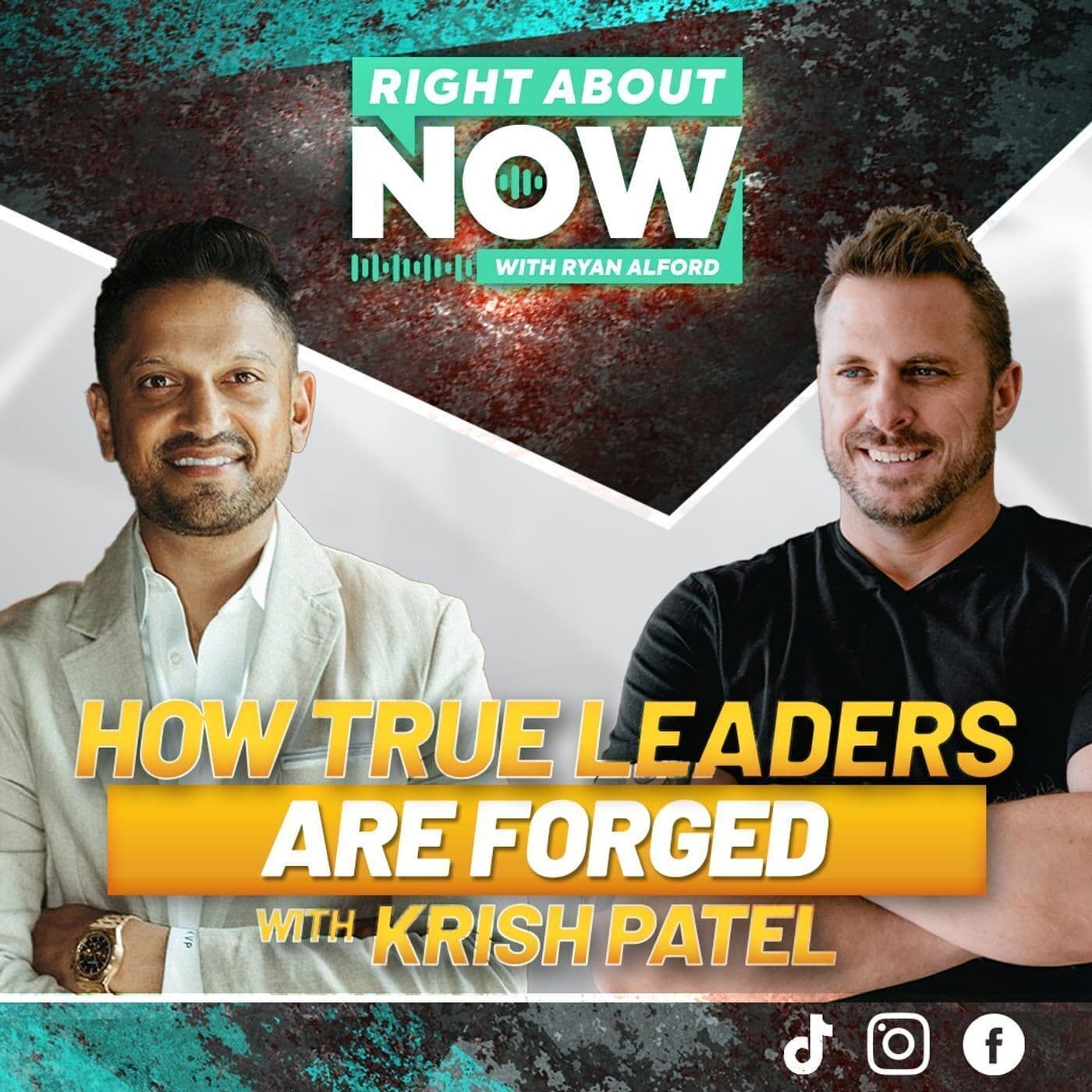
How True Leaders Are Forged with Krish Patel
Growth comes when you are doing something beyond your wildest imagination. If it's easy, everybody would be doing it and you wouldn't be challenged yourself. Problems are a sign of life. Quote by Tony Robbins. If you don't have problems in your life, you're not reaching for something bigger than yourself. You're playing the safe. This is right about now with Ryan Alford, a Radcast Network production.
We are the number one business show on the planet with over 1 million downloads a month. Taking the BS out of business for over six years and over 400 episodes. You ready to start snapping necks and caching checks? Well, it starts right about now. Hello and welcome to right about now. You know, we say we're taking the BS out of business and our next guest is both a friend we've done some business together. In the day, I just respect the hell out of them. He's the real KVP, Krish V Patel. What's up, Krish? How you doing? Thanks for having me on the show. Hey, man. It's been fun to get to know you and I was excited to have you on. But for number one, you're an entrepreneur that I really respect in our market here at Greenville
and in general. And you know, it's been fun getting to know you. But I'm like, I get to have you on the show and then I really get to pick your brain. Yeah, I get to get all the secrets. Krish is a Uber entrepreneur here in Greenville, South Carolina where I'm born and raised. And you know, I've watched from afar, you know, been, you know, we're in Krish's building today. Watch from afar him bring to life a lot of businesses. If you come driving through Greenville, you'll see a KVP sign. Maybe on every corner now. It need to be a crane because of the growth we have or all the things that Krish has got your hands into and it's got to be fun though and rewarding seeing, you know,
everything's happening in Greenville and having a hand in it, right? Yeah, absolutely. Well, you know, the thing that's rewarding is to see the progress, you know, to plant a seed and then to watch the seed kind of blossom and to know that there's been touch points when you've nurtured the seed, when you've watered it, when maybe it looks like it's especially growing in the wrong direction. Then you got a backtrack a little bit and check the roots. Now use this as an analogy because, you know, there's no building or business that just happens overnight, you know, whether you're developing leaders, team or growing a business in sales and marketing, there's steps you have to take to get to whatever your definition of success is. Yeah, and I think you're a living breathing example of that and so is Greenville, but let's set
the table for our audience. Yeah. Who the hell is Chris V. Patel? Yeah. Well, I'll tell a little bit about my childhood just because I think that helps kind of set the platform for who I am today. Prodigy. Yeah, working on that. So, you know, my parents are immigrants from India. They moved here to set sale for the American dream, came with literally nothing. They came with a couple suitcases, moved to Houston, Texas. I was born a year later and they did odd jobs for the first couple of years. My mom worked at a high school cafeteria. My dad delivered pizzas at night, worked in an officer in the day. Fast forward two years, they started their first business. They were in the liquor business.
They did that for five years and I watched that as a child. Fast forward, we moved to Atlanta. They got into the dry cleaning business and this was when I was probably age five to 12. So, I watched that. I watched them work hard in the hot Atlanta summer heat, running a dry cleaning business. And in fact, on the weekends, I would go work at the dry cleaner and work the the drive through window. And I would get like a Chris $20 bill for working the day. And all I do is you drive up and you'd hand me your ticket. I'd go pull the tag put in your back seat and that was it. So, I've always watched entrepreneurship or small business ownership, you know, at a smaller scale growing up.
We left Atlanta in 1996 to move to Greenville. So, I've been in Greenville since the fifth grade. They got into the hotel business and I continued to watch my parents display characteristics of small business ownership, of entrepreneurship, of what it takes to get the job done and how to face downturns, how to face adversity. So, anyway, fast forwarding, you know, when I was probably junior, senior in high school, I've already had six jobs by then from Holly Tree Country Club being the cartboy at, you know, like 14, 15 picking up balls, range balls at, you know, six a.m. To then getting into retail, I had, I mean, I had jobs all the time from Best Buy, Gap, you know, like I loved retail and I love working with people.
So, I always wanted to be in scenarios where I could interact. And then when I was in high school, my senior year, cell phones was like the new thing. This was kind of put a timestamp to it, 2003 to 2004. I was a senior at Maldon High and I was working at Best Buy and I thought, you know, cell phones are pretty cool. I want to see what this industry is about. I remember getting my first cell phone, probably sophomore or junior year. Was it a razor or not? It's right around that time. Yeah, razors came out a little bit later. I had a, I had a flip phone with a camera on it. And anyway, I thought, you know what? I'm going to go check out this Verizon wireless, you know, thing and see what they got going on.
I've heard some good things about them. They set up a call center in Greenville. So, there's a lot of people promoting Verizon at the time. So, I went and applied to a retail store and they brought me on. They said, hey, we don't have any sales positions, but we have a customer service position in store. So, I said, all right, cool. I'd love to learn the business within three months. They promoted me to sales because I was selling more out of the back of the house than some of the guys were on the front. So, anyway, my journey as a Verizon retail sales rep started June 2004. And I was applying to colleges, you know, all over the place. And when I took this job at Verizon, it was too good to be true.
I was 17 years old. I was making 13, 75 an hour in 2004. They had tuition assistance program. They had all these cool benefits. And I was like, you know, this is kind of too good to pass up and then just go straight to college. So, then I thought, all right, here's what I'm going to do. I'm going to ride this thing out, see where it goes, and stay local. So, I applied to USC Sparnberg, University of South Carolina Sparnberg. And I thought, okay, I'm going to go there full time. I'm going to work in commute. So, what I did is after my freshman year, I didn't have any summer plans. And I said, hey, can I work full time for the summer? And they're like, all right, sure.
So, I went full time and then I never went back part time. So, I was working full time. I was going to school full time. I was commuting from Greenville to Sparnberg. I lived in Sparnberg, worked in Greenville. Fast forward the story three years. Junior year of college, I was making close to $100,000, selling cell phones. Everybody knew me as the Verizon guy. You know, if somebody needed a cell phone, they need to call, call Krish. And so, I just kind of became known as this Verizon sales guy. My major in college was business. And one of my senior projects was build a business plan and sell it back to the class. And so, I just thought, man, I'm doing so well with Verizon. I wonder if I could go open my own franchise license agreement.
I didn't know what the entity name was called. So, I did some research and realized that they had an authorized retail program where you could apply for a license and then go basically build your own brick and mortar and then get their backend billing. So, I did my business plan on this Verizon retail store. I thought, if I'm making, if I'm selling 150 phones a month by myself out of a retail store, I could truly do that out of my own store and then go rally a sales team to go pick up incremental. So, by the way, through this journey of Verizon, I got promoted into management. So, I went from being one of the top sales people, then I got into management bottom of the barrel, but continued to learn the other part of the business.
And I graduated college, May of 2008, I applied for my license. I got the approval sometime in April of 2008. And here I was, graduate, 20 years old, got this Verizon license. They told me, by the way, they only grant, it was either 5 or 10 licenses, commitments, and we don't give one or two. So, I was like, all right, I'll open up 5 or 10, and never thought I was going to open up 5 or 10. I was like, I'm going to open up 1 or 2, they're going to love me and we'll be okay. So, what happened was, so here I am, I've got this plan, I know how to do sales, I know Verizon, so then I started hunting real estate, and I needed money.
So, one part of this story I left out was, in 2006, I started my first LLC flipping real estate. Downtown Greenville was booming at the time. I was making close to 100 grand a year. One of my fraternity brothers was becoming a real estate agent. He said, hey, there's a lot of opportunities in downtown in undeveloped areas. There's houses going for sale for 10, 15, 25, $50,000. You want to, you know, there's some money, and that's cool. So, we set up an LLC and working full-time, started flipping houses, and going to school full-time. True entrepreneur journey. We've got, you know, college going on, we've got the side hustle. Yes. We've got the full-time, the board time. Yes, I know. So, now I need money to open up my Verizon store.
I go to a local bank, and I said, hey, I need $65,000. Here's my business plan. Here's what I'm going to do. I'm going to open up in Greenville. Here's my track record at Verizon. And they're like, all right, well, looks like you got a good thing going on here. Can we get somebody to co-sign for you? Maybe a parent. And I said, absolutely not. I want to give me whatever you're going to give me, but I want to do it on my own. It's going to be my name signing the line. So, they gave me a seven, almost an 8% interest rate. It was $7.75, $65,000 SBA Express loan. And I was just over the moon. I thought, man, this is great. Seven.75 interest rate locked in.
And they just handed me a check and I went and build out my store. I opened my first store, October 1st, 2008. And I had pinpointed two stores here in Greenville. Because I was like, if I'm going to do it, let me just open two and see how it works. So, I opened my first store, Pelham Road, my second store, Guester Road. I rallied a couple of my fraternity brothers.
And we said, let's go. So, we built a sales culture. I knew how to sell. I knew customer relations and I already had a base. So, within a year, things just started opening up. And Verizon recognized our success and our quality sales. Not to fill you in. I mean, not to bore you with all the fill in between within five years. We were over $40 million in our business.
We had 35 plus locations. We were ranked number one fastest growing company in South Carolina. We were ranked 25th on the Inc. 500 magazine for fastest growing companies in America. Fast forward the story a couple of years later. Doing close to 50 million plus in the top line revenue. 300 employees, full executive team, we're in five states. South Carolina, Georgia, Kentucky, West Virginia, Texas. And I was a young 20 CEO that was literally learning how to be a CEO. I was a sales guy, but I had to learn how to be a CEO overnight. I surrounded myself by with mentors, with professional coaches. I got into organization called Entrepreneurs Organization. It's a peer-to-peer network of entrepreneurs. And I started learning from giants. And I started learning from people that have already been successful for where I wanted to go.
And then we just kept growing. And I remember it to this day, you know, like it was imprinted in my mind, 1.3 million. That was the golden number each month of gross profit margin that we had to hit. So we had to do four to five million dollars in sales to meet our 1.3 gross profit margin because my overhead was about a million. Between 300 employees rent, I'm sorry 300 employees payroll, 50 plus locations of rent, insurance, overhead, general administration, etc, etc. So, you know, I was drinking out of a fire hose. My bank had me in, I forget what it's called, a special assets division because we were growing so fast and they didn't understand our profitability. And we were opening on average one store a quarter.
I was driving around the state finding locations. The real estate market was working for me because we were coming out of the 2008 recession. And so I was picking up real estate in places like Lawrence and Newberry and Winder, Georgia and Perry, Georgia and Charleston, West Virginia and market rates that were below, well below what they are today. But what happened was over these years, we probably opened over 70 stores. We maintained 55. We were buying and selling and trading all the time. But I inherently learned real estate. I learned how to go find great markets. I learned what data to use to go find peak real estate. So that was something I was just kind of keeping my toolbox.
I knew I needed to be a better CEO and I needed to learn more and I wanted to learn more. I'm always a student of learning even to this day. So I thought, okay, I want to go get my MBA. So I went to my coach and I said, hey, I want to be, you know, I want to be a better CEO. I need to learn more. So you don't need an MBA. It's going to be a distraction. It's going to waste your time. If you really want to learn, let's find an executive program for you. So you can really learn the skills and the characteristics that are going to help you because you don't need textbook. You need something more. So then we started looking at all these programs.
I'm like, you know what? If we're going to do it, let's swing for the fence. So I applied to Harvard Business School for a program called OPM, which is owner-president management. They bring in about a hundred people a year, several qualifications. Anyway, I got accepted to that in 2013, finished that program in 2015. That really inspired me to think bigger. So when I come back from this program or mid-program because it was one month every year for three years, I said, okay, I'm going to take this company to a hundred million dollar company. We're going to go national and we're going to be one of Verizon's best premier agents. Through this time, private equity guys started dabbling into the wireless industry. Wireless industry had good cashflow models. Private equity guys showed up
and said, hey, we want to buy your business. I'm like, well, what do you mean? I'm 27, 26 years old. I thought this is going to be my lifetime business until, you know, the day I die. Well, we really like your business. Just give us your number. I'm like, well, that's an interesting question. Yeah. What's your number? What's your number? I've never thought about that. My number is 1.3 every month. That's all I've been focused on. That's all I've been focused on. And growth. So anyway, we engage in an L.O.I with them and then I got my second education, MBA on private equity. So we signed a, we signed a number and within 90 days, they beat that down by 20%. And then I was like, man, this is just not worth it. By the time I pay taxes,
this isn't, if I'm going to sell, I'm going to, I'm going to be trading what I have to try to supplement whatever lifestyle I want for the rest of my life. That was kind of the formula I had in my head. So anyway, fast forward the story. We passed on that deal. I was continuing to build my executive team. I was literally hiring a VP. I had a, I brought in a president and a COO and I remained as CEO and I'd focus on customer experience, employee development and growth.
Another offer came in by accident. The VP I hired said, hey, I want you to meet this guy. He's another Verizon guy and I'm one of those guys I love to meet people in the industry because there's no like silver bullet. Like we can, we can share best practices. The funny thing I've learned over my years is that I could show you my blueprint. You could show me years. It doesn't matter because the person still has to execute. And so we've always been open to best practices because we can learn from each other. So we brought this guy in. We go out to dinner. He's running a hundred, 130 locations at the time. Were you still around 50? Yeah, we were about 55 or so.
And we go to dinner, took him a lazy goat. It's one of my favorite restaurants at the time and he's, and he, we're sitting at dinner, me, him and my future VP and he's like, hey, we like your business. And I was like, oh, that's what this is about. And so we're not for sale. I said, we've already been through this, you know, but I do appreciate it. I'm flattered. He said, no, no, just give me your number. So I said, okay, we're going to play that game. I said, boom, here's my number. He said, okay, I'll have you in L.O.I. by 9 a.m. tomorrow.
And I just, I looked at him and then I looked at my, my VP and I was like, oh, shit, my number is too low. Yeah, you're like, did I cut it short? What did I just do? So this is January 2015. Yeah. We sold 45 of those stores March 31, 2015. So nine years, nine years, four days ago. And my true entrepreneurial part two journey had begun since that day. So what happened was we had 55 plus stores. I aggressively expanded in Austin, Texas in 2012. And none of those stores had any EBITDA value because they were still new. So they hadn't stabilized. So they came to me and said, hey, these 10 stores, we can't pay you anything on them. We'll take them off your hands. If you want, if you want to get out of the business completely,
or you run them and sell them back to us down the line. And I'm like, what do you mean, take them off your hands? I got a million dollars invested in them. I'm not just going to give to you for free. I'm Chris Patel. I can do this. I can run these remotely. We close on the 45 stores. We keep the 10. So I still have one foot in the door. I lose a million bucks out of that market. Post sale. I hand the keys in the checkbook to my guy. As a result of that, we, you know, the market was tough. There were some challenges. And, you know, my guy did the best he could. But the net outcome of that was we lost a million bucks. So I was like, well, hell with this.
I didn't just sell to continue to lose money. So then I pack up my bags and I said, I'm going to go make this thing right. So I go to Austin 2016. We bring on a new team. We bring on an operating partner. We turn those around fast forward the story. March 31st, 2020. We sell the remaining 10 stores. So completely out of the Verizon game since 2020. I started KVP. We want to talk about any of the numbers. I mean, I'm happy to. My, my NDA has been, been long gone. Well, the 45 stores, what are we talking about? Yeah, it's probably in the 15 million range. I was guessing in the 15 20. That was my guess. All right. So yeah. Yeah. My turn around. Yeah. It wasn't, it wasn't,
in my mind, FU money, but it was enough money to say, you know what? I don't want to work for the rest of my life about I want to. Yeah. But as you know, talking and being an entrepreneur yourself, and I'm sure talking to many successful entrepreneurs, it is rarely ever about the money. Yeah. And, you know, once you figure out what your passion is and what you wake up for and what really inspires you, the money just becomes secondary. And, and I know that's really can be hard to swallow for, you know, somebody looking outside in them because like, you know, you're out here working hard and doing all these big things. Of course, it's about the money. The money is a result, you know, it's not the reason. Yep. 100%. So, uh, are we in round three
of entrepreneur? Yeah. So I think we're in three 2020. Yeah. So we're out of the wireless business. Yeah. So I have the backtrack. So when I sold the first round of stores 2015, when I joined EO in 2012, that's when I surrounded myself by mentors and coaches. I was out of shape. I was working 70 hours a week. Um, I mean, I was working six days a week. Sundays were really my only days off. I could count on how many times I've taken a vacation. I was 30 pounds heavier than I am today. And in 2012, somebody was like, hey, you should try yoga. And I was like, am I gonna try yoga? That doesn't make any sense. And they're like, no, it's good, you know, it's good for your mind. Shut you off. I was running around with two cell phones in my
pocket, you know, I was connected to the blackberry, uh, crackberry. And you just, you know, so anyway, my yoga journey began, my wellness journey began in 2012, got into yoga, fell in love with it, changed my life, got on this gluten-free diet, started practicing yoga. One year later, I lose 30 pounds. I feel great. I'm kind of better balanced. And then after that yoga journey of a year, now we're into 2013. And I thought, man, I want to share this with other people. I want to share this yoga experience with people like me who are busy, who are on the go, whether you're a busy parent or you're a busy entrepreneur or you're working professional, but you need an outlet to shut it off and to feel great. And traditionally, the yoga business has been one of those known as
kind of dirty, kind of, you know, cozy, kind of just put together. And I thought, no, if I, I want an experience where I walk in, it's clean, there's showers, there's towels, you walk in and you feel like, man, you're at a spa wellness club, something that, you know, you're proud to go to and feel good leaving. So I thought, 2015, perfect time. I just sold a huge, you know, portion of my time. Now I have some money. I still have my Verizon business. I'm going to go open up a yoga studio. I'm going to open up the best yoga studio in the state. I'm open the best yoga student country. So I started traveling around the world visiting yoga studios. I started doing yoga teacher trainings from the best teacher facilitators and teacher
training organizations. I bring all those principles and learnings back. And then the journey of sol yoga begins. And I go higher and bring some of the best teachers in town. And I'm like, guys, I'm never owned a yoga studio, but I've owned several businesses. I know how to work with people. I'm a practitioner. So I know what the experience I want. So we're going to open up soul. So souls journey began nine years ago. And since then I've opened three other studios. I had a brand in Austin, Texas called wanderlust yoga. We were probably one of the biggest yoga studios in the country. Since the pandemic, we renamed it. And then we have, we have a new owner that that has taken the lead on that. And then I've got two sole yogas here in town. So my yoga
journey began as a practitioner 2012. My business began in 2015. And then KVP Inc, which is a real state development and private equity company. We manage over a hundred million dollars in assets. We run six to seven different businesses. We have a property management company called go property management. We have two yoga studios. We have a half a dozen storage facilities. As Americans, we love to keep our stuff. And believe it or not, most Americans already have storage. It starts in the garage. And then we are the second outlet. Because when the wife or the husband says, get this stuff out of the house, but it can't be thrown away, we have that storage facility. And that's where most of the time things of precious and momentous value go to just, unfortunately,
just kind of be stored away. But anyway, we got that business by accident as well. So yeah, between property management, fitness, development, and really my development pitch is very simple. We try to work with local entrepreneurs and business owners that are looking to be in a special place. So most of our projects are comprised with local business owners and local entrepreneurs. I can't tell you the amount of times when I was going out across the nation working with big box like Simon Retail, some of these national companies that won't even give you the time of the day because you're a small business owner. So we tend to try to focus on bringing entrepreneurs up within the community when we build development. So between Verizon, wellness, KVP Inc,
been an entrepreneur now for losing track over 22 years. What drives you, man? I think when people hear that story and you grow up with parents or entrepreneurs, so you solve that. But something inside you makes you want to succeed. There's something that's like, I'm going to be the best version of me. I am driven. What is it inside you?
It takes a lot of introspection because sometimes I think driven people, I'm driven. I don't know if I'm driven to you. I don't know who would make someone, but like hard to introspectively say what it is. Either guy or you don't sometimes. But what is it that drives you? Is there something? Is there like the little Christians inside you that always wanted to show people that you were going to be the man? Part of it feels, I don't know you pretty well, but part of me if I was dissecting, it's like, I feel like there's a little chip somewhere. It's a great question, right? I would say that the 1.0 version of me being a business owner and entrepreneur was there's definitely the nose fueled me. There's this saying and universal saying and sales and sales doesn't begin until you're
know. That's kind of the culture that I've, that's in my DNA, like a challenge is what makes it fun. But I've been told, know so many times, I can't tell you the amount of people I went to to raise money for my Verizon stores when I was 20, 21 years old. People told me, no, and you know, it's not a good idea and not the right time, blah, blah. And that kind of early stage was like, yeah, I got this, so I'm going to go do it. And it was me believing in myself and quite honestly, most people doubted me. The only two people that didn't were my parents, my mom and my dad, they always told me, whatever you want in your life, go out and work for it. You know, dream big
and work for whatever you want. No handouts. And if you dream it, you know, you can achieve it, but you got to go out and work. The fast forwarding to today, the perspective has changed drastically because I feel like I'm, I try to be more in tune with more of a conscious and a spiritual effort. And it's about serving and it's about leading and it's about giving because it's not fun when you're winning by yourself, but it is amazing when you can see the impact you have on other people's lives, whether it's them buying their first house or getting a promotion or being able to put their kids through college and having a small ounce of that and knowing that you're leaving your community or your friends or the circle you in a little bit better place. And, you know,
the one of one thing that I learned early was learn, earn and give and those are kind of the steps. And so now I've tried to have as much impact as I possibly can and that's what is a majority part of my, my fuel is how much of an impact can I have? Not how much money can I make, but and how much can I do because I have to always outdo myself. And that can be detrimental at times because it's me versus me just constantly grinding. And so then I have to backtrack a little bit. It's like, do I need that extra? Do I need to do that other project? We did a, we did our development plan last year, two years ago. And we had a one billion dollar behagged. And what that meant was
in 10 years, we wanted to develop an aggregate value of a billion dollars of real estate. And I kind of laughed as a year ago or something. And I was like, you know what? Let's change that to half a billion and we'll still be happy. And we'll still make a great impact because quality of life is important. Obviously, I'm big into wellness and leadership development. I'm at Tony Robbins and listen to Gary Vee. You know, I always try to when it comes back to your question of what, what's the spark? It's like, how do I be a better version of me? And that's not just business. It's relationships, it's impact. And how do I be mindful of my time? Because I feel guilty when somebody wants to reach out and I want to give, I want to give and I want to give. And then I
know I got to fill my cup too. And so the way I can help other people is by serving. What's a bad day for Krish Patel? And like, you know, like I get, okay, I did hit my goals this day. I mean, I understand you're driven guy. But what, what makes for a bad day? I know what makes for a good day for you. Yeah, you know, you described a lot of it. Yeah, bad day. And I have a lot of bad days. But I have to remember, first and foremost, that I have to surround myself and remind myself by the gratitude and the appreciation that is within me already. Healthy, healthy parents live in one of the best parts of the world, in my opinion. And things are good. A bad day is just
pressure of being an entrepreneur, loans being due, investors screaming about returns, employees asking for things that are seem unreasonable, customers that are leaving you. You know, brick wall after brick wall after brick wall. And I'd be lying to you if I said, there aren't, there aren't days that I wanted to quit and just kind of say, you know what? I'm just kind of kind of scale back and we're going to go cruise control. But when those moments happen and I get hit with the loan or I get hit with the banker or I get hit with the roadblock or city says you can't do this, I have to remind myself that leadership and greatness is formed in those times of no. And it's formed of those times where growth comes when you are doing something
beyond your wildest imagination. If it's easy, everybody would be doing it and you wouldn't be challenged yourself. Problems are a sign of life, quote by Tony Robbins. And if you don't have problems in your life, you're not reaching for something bigger than yourself. You're playing the safe. And so, you know, I tried to set goals, personal, professional and business that scare me and that are like outlandish and that are crazy. And then when I get to reflect on what's been done or what hasn't been done, there's a direct correlation of how much time I've put into something versus how much I've not. And so, you know, the bad days are acknowledging all the challenges that are in front of me and then realizing really quick, this is not a pity party,
but how am I going to solve these problems? Because it's a choice. Decisions determine your destiny, another Tony Robbins quote. And if you make the decision to either kind of hang out, self-pity, blame, why me, pour me, or you know what, I'm going to go attack this and this is going to make me stronger on the other side. And that's what we talk about a lot in our yoga experience in a very yogic way is that, you know, you're in charge of your own destiny. Sure, let it flow and let it ride and be open to what's possible, but also have a clear vision of where you want to go. Because if you don't have a vision for where you want to go in your life, somebody else will plan it for you,
most likely, that's not where you want to go. What do you want people to say when you're gone? Like what matters? Yeah. You know, I weirdly enough, me and some of my peer group, we occasionally talk about our eulogy and we even write it. And it's a really kind of unusual exercise. It is. I have. And I mean, you're such young, I mean, Alex, I'm still was young. I'm a little older than you, but you're young guys. So you don't, hopefully you've got another 60 years to think about it, but, you know, hopefully, yeah. But I do think for a guy like you, like, sometimes we get moving so fast, it's like, and we're doing and we're driven and all that. And like, you clearly have morals and values and all these things, but it's like the impact that you're making
is great. But we have to stop to think about, okay, what impact we're really leading. Yeah. You know, yeah. And I appreciate saying that and I appreciate the question because I think it's important, especially for regardless of your entrepreneur or not, I think if you are a driven, successful individual parent leader in your community and you're focused on something beyond yourself, you got to remember that there's yourself. And then there's also what is this giving you? What do you, what do you want to achieve? What's the end game? Yeah. And so for me, you know, initially I thought my, my eulogy or my legacy was about what I'm leaving behind physically or monetarily. And then I learned real quick. Unfortunately, one of my really close friends,
he passed from cancer very early. And I went to his celebration of life and you know, all his friends and family were reading things about him. And he was a successful entrepreneur ran a 50 million dollar business was the president of the chamber. I mean, the resume was stacked. Not one single person in that crowd of his three daughters of his friends and his family and his neighbors, not one person said anything about his business and how much money he made. And about any of those accolades. But what everyone did say is how he made them feel of how inclusive he was.
The charismatic individual he was. And that those are the gifts that he's leaving behind that will resonate. And it was, I mean, it was one of those moments where he was like, you know, the universe or God like talking to me. Yeah. You're like, you're looking around like you're here. I'm here with 500 people or whatever. But is someone talking directly to me? Yeah. I was in tears. And it was one of those moments, whereas like a wake up call. And it's like, okay. So for me, it's about the impact. And it's about the people, whether whether it's my family or my parents or, you know, I'm a single guy. Hopefully there's a family for me in the future. And I want to, you know, I want kids and families very important to me. And I want to be able to share, you know,
the characteristics and principles of just how to be a great human and how to be an individual that has a vision that has a heart that knows one of the things that I learn is the longest journey you'll take in your life is the 14 inches from your head to your heart. And once you learn how to connect those two, you can be great. Because if you're coming too much from heart forward, sometimes you may, you know, you may get taken or may get taken advantage of or maybe your heart will get trampled on a little bit. If you think too much through your head, then, you know, and I'm sure at times that's, you know, that that could be a perception that is out there for myself or many other entrepreneurs that are very focused and driven. But, you know,
I want to leave and create a legacy that is of giving, that is of discipline, that's of determination, that's of dreaming period. Like it's, it's not about the money. It's about how you're able to make it a better place. I love it, man. That's the real KVP right there. Yeah, thank you. Where can everybody learn more in these episodes? I feel like there's sometimes I have them and it's like, how long has it been? I think this is episode. I feel like I could listen to your story and there could be learnings for hours. So maybe we'll do a part two, but where can everybody keep up with whatever everything you've got going on? Yeah, yeah. Well, I'd love to be back and there can
be a part two and there could be many more because I gave you kind of a 10,000-foot view. It was, but it was a good story. It was like, I was just enthralled and I think everybody will too, because there's such a journey there that we might have to get underneath some of that part. Yeah, I love to because it's so easy to judge a book by its cover. But if you're willing to kind of read the chapter notes and the bullets, you're like, oh, wait, I didn't realize that this guy came from nothing because the perception is, oh, mom and dad gave him everything. Most of the time, him or her, whoever it is. I didn't realize this guy worked for himself. So I'd love to be back.
Thank you for hosting me. Yeah, find me on social, the real KVP. Find me on our development website, kvpank.com. I'm always happy to meet and to talk and to share and if I can be an inspiration or just be a help of a sounding board to anybody who wants to be up to something big. It's all about paying it forward. We've got some segments coming in the new show and you're right next door or right here. So maybe tapping into you, brother. Awesome. Really appreciate you coming on. Yeah, thank you, probably. Hey, guys, you know, to find us, Ryan is right.com. You'll find all the highlight clips from today. You'll find all the links to Chris's info. And let me tell you, it's a chat. There's a lot of chapters in this story.
What we bring them forward. That's what we do. We take the BS out of business. We'll see you next time. All right about now. This has been right about now with Ryan Alford, a Radcast Network production. Visit Ryanisright.com for full audio and video versions of the show or to inquire about sponsorship opportunities. Thanks for listening.