
From Corporate CFO to “Mr. Biz”: Ken Wentworth on Scaling Businesses, Cash Flow & Entrepreneur Mindset
Fractional CFO Ken "Mr. Biz" Wentworth on the three pillars of financial success, pricing and margins, and why faking it till you make it is trash advice.
- Start every financial turnaround with three pillars in order: cash flow, a real monthly budget, and margins — Ken won't take a client who refuses to run a budget.
- A budget's job is monthly measurement, so you catch a sales shortfall in month two instead of discovering it six months into the year.
- Margin improvement isn't just expense cutting — a lot of owners price "out of the air" without ever deciding what their margins should be.
- Advice is worthless without implementation: qualify prospects on whether they'll actually change, and find an ally under the CEO who will execute.
- Require a seat in the client's leadership staff meetings and quarterly planning offsites — that's how an outside advisor keeps a finger on the pulse and a voice at the table.
- Set the growth expectation before the engagement starts; Ken told a 40-year-old, $20M company he'd push them to $50M and to not hire him if they didn't want that.
- Marketing can't fix a broken business — as Ryan puts it, one great ad campaign is lipstick on a pig if operational problems stay in the way.
- Test brand and title decisions with real audience data: Ken surveyed 1,000 people in his book's demo, and "F Being Average" beat the other three subtitles combined with 54% of the vote.
A lot of times business owners are really good at the widget they produce or whatever service they're providing but they're not really good on the business side of things
she said, well, there's got to be a price. Give me a price. And I said $5 million. She said, for what? For 10-year contract. I said, no, for one year.
if you want a CFO that's going to help you maintain your 20 million a year or 22 million a year, I'm not your guy. Because this company is a 50 million dollar company. If you hire me, I'm going to push your ass to 50 million.
A lot of times business owners are really good at the widget they produce or whatever service they're providing but they're not really good on the business side of things, increasing sales, increasing your net income, increasing the value of the company, especially now you get a lot of baby boomers that are considering exiting and wanting to sell their company. How do I improve the value of my company? This is right about now with Ryan Alford, a Radcast Network production. We are the number one business show on the planet with over 1 million downloads a month. Taking the BS out of business for over six years and over 400 episodes. You ready to start snapping necks and caching checks? Well, it starts right about now. Hey, guys. What's up? Welcome to right about now. We're always getting right. We're always right now.
We're taking the BS out of business and hey, what better way to take the BS out of business than talk to Mr. Bizz himself? Ken went worth author of three best-selling books, a known radio master. What's up, Ken? Good to be here, man. We're taking the BS out of business. We gotta go straight to Mr. Bizz. That's right, man. I'm here for it. I do respect the registered trademark on Mr. Bizz as a marketing guy. Hey, you got to lean into that brand, baby. Honestly, I was very hesitant initially. Enough people will push me. I finally said, I might as well lean into it. People remember stories and they also remember cat phrases and things. There's mastery and simplicity. And Mr. Bizz is simple, but it's straight to the point. You're Mr. Business. You talk about young business. The brand is aligned and it's what people remember.
Let's set the table on who is Mr. Bizz. I had a corporate career for a long time. I worked at JPMorgan. I was able to send a pretty high level there. I was being promoted in the top 1% of the company. It sounds great. I got a mentor, walked through things. He said, you need to be a CFO for six rate businesses. And I'm thinking, how the heck do you do that? Because being a CFO in my corporate world for one business in JPMorgan is a 60-year to 80-hour-a-week job. How can you do that for multiple? Are you gonna call yourself with the heck? He's like, no, you're doing on a fractional basis, part-time basis. Once he explained it to me, it made a lot of sense.
I left JPMorgan. I got my first client. This is what I'm supposed to be doing. It's not work for me. What I do for a living is a hobby now. It's a hobby you enjoy to do because I love it so much. Someone asked me, how many hours a week do you work and I go, I don't know, I don't punch clock. They said, what do you mean you don't know? You don't work a certain, I'm like, no, I don't. I mean, I have flexibility. My kid's got a game. I take off and I just quit work at 2.30 now. Afternoon, go to the game. I might work from nine o'clock at night, so one in the morning or something, too. I do some form of work almost seven days a week. I don't say that to brag or like, oh man, I'm this big hustle grind or whatever.
It's just because I like it. A lot of times my wife and daughter will go to bed in the evening. I'll pop into my home office because I've got something I'm working on. I'm excited about. I'd rather do that than sit and watch TV. And people are like, man, there's something wrong with you. I'm the same way on multiple companies. And I might be gone at 11 a.m. to do something that no one else has the fuck's ability to do. I'm doing business. It's not because you had to, but you enjoyed. You got an idea. You want to flush it out. Same thing. I think that's the entrepreneur gene. It helps with you do what you love. I'm very grateful, blessed that I'm in a position I'm in now. I had a client I had been working with for a while.
They're getting the point where they need a full-time CFO. I said, okay, I'll help you transition. I'll help you find someone. And then we'll do the transitional. She said, well, why don't you just come work for us? I said, I love working with a great client, great people. I didn't want to do it. I can't imagine ever again working with one company going to one office. I just can't imagine now being kind of locked down to that. They're just working with one company or whatever. It's one of the things I love about what I do is different challenges of different companies, different personalities, different industries. And she said, well, there's got to be a price. Give me a price. And I said $5 million. She said, for what? For 10-year contract. I said, no, for one year. She said, I can't afford that. I said, right.
So that means the conversation's over. So let's move on. I'm very grateful in a position I'm in now. It's pretty rare. I mean, how many times you talk to someone who actually loves what they do for a living? And they're not just checking the box. They're not on Wednesday going, oh my gosh, is the weekend here yet. I'm not that way. Sunday nights a lot of times I have trouble sleeping. I start playing on my week on Sunday. And I get jazzed up about what I got going on during the week. I'm laying in bed on Sunday night going, man, on Tuesday. That's going to be awesome. I'm going to do this. I'm going to do that. Wednesday, I'm going to talk this out. There's not many people in that position. I don't take it for granted, but I'm definitely very grateful for it.
You have a popular radio show. Talk about that where the Mr. Biz came. Talk a little bit about that journey. They had asked me to be a guest on someone else's show to come on as a business expert. They take collars. There was me, there was an attorney, and there was like a marketing person. The senators would call and ask a question, depending which one of us would answer the question, try to give them help. I was on the show two different times. Did a couple of different segments. The GM, the station said, hey, man, I've been looking for someone to host a business related show for almost a year now. You're my guy. You got a host of show. I'm like, I don't do that. This was fun, but that's not in my wheelhouse.
And he said what I'm finding is I'm finding people who are either super knowledgeable, but they have the personality of a thumbtack. Or they don't have any depth of knowledge, and they're just super charismatic and sound like you use car salesmen. You're a combination of both. I'm like, I'm not sure how to take that, but they finally warm me down. I said, I'll do eight shows and see if I like it. Probably about three or four shows in. I was like, this is pretty cool. I really enjoy it. It's funny. I think a lot of people think, oh, you're a radio show host. I'm like, that's like this much of what I do. That's almost like a little side project thing. I do enjoy it. It's a lot of fun.
I get to meet a lot of cool people and talk a lot of cool people and learn from a bunch of different people as well. I guess I want to show and things like that. It's another avenue creating content and be able to put content off of people and things like that. I definitely enjoy it. It was a fractional CFO. When you step in, what are people looking for you to help with? And maybe what's some of the most practical outcomes that come from your expertise and what you end up helping businesses with? Typically, I come in as very strategic. My undergrad is in accounting, but it's bored me to tears. I worked for the first couple of years in my career in accounting and I'm like, oh, my gosh.
This is like way too far in the weeds for me. Typically coming in and helping a business. A lot of times they're businesses that probably a lot of people can relate is they've been a business for 8, 10, 15, 20 years. And you kind of start to get a little bit of tunnel vision and you start to get the, this is the way we've always done it mentality and having a fresh set of eyes that come in and say, wait a minute guys, why are we doing this? It's so often I come into a business and there's so much low hanging fruit of ways to improve and make massive changes where managing their margins better. In a nutshell, meaning that for every dollar you're bringing in and sales, you're keeping more of it. More of it standing up in your pocket to end of the day.
And that's not just cutting expenses and things like that. It's a lot of other strategic things to do and making sure you're pricing things and a lot of people just come in the air and they're pricing things a lot of times without considering what should your margins be on. There's different things and managing through some of that stuff, ways to increase sales, this stuff's in your wills as well. So many times you get that mentality that we've always done it this way and picking their head up out of the weeds to like see the forest a little better and a little clear. When I first started doing this after I left my corporate career, I was like, can I really do this? Can I help people? Can I really make a difference?
And then the first client I'm with can 90 days, the change you could see the transformation in just the first 90 days and then obviously beyond that. The first client I got and it's like, holy crap, it gave me a lot of confidence to say, yeah, I am pretty good at this. It's easy for me to go in and I just always thought because everyone has this knowledge. I was in the corporate world. I was in a financial company and there's a lot of financial smart people around me. So I just thought everyone has this knowledge, everyone thinks this way. A lot of times business owners are really good at the widget they produce or whatever service they're providing, but they're not really good on the business side of things.
Increasing sales, increasing your net income, increasing the value of the company, especially now you get a lot of baby boomers that are considering exiting and wanting to sell their company. How do I improve the value of my company? In my agency now, my role of a lot of times with the client is what you just describe because that's my expertise in marketing and branding is really almost more of that business consultant type role. And I was just thinking, I'm going at this from some of the challenges we have is we're kind of always on the agency side of the fence. They want to listen to me, but unless you're like on the team, even if fractually, it's hard to get implementation to happen. I have the time we work with a client. If they would get this, this and this out of their way or do this, a lot of times that's more than one ad was going to save the day.
This ad could do it and we can write you a great campaign, but that's just going to be a lipstick on the pig. When I'm talking to someone who's a prospective client and I found this out early on, you got to have someone who's willing to listen and willing to implement. I had one client. This is how I learned it that given them all these different things to do and change in their business and they're not implementing anything. I really took a step back. I tried some different approaches. I really have to make sure that when I'm talking to someone to prospective client that they are going to listen, I'm not saying everything I say is gospel like I've got every great idea in the world.
When we do agree on something that they're actually going to make the change. For me, having someone that's an ally in the business that's not just a CEO, but someone under the CEO that's CEO or something like that that's actually going to be implementing some of these things, it's critically important. One of the things I do that I require for a client, if you have a staff meeting with your leadership team, I'm in it because I want to be part of the team. It helps me keep my finger on the pulse of the business and it gives me a voice at that table to push some of the initiatives that I'm trying to get some of the changes I'm trying to think who's picking up on this.
I've made any progress on this and that made a huge difference really making sure that I'm involved in some of those key meetings when they have quarterly planning off sites. I'm there and a lot of the clients are like, you'll do that. You're not even going to employee of ours. I got to be part of this. I want to and it's going to help me be able to help you better. It's critically important to be involved. It's so frustrating to have someone who doesn't implement. You just did these two other things. It could be explosive. The name of our agency is radical and that was intentional because I think of myself as a progressive marketing guy and progressive thinker. Also to give license to ideas because I'll pull the car to the client. You hired a fucking agency named Radical and you're telling me that idea is too crazy.
I do the same thing. I had the last big client I brought on. It was a company they've been in business for almost 40 years doing pretty well. They're doing 20 million a year. They gave me their books and I'm looking them over and I went back and I had second meeting with them. We get to the end of the meeting and I said, look, if you want a CFO that's going to help you maintain your 20 million a year or 22 million a year, I'm not your guy. Because this company is a 50 million dollar company. If you hire me, I'm going to push your ass to 50 million. You don't like that and you don't want that. Don't hire me because you're going to frustrate the crap out of me and I'm going to frustrate the crap out of you.
You want someone to push you to 50, then hire me. Let's go. Let's roll. And their guy stood up. He pounded his hands on the table and he's like, you're my guy. That's fucking go. I'm like, okay. I love it. I knew that company and the potential they have and I'm like, man, they're going to drive me nuts. If they want to just chum along at 20 or 25 million, that's going to drive me crazy because I can see the potential for it. Just put the cards on the table. If that's not going to work for you, then we probably shouldn't work together. Exactly. Again, for we transition into the state of business, what has formulated Mr. Biz? Is this nature or nurture? Are you a student of some form of business technique or you've read a million business books and you've just distilled it into your own thing or is this just innate?
I think it's a little bit of a combination of almost a little bit of everything. A lot of it was just the experience I got in the corporate or JP Morgan working in a lot of different types of businesses. At one point in my career, I worked in the private equity group. We would go into businesses and private equity. We would go in and turn businesses around. I love that. The only reason I stayed with that is we started a family and I was traveling a lot. And so I don't want to be on the road and missing out on my kids and all that kind of stuff. So I pulled out of that group. I call my three pillars of financial success. So this is what I start with with every business with every client I start with.
We start with cash flow, you know, cash flow of business. And there's almost always ways you can improve your cash flow. Usually things are very simple to implement to improve your cash flow pretty quickly. Budget. If you're not going to have a budget, you can't work with me because a budget is so critically important on making sure you're measuring how you're doing every single month. That way you see what the heck is working and what the heck is not working. And you could fix it right away and not get six months into the year and go, holy shit, we're not going to end our sales bowl for the year. Now what do we do? And then the last part is I caught mine in your margins talking about your pricing and your margins and everything.
I touched on a little bit earlier, but there's almost always subtle ways to improve that. I don't mean just cutting expenses and things like that. But ways to improve those things. Those are the foundation of any financially strong company. You have to have those three things. Once you have those right, you got three strong pillars to set the business on. And then we can start talking about other things. Really, for me, foundation, you got to start with those. But yeah, I think it's a combination of my experience just seeing a bunch of different businesses. And that's what people want to see. And again, I'm like, I am pretty good at this because someone will give me their P&L and I'll look at it and I'll be like, your sales have been declining for the last six to nine months or so.
I can see here, you know, they're like, how can you tell that from looking at that? I'm like, I don't know. If anyone remembers the baseball player Barry Barnes, right? I remember seeing him interview this one, he's still playing and they were doing a slow mo of the picture. And they said, tell me what you're thinking and they show a picture and he's winding up and they literally to give him the remote control. And the picture like starts to rock back in his stance and it was wind up and he paused it and he said, you see how he rock back on his left foot? He's took a step back further than he did last pitch. He said that probably means that it's going to be a fastball because he's dipping back further to get more.
And they're like, you saw that and then he's like, you get a little bit further and he's like, you see how he's got his glove held? It's probably a change up because of this, this and this and they're like, how do you know that? He goes, I don't know. I see it and I think, why can't everyone else see it? It was interesting. Barry Barnes hit a few home runs and he was a natural for sure.
Ken, working everybody keep up with everything you're doing, your books, talk about don't fake the funk, your latest book. What do people expect from that and where can they find it and all that stuff? Yeah, the easiest way to find everything we got going on is MrBiz.com, all the stuff's out there. Radio show, the books, all that good stuff. You know, the book, it's different. I mean, first two books were business related books. This one was completely different. It's not business. It's more goal-oriented. I had unbeknownst to me just kind of going along. I used to be a competitive powerlifter and had a lot of success there. And a lot of the goals I tackled in life, I developed this four step approach on how to tackle goals and achieve like big goals.
I was talking with someone who I mentor and was kind of walking him through. He was trying to do something. I'm like, well, I would do this. I was kind of walking through. And again, not even knowing. And he's taking notes and he's like, really, just make sure I got this right. It's basically just like four steps. I'm like, yeah, I guess so. A couple weeks later, going through the same process with someone else I mentor, same thing. The woman's like, it really sounds like it's kind of just like four steps. And I was like, so I started thinking I'm driving home from that second of meeting. And I'm like, yeah, it is kind of four. And they're like, this is great. I do a lot of speaking engagements. It was this guy.
There's a speaker backed out on him. It was early December. And it was like a holiday party kind of thing. And he's like, hey, can you come and talk? I'm not going to talk about business at a holiday party. Like people don't want to hear that crap. Like people are having some adult frescoes. They don't want to listen to someone talk about cash flow or whatever. They got this new topic talked about it. Everyone loved it. Staying in innovation, all this other crap and people coming afterwards. And they're like, please tell me you have a book about this that outlines all this. And I'm like, no. So I'm like, maybe you need to write a book about it. So then that's what it ended up becoming. Don't fake the funk.
And subtitle you might appreciate is F being average from marketing branding. We were testing out subtitles for the book. I knew don't fake the funk was going to title, but like what's the subtitle? Right. We came up. We can't brought it down to four options. And we hired a company. We surveyed a thousand people that were in the demo for the book. F being average had more than the other three options combined. It had 54% of the votes. And the other three combined had 46%. I was like, okay, let's go. Because people are like, you can't put profanity let alone the F word in a subtitle your book. And I'm like, the people are spoken. Let's go. Yes. There's not surprising. It's funny. I was surprised by the results. We put the asterisk. It's not spelled out, but still. I mean, I was very surprised.
And I caught some heat. People will say, you know, I know what kind of person you put that word in the subtitle your book. And I'm like, Hey, man, if that offends you, you probably don't want to read the book. And you probably won't like me either. Some of you get caught up on the cussing thing. I don't think I have a potty mouth, but it's just natural. It's this words, man. It has emphasis. But man, the amount of people that really get in their panties in a lot over that shit, it's mind blowing. Anyway, I love it. Don't fake the funk fuck being average. With or without the fuck, it's empowering and motivational. That's why people like it. I'm assuming from the premise, and I did skim through it, but admittedly from showbooking to getting you on, I haven't read the full book.
But I have to assume you're kind of saying, you know, don't fake it till you make it. You got to live it to get there. Absolutely. Yeah. I'm not a fake it till you make a guy at all. I think that's trash advice. If you're faking it till you make it, it's always fake. If what you're making a copy of isn't great, then what you get out of the other, it's not going to magically behave higher resolution. If you make a copy of a bad photograph, yeah, right? Right? Exactly. It's the most exact same thing. I really appreciate you coming on. I'm honored to be here. I mean, I appreciate it. It's a good conversation, Ryan. You don't find us. Ryan is right.com. You'll find all the highlight clips and the full episodes from today, including the YouTube video.
We got some exciting things coming on the video side, and I'm always at Ryan offered with that blue check before you can buy it. We'll see you next time. I'll write about now. This has been right about now with Ryan Alfred, a Radcast Network production. This at Ryan is right.com for full audio and video versions of the show, or to inquire about sponsorship opportunities. Thanks for listening.
Rejection, Resilience and Momentum: From Zero to Hero
Alex Morton, Jen Gottlieb, Ken Wentworth, Mike Sancio and Jamil Damjie on rock bottom, rejection and the first win that changes everything.
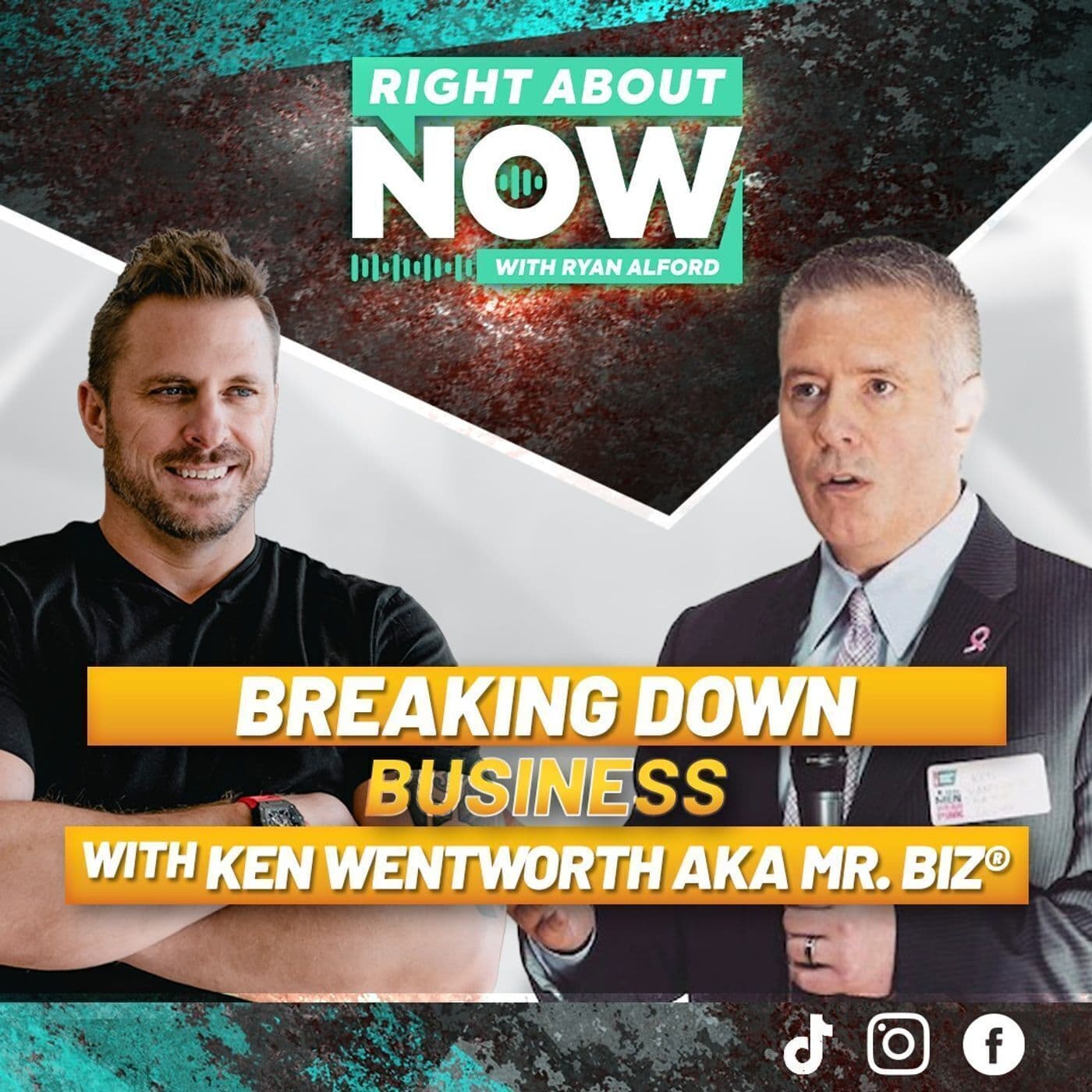
Ken Wentworth on Cash Flow, Budgets and Real Growth
Fractional CFO Ken Wentworth (Mr. Biz) shares his three pillars of financial success, why most companies stall at 3% growth, and how to scale without
The Universe Is Hiring: Purpose, Action and Self-Discovery
Anniston Riekstins joins Ryan Alford to talk about her book The Universe Is Hiring, applying personal development, and finding your unique gift.