
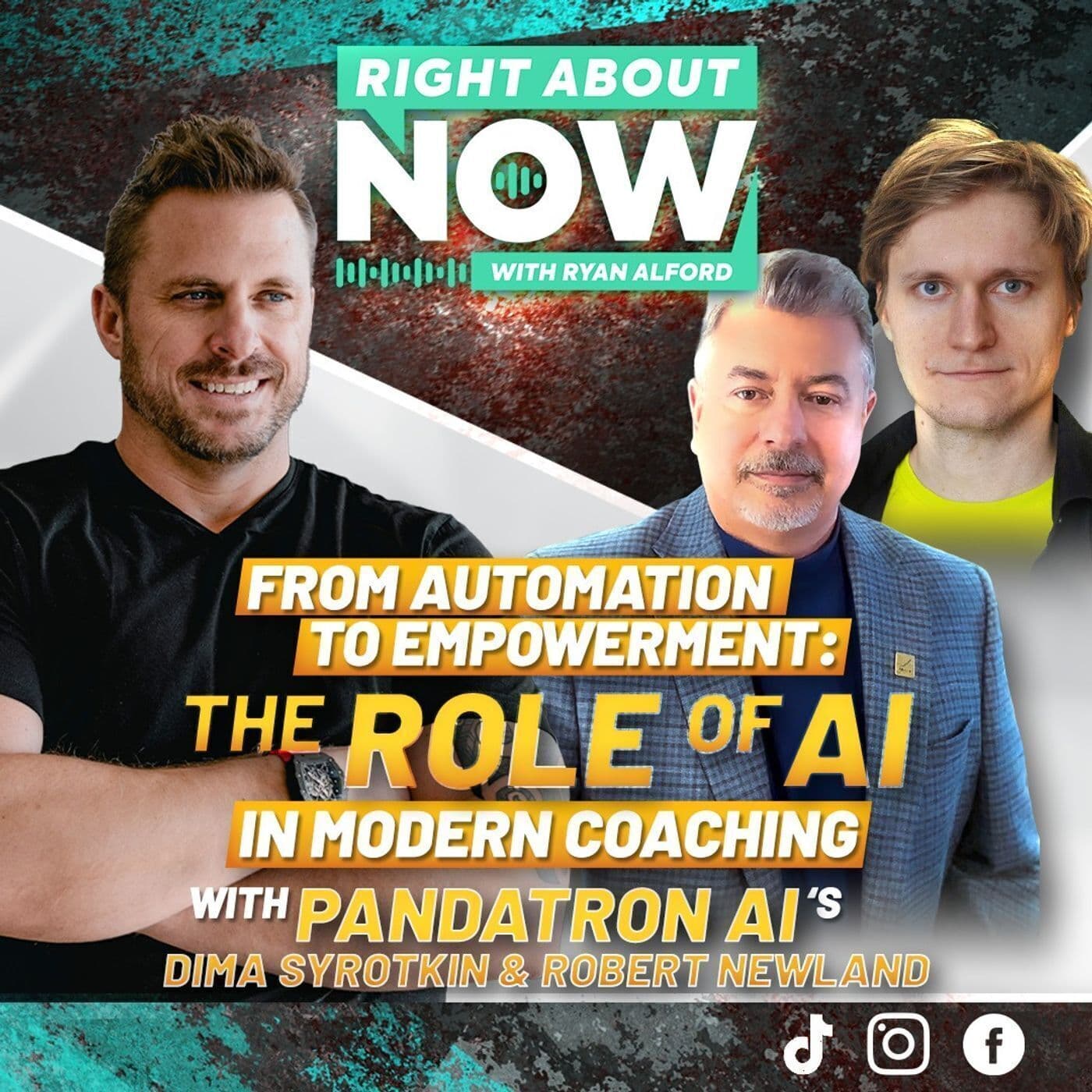
From Automation to Empowerment: The Role of AI in Modern Coaching
Pandatron's Dima Syrotkin and Robert Newland join Ryan Alford to explain why AI coaching goes far beyond automation and how it changes company culture.
- Treating AI purely as an automation tool underrates it; Dima argues the bigger unlock is aggregating what thousands of employees say in coaching conversations to surface root causes and inform strategy.
- Traditional HR engagement surveys that move a score from 7.4 to 7.6 tell you almost nothing; conversational AI can capture the meaning behind the answers at scale.
- Pandatron sees two buyer problems: scaling coaching beyond the executive tier to thousands of employees, and driving specific change like innovation or AI adoption.
- One public company used AI coaching to launch three AI products in six months and its stock rose 24% over that period.
- People often disclose more to an AI coach because they don't feel judged, which unlocks a level of vulnerability Robert says he never saw in decades of talent management.
- Even if you think your organization is too early for AI, the percentage of employees already using it is high, so you are catching up to your own staff.
- Adoption of ChatGPT grew faster in developing countries than in wealthy developed countries, per an Oliver Wyman/World Economic Forum study Robert cites.
- Rather than scraping expert frameworks, Pandatron is negotiating partnerships with roughly 50 top thought leaders so their work is cited inside the AI coach.
I know this is on a sound kind of weird, because although I know I'm talking to an AI chatbot, somehow I'm more comfortable talking to my AI coach than a human, because I do not feel judged.
in all these years, I have not seen something experiential that allows for this level of vulnerability for a human. I never thought it would be possible.
Even the PC took about 20 years to reach mass adoption, tragedy took 10 months.
I don't think this is your place in equipment. This is just helping me, it's like that I was a human, so I can be better with other people, be better on a workplace, be better with my family. Just fascinating, I do not expect it and it's wonderful. This is right about now with Ryan Alford, a Radcast Network production.
We are the number one business show on the planet with over 1 million downloads a month. Taking the BS out of business for over six years and over 400 episodes. You ready to start snapping necks and cash and checks? Well, it starts right about now. What's up guys, welcome to right about now. Hey, we say we're always getting right and it's always talking about what's now. And look guys, if you're listening and you don't know, there's a little buzz word out there. I hear on every corner, I see on every social post. Two little letters called A and I. I can't get away from them. They're everywhere, but look, they make my life easier. They're making every world. The world a better place in a lot of ways and look, I'm pumped to have two guests today
who are at the forefront. The CEO of PandaTron, Dima Serunkin and Robert Newland, the Chief Money Officers, what I'm going to call him, Robert. I said, he's Chief Denero Hancho. It's great to have you guys. Hey, we're all over the planet today. And Robert, you're down in Florida and Dima, I think you're across the pond, right? Or it's home today. Yep. I'm in Helsinki, yes. We have a pretty big office here, so is it on people here? Yes, very good, very good. I mean, you know, I joined my monologue about the AI thing and we're going to get to be, we're going to talk all about PandaTron, AI coaching, driving organizational performance. But it is the buzz word of the day. I mean, it is everywhere.
How do you guys balance that, like, the differentiation of what you like you're doing? And like, you know, what's the overall, I don't know, sentiment of the industry these days? Robert, do you want to take it? Sure, I'm happy to buy some substances. So, you know, we talk to a lot of people out there and I can tell you, at least from a corporate standpoint, there is in a single company larger midsize that is not investing crazy amounts of money in how leverage AI in many different ways that we can get into later. So, this is not, therefore, when this is a happening now, probably for a number of years, but everybody's in the bandwagon right now. Not everybody knows what to do with it, but everybody's spending crazy amounts of money
and trying to figure it out. Well, it had to come down to, like, they know, you know, they have to because at some point, the efficiencies that your competition can't have, like, what, a 60% operational efficiency over you, right? Is that what it sort of comes down to that? And the promise of the, I don't know, the money savings combined with human combined with, you know, right sizing organizational structure. I mean, there's a lot of different things, but it seems like Robert, you know, being the money guy at the end of the day, it seems like it's somewhere grounded in that, I think, for a lot of organizations, like, they don't want to get left behind. Is that what it is? Yeah, but there's also a once in a generation opportunity, probably, you know, even Bill Gates
said this is bigger than the PC, for example, because it's not just a big shift in the way in which we do business, but it's also a speed of change. Even the PC took about 20 years to reach mass adoption, tragedy took 10 months. So again, when you combine the two of them, it just makes it compelling for everybody to get on the band live and so that's possible. Yeah. Do you know what's your perspective here? You know, what you're saying? You guys go to all the conferences. All right. Yeah, I think like people think a bit too much about AI being only an automation tool, and I think it's so much more. And maybe we'll tap that with, you know, what we do as well, but we see, you know, even though we say AI coaching is so much more than
just coaching, makes suddenly it becomes, you know, completely different tool, but we've never had before, that can also guide, you know, the whole strategy. Because suddenly, besides just coaching people, you can also collect data about what are the biggest topics that they're, you know, talking about, and what's behind those topics, what's the roof causes, and then you can combine all that. I could get that and look at the patterns. And it's something you would never do with human coaching. So I think people oftentimes think too much of it as like this, well, I have this process, I'm going to automate it, and that's going to be the saving. And I think that's going to be the first step. I think that makes sense. But I think it's going to go beyond that. And we're not
fully even comprehending that like what are all those, what, what all those things could be? Yeah. And I think it's, when I think about, I simplify things for clients. And you know, for a long time, it's sort of like, is it, I sort of was dividing into, okay, it's going to do more for us, but it's kind of doing, it's doing and thinking, you know, at a process level. And I think a little bit of what you just described, Deema, like the way it can process that information and withhold it because, you know, if we walk into a meeting and have a discussion, you know, unless someone took really good notes, you know, it best, it has somewhat of value. But when that information is being processed and managed like you said, by someone that can sort of create trends, create,
like think through that data, process it at faster speeds and, and curate it in different ways, we get into a really fascinating place with just the overall advancement as these things come together. We talk a lot about like AI, but the way we've never, we could never do before, I think, is also remarkable. So that's also something like for us, right? BSD companies maybe have HR surveys where they would ask people, how do you feel, you know, scale from zero to 10 and then they're like, okay, it moves from 0.4 to whatever 7.7.6. And you're like, what does it mean? It doesn't really, it doesn't really mean anything. And that suddenly you can make it very complete, but actually going into specifically what people sat in, what was the meaning behind it,
and then create all this constant fine kind of commonalities and almost like talk to thousands of people at the same time. Let's back up for the audience. I got so excited because AI is like all around me, you know, like, what down these roads? Nima, how the hell do you get so smart? Like, that's what I want to know. Did AI program your brain or something? I mean, you know, you're a young guy, you're getting after it. Let's set the table, you know, as a CEO of Panditron, talking with them, you know, like, what what created this path to intelligence and entrepreneurism? Robert, we'll talk Buccio De Nero in a minute.
No, yeah. So yeah, like jokes aside, actually, there is like a Genesis story for the company, which is connected to like my Genesis story as well, where like, I, I was bored of a nonprofit called Isaac, accidentally actually Robert was also part of it. So what are we 30 years prior? Um, but he's got great hair. He's got great hair. We can hire him. I've got some of the beard here. I know, Robert, you're not probably closer. I'm with your brother. Yeah. And the big part of that was actually getting exposed to coaching for the first time. Maybe like being like, okay, what do I actually want to life? Like, where am I going? What's important? What are my fears? What are my dreams? And I think before that, I've never really like asked myself those questions.
And that's fundamentally what coaching is about. It's about asking this like very deep questions, supporting someone through that process, helping them set goals for a lot of them. And that's really like, you know, so to your question, I wasn't to be pursuing AI. I was pursuing the problem of how do we provide this powerful technology, a psychotechnology of coaching to more people? Because it felt like, okay, you know, if you've got any problem in the world, if you think of, you know, the Ukrainian war, like sometimes they think, well, if we didn't have had therapy in childhood, like, would have that been preventive. And sometimes people like, well, Dima, but what about like an asteroid, right? Like, you can't control that. That's not related to
psychology. And then we have this movie, Don't Look Up. And there there was an asteroid and they fucked it up, you know, they were like, well, how it's my best, right? They did them because they were like fighting for the last like, yeah, like to change everything is related to how we behave and how we react, how we think, how emotionally aware we are. And so I was pursuing that problem and we were in this space even before AI became a thing. And we had like human coaches and then like a founder was our half coach, Laudie was like, we should do job bots. And I'm like, jobbots don't work, dude, like it's just, it's not going to work. And so we had like human coaches
who were doing it. We had chats. So they would just like log in and they would do like, like, he would text his friend on the WhatsApp, but was it was a coach? You know, it's, it's fascinating. Playing with the tool, I was, you know, in watching Amy and listening to her, you know, interact with it. It's really crazy how far it's come. Like, you know, the intelligence, they react to the human, the humanity that you can sort of feel within these tools, especially with Panatron. I mean, it's, it's amazing. I mean, because part of me is like, can you replace that human touch and all that, but then you start interacting with the tool and the way with, I'm joking that it's more empathetic than I am. Yeah. He's probably true.
He's not joking by me. I just barely get to know you, but I think, I think it might be. But be not lonely. There is a quote from, from one of our uses in Australia, which is, demonosis, my favorite. And she says, I know this is on a sound kind of weird, because although I know I'm talking to an AI chatbot, somehow I'm more comfortable talking to my AI coach than a human, because I do not feel judged. So what we're learning from there is at least an AI within the realm of, of coaching is that in coaching, what people are looking for is, you know, looking for availability and empathy, right? And then reflection. And we can provide a high level of consistent empathy to AI coaching 24, 7 availability and then deep reflection in meaningful ways. And it
really, you know, it's one of the areas, and I want to quote demon here that from an ethics standpoint, you know, AI coaching is one of the errors in ad that is not really replacing humans. I think we help humans reflect better on themselves so that they get into our better with one another and I think that's a beautiful thing. Yeah. I mean, it is because, and I think you, you started with like the biggest point I think and I think about, you know, people think about the judgment of others a lot. And if you can remove that barrier, yeah, I think you unlock some potential authenticity and realness that never gets unlocked human to human. That's exactly what we're seeing. And listen, I, I've been in talent management. Okay, I'll say that as long as
demon is being alive. Yeah. Yeah. But in all these years, I have not seen something experiential that allows for this level of vulnerability for a human. I never thought it would be possible. Even when I first started seeing this comments, I thought, no, it's got to be an outlier. Then you see consistently getting this feedback of the experience. And again, I don't think this is replacing a human. This is just helping me. It's like better as a human so I can be better with other people, be better on my workplace, we better with my family. Just fascinating. I did not expect it. And, and, but, you know, it's, it's my book, frankly. Talk about the nuts and bolts, you know, of Panda Tron, you know, like I'm an organization. And, and this is for either you
rob or you demon, you know, like, what is my problem? And what is this solution? Like just as plainly as, you know, your, your natural voice, you know, if what it is, you know, sometimes we, you reap products, slicks of cheats and speeds and feeds and all these things. But I love what you said, demon, because starting with the problem like you did versus a lot of people are kind of going, okay, I'm, this is AI. Pretend this had as AI. I'm, I'm trying to fit the AI into finding a problem versus starting with the problem and AI being part of the solution, which is what I heard from you. But talk to me about that exact, you know, deliverment to, to a, to a, to a potential company.
I think there's two big buckets of problems that, that companies try to address. One is just scaling coaching and supporting police. They already have this programs, but typically it's just an executive level. And they're saying, hey, how, how can I give this to a thousand people? And the goals there are pretty broad, right? It can be employee engagement, it can be leadership development. That's one bucket. The second bucket is when a company comes to us and they say, look, we want to change. We want to be not more innovative. We want to install, you know, we'll say, yeah, you know, people to experiment with the AI. We want them to actually launch new products. We want them to play with it. We want them, you know, to resolve whatever fears
they have and kind of go rounded and test them. Are they, are they actually true? So in the span of like six months, we helped them to launch three AI products with AI coaching tool. And it was a public company. The stock went up 24%. They were quite happy. As a result, of course, you know, as it was only I will see, you know, where the results actually, you know, end up delivering, but I think it was, it was, I just want to say, we're in an office or not. Happy to be like, equity deal on that one. I'm going to say, Robert would be happy. Robert would take that 24% increase in stock. Yeah, we should have done that. Hey, it's hindsight 2022, right? Yes.
Yeah. And it was also kind of changes, right? Whether it is AI change, or there's like, we want to be more innovative agile transformation. There's a lot of bulwark that gets thrown around where we basically bolted it, blurry teeth that like, you know, the silos always like when you have like 100,000 people, let's say you have a CEO of Siemens, it's really freaking difficult. So like, change the direction of the Titanic. It's like, even if you're the CEO, you're the most powerful person in the company doesn't really mean much. Like, all you can do is like send people email, like do training and then immediately and behavior is so entrenched that it's super difficult to change it. And this is the tool that suddenly allows you to go and sort of like talk to everyone,
kind of spread your gospel, nudge them in that way, but also do it in a way when kind of interact with them, and you also get their opinion. And you then kind of deliver back, what is it on just what's stopping us from transforming better, right? What are the systemic challenges? Yeah. Is it, I mean, in a way, when I was, I don't know if I saw these exact words, I'm sure they were somewhere. I'm sure you guys would like me if they were. But like HR, in a way, like human resources, you know, a sub segment of it. I know you're not replacing, but it certainly felt like a gigantic HR resource. Well, let me, let me bucket this things in a certain way and then kind of frame us. So when you look at the other organizations,
you see a lot of HR assistance, right? How can I use this information to AI and be quicker at it? Then you have within the percent, which is, how do I optimize process into AI? What we're doing, and which isn't the talent management sort of realm, if you will, is sort of dealing with, you know, with the Simon Sinek's of why, you know, it's not what you do, but why you do it. At the end of the day, every individual does something for a reason. And if you want an individual to contribute to our recession, if you want an individual to sort of shift direction with organization, because they're going to a new market, new product, new industry, whatever the case may be, it's personal for them, although it's strategic for the organization.
And the AI coach allows you to reflect on the why and what are your inner drivers and intrinsic motivations to sort of come along for the ride. So I think a lot of the mistakes that we see in organizations is that we train them on direction. We tell them where they need to go, but we're not really investing time in helping them think through the why should we come along for the ride. And it's all nearly impossible to do that until you get to scalable AI based coaching. Because otherwise you can do this, you know, mass training, mass messaging, mass communication. The ability to move the needle at scale by engaging with people in the thousands at a one-on-one basis to sort of discuss why is really game changer for organizations and humans. And I got to tell
you, Ryan, I'm just happy to be all right now in this moment with AI because it's really a big, big thing happening for the planet. Yes, it is. I mean, it's clear. I think the note on the how fast GPT, you know, the 10 months, like the scale is, you know, a proof point of that. So I know, I mean, you guys are all the AI conferences these days. I mean, what's the, I mean, it feels like a little bit of the wild wild west, but not because like people aren't intentional, but like, what is it like with all the AI buzz? It, you know, from a broader perspective in the industry and, you know, sharing what you guys are doing and the investor talks and all that
stuff. What's the, what's the lay of the land? I think in many ways, like on, on, on both like the client and investor sides, for many people, the question right now is, uh, what happens when this case, right? I think there's currently an AI experimentation budget. And it's not yet clear, like, where does the AI budget go after that? Right? So we experiment. Once we start scaling all this, like, where does this go? Does this go under, you know, the existing budget to be like caught some of the, you know, existing stuff in kind of a place piece of that. How do the processes work? Do we need to hire less people? Do we need to hire more people? Because of this, I think, like, we're very early on where it's like still in many ways experimentation and many companies
are trying to extend. No, what's what's actually going to happen next? Like, how is this going to impact it? And I think another thing that always says that like, even though we say that it's AI and this are just two letters, there's so many different applications, like, like a tragedy and a self-drying taxi that I use frequently in San Francisco. I like so freakishly different. Like, there's almost like nothing in common, but both are like AI, you know, and so in that regard, like, we need to be kind of very careful with, you know, when testing this things, treating them all differently as well, because they are different. Yes, Dima, I like that analogy, because you know what I like to say? I think podcasting is too broad. You've got two guys in a
closet doing a hobby. And then you got the number one show in the world and more been business. And Rogan make it 300 million over here. You know, I don't like broad categorization, you know, like, AI, there's a lot of different things with which sort of the principles, I guess, of artificial intelligence are being deployed in a million different ways, right? I think that's what you're saying. Exactly, exactly. And also that we're still comprehending, right, like what the impacts are going to be, right? Like, for example, it was what we do, right? You, again, even though we call it AI coaching, I almost feel like this can be a tool to almost like lead your organization in a completely unique way, because suddenly in comparison to like human coaches, you can actually align a AI
with your organizational objectives, so it can kind of nudge people in that direction. You can collect all this data about like what are the systemic issues that can again help you adjust your strategy. And at the same time, you can kind of support people so it almost becomes, you know, less of an employee benefit tool and more of a leadership as a service, if you will, right? All that leadership wasn't done, maybe because of lack of skill, maybe because of lack of time, whatever, whatever the case may be. And so I think in many cases, you know, since we're still figuring out like what happens once we scale this thing, like, you know, another example is like all the processes, right? Like, you know, customer service, I think there was a Swedish
Syntech company that published that they saved like, you know, millions on kind of automating, I think 90% of their customer service can say, actually, like, a lot of it is not that difficult and it's pretty repetitive. And, you know, yes, we need to have like a little bit of a conversational touch there, and we now can have it with you in the AI. Dama, Robert, you know, what's your perspective, you know, on, you know, like what you guys are doing, the conversational kind of chatbot experience versus the AI where like it could be one of the three of us regenerated and talking these things, you know, the humanity that might be artificial versus the words on the screen, you know, have you guys, what's your perspective there?
You might want to go? Yeah, I mean, I think in some ways, we're still, you know, sometimes, sometimes away from that, and I think it's an interesting question of like, you know, will we get there fully and will it still be a gimmick? And I think that was the current level of technology, you can do a lot already, right? Like, I think was the current level of like, GPT-4 level technology, you can do, yeah, coaching, for example, right? In the same like, format as we do it, you can most certainly do voice. Can you do sort of an avatar that sort of does as well, maybe sure? But can you get it from this level of like, I don't know what is it at right now? Like a bachelor student to, you know, something that's actually like even more intelligent,
and that's not totally clear because currently, I mean, you know, a bunch of models are kind of converging on a similar level performance. And so I think that's really like, that's going to be very interesting in the next year to see, you know, what, what are this, you know, Microsoft and similar companies that are building this huge data centers, like, what's, what's GP, GPT-5 going to be like? But the thing is, like, I think even if we stop here in terms of it, we should like a certain plateau before the next breakthrough occurs, that's already like having a huge impact. And I think like, that's, that's way more likely than, than like this, what's called like a artificial general intelligence word, like really civilized human in like every way.
So far, we don't really have any clue on how to do it. And, and, you know, maybe the metaphor, I don't know if it's as clear, but it's like, people sometimes are like, well, you know, won't we, like, just upload our mind, right? And just like, exist forever. Like in theory, that's a good idea. But we have no clue how to do it. Like, like, like, how are you going to like encode consciousness into something digital? And this is like a similar level problem where it's like, yes, this like, you know, a chatbot that predicts the next token and sort of responds more or less kind of possibly, that seems, you know, we've done it. We can see how, how that's done. But like, doing
something that actually goes beyond that, hard to say. Yeah. We were already consumed all the internet data. That's what it came up with. So am I, so am I simplifying a demon like in your, you describing that? Like, obviously, they already have like talking avatars now, right? Like we can duplicate ourselves or pick, you know, Tom, Harry or Sally that we like. That's the, you know, regenerated avatar. So knowing that those exist, am I oversimplifying that you couldn't just feed the answers that you're giving to that avatar to then give it back to them as a human form talking to them? Yeah. I think the question is just like the quality of the responses and the quality of like facial expressions. I think like it will probably get there over time. The
question is like, what are we talking? Yeah. And in terms of like GPT-4, I mean, anyone who used GPT, I think you're both like amazed at its quality, but you also like notice these limitations. Yeah. And it's like, it's easier to go like 95% there, but going like 100% there, I think that's like super challenging. And that's where like a lot of our engineering work, right? Like it's not just GPT-5, you need to do a lot of work with both like experts, like, right? So we employ like coaches, social psychologists, therapists to kind of look at that and see, you know, change management consultants, you know, what do we need to tweak, what didn't work, how do we approach it better, to also technological solutions, right? Like, okay, how do we kind of simplify the flow so that we
kind of simulate this magic? And it's not visible that like in reality, there is like, you know, there are cracks. Yeah. And you can find them if you like, try really hard. When are we going to get so that I think like, yeah, we're really at crossroads right now. So it's very interesting like what the next year is going to show. Either it's, you know, straight into singularity or oh, we're just settled with this, you know, beautiful society that automates, you know, 80% of routine work, which is also pretty good. Yes. I talked about this on my news show. You kind of said something to spark to Dima. You hire therapists and you hire all these other inputs, right? Because to get an output yet that input, we can agree with that, right? So my problem has been
with chat GBT and all this other things. You know, the great thing about Google search is, okay, that Google makes a lot of money, but you get SEO value and you get people ultimately to your website where I will do a transaction for the content that I've created, right? If you do it right, chat GBT and a lot of these tools are taking information from people that spent money, time or their thought to create. And we ain't paying for the ingredients. Excuse my ape. And so we have to, you know, if I want to make chocolate chip cookies, I got to go by the store, I got about flour, I got about chocolate chips and sugar and milk. So all we pay for the ingredients,
you know, with all these tools, it sounds like you guys are. But, you know, Google ultimately pays for the ingredients because they pay back the publishers via raises and, you know, getting people ultimately to their sites. But once you deliver the answer without the source, you know, when I was in history class, I had to cite my sources. So is it creating new knowledge or is it taking existing knowledge that should have been paid for and turning it into something? I think that, I mean, even if you Google stuff now, you see that there's a little gen AIs summary up on top. Oh yeah. So some people are saying, you know, it's not even taking me to my site anymore because Google is summarizing it. And is that fair or unfair, right? So it gets,
there are so many layers to these that are that are on for seeing right now. You really don't know, you know, what the future holds quite frankly. But there is something to be said about, you know, segregating between going to a chat GPT for a solution or feedback versus when you're using something framework like say, you know, Panditron, right? Right.
You're getting specific guidelines tailor say to coaching that is asking you to reflect on something, which is sort of like an interactive dynamic experience that helps you think versus just feeding you information. So it's a bit different than say, go to Google, give me an answer. And here is, well, you know, how did that make you feel? Is there a better way to do it? What did you learn from it? What would you do next? It's a whole different kind of experience. And you know, always tell people that when you look at this things, not only is like Dema said, you know, a self-driving taxi different from chat GPT, but also chat GPT is different from say AI coaching than an AI assistant. There's just so many different ways. But I am curious as to what's
going to happen with with with with Google when you sort of go from because we used to say, when you Google it and now people are being say, why didn't you chat GPT it? So curious to see what's going to happen say three years from now when it comes to that dynamic. I don't know. Yeah. And to add from our perspective, I mean, what we decided to do is that, you know, we we're conscious of the fact that we still want to use frameworks from some of the top leaders in the world, top-fault leaders in the world. And we're like, hey, let's just partner with them. And so with currently discussions was, you know, the top 50 kind of felt leaders and, you know, including,
you know, anything from leadership happiness, change management, anything that's related to what we do and saying, hey, you know, we would like to mention your work in our AI coach. And it will help you to sell your books. It will help you to get into those executive rooms because the employees will start talking about, you know, your frameworks a bit more. And so in general, it's a win. I think one interesting question, of course, though, is, you know, it will make the people who are at the top, you know, in a sense, you know, props prosper even more because suddenly you can kind of scale that to everyone. It's kind of like, you know, if you could scale the best teacher in the world, why would you go for like, you know, hundreds best if you can
get like the best. So that's, I think that's a dilemma. And that's like, you know, and that's the same kind of everywhere, like how do we actually then get junior people to progress in their career before they had that like top experts, you know, because because we are sort of then replicating with the top expertise. But at least like in terms of like compensating people for their work, I think that's super important. As we flows out here, guys, I know we're backing up against the timeline and maybe we'll have a part two. I think there could be a double episode here, for sure. You know, are we looking for investors? Are we looking for more clients or, or yes, please, like what's, uh, what is that sort of roadmap for you guys? Are we, uh, who are we, uh, looking for?
Yeah, investors, DM our clients, Robert. Yeah, I would say, I'll say clients first. And those are mostly, you know, big companies, um, typically, but we also now starting to roll it out to like lower middle market and starting to experiment there as well. Um, I would say another thing, what I mentioned, right, top top leaders, uh, so all the Simon Synex, uh, and Amy, uh, Edmonds, uh, out of the world, uh, we would love to chat and partner and collaborate because we think that this, this is, you know, um, it's going to be very impactful. Um, and we want to kind of copy this collectively. Um, and then lastly, yes, um, investors, uh, but, uh, the first two things are private. I think Ryan, on the, on the customer side, you know, what I, what I've found that
has been, uh, why surprising is that there's an, an agnosticism from industry and geography, meaning that we have large enterprises in, in, in pharma, in consumer package goods. Uh, some of the major global consultancies are coming, Joseph saying, hey, we want to partner with you guys to present you as a sort of bundled offering to our customers because what you have is it's a pretty unique as well. The thing that I've found, uh, that's interesting is that when you look at adoption of, of, of, of AI is a chat, UBT, uh, the speed of growth, uh, of, of, say, there's a great study from that was from, uh, Oliver Weinmann, the world company forum, and it showed five-month growth in adoption of chat, UBT, and by regions. And for example, you saw what I call us,
a don't fight unhappy countries, they develop countries doing financially well, that the rate of growth was slower than the developing countries. So, so this to me is very interesting, the impact it can have in the global economy in terms of who's catching up over what. So, I'm curious to see what happens a year or two from now in terms of, uh, of adoption and advancement and what that entails, and what it implies in terms of little competitiveness, right? Um, we're also seeing, you know, something I'd like to say, if your organization's thinking that you're too soon to use AI, uh, the percentage of employees using AI and just about every industry is crazy. So, even if you're not using AI, your employees are. Yeah. It's just amazing. You just have to catch
up with your employees. Yes, and I know we may be having a little bit of technical difficulty with Dima, and I know he has other commitment. Robert, where can everybody learn more about what everything you're doing, learn more about how to get in touch? All of the, you know, sort of calls to action for everyone listening. Thank you so much for the plug. Two places, certainly pandertron.ai. And since we're, we're going to be on, on the, you know, the podcast set up, which will large amount of people, uh, if you do try dot pandertron.ai, you may even take it for a ride and, and let us know how you feel and, and how you like it. Hey guys, I really recommend you do that. The little bit I've played with it and our team has played with it. It's been highly impressed.
These guys know what they're doing, and we will get them on for a part two, uh, because a lot of questions I still have and I, uh, want to, I want to task Robert for the money and, uh, Dima for for the, uh, coding, you know, I want to get all the, uh, zeroes and ones out of him.
It's got a lot more than that, I think. Gentlemen, it's been a pleasure having you on the show. I really appreciate it. And I do, uh, mean that on a part two, what to do that in a couple of months. Thanks for having us. Hey guys, you ought to find us. Ryan is right dot com. You'll find the highlight clips from today, the full episode and links to pandertron. Look, if you are trying AI, you're going to get left behind and these guys know it and they're out there helping the world be a better place. We'll see you next time on right about now. This has been right about now with Ryan Alford, a radcast network production. Visit Ryan is right dot com for full audio and video
versions of the show or to inquire about sponsorship opportunities. Thanks for listening.

Justin Brennan on Multifamily and Other People's Money
Real estate investor Justin Brennan explains syndication, check equity vs. sweat equity, bonus depreciation, and how to buy apartments without your own

Hiring Is a Marketing Problem: Nicole Feenstra
Nicole Feenstra of The DNA Agency tells Ryan Alford why job descriptions fail, how to market the trades, and how geofencing and storytelling win

Jason Brown on Options Trading, Risk and Rebuilding
Jason Brown turned a $10K student loan into six figures, lost $250K on one trade, and rebuilt. He shares his options, risk and wealth roadmap with Ryan