
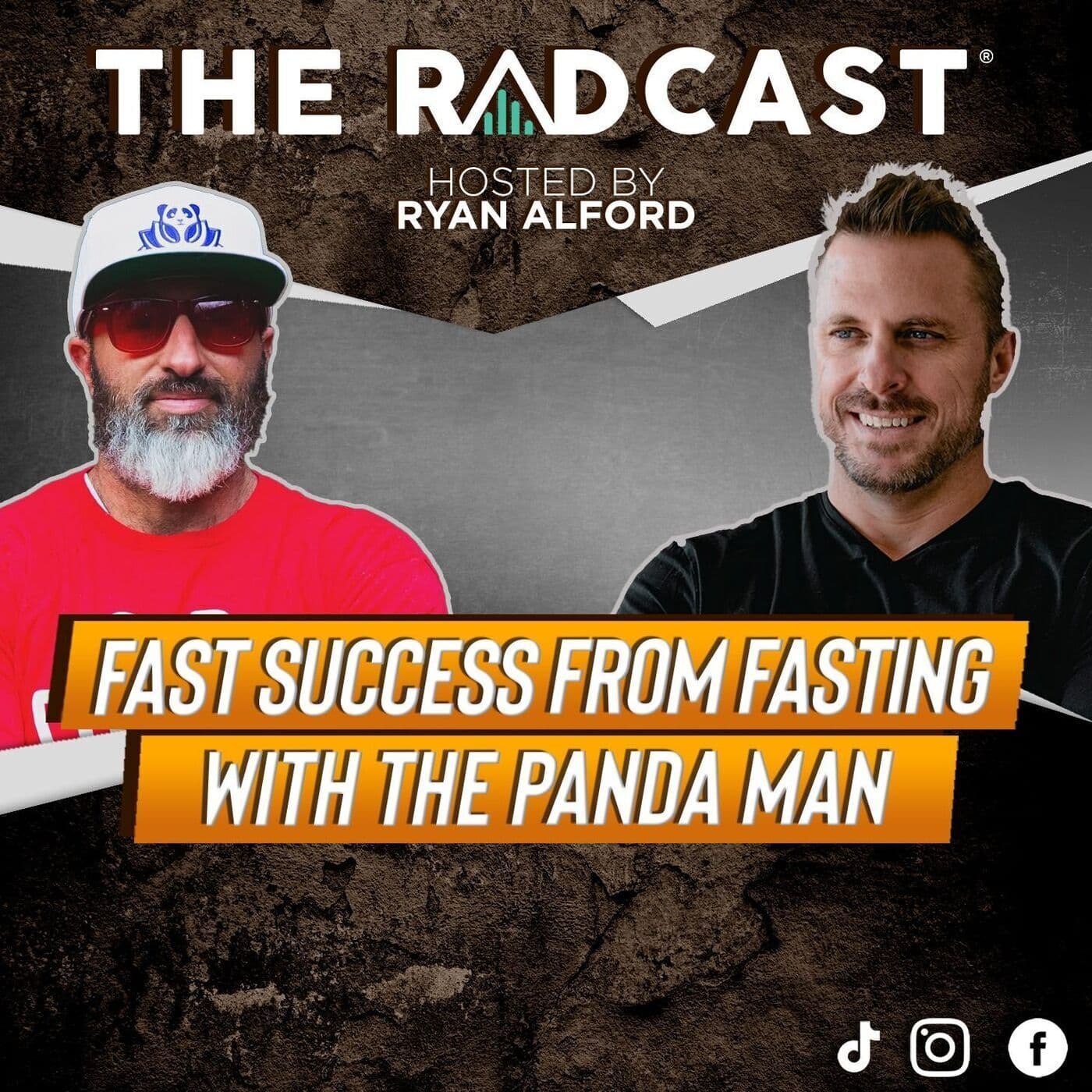
Fast Success From Fasting with The Panda Man
Kyle Newell, aka The Panda Man, breaks down the Panda Method, incremental fasting, cold plunges, urine therapy, and building two gyms with Ryan Alford.
We have to eliminate willpower as much as we can, willpower doesn't work.
So I really lock in with my students on the word decision. It means to sever it. Cut yourself off. Any other possibility.
So when you feel hunger, you have to reframe it. This is the key thing. This is what fat laws feels like.
We have to eliminate willpower as much as we can, willpower doesn't work. If you can rely on a lot on willpower, it's what one of the reasons the traditional North American diet doesn't work. So it's black and white, either fasting or you're feasting.
You're listening to the Rodcast, a top 25 worldwide business podcast. If it's radical, we cover it. Here's your host, Ryan Alford. Hey guys, what's up? Welcome to the latest edition of the Radcast. Hey, I'm Ryan Alford, your host. We say if it's radical, you cover it, we cover it, and you're here to listen. And you know, this gentleman hit my feed, a lot of people hit your feed on social media on the Graham and kept coming, kept going, I don't know what it was. The algorithm was speaking to me, I guess.
I was like, I don't know if I was diet searching or what I was doing. I was like, how can I stop eating so much? But Kyle Newell here, the panda man, what's up Kyle? What's up, Ryan? Thanks for having me, man. That's really cool to be here. Yeah, I'm so glad you could make it in studio. Welcome to G Vegas. This is what you call it. Beautiful Greenville South Carolina. Beautiful place, man. I can have to bring my family down here. Hey, see? Yeah, I know. I need to get, I need to get the Greenville tourism involved here. Oh, there's a sponsor. Yeah, there you go. And what I bring to Greenville is, man, it's nice shouldn't expect it. Beautiful. Yeah, it's beautiful. Hidden gem.
I know. So speaking of hidden gems, the panda diet, I know you got the book, coming out or already out. The book's out, yeah, the book's out. Books already out. I started reading about it because the fasting stuff has gotten so popular. And I know there's a lot more to it. I like that's what I liked about it. I see many people like promoting the fasting. And I was like, and I've done a couple and we've all done them. But I'm like, I need something more full body, mind, spirit, soul, like whatever. And I think that's when you hit my feet. And I'm like, all right, like this guy. Yeah. This makes sense to me. Yeah. I hadn't done the one meal a day thing.
I know we're going to get into that. Some of the core benefits of it. But God, let's set the stage for everybody. Let's let's talk about the Kyle Little Store. Yeah, sure, man. So what do I begin with that? I grew up, as we were saying before, I got three brothers. We're all close in age, all born between 1980 and 1985. I'm the second oldest in playing sports throughout our upbringing. Really big into sports fans, playing all pretty good athletes. My parents were great. And it's still all great. I grew up in a very non-judgmental environment. Like my parents gave us a lot of freedom. But we, they taught us the values, right? So we were just good kind people. So we moved to New Jersey in the late 80s.
And we've been in New Jersey ever since. And then coming up when I went to college at university, back in high school, I went back up playing. I gave everything up for basketball. That was kind of stupidly. I got to stop playing baseball, stop playing football. I was like, now I want to play division one basketball. So I developed a lot of discipline around basketball. 500 jump shots a day. Making at the time an AAU team was a big deal. Now everybody's got it. Doing stuff like that. And through that path, I got into lifting. I remember the first book I ever ordered in the high, it was at the end of my, it was my senior year. I ordered this physical book from a bodybuilding magazine.
It's called Big Beyond Belief. And it was all about training. Because I was getting really into it and it just grew into a passion. To the point where my senior year, I almost didn't play basketball because I felt so in love with the lifting. So I've been studying this for way more than half my life now. On a pretty deep level. And then that kind of led to going to school, fitness management, went to university at Delaware. It was a good experience. But what am I going to do when I come out with that? So you played basketball? No, I didn't. If it got you to go with two schools that had reached out that I could play at. But by that point, I was like, like you said, with the intramural.
Yeah, I'm good playing for fun. Yeah, you knew what it would be forever. Yeah, yeah, that's it. And it came out with Rutgers football strength and conditioning. So that was really good experience. But again, at the end of that summer, I'm like, what am I going to do? Went back for teaching, health and fizz ad. And while I was doing that, I was also competing in natural bodybuilding shows at the time. So again, just learning a ton. People would always come up to me, ask me questions at the gym. Hey, what you're doing looks unusual. What is that? I have people asking me about my training way back in the day. Before I even crossed, it was barely started. I didn't know what it was.
And people say, is that crossfit? I'm like, I don't even know what crossfit is. But this is it. I don't know. You told me at the time. It was crazy. But I took what I had learned. And then what I learned from Rutgers football, like a lot of those dudes were jacked. I'm like, okay, just got to be a different way to train and just bodybuilding training. So I applied that when I would get ready for shows, trying to more like an athlete for the show. And then over time, my methods just kept growing. And I just kept studying. I'm always studying. I still feel like a novice with everything. So I'm just voracious with how I read and who I learned from. And I taught in the public school system from 2006 to 2012.
And at that point, I resigned. I put in my letter of resignation because I had started my gym. Started out of my car. Then my parents let me build something in the basement in the studio. But my wife, who we met through teaching, she was a teacher as well. I had a really bad tele-attended rupture that year. Like pneumonia. And we just realized, okay, you're burning out. So I would train people in four school, go teach all day drive, right back to the gym, train people all night. And this was five days a week and then Saturday mornings. And I wasn't sleeping because I was like, man, I got more to do. So I put in a letter of resignation. And when I put that letter in, literally that weekend,
I put it in on Friday, Hurricane Sandy hit New Jersey. And the roof got ripped off my gym. And so I already have to let in. And I'm like, man, I took it as just a test from God that, what are you going to do now? I was like, I can't go back. So the gym was destroyed. I had to move spots. Wanted to go into a bigger spot. Been, but I don't have my safety net of teaching anymore. Yeah, but it all worked out and then it just kept evolving. It evolved. We opened another gym probably about five years ago now in a local neighboring town. What are the gyms called? Newell, my last name, Newell Strength. Newell Strength. Yeah. So it's all small group personal training and through that,
it's met so many great people in with marketing. I probably studied that just as much as the training. Once I realized, okay, you're going to learn how to write. You got to learn how to do direct response marketing. You got to learn all this stuff. The branding. Yeah. Yeah, exactly. Yeah, it's all part of it. Yeah. And I will say this back to the roof is that you wanted to wait into the water. God said, no, you're going to the deep end. You got to the deep end. That's exactly what happened. When we looked at it, I'm waiting there. I'm good. Yeah. No, you diving in right in. And then when they were showing me replacement units, they showed me one that was twice the size.
I took my father-in-law. He was a business owner and I thought he was going to be like, I played safe. Excuse me again, now over the overheads, you know, rents going to double and all that. And he said, hey, go bigger, go home, man. He goes, this is what you wanted. Boom, sign the papers and just kept moving forward. My wife's been, my wife, Daven, she's been incredibly supportive. She knew from day one that marched to the beat of a different drummer that she was going to be in for a different type of life. And so she resigned from teaching after our second child. So she'll help with the businesses. And finally, this year, now she's just stayed home. She's running the household. Which I wanted.
That's very cool. Yeah. Yeah, man. Talk to me about new old strength. Like, where did I know you started? The foundational stuff said everybody always said, what are you doing when you're at the gym, but were there like foundational beliefs in the way you trained? What grounded all that? Yeah. So my philosophy from early on was his strength and conditioning. So it's not do a set of bench press and then sit around. I always believed in, okay, let's keep a fast pace going. Let's, okay, if you're hitting a push or a chest day, let's supplement that while you recover from that and do something else, it's going to keep your heart rate over there, do upper lower. So is that type of training? And then different moves working on different planes of motion.
So I haven't that influence of being a record football scene, how J, J B trying these guys. And then I would learn and I would apply and I would do that. And it just became something unique as far as like farmers walks. I was doing those before anybody knew what they were. I pick up the dumbbells in the gym and walk around in the gym. What are you doing? I'm working on carries. What is that thing? It was just stuff like that. It just kept growing. So I called PHA as T peripheral heart action strength training. So I went ahead pumping the heart pumping head to toe with blood. So that was the foundations of it. And just train hard, you train hard. How long did your workouts, when you're doing those?
When I was doing those, man, when I first started with that original book, man, I would spend two, two and a half, three hours in the gym. Now it's efficient, man. And we work out the guys Friday morning and it's everybody catches up. There's a social aspect. But I believe in 45 minutes, you should be. If you're going hard, you should be smoked. I always liked the staying active. So that kind of really did with me. Like the, like you do the bench press. But doing something like in between, keep your heart rate up or at least mentally in the game. Yeah. Because for me, I'm distracted. 80d, whatever you get your phone out, like that's my biggest thing. It's like staying in the moment.
Staying locked in. Yeah, it is. You could make a workout almost meditative when you keep that pace up when you don't have the time to. And so I like even working to the clock. Just when I'm working with writing something, set the timer. Okay. I think that's a great method for people to count down clock. Yeah. It creates more urgency. It does. And it's both urgency and you both know and starts and knows when it ends. You know what it sounds like. Yeah, you got a patient, but also stay at it to know. Yeah. You've got an end in sight. Yeah, that's huge. Yeah, having that deadline. Exactly. So you built the whole business kind of around those techniques and doing growth. So what, like three, four, five people, like small groups.
So yeah, when I first opened the first facility, at that point, it was didn't have the systems in place, right? Like I was training people in, I started with one on one. Then I said, okay, I'm getting burnt out with that. Then I went to the semi-private. I called it three to four people. Then when I moved to the facility, it was like, okay, I'm open from four to eight. Show up our coaches. I had to work out and I would have 15 guys and there are 20 guys going. So nowadays, what it is is we have a ratio of six to one clients to coach. So we'll have usually a max of 12 in the session. So we're still getting that personal training feel
the coach could administer and make the changes as needed. But it's a great model for people because you're getting coaching but you're not necessarily a lot of people don't want to pay $150, $200 an hour for a personal trainer. Yeah. So it's like that hybrid model. Yep. Still getting enough one to one to where they can tailor something to you. Yeah. You also getting the camaraderie of a small group. That's huge. Kind of gets a lot of thing, which is a lot of thing for people. It's huge. That team aspect. It really is. It's that social aspect. And you know, one on one gets boring, man, when people are there and it's when you have other people working alongside you and they're trying to work
towards a similar goal is big. What don't want to me a lot of what I see is just therapy happening in the and I know judging. It's just I just see it and it's a lot of talking and a lot of everything else. I'm like, seems that way now. It's a thousand percent. I tell you know. And that's fine. But if you want therapy, you know, a little counts. Yeah, and I can talk to somebody. But it's exactly. You know, it wants it driving like a young trainer or whatever. They'll go crazy with that because they want to train. But then you want to talk and like you're saying 40 minutes out of the 60 minutes. Yeah. Because people just want someone to talk to you.
They didn't outlet. Yeah. It was fine. Yeah. But so there. So we got the two gyms. Where did the panda come in? So panda, so it's an interesting story. It was I think 2014 or so. So I'd resigned already from teaching. So I'd work from home there in the days and then go to the gym at night and for the PM hours. But Ron, our test. Do you remember Ron, our test? Oh, yeah. Yeah. So I was a big fan of the Bulls. Yeah. The Bulls, Lakers, one of the title would be. And I liked, I always followed him at St. John's. I love this style. It was more like the old school style. Just tough defense. It's a little bit crazy. It's Ron that became metal world peace.
Yeah. Is that the same thing? Yeah. So he became metal world peace. But for a little period of time, he became, I think it was the panda's friend in an episode that. And I was a fan of this. And he sent out and I was on his email list. And so I got new apparel coming out. And I said, oh, I'll support him. I said, I got to be cool panda. So I bought his hat and I actually got a panda tattoo here. I started researching the animal. Well, a panda, man. A lot of people thought it was a mythological creature to not that long ago.
It's cool, man. It's like, it was thought to be this myth. And then it got to black or white. You got to do a lot of people think it's this cuddly creature, but it also rip you to shreds. I was like, I connect with that. I feel like that connects with me. If you call it like a spirit animal. So then that was that. And then when 2019 camera. So at the time, I just started fasting, like, intermittent fasting, which was your 16 hour fast, which was a game changer from what I was doing with the bodybuilding. I knew I was on to something, but I did that for about five years, 16 to 18 hour fast.
And then when it came time in 2019 to do a fat loss contest with my staff, because we were participating alongside the clients, okay, I got to step on my game. I was about 250 pounds, 16 percent body fat. So I wasn't fat, but I just didn't feel I was too big. I didn't like it. My neck felt too big. So let me start looking at longer form fasting. So I did that to hope for some of us doing 72 hour fast every week and one meal a day and just experiment. And then I started saying, okay, I could teach this to people. And when it came time to write the book, which I wrote, like in the peak of the COVID hysteria, so what am I going to call this?
I saw the panda die, but just popped into my head. And now as far as the panda man, when it was a little over a year ago, I had lost my Instagram account, by my personal one. I don't know if I had posted something that was offensive, whatever, but it was gone. There was not even a record of it. And then when owner here had approached me, he wanted to start a media company. We kind of said, okay, what are we going to, what are we going to call this? And then played around with, I think I come up with a temporary one of the panda man, can my initials was the panda man. So that's kind of where it came from, the panda man.
Yeah, yeah, I love it. I love the branding too. Yeah, thank you. If you're not, if you're listening, you got to go watch this on YouTube, plug the YouTube channel in so you can see the panda gear. These, you know what, these are my panda's, you know what these actually are. They look like panda, that's the thing they do with. Ewoks. Oh, yeah. That was literally Ewoks. Yeah, yeah, from Star Wars. Yeah, oh, yeah. Yeah, pretty awesome. And then you get the hat. This is all brand, you know, the panda. I like it. Yeah. Hey, man. Brandy's everything. Yeah. Hey, it's called my attention. I'll be honest, because then I was like, the substance, the brain caught the eye than the substance of you. Yeah.
What is this? There's like this quiet confidence with you that resonated with your content that was some of the yelling screaming guys and the stuff that everybody's got their own stick or their own way. But always liked that about you and then now in person. You always been that way? Or did you have something transform you into that way? I don't think so. I think it's him. I think I've probably always been this way. I'm a big introvert.
When we decided to go all in on the personal brand, me and my wife and then it just everything was synchronicity when owner reached out here. And but she had told me she said, you got to be more comfortable with being a celebrity. A lot of people locally look at me like that. Then on national TV with the news and all that. So I haven't. But I was always I don't like attention. Yeah. But I'm going back to the studying aspect. I'm constantly just learning. And sometimes you think that's normal, but I get it's not a normal thing for most people. No. So I have built up a lot of knowledge and then I experiment with everything. So I developed what I call direct knowledge,
which is to me wisdom. So I'm like, when I teach my stuff, the way it comes across, it to me, it's just the truth. So I'm like, I don't have to yell to get that across or whatever it is. This is the truth is I know it. And it's okay if you disagree with it, but this is what I've counted through direct experience. Yes. I'm always trying to seek and acquire wisdom. And again, being the introvert, I was always shy, not loud or boisterous or anything like that. So I think I've probably always been like this. I think the I use the analogy, you're either a sponge or a faucet. And the faucet's always letting out too much. The sponge is always soaking in too much sometimes.
But you got to like this good balance. Maybe you found the way to you've been soaking it all in, but you're finding ways not to share it. To share it. Yeah. And it's I was the social media's huge. And the teaching obsessed with because that's how I learned the best. I think that's the highest form of learning. Yeah. So to me, it's learned to teach. Even before I'd necessarily even know sometimes all the answers. I'm like, I don't know if you ever know all the answers. But I'm like, teach it now. I internalize it more and I figured out more. What was it like? You got the gems. We get a lot of people, obviously business and marketing show. Like scaling the company, growing it.
What are some of the trials, the tribulations of doing that? Yeah. What are the learnings? It's huge, man. Still for going being the technician where it was just me and the passion was the training. So I was doing that, right? That was me. I had an intern when I opened the first facility. And once I realized, okay, you get a higher people. Yeah, because you were in the business and not working on them. Correct. Every little break I had during the teaching day when I was doing both was spent on the business. Yeah. But then doing all the technical stuff and then getting burnt out with all that. So the biggest thing starting to finish to now is managing people, hiring the right people. I remember the first time I had to fire somebody, man.
It was nerve-wracking. And one of my coaches, who still coaches me, as a business coach, is a great friend. He had walked me through it. And I remember the one piece of advice, he said, listen, as soon as you sit down with this guy, think of a punch him in the face. Tell him right away, don't make small talk. And then you can go into. And yeah, obviously there's been many times since I've had to do stuff like that. But it's been managing a people. Like, because that's where the emotion comes in. If you take the emotion out of business, it's easy. But it's hard to do with people. Exactly. It's hard to do. Have you just been in a acquired skill or has it been something that's just
over time, you get better at it? Both. Yeah, it's been acquired. A lot of investing and education. And that stuff and coaches and masterminds. And then just kind of letting whatever my natural leadership at style is, because it's the same thing. I'm not yelling at them. I expect them to do a certain way. Do their job and be a pro, live by our core values. But I'm not micromanaging them. I want, I think, autonomy is huge for people. So give them people. Hey, you do it. As long as it gets done, the right way, do whatever you want. So you got the two facilities. Yeah. Any plans or has there been about going broader, bigger? So it's kind of the end of the dual. Yeah, that's funny.
It's when we opened the second one. At the time. So that was 2018. The plan was to open 7 to 10 within a pretty tight footprint, part of Pennsylvania and New Jersey. And then once COVID hit and all that, I was like, I don't want to do 7 to 10 right now. It's just because I was saying I'm like, man, you got to manage more people. Everything's, I just didn't want to do it. That's how the second one came about. Like it in hindsight, again, I'll probably just kept it one. If I knew that. So right now, there's no plans to we're thinking with the pandemic and merging that with no strength, like a gym without walls. We can educate people and teach people and put them through stuff.
And so as far as physical locations, I wouldn't be opposed to it, but it would have to be the right person. Yeah. It would have to be me not being. Now, I'm not very super hands-on in the day to day with the gym now as it is. So it would have to remain that way. Yeah, exactly. Yeah. Let's talk a little more about panda. What are the key attributes for pandas, though? Like for the actual animal? Yeah. So a lot of people will ask me to play because that's what a panda eats. No, it's got a pandas-y bamboo larger, which is funny because around our house, we have a ton of bamboo just coincidentally when we moved to that house. So the key attributes as far as
the reason that, again, I look at this symbology of black or white. Right? So I do something called mind mapping, which is the signs of how your brain forms habits. And a big part of that is clarity. And we have to eliminate willpower as much as we can. Willpower doesn't work. If you can rely on a lot on willpower, it's what one of the reasons traditional North American diet doesn't work. So it's black or white. You're the fasting or your feasting. So I really lock in with my students on the word decision. It means to sever it. Cut yourself off. Any other possibility. If you leave the option to, I might eat, let me see how I feel. You're not going to succeed. So it's like a, you take like a meat cleaver to it.
Black or white. And then the mindfulness, like the yin yang, the black or white, I want you to enjoy your food to drug. But we should be present when we did not eating in a rush in the stress state. So I bring that to it. So that's the philosophy behind it. And as far as the mechanics, it's ancient biblical stuff that's been around. I'm just putting my own, my own verbiage on it. But it's longer form fasting is the premise. Right? So if you look at my black panda, which is how I live, it's a 48 hour fast to start the week. And then I go one meal a day, which sounds extreme. But coming from the bodybuilding background, everything had to be weighed, measured.
And I'd be doing these starvation diets. And I can never get as lean as I wanted to. But I wasn't stepping on stage. So it got a bit better way than this. And then experiment with the longer form fasting, researching, immersing myself in it. I found that this is the way. So Monday to 40 hours. So let's just say it's seven day week. Let's, it might be different for you. Yeah. Monday and Tuesday, we're not eating period. So with Sunday night, yeah, but I break it Tuesday night. Got it. So go 48 hours in between. So Monday's the only day on a regular week that I'm not eating. I got it. So it's only one. Yeah, it's one day, but it's for you now 48 hours.
And then you'll have a meal Sunday night. Correct. And then you'll have a meal Tuesday night. Correct. Okay, got it. And then one meal a day. And I built within that when I take people through it. Hey, if you want to have a cheat day or cheat meal, totally fine, because that was something I used to do big time when I was bodybuilding. And it's more of just a psychological outlet for people. When I'm like, don't worry about, I don't stress. I say, okay, I'm big into making sure people get fruit in their diet. But let's get your fasting time down first. You have a lot more leeway when you eat like this with what you eat. So you can enjoy the foods you want to enjoy too.
It's not, oh, you can never have a carb. You can't do this and that stuff that doesn't work. Yeah, how many, how big of the one meal is it just eating as much as you want? It's a feast. So I teach a feast, man. So you tell you're done. Yeah, I've got a me person. I've got a voracious appetite. How many calories are in your one meal for me? On average one is between three and five thousand. Yeah, but if I'm super hungry, like my appetite's built up, like when I used to do those cheat days when I was bodybuilding, when I'd be in what's called super compensation state. Now throughout the whole day, though, I'd be doing it. I've done as high as 25,000 calories in a day,
which I can't do, like I can't do that normally. But it was when you're in the super depleted state, hunger hormones are all messed up in all this. So you combine that with the natural appetite already. 25,000 calories in a day. Feel terrible afterwards though. But that's one meal. No, that was that. That was before the first out. Yeah, that was before the fasting. That was an all day. I'm thinking, how do you do that? Like how do you get 20,000? That was all day fat. That was all day eating. Excuse me, yeah. Even for us eating like every hour on the day. Every hour you eat in boxes of Girl Scout cookies, or eating peanut bars, or whatever, but eventually my wife was like,
because I would be able to stay lean like that in being in a deficit the rest of the week when I was doing a traditional stuff. But I'd be in a food coma by four o'clock. Which is just really worth it. I'm like, yeah, probably not. It was a cool, I would look forward to those cheat days, but it was not a good way to actually function.
No, I don't know. Yeah, what's in the, is it up to the person? What that one meal is? So you go 48 hours, you get the one meal per day. Yeah. Is it up to the person of what they want to eat? So what I teach, like, is, in an ideal setting, if you're at your home day, start with fruit. I like to start with fruit, not at the end. What kind? Whatever you want. How much? How much you want? And just keep in mind, if you're one meal. So you get too full on the bananas. Yeah, you're not going to have as much steak as you want. Correct. A lot of people would ever know. It knows that fruit. It's great for them. It talks, find a body.
It's digested further down in the intestine. So I want to get it through the system first. It's got all the micronutrients. It's like a superfood if there was one category. And it hits those stretch receptors on the stomach, right? So all of a sudden, you are, okay, let me just go to a nice pace here. Don't have to gorge myself. And then anything that came from the earth, I say like an, again, an ideal setting. Veggie, have your potatoes, your rice, whatever your protein source. And then what I do on a regular night, I do like soaked oats. I put oatmeal, raw milk earlier in the day, cocoa powder, cinnamon, stevia, put a little frozen blueberries when I have it. That's my dessert. So I love that structure.
And what I find with people on myself over time when you do this, you really start craving those types of foods. Yeah. Like you really start craving to get nutrition stuff. Because that you want. So there is still some pretty healthy food, even as much as you want. Yeah, but I have people that, do you have people doing pizza? Every night and they still get results. Yeah. It's because your pizza and peach cobbler. Okay. Yeah. Nice girl. You're a matter at the end of the day. Much because you've got totally one meal a day. Correct. You get the two dates fasting built in. Yeah, it almost like it wouldn't matter. Because you're limited. You're going to get full. Yeah. So that's it. Well, you eat 3,000 or 6,500.
That might be a little more than you want, but still you get full. And you're already controlling insulin from majority of the day. That's what we're trying to do. So when people, because I get people on that flip side, well, I want to do this, but I then I want to do carnivore. I want to still have. You don't break it with any carbs. I'm like, why? Why? So I have them explain it. I want to limit my insulin. You already did that. You know, so now let's take advantage of the anabolic effect of insulin when we eat as long as we're training. Anabolic insulin is the most anabolic hormone in the body, right? So let's use that to our advantage to build muscle to flood these nutrients
into muscle cells rather than fat cells. So it's like this slingshot effect I call. What time do you each, so Tuesday night you're eating? Yeah. What time are the one meals dinner? It's always dinner. Yeah. That's where I recommend for people and what I do because of habit formation. That's usually you can eat with your family or your social events. Physiologically, the best time of the day to eat would be around lunch. But how many people are going to form a habit around that? Yeah. So I like dinner. That makes sense to me too, because like when I've done anything, I haven't done anything like this just in full transparency. But when I've done other diets or things, I'm not hungry. I can go. Not only that hungry,
when Adam is a man thing or whatever, I can go till two, three o'clock, practically anyway. Like when days I'm busy, get busy in the morning. Yeah, I get hungry, but like they start of there's nothing like the hungry at night. Yeah. And so I feel like that's doable to make it till six p.m. or whatever the time is. That one meal gives you something to look forward to. That fees to get a huge dopamine hit. You're you're going to be much more efficient. People in general, if they're in that hunger state throughout today, what goes on with the hormones and the hunger pass is quick. And then you have that in the now dinner, but at point our day should be pretty much, hey, I can relax.
I want people to eat in that relaxed state in that parasympathetic nervous system. Yeah. And it's also when you have the downtime. So if you have the downtime at night and you're starving, that's you think about it more. Yeah. And you send something that they really resonate because like Steve Jobs with this wave worked with Apple back in the day with Steve Jobs rest in peace. He liked to limit decisions. That's why he always wore the same thing. Yeah. Black shirt and the pants, the slacks. That's why he always seemed with the turtleneck all that because he took, he wanted to limit, he want to know other decisions to take up time and mental energy, which is somewhat you're saying. I leave it up to you to,
for the habits or whatever. The similar principle. It's like one less thing to think about. Don't leave it up to your will, your desire, whatever that might be. It's a thousand percent. The that gray area is going to eat up so much mental energy when you don't make a decision in the willpower. That part of your brain is very finite, but in the day that part of your brain is depleted or frontal lobe, right? It's gone. So if you rely on willpower because you gave, you didn't make decisions with all this stuff throughout the day. You're going to be shot. You're not going to succeed. And yeah, with people all the time, oh, I'm starting my diet. And did a day during the pantry in cookies.
They didn't tend to do that, but that drug of food in the emotional state they're in and the executive functioning is lowered. No chance. Yeah. And we, anything, that's what people we try to over complicate things like with success and like other things. But you have to, you don't create discipline. You create habits. Yes, great way to put it. No, you just have to. Like, something we're talking about this show. All right, we're done two weeks. Like this set up things that like, okay, that create the habitual things that we do as human beings because we're, we are like, it's so funny as human beings like, we become and have a hard time breaking out of those patterns. But once you can get them set
and remove like what you think you want to do. Yes. Everything gets a lot easier. It does. And that's the brain is a pattern recognition machine. You know, that's it likes prediction and response. So we got to give it that to move forward constantly. And a lot of people once they recognize patterns, utilize them and create patterns. It's huge. Is the, so the, we call it the panda workout. Where does the workout come in on top of the diet? The workout. So I call it the panda method, right? We're going to come up as everything. And that's a fast beast, which is your training. Yep. And then you're feast. So the first thing I tell people, because I get people that come to me that when I do my challenges,
they don't have any background work in them. And you can think about habits or whether I just start walking. So I tell people you should do something every day. Walking is highly underrated. So at least a walk and start with 20 minutes and you build up, let momentum build. But then when we get into the weights, it's that full body stuff I do or pushing it. We're doing crazy long that for me, personally, like long sets of squats, stuff that we're just getting a challenge. We do like a barbarian walk once it gets some romance for the guys. Go out. We got to, as a team, go half a mile with all this crazy weights and all this. So it's just getting people to realize
as far as the workout. I get a lot of people that want, so we're not getting lean through the working out. That's a big myth. But it's more for your brain and anything else. But then as far as building muscle, I get that a lot. And they always want to, how am I going to eat that much to build muscle? They always skip over the training. The training, if you want to put on muscle, that's distinguished. Not what you're eating. Are you training all enough to force that adaptation? So with that, then you've got to apply different intensity techniques with the training. You got to apply a higher, greater stress for the body to come back bigger and stronger. So I incorporate all that stuff.
The biggest thing is you got to be mentally engaged. So you got to make sure that you're into what you're doing. Yeah. Is the pain and method, sounds like you have a lot of different outcomes. Like you could do it for lean, but getting lean. Yeah. Like you could do it for building muscle. If you build in the right workouts. Yeah. So it sounds like a lot of variability. Yeah, and it's physically it has variability. Blood work is going to improve. You're going to see all this stuff. But that's just the tip of the iceberg where you have all these deeper health benefits, cellular ontophagy and healing your insulin resistance. But to me, it's more of a self-development tool when you peel it back. Because now you got to worry,
not worry about it. You got to focus on this inner dialogue. Oh, I still got 12 more hours to go. But I'm feeling a little hunger. Okay. How do you deal with that? What do you tell yourself? So the ability to think about your thoughts, like that metacognition is greatly enhanced when you're fasting long form. So that's like the biggest benefit. And then your energy is going to come up too for many reasons when you do this. That's a huge benefit. And so it's, it gives people the confidence to take control over other areas of their life too. What are like, I'm sure there's best foundation for you. They may be part of the pain and the method. Some of the other things, like whether it's supplementation,
whether it's cold plunges, other, like very things that you recommend that are being part of your kind of routine. Yeah, big time, man. So the cold therapy is huge. That's become a big part of my routine. I built a cold tub at home out of a box freezer. Went to Wim Hof's. I failed many times with Wim Hof's course. I'm 65260 brother. You got a box for you. You got a, you got a, you got a funny story about that. I'm going to go to the meat market. Yeah, you got to have to, man. But I went to Lowe's to get it. I asked the guy, I said, hey, this is going to be weird. But do you care if I get into the freezer?
He said, what? I don't care. He said, I explain what I was doing. So I had to do that. So yeah, you'd have to definitely test it out first, man. Make sure to. I might even have one of the free maven though. Yeah, you could do that too. Yeah. So I got that. But that to me is huge. It's a love hate. I hate getting in it. But it just feels fantastic. How long do you get in? I'll go. I try to get two and a half to four minutes on it every day. Yeah, I try to do every day. I did a cold shower this morning because of traveling. Yeah. But it's, I love the mental toughness aspect. But then you get into dopamine.
You're getting metabolic rate goes up. So that's a big thing at night. I take my mouth shut when I sleep. Since the mixture I'm breathing through my nose. That has come up a lot. We would talk a little bit. Oh, yeah. Is that right? Yeah. Yeah. Between the vague eight-fire guy I said, ragging like a lot, the mouth taping seems to be popping up. Yeah. And it's I don't know if I could do that. A lot of people I'm like, okay, just sitting there chair first and just test it. Because a lot of people might get like a claustrophobic or suffocation feeling. But if you're breathing through your mouth when you sleep at night, you're not good for your health. So I was like, this is an easy way.
Medical table. So I do that. And my wife still laughs about it. And I always say, you want a piece? No, I don't need a piece. So I do that. What else to write? The most far out thing I started doing a little over a year ago is urine therapy. Which a lot of people have no idea about. All right. I have my mind that this swirling here on the rack. I told you it was fucking radical. We covered here on the rack. You're in therapy. Here we go. You're in therapy. So where did this come from? Where did I hear it? I was listening to his interview with this doctor. And he was talking about the vaccines at the time with COVID and the clotting issues.
And I didn't mean my family didn't get them. Whatever you put it's he's talking about. The guy said, what can people do? That got it for the clotting. He goes, it's going to sound really weird. He goes, but there's all these compounds in your urine that dissolve clots. And he started going on about the other health benefits. I'm like, wow. So I started researching. I'm like, what is the urine therapy? How does this work? That's like, it's going where I think it's going. Yeah, it is. Yeah, oh, yeah.
I saw a reading, but what I do, as soon as I learned something like that, I heard, I remember I heard it that day. Next day, I did it. So first thing in the morning, being a cop, about two ounces or so. But I posted on my Instagram and my story pretty much every day. People were like, you shouldn't post that. I'm like, this is what I do. Yeah, that was a big story. You'll see it, man. I do it to the piniacalitis on the, uh, the mixing with anything. No, you just did that. Can you? You get it right? Yeah, I suppose you can. But look, it's got 2600 enzymes, hormones, nutrients, stem cells, already highly filtered by your body. So if you look at the research on it and what the most
studied thing by pharmaceutical medical community, they don't tell you it's urine because there's so many powerful compounds in it. If you look at skincare products for women, the number one thing in there is urea. Comes from urine. If you look at the Indian snake charmers that dance with the king cobras, would they always have next to them bottle of urine? Because it's fantastic at healing wounds if they get bit, but it's anti venom if they drink it. So it's like, there's all these things. And it's okay. To me, I believe a lot of this stuff has been hidden from us. Intentionally, for if you can develop even through fasting, all this superior health, why isn't this taught? I have different theories about that, but it's.
So what exactly is the, what are the, I'm hearing the uses of it, but the, let's just be clear, we're drinking our own urine. Correct, yeah. Two ounces a day. About two. Two ounces a day every day. Yeah. And what are the overall from drinking it? Absolute benefit. So yeah, it's hormonal lead. And I haven't, I should have done blood work before I started it. Yeah, to see, but I know it's a huge antiviral, antibiotic, inter parasitic, antifungal. So those aspects, now when you drink it too, your, your rea is going to go up slightly in your blood, which makes it even more potent as an antibiotic. So another thing I started, it'll vary depending which year, if I'm in a longer fast, it's get a taste different.
Sometimes it's almost Swedish, like sweet. Sometimes it's bitter. And something I started doing, I haven't done. Is there any instance where someone's shitting? Yes. If you want a lot of medication, if you're really not healthy, because there's going to be toxins in there today, you're just recycling some of this stuff. If you're a big drinker and you're doing that, you're putting a lot of that stuff back into your body. Okay. So the better shape you're in, the better. When you know you're leaving clean, you got everything cleaned up. Yeah, probably the best time to do it. Yeah. And just it's a disclaimer. We make no medical claims here all the right. Yes. And the experiment in the pandemic, I know is sharing what he does.
Yes. Yeah. Yeah. And that's what I do, experiment. It's still, yeah. It makes sense on one, well, and I do look. The VK podcast is always is all about alternative wellness. And our firm belief is that not only things have been hidden from us, pharmaceutical companies, all this stuff, it's some point lab-based things became good and things on the earth became taboo and bad. Yeah. Who profited from that? Exactly. Yeah. And so you're preaching to the choir on that belief now. Sure. I can't say, I think I've heard of the yearning thing, but I always wrote that one a little bit off, as I said, it's not quite sure. Yeah. Yeah. That's the only way. How long have you been doing that? Since two November's ago.
So over a year now. Okay. I'm still living. Yeah. Is that what people tell you? Do you put that was that built into the panda method? No, I don't like even the coal plunge and all that. Like when people, and it was I want private coaching, eventually we might work into that stuff. But I'm like, okay, get this. Get your foundational stuff. Get your daily walk. Yeah. Get your fast and go. And then if they want, and most people with the yearning. The walk of things become, it's starting to build up too. Like any of your solo life studies have hard to get the walk built into and all that stuff. And so there's that's so underrated. Yeah. It's so good for you. It's like just motion, man.
Yeah, it is. It's like we're so sedentary with like our jobs and like doing stuff. Yeah, go figure. If we move around some all day, or long periods, it's good for you. Yeah. Our ancestors all they did was walk around. Walk, man. It's really the only form of exercise. It's going to lower stress hormones. You're going to get a lot of ideas when you're walking. So it's just like, why would you not do it? No, almost most people can walk. It's a low barrier for people to do something. Yeah. The American diet has got a lot of people on the couch or overweight or big time. All of those things. But and there's nothing to be said also, we're especially when you do it alone.
I find it therapeutic. I don't know why now go and walk some vacation, things like that, which is a whole different experience. But alone, when you're walking, you're not talking. So you're thinking, yes. It's like time to think. Yeah. And so I think that's underrated. We've all spent enough time thinking. Yeah. It's fucked up as that is. Your thought, I tell people about all time. That's the number one important thing that we should do as human beings is actually take time to think. Yeah, because without thinking, there's no discernment. And without discernment, becomes taking a lot of orders and just doing what the herd is. Yeah. And that's a problem at some point. It's a big problem. Yeah. It's the group think and just fall one along
just because that's where like people can't think for themselves. What are the six, I know there's been success stories from the Panadai at the Panadai method. Like what would have been some the gratitude you've gotten from that from seeing the results? I see you have the massive weight loss, 100 pounds plus. That's all that clients and people that have done it. Oh, yeah. Yeah, that's always amazing. That's always amazing. But it's my favorite ones are that dad that's in our age range, that all of a sudden, they start looking a little better, feeling better, confident comes back and they start to say, oh, man, I've been doing it wrong this whole time. We're not optimal. And that just carries over to them being a better father.
Yeah. Like that's to me what I really want is I'm passionate about that. Helping dads become better fathers. Yeah. I know being we can talk about your dad. Yeah. You've got three kids. Yeah. You know, what age is again? 86 and four. So we've got two boys and a girl. Okay. Who's the youngest? Emma's the youngest. Oh, girls young. Yeah, yeah, yeah. I told you, I got the, there's four boys in my family and three brothers. So this was completely in the way of two boys. So this was a new territory for me. Any of your brothers doing the panda method? Yeah, they pretty much all do it. Yeah, the youngest one I told you about. Yeah. He doesn't go as long. He might do like a 20 hour fast.
And he's always like, what about this? I'm like, just do it. I laid out for you. It works, man. Yeah. But the other brothers do it. Yeah, they do it 48 every week. And then we'll hit, if you want to tighten up a little for a summer, okay, we'll hit a string of 72s. It's so simple, man. Yeah. You still get to enjoy what you eat. Well, I bet that seems like a good way. I know you're not coaching it this way. But it seems like a good way if you're trying to drop weight quickly too for a week or two. Yeah. And you drop like five 10 pounds. It's so simple. It's so simple. If you had to make a weight for a division or something.
And if you're putting your sodium in and all that and if you've already been somewhat acclimated to some type of fasting, it makes it so much easier to get to that weight. Oh, hey, I got a shoot. I got to look this way. Okay. What are some people? All right. I'm going to play the voice of the people listening. How do you make, how do you get into this where you make it through the fasting? Obviously, it's the willpower and all that stuff. We talked about, but what are the tips and tricks to get through the fasting? Yeah. So as far as physically, we call it the juice, right? So it's different solitude, put in your water, sodium, potassium, baking soda. So that's going to help you just feel great.
Most people are different. That's one of your supplements, isn't it? Yeah, so it's my one body made it, made it into a supplement as far as it's undisputed juice, which tastes really good, made with stevia, monk fruit extract. But where you can make it on your own and just put the salts in there in your water. So that's one thing, right? That's going to fight hunger pains. It's going to keep performance up. So that's really good. Now, it's really comes down to the mental. So people are going to feel hunger. And I did differentiate when I teach people this, hunger and appetite aren't the same thing. People think they're the same thing, right? Hunger can be signaled just by smelling food, right? Doesn't mean you actually need to go eat, right?
But I teach people, okay, your body fat, one of the main things I teach how to get is a food source. That's the primary reason we have it as fuel, not the only reason, but the primary reason. So if we want to tap into that, we're going to have to go through these periods where we're not eating for a while, keep insulin low. So when you feel hunger, you have to reframe it. This is the key thing. This is what fat laws feels like. You feel it. It's now you just flipped it in your head. It's almost a good thing. You seek out. Like I've got to say now, I get a little hunger pan right now. I'm like, this is good. It gives me that energy.
That primal thing that you've got to tap into. So it's just reframing it. That's the biggest thing is that. Then as far as making it through incremental fasting is something else that we develop instead of intermittent. Normally, like in my regular pan to challenge, I'll take people right into the 48 to build their confidence. So okay, you're going to be fine. Let's do it right out the gate. But then the incremental is okay. Just take it 12 hours at a time. So you're not thinking too far out. And you get to that 12 hour mark. Decide. Do I want to keep going? Can I keep going? In that way, you can string together some pretty long fast doing that. But it's really that that mental.
This is what fat laws feels like around me. I'm telling myself I'm building mental muscle every time I do this. Yeah. And then once it gets to a habit, it's easy. Can we drink whatever we want? As long as there's no calories? Yeah. Pretty much yeah. Pretty much you have black coffee tea. I could do by a monster in the energy of no sugar. Yeah. So the thing I went away from. I don't do those that much anymore. Just all the chemicals in it. Yeah. I'm like, okay, the liver's got it detoxify all this. But caffeine's okay. Yeah. Yes, certainly. Yeah. It's caffeine will make you cup coffee. Black coffee will. Yeah. Kind of killed hunger. It will. That work out. It's going to really keep that appetite or that hunger limited.
Yeah. It was like the most stringious time point. Is it Monday? Is it Tuesday morning or Tuesday at lunchtime where it's like in a regular for the hardest the hardest part that you get over or is Monday at 7 p.m. I would say for most people if they're doing that protocol, it's that Monday night around dinner because you have these entrainment patterns when your body expects food. Yeah. Tuesday by and large. Dinner's coming that night. Yeah. You gotta wake up you're kind of yeah, the hungry maybe you're going to feel great to you say like most people like now I don't remember ever feeling this great like the energy the clarity you feel light. So it's the opposite of what people think happens. But as you get closer to dinner,
that's when some of those hunger hormones are released because you're expecting it right. The pattern it's all right. I can't wait to get there. So that's where people will usually struggle a little bit. Keep yourself busy. Yes, that's it. Stay busy. Keep busy. Where's this all going, Kyle? What's the future hold? Data future holds that we have a vision of helping millions of people that are struggling. And to me again, the body is just the it's the doorway, it's the entryway. Get the body healthy. That's bodies your temple. It houses your mind and your spirit. So let's get that and then we can become more confident. We can increase our energy. And I think it's just really transforming lives those million lives through inspiring them.
Just sharing how I live. Right, I'm done the same path is everybody else. I'm just learning and I share what I learn. So it's having that legacy when it's all set and down is okay. People with what I teach with the fasting or the mind said, oh, I want them to look back and play. Of course, that was but we didn't use to think that way. This is the way this is the way to do it. And the main thing for me is setting the pattern for my kids too. That they've seen it. I'm trying to achieve what I set out to achieve and giving them that pattern to model. Like that's the main thing. Yep. Strong man. If working people keep up with everything you got going on.
They can go to the Pandaman official on Instagram. TikTok. We've got a lot of followers there too. YouTube, the Pandaman official. And then if they go to the website, the Pandaman official.com, they can get some free downloads and get an awesome fasting book which breaks everything down. People reach out to me. I always get back to them personally. Yeah, man. That's awesome. I really appreciate you coming in. I want to do a follow up here later in the year. Yeah. I would love to. It's always, I don't know, meeting people you to my age and mind said. It's always rewarding and I just can't appreciate it enough. Yeah, thank you, Ron. This has been awesome. We'll definitely have to do part two, man. Yeah, for sure.
Hey guys, you will find us the radcast.com search for Condole. You'll find all or just a panda man. You're getting me search for the Pandaman. All the highlight clips will be attached to those keywords. Find the highlight clips. The full episodes, the YouTube, everything. All at the radcast.com to find me. Ryan offered on all the social media platforms. Had that blue check before you could buy it. We'll see you next time on the radcast.
dot rad dot past or at Ryan Alfred. Stay radical.
Justin Brennan on Multifamily and Other People's Money
Real estate investor Justin Brennan explains syndication, check equity vs. sweat equity, bonus depreciation, and how to buy apartments without your own
Hiring Is a Marketing Problem: Nicole Feenstra
Nicole Feenstra of The DNA Agency tells Ryan Alford why job descriptions fail, how to market the trades, and how geofencing and storytelling win

Jason Brown on Options Trading, Risk and Rebuilding
Jason Brown turned a $10K student loan into six figures, lost $250K on one trade, and rebuilt. He shares his options, risk and wealth roadmap with Ryan