
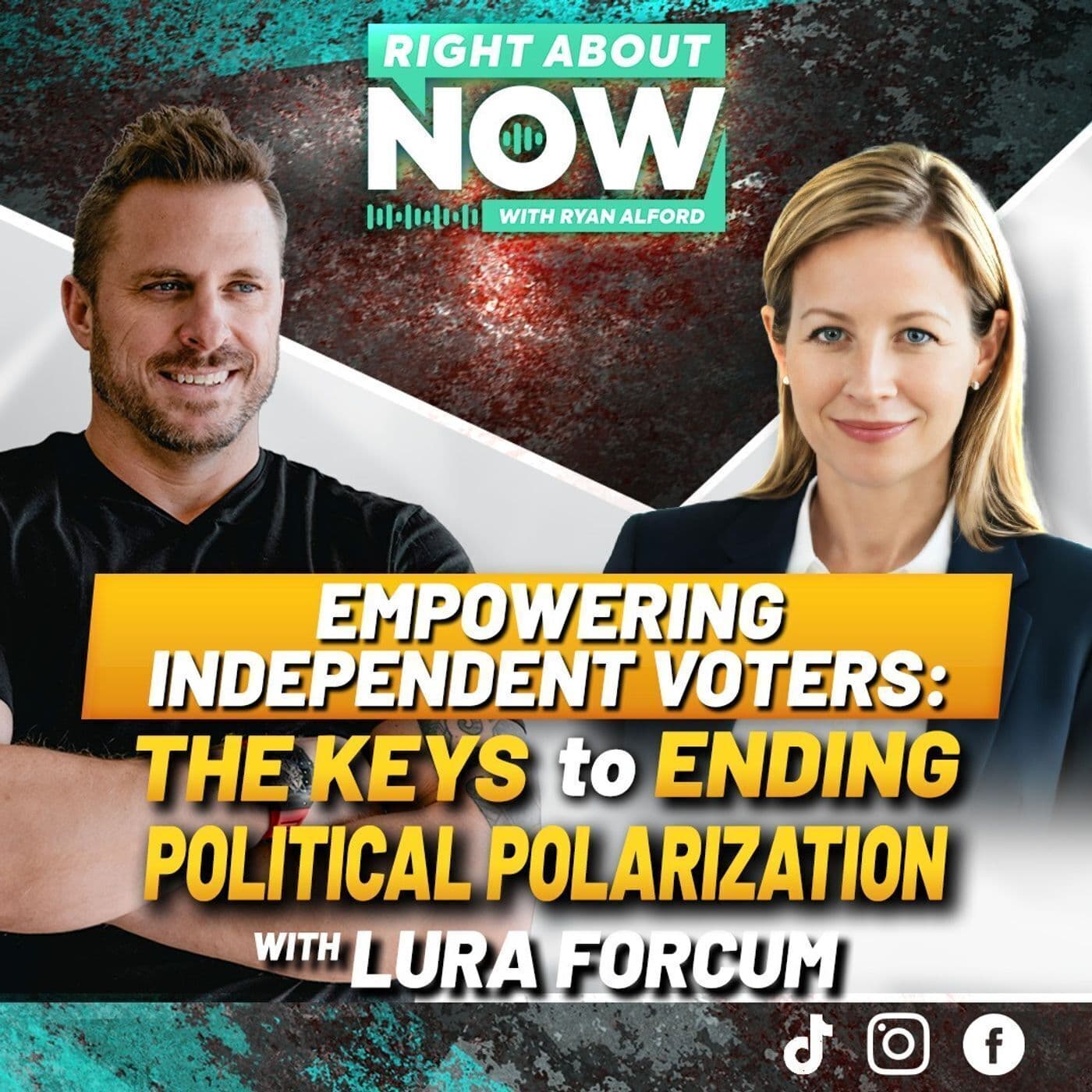
Empowering Independent Voters: The Keys to Ending Political Polarization with Lura Forcum
Independent Center president Lura Forcum joins Ryan Alford on the changing American dream, independent voters, split tickets and why outrage isn't
- Lura's research finds the single biggest driver of human behavior is relationships and social connection, and socially isolated people have measurably worse health outcomes.
- Younger generations still hold an American dream, but it centers on experiences, security and freedom rather than homeownership and a set number of kids.
- Instead of asking people their party, Lura's prior research segmented people by their resources, social connection and views on harm, showing that politics is not one of the core human needs.
- Independents don't need a third party to matter: they can vote candidate by candidate and split the ticket, which is exactly what the Independent Center saw in the last election.
- Independent Center polling at the start of the Trump administration found Republicans, Democrats and independents all expect bipartisanship, which neither party is selling.
- Gen Z and millennials are roughly 52% independent, and independent identification overall is higher than ever.
- Being outraged by the other side's behavior feels like political engagement but has more in common with gossip than with solving policy problems.
- Follow the Independent Center's surveys, blog and weekly newsletter at independentcenter.org for policy analysis from an independent angle.
Younger generations absolutely have an American dream. It just doesn't look like what older generations had.
Like, we don't have to agree with each other in order to be good neighbors with each other.
So, I mean, this is absolutely what we are saying to people is that you don't need to vote for a third party to be an independent.
Did young people value the idea of the American dream in your mind? Oh, absolutely. I think that's a really interesting question too, and it's something we've seen in our research. Younger generations absolutely have an American dream. It just doesn't look like what older generations had. This is right about now with Ryan Alford, a Radcast Network production. We are the number one business show on the planet with over 1 million downloads a month. Taking the BS out of business for over six years and over 400 episodes. You ready to start snapping necks and caching checks? Well, it starts right about now. What's up guys? Welcome to right about now. We're always talking about what's now. We can talk about the future, we can talk about the past, but we're talking about today.
What you need to know, how you get ahead and look. I think you're going to recognize a name today because I've been talking about them for a few months. It really matters today. A lot of the stuff is going on is very partisan and very political. I like to cut through the bullshit and ultimately talk about policies that matter. That's why I love the Independence Center and that's why we brought the President. We're going straight to the top, baby. Straight to the top. We got the Doctor of Independence, Lori Forkum. What's up, Lori? Hey, Ryan. Good to be here. Good. Thank you for having me. Yeah, it's good. It's good. Hey, in person too. Yeah. I was like, hey, can't pass that up. I know. I'm your neighbor.
I know. And you're down the road. I'm down the road in Pendleton. And you're in marketing and you're a professor at Clemson where I went. How did we not know each other? Well, I were the same age. You weren't a professor there. This is true. I was a professor after you finished there. I spent several years teaching marketing there, studying human behavior, psychology. What motivates people? That's a whole separate podcast. You did that, though. You did not boil down to one or two things. Yes. So I would say like the key motivation for everybody is their relationships and feeling connected to other people, the people around them. It's their family, it's their friends, it's neighbors and communities. Like we are inherently social animals. And you can explain so much of human behavior by trying to like protect those relationships.
People flourish when they're connected to other people. And they like we know now that people who are socially isolated just. Life is really hard for them. They have poor health outcomes, all kinds of things. So we are social creatures. Yes, we are. And you know, I'm not mistracademia. Another story for another day. I've talked about it on the show. But I do like some marketing books. This is one of my favorite or like the art of persuasion and like those kind of things. I always say people think what they're head and they bow with their heart. Absolutely. I mean, so one of the relationships we have is with ourselves. Right? Like you could think of that as almost a social relationship. And people buy things and ideas, right?
And like relationships in some senses when it helps them feel more connected to themselves. Like that's their identity, right? Like that is our relationship with ourselves. So whatever marketers can do to make it seem like their product helps you be more connected to yourself or to the other people in your life. Like that's such a motivating factor. I think so. I think it actually ties into the American dream too. Yeah, absolutely. When you think about those motivations and those, the history of that. And that's what's so fascinating. We've been talking about that on the show. And I love what the independent setters doing around this, you know, bringing the studies, the data, the stuff we've done, the man on the street stuff, which you've probably seen in some of my content.
Yeah. I mean, when you hear, like, yeah, Laura Forkham, like, what's the American dream to you? I have a very geeky American dream. And this is kind of what I have realized as my career is developed. But like to me, what's really exciting is when people are participating in public policy conversations, which I know is not for everybody, right? But I know it's important to you too. And I think. I think the thing that's really important is people making their voices known about what they need to live their lives the way they want, what they don't need. And that's how we make everybody better off. And I know that politics right now happens in a way that's very off-putting to people. A lot of people are checked out because they don't want to participate in the vitriol
and divisiveness that you talked about. And so what I realized was I wanted to take my research expertise and, like, that background and translate it into, like, can we make this better? Can we make it so that people want to participate in politics? It doesn't feel polarizing. It feels like something for everybody. So I look at policy as, like, this is how we, as different complex individuals, sort out our values and what we need and, like, figure out how to make our lives better. And so that's my American dream. Yeah. We love the man on the street interviews that you guys did, because I think what they show is that, like, instead of everybody having the same American dream, right? Like, people have very unique American dreams.
But the thing that matters is you're pursuing what's important to you. And that you can get those things through your own effort. That's right. I was surprised, you know, we've talked. I mean, it was, they almost felt scripted because of how thoughtful they were and how they aligned with what we assumed to be kind of like the silent majority of people that, you know, feel this way about the American dream and have diverse feelings. But, you know, there's also this era of feeling scared to sort of talk about it. Yes. And because no one wants to be polarizing and they're kind of tired of us. They don't want to feed that. Yeah. And it's like, it's almost hard to have an opinion and feel like you could have a dialogue.
I think this is a terrible place to be in when it's like, I need to make sure you agree with me before we talk about politics. Exactly. You know, how can we have conversations about how we want elected officials to behave or what kind of laws are right or what kind of programs are right if we need to know that we agree before we can even talk about it? Yeah. Exactly. Of course, we're different people. This is a really like diverse country. It's okay to disagree, right? Like, I think we're actually better by the fact that we like and value different things. That makes us stronger. Yeah. I mean, creativity comes from the very fabric of different ideas and thoughts blended together. Yeah, absolutely. Like, if you were only exposed to ideas and people you agreed with, like, your life would be impoverished.
That's right. I mean, I think about myself growing up. The diversity within my own family dynamic is what makes you who you are. Like, and we get in these, I don't know, echo chambers. And I don't know when that, you know, I'm in my 40s. But I don't, it wasn't always that way. Even in my growing up, I didn't feel like I feel like as I can remember, I feel like in my 20s, where I'd have disagreements with people about certain things and it was okay. You know, like, we still have beers that night or go out or play a sport. It just, I don't know, when did that flip? I don't know. But I think what's accelerating it, one of the things accelerating it is, you know, algorithms and social media.
Yeah. Or just showing you the stuff that they can tell that you like, right? And so you just get more and more insulated from other points of view. And, you know, sometimes you hear somebody else's point of view and you change your mind. Sometimes you hear somebody else's point of view and you're just like, well, that's interesting, but no thanks. Yeah. But, you know, I don't think that you are made worse off by hearing what other people think. Because sometimes they agree with you for a different reason. That's right. And I think, like, we benefit from being connected like this, even if we're not in total agreement. Did young people value the idea of the American dream in your mind? Oh, absolutely. I think that's a really interesting question too.
And it's something we've seen in our research where, like, younger generations absolutely have an American dream. It just doesn't look like what older generations had as their American. Right. It's not a house on the little house on the ferry. And, like, 2.5 kids are something, right? Whatever that number is. Yeah, and a dog and a cat and maybe some fish. Yeah. I think sometimes, like, older generations think, like, oh, I can't relate to the kids today. They don't even want the things we used to want. And, like, they do. It just looks a little bit different, right? Like, they're more interested in younger generations are more interested in experiences rather than material things. And I think that's, there's actually a lot of research showing that people consuming experiences, like, really meaningful.
And so I think it's really cool the research you did too, the interviews, because it shows, like, this is how different it can look. But it's all still the same overarching thing, which is, we know who we are, and we're pursuing the things that make our lives rich and meaningful. And then the question for the IC for the Independent Center is, like, okay, well, what kind of policy environments and governing makes that easier for people to accomplish? You know, I've thought a lot about this, and it comes back to, like, some really simple themes to me. Security, safety, and the right to do whatever the hell I want when I want. You know, like, within reading, within the law. As long as it doesn't hurt other people, security, safety freedom.
Yeah. That's the American dream. Yeah. This might, it might be a shiny house. It might be a rented apartment, but you have security and safety and insurance that you can make it on your own, right? Or with your family dynamic, whatever that is. Yeah, absolutely. Actually, so some previous research, I conducted what we looked at was, instead of asking people what's your political party, we asked them those same things that you just named. We asked them questions about, do you have the resources you need? How socially connected are you? Do you feel like you're part of a community? And we asked them about harm, which is related to your idea of security. Like, we asked them, like, what is harmful? What hurts other people? What should we do about harm?
So we took those and we formed them into these segments. And the interesting thing about that is they're not political segments, right? So, like, politics is not any one of those needs that you just named. And somehow we put it on top of our lives and made this really destructive kind of argumentative, polarizing conversation, like, so important. When really, it's not any of those things that you just talked about. Yeah, yeah. It's definitely grown in perceived importance. Doesn't really align with the actual value or interest. Yeah. That's one of the things I've found about living in South Carolina, so I'm not originally from here. I'm a transplant. But one of the things I notice is that, you know, the people around me may have voted really differently than I did.
But we can still all get together and run our town in a way that is healthy and makes it a strong community. Like, we don't have to agree with each other in order to be good neighbors with each other. Still Americans. Yeah, we're all Americans at the end of the day. And I think this, like, political rhetoric that the other side is the enemy and has to be obstructed. Like, this just pushes people out of politics. And I want to bring them into, I want to bring them in. That's what the IC is here to do is bring people into political participation. What do you think, you know, are some of the bigger, I don't know, meaningful topics that are at the heart of people today.
That need to be elevated. I think one of the really big things that we hear from our audience is about entrepreneurship, right? And I think that's something your audience is interested in as well. And so, you know, if you're trying to build a business, I think that has aspects of, like, your relationship and your identity because it's about, like, what are you really good at? And what really excites you at the end of the day? And you can do in a way that nobody else can do, right? And so we know our audience is interested in entrepreneurship. And then the question is, like, what are the policies that make it easier for you to succeed in growing a company or growing a business? And what kind of policies are going to make that hard?
So it touches all kinds of things, right? And, like, really complex areas that you and I are not experts in. In finance and, like, all kinds of complicated stuff, right? Immigration policy, but the overarching question is sort of like, well, what are the things that we could do? And what is the legislation that could be enacted so that people can build their businesses? And they prosper. And then they're making life better for all of us because I buy your products, right? I can use the services and things that are being created. I mean, what makes America great is our ingenuity and creativity. And small businesses, entrepreneurs starting and then growing them maybe into the next Tesla or maybe the next local coffee shop. But that's sort of the fabric of America.
So if we're not stimulating that, we're in trouble. Right. And, you know, if you have policies that make it hard for somebody to open a business, whether it's a coffee shop, a salon, right? Like, if it's just impossible to build things and to offer your services, then that makes everybody worse off. It makes it hard for people to, like, get their American dream. And so we need to, I think it's cool to see the extent to which people, I think this is part of like the side hustle, right? Like that way of looking at work is sort of saying, well, what am I good at and what does the market need? And then, you know, the independent center's angle is sort of like, okay, what else would make it so that you can pursue those things?
Right. And what are the barriers? Do we really need gatekeepers who are saying, like, no, you can't open that business or no, you can't build that? Yeah. Laura, this likes to leave me right into the water. I'm wanting to wait into. I love it. Talking to Laura Forkum, she is the president of the independent center. So, Laura, I think when you think about politics, the right and the left, I'm going to oversimplify. But I want to know, like, where are we where we feel like the independent, out of the independent center, Switzerland. But it's more the policies than not the politics. I'm going to lead it within the politics. I think the right, less government, less involvement, get out of my shit. The left doesn't necessarily say get in my shit, but we need governance. We need hardcore.
I mean, I'm simplifying. But I think that's a big difference of the right. The independent center being Switzerland and listening to people that some policies, do people lean more right or left in that or not even right or left? Get politics over here. They lean more regulation or less regulation for what you guys hear. Our audience, when we're surveying them, we are absolutely hearing them say, like, less gatekeepers, right? Like, once regulation is probably the right way to go, they want government that is effective. The problem with the polarization right now is that these are two parties that are just entrenched in doing their own thing instead of what's best for the American people. So what we hear from our audiences, like, we expect government to be effective in the story.
You know, when parties are instead just kind of obstructing and not working with the other side, that is not serving anybody but them, right? So it's really interesting. You know, obviously, like, we do a lot of research on our audience. We do surveying and polling. We do some AI insights work. And we do focus groups and one on one interviews and one of the things that strikes me a lot is that independence are, excuse me, independence are like incredibly thoughtful people who understand that policy is really complex. And they're trade-offs in policy, right? Like, you think you're getting one thing, you end up with something else. And so they're just aware that, like, this is a complicated process and having these two super polarized parties is not going to get you the kind of good high quality policy that would make people's lives better.
Yeah, I think we've lost compromise. I know it sounds weak. And I hate, as a strong opinion guy, it is like, you know, like, I don't know that I always like to, but I like effectiveness. You do. Yeah. And it's ineffective not to compromise sometimes. Because some kind of compromise means like, you gave in in your week. Yeah. Now, it means that there's usually middle ground. Yes, you found common ground. Like, that's actually some strength because it's like, you knew what was important to you. You understood what was important to the other side and you found an area where you could overlap. Exactly. And that's what's missing. Yeah, totally. It's just, I'm going to have my way. And we've gotten to where, like, used to be that, but then it's just now brute force of my way the highway seemingly.
Yeah. I mean, some people describe this as politics where you're saying, like, the problem in politics is that my side doesn't have more power. And I think independence are saying, regardless of who has power, we expect you to govern. We expect the government to work. We expect some fiscal accountability. Like, let's be sensible here with our spending and let's be sensible on the social side too. Like, we can tolerate other people's behavior that doesn't impact us. Yeah. And we see a lot of that. We see it in younger generations, especially, are more likely to say that they're independent because they really don't see either side as totally representing who they are. Yeah. I mean, it's a melting pot of, you know, I like this. I like that. And it's supposed to be that way, right?
Yeah. We're forced seemingly by our social groups into one camp or the other. Yeah. Like, it's really more like a tribe that it is. It is. Very tribal. It's very tribal. And social media is, you know, you know, the stomping ground of it all. Yes, absolutely. And the other thing that is, you know, comes from my research and some of the social psychology looking at human dynamics. So there's this work about in groups and out groups and out groups over human history were like people you ward with. They were the other guys, the bad guys, right? And the problem, I think, in American politics is that we've gotten to this in group out group dynamic where the other side is the out group. It's okay to take from them. It's okay to harm them. They don't count. They're not us.
That's not how I think anybody wants us to be treating fellow Americans, right? Like, we can have a politics that is about differing opinions, but at the end of the day, we're still citizens of the same country. Like, these are not our enemies. We are not out groups to one another. Yeah, exactly. It's all one America back to the thing. I think that's what most people want. And again, we've forced into these camps. It's even a struggle for me because you think of how kind of you're dependent. You're still trying to be wooed to one side of the other, typically, especially when it comes to voting time. And it's like, yeah, we have a two party system for the most part. I mean, independence never won the president. Right.
And so I don't know where this, you know, how do we break the pattern that we're in? So, I mean, this is absolutely what we are saying to people is that you don't need to vote for a third party to be an independent. You can be an independent and exercise your vote and vote for the candidates and the policies that you think are more successful. I think what's really unhealthy is when people are dropping out of political participation because they don't feel attached to either party. So they're sort of saying, well, I'm a political. And what we want to say to independence is, if neither of those parties are for you, that's fine. But, like, come in and express your opinion at the ballot box.
They swing vote, right? They split ticket. We saw tons of split ticket voting this last election. So somebody at the top is voting for Donald Trump, lower down the ticket. They're voting for Democrats for governors and senators and representatives. So, like, that's what an independent does. And that's awesome. We need that kind of political participation because they're saying what matters most is not my tribe. It's a government that actually works. Yeah. And I've been vocal about where I voted in the last election. But I voted on both sides of the aisle in multiple elections, in past elections. I, you know, am a true independent. But, you know, I think. But then I felt even my own personal experience of getting thrown into one camp or the other because I like a certain policy, you know,
being an entrepreneur to side of things, and not because I'm in love with the person. But I like the policies. Even I felt the, you know, the wave of one side being happy and the wave of another side just, you know, lumping me in with something else. They assume they know everything about you because they know about one policy. Yeah. And one candidate, you know, this time around. No, these like blanket kind of assumptions about people, you know, people support the things they support and they value the things they value for all kinds of complicated reasons. But like when we assume that the other side votes the way they do because they are bigoted or snowflakes or whatever, we're just not understanding each other. We can't govern like that.
Yeah. Well, it drives you every day. Like, you know, like what? What sets your frame of reference for, you know, why you do it? You do. Oh, that's a great question. So, I mean, like I have three kids. My kids are, I think like parenting them. Maybe this has been your experience too. But parenting them has made me realize like it doesn't work the way I thought it would work. Like they don't follow orders. Maybe you're parenting better than I am. No, I don't know about that. But I'm probably a little less structured. A wife is not though. She's a principal at a middle school. So they get both sides of the aisle. You can say I can sit by watch. I know exactly what she's doing right now.
Okay. I parent the way you do. But it's like they, they have their unique gifts. And I want them to be able to like flourish as human beings. And I want a world where they can flourish. And I feel like they, I have to trust them to do the things that are important to them and that are who they are. And so I think that applies to like how we think about politics too. Actually, it's like we have to trust people to pursue the things that are like deeply who they are, deeply meaningful to them. That makes their lives more meaningful. It makes the world a better place. But like it means you let go of a lot of control, right? Yes. Because I'm not going to dictate what is best for them.
I'm going to have to like let them choose that find their way, right? And I try like for my kids, my big part of my energy is like, how do I, how do I help you find that and put the things in front of you that will let you express yourself, the version of you you'd like to be? And so I think like that's how we should be looking at public policy too. Like how do we help people flourish and be abundant and trust them to make choices for themselves instead of saying, well, we're going to tell you what the answers are and how to live and how to run your life and what's okay and what's not okay. It's hard as hell to take let control go.
Oh, it's really hard because I'm not a, I'm not a controlling person at all. Myself, yes, very particular, but like others are even, but with your children though, you know, because you know what they don't know and you want the best for them. And it's, you know, there's the fine line of living vicariously through your children with somebody will do. I thought let's put that over the side and more like wanting the best for them and knowing what are hard paths and what are easier paths and like and letting them figure that out while also coaching them. It's funny because I just had to thought like maybe you were a kid like I was. I was a kid that like you could not tell me anything.
Yeah, I was close. Well, you kind of like that. I had, you know, I got along with everyone, but silently you couldn't really tell me what to do. Yeah, I did not take any feedback or advice. Yeah, I took very little. Right. My oldest kid is like that. It is infuriating. And now I know. Yeah, it's not my way back. Yeah, it is your way back. Yes. But yeah, like he's just going to have to figure it out. Right. And like I need to stop him from doing things that have permanent consequences. But the rest of it is like, well, you're going to, you're going to figure this out. Eventually, you'll realize like your mom is one or two things. That might be it. Yeah.
Oh, PhD. You know, if you were in one or two things. What success look like for the independent center? Oh, that is a great question. You know, we, we're really focused on being like bottom up. We're not trying to tell this audience of people what to do. We're concentrating on listening to them through our research and focus groups and pulling all the stuff. And we're trying to help them voice what is important to them and what they need through the political process. Right. Like we want them to participate politically and in policy conversations. So we're in a lot of senses like listening to them. So I would say our metric of success is like, can we get more people engaged in public policy conversations? Can we get more people checked back into politics?
Because, you know, where we are so polarized, right? Like we can't get really extreme positions out of politics. But we can add in more people who have more nuanced views. And I think that's where there's a huge opportunity for us. Yeah. I think, I think about like social media and the pot. You know, I'm marking. Yeah. We're marketers. Like, well, you know, like it's such a great vehicle for exchanging ideas and doing things. But what I, what I hear you answering that questions and I even think about my own life, I feel like it gets in the way sometimes though of progress of this type of thinking and thought and independence and not feeling like you're being judged, you know, to get to that point.
And I think I really hope we can get to this place where the policies are just elevated to a point where you can't ignore them anymore. And you, and you almost go the politics, the, you just push it to the side, almost like, you know, two teams fight it, you know, it matters. But this is what matters. You know, like, well, you know, one of the ways I, I look at this is that I think right now, what people consider being politically engaged is not really in a way that's helpful to our policy debates. No. Because when they're, when they think they're doing politics, they're like seeing somebody else's behavior and they're being outraged by it, right? So like, they look at the other side's candidates and they're like, oh, can you believe she said that?
Or can you believe they did that, right? And like, that's just outrage. It actually has more in common with like gossiping than anything else, right? So as long as we're doing that stuff, we think we're doing, we think we're politically engaged, but we're not actually contributing to conversations about policy and solving our challenges. So like, if we want to solve issues around regulation or immigration or, you know, entitlements, right? Like, that's going to require us coming together and having conversations about what's important and what matters, right? And sorting out those areas of disagreement and it's not going to be, we can't do it as long as we think of politics as being outraged by the other side. Yeah. And it's scorekeeping at all times. Yeah.
It's like, you know, everything that happens is slanted this way or that way and how can we, you know, one up the score? Yeah. And that's not doing anything to advance us. No. Even if like, it's almost like it might accidentally do it, but it's not getting to the core of the issues that we're dealing with. Yeah. If of how I can paint with a red bus or a blue brush, you know, like how I can, you know, make one candidate look good and one look bad with the exact same story. Yeah. Yeah, exactly. I mean, obviously it's entertaining to people. It does. I think that's what it is. Yeah. It's like entertainment. It's, you know, freaking the real world, but in politics. I mean, it probably should be kind of boring, right?
Because a lot of the stuff is incredibly detailed and there are, you know, implications, like if you look at insurance markets and how you respond to natural disasters, right? Like, that's incredibly complex. I want experts and we do have incredible experts that can, that are really well versed in this, right? And like, they can tell you what makes a good policy, what makes bad policy. They're in government, they're in private sector, they're academics, right? Like, that's who I want talking about public policy and sorting it out, right? With people's input. But as long as we're just focused on like what's being said on Twitter, as though that's politics, like we're not, we're not going to solve these issues. Speaking of issues, you know, you've gotten into this job and everything you guys are doing at the independent center and looked at data and studies from people smarter than me.
Lots smarter and, but like, so you need to surprised you. Is there like a source of data or a fact or, you know, thing that may, because again, you're like, you're strong willed independent person. Yeah, there you go. You admitted it. You already own it. No, that's not real. Yeah, you're going to tell me anything. So was there, but is there stuff that even surprised you from the data for, you know, it's wide open. It could be on anything, but it was different than maybe you thought. Well, so one thing that's just come out recently, we just did some polling here at the start of the Trump administration where we asked independence, Republicans and Democrats. We pulled them all and said, what are you expecting to see, right?
Like, that's part of keeping any elected official accountable is like, what do voters expect? Yeah. Right. And then later on, we'll pull again and say, like, did you get what you were expected to happen? Yeah. Yeah. And one of the things. Go figure. Sounds like the exact what it should be. Right. But one of the things that surprised me was that Republicans independence, everybody is looking for bipartisanship. And that's not what either the parties are selling. Neither one of them are saying, hey, you know what we're planning to do? We're planning to work with the other side. So voters are expecting bipartisanship. I think because they know that with small margins, you're going to have to work across the aisles to deal with our problems.
And I don't think anybody wants one mono party that's like going out there deciding everything, right? Like, that's not going to get us good policy. So what we learned in the survey is that voters are looking for bipartisan behavior. And, you know, we're going to go check back in a little at the end of the year and figure out, is that what we see? Is that what voters saw? Are they pleased with what they're getting? Yeah. And, you know, like, that's the other thing I want to say about the independent center's work. Like, our feeling is you should let people choose what is right for them and what's best for them. To the extent we can, we want to offer people choice at the ballot box, right?
And we think that when you have more choices, you can get closer to the things that matter to you, right? And like, that's very marketing-centric thinking, right? When consumers have more choices, they are better off because they get the product that matches what they want. And so, like, why wouldn't we have that in politics, too? Yeah. As you close out here, Laura, you know, I bring it back to the American dream. And I feel like everything I've been hearing you say is leading towards educating people on things and policies that can help them fulfill their American dream. And, you know, I almost feel like, you know, we're talking about our kids and talking about just coming up. Like, if I think those in power, or even maybe the next generation, because we can admit, we're kind of, you know, the elected officials we have have already been here.
We know what we got. And I'm almost thinking like eight to 12 years, 16 years from now. I don't think the kids and the young people are going to do it the way it's being done right now. Yeah. And I think so. I think the boat's going to have to change, or they're going to be, I don't know, a revolution anyway. Yeah. I mean, you know, younger generations, Gen Z millennials are actually like 52% independent. Yeah. That's got to be high compared to 30 years ago, 20 years ago. Oh, it's way higher. Yeah, yeah, it's way higher. And across the board, like, you know, people are now identifying themselves as independent, higher levels than ever. And so I think a shift is coming, maybe where people don't want to think in just these dualistic terms of like, I'm this side or that side, you're saying like, no, it's some of both.
And so, you know, I think that having people with complex ways of thinking about policy and politics and kind of like you said, looking at this and being like, this is bullshit. Yeah. Right? Like, that's who I want to involve in politics. I think when you look at one party and say, like, everything you do is great. That's, that's not reason. No. Right? Like, some of it is, some of it is better than others. Yes. Right? But like, we can do better. Yeah. We can do better. That's what America dream is helping us do. They're proud sponsor and look, whether they're a sponsor or not, I'd be supported them because I believe in the American dream and what we're pushing for. Laura, how can everybody keep up with what you're doing, whether the independent center is doing and get involved, all that good stuff?
Yeah. Reach out to us. We're at independentcenter.org. We have a weekly newsletter. We publish our surveys. If you have questions about, like, what do people think about different policy issues? We have lots of survey work. We publish blog articles about what's going on in politics from an independent angle. So if you don't want to just hear, like, what is the red side or the blue side on this stuff? If you want to hear, like, here's what matters for independence. Sign up for our newsletter. Come check us out online and reach out to us. Like, we're always happy to talk and chat with people. Get connected. You're very approachable. And I appreciate you coming along. Thank you. Thank you for having me. This is great. Yeah. Of course.
And I think that's what we need in America. You'll find that link to independent center in our show notes on my bio and Instagram. And look, go sign up for the newsletter. Get the politics out of the way. Get the policies at the front of the line. That's what we need. That is what is now. Go find me. Ryan is right.com. Go find links to all of the highlight clips from today's show. All the good stuff. None of the bad stuff. All what's now. We'll see you next time. All right about that. This has been right about now with Ryan Alford, a Radcast Network production. Visit Ryanisright.com for full audio and video versions of the show. Order one choir about sponsorship opportunities. Thanks for listening.
Bye.

Justin Brennan on Multifamily and Other People's Money
Real estate investor Justin Brennan explains syndication, check equity vs. sweat equity, bonus depreciation, and how to buy apartments without your own
Hiring Is a Marketing Problem: Nicole Feenstra
Nicole Feenstra of The DNA Agency tells Ryan Alford why job descriptions fail, how to market the trades, and how geofencing and storytelling win

Jason Brown on Options Trading, Risk and Rebuilding
Jason Brown turned a $10K student loan into six figures, lost $250K on one trade, and rebuilt. He shares his options, risk and wealth roadmap with Ryan