
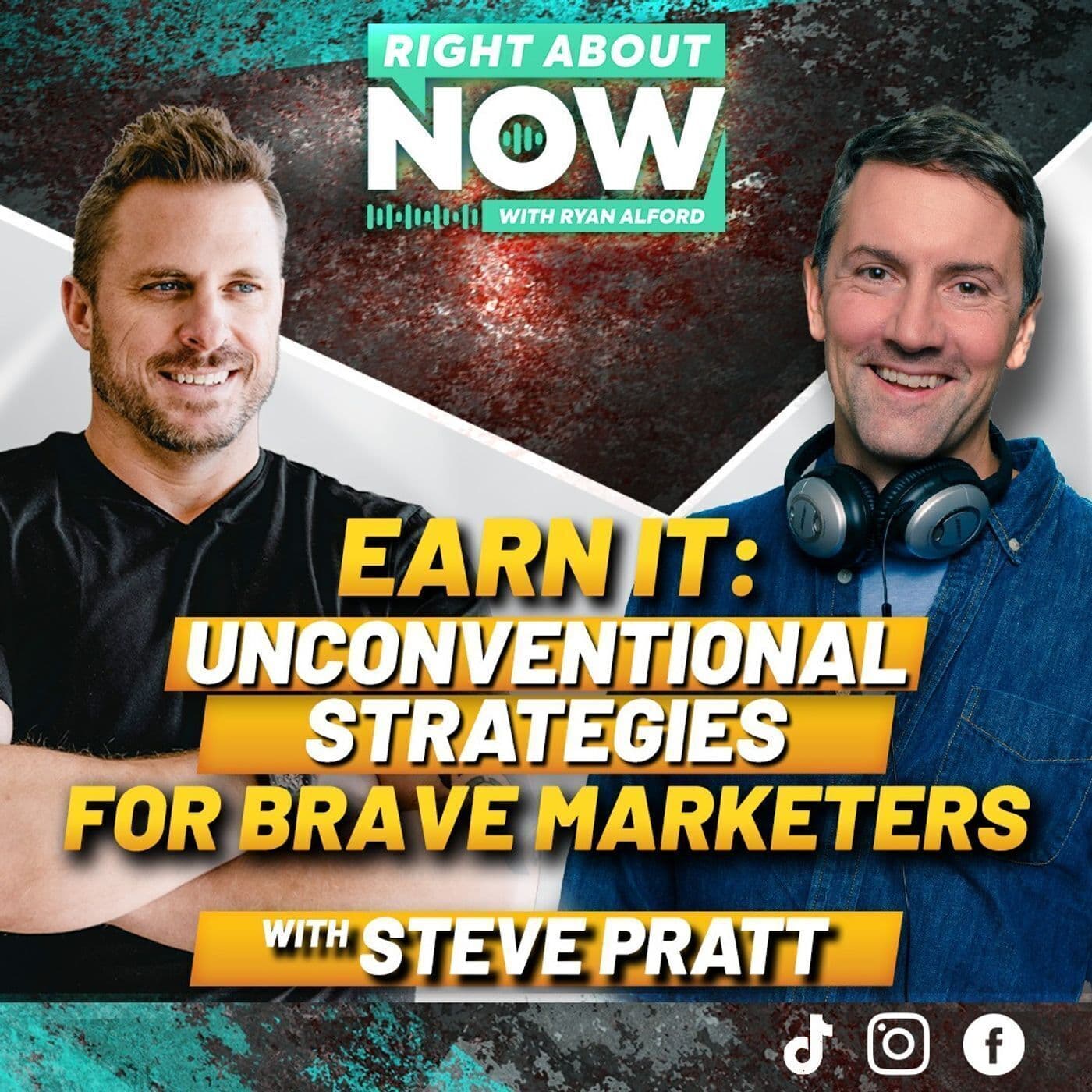
Earn It: Unconventional Strategies for Brave Marketers
Earn It author Steve Pratt joins Ryan Alford on creative bravery, why short-termism kills marketing, and how niche content earns real attention.
- Start with attention, not outcomes: without attention there is no audience, engagement, trust or relationship to convert later.
- Design content as a "gift" that sits in the Venn diagram overlap between the business outcome you need and genuine value for the audience.
- Roughly 95% of the people your marketing reaches are not in buying mode, so use that time to build familiarity and trust that pays off when the 5% window opens.
- Judge your content against three creative bravery tests: would you consume it if you didn't work there, is it good enough to tell others about, and would you remember it in five years.
- Sub-1% digital ad conversion rates are treated as success; question whether annoying 99% of the audience is the only option.
- Differentiation often comes from the format wrapper, not the subject matter - McAfee turned generic cybersecurity tips into Hackable, a Mythbusters/Mr. Robot hybrid where the host actually gets hacked.
- Super-serve an underserved niche and aggregate the pockets: a Canadian-only, all-genre, new-artists-only show hit #1 in the country with 80,000-100,000 weekly downloads in 2005, and Red Hat's open source show outperformed mainstream shows.
- When promoting content, measure cost per sample rather than CPMs - paying higher rates to a trusted, tightly matched channel like Past Gas for the Ford Bronco podcast drove acquisition cost down.
I start with attention because if you don't have any attention, you have nothing. You have no audience, you have no time, you have no engagement, you have no trust, no relationships, no one's even hearing you, no one sampling.
Short-termism is the greatest disease in marketing.
there's nothing else in the planet where 1% success would be considered awesome.
I start with attention because if you don't have any attention, you have nothing. You have no audience, you have no time, you have no engagement, you have no trust, no relationships, no one's even hearing you, no one sampling. This is right about now with Ryan Alford, a Radcast Network production.
We are the number one business show on the planet with over 1 million downloads a month. Taking the BS out of business for over six years and over 400 episodes. You ready to start snapping necks and caching checks? Well, it starts right about now. What's up guys? Welcome to right about now. We're always talking about now, not about yesterday, not about the future, because look, it's about what works today in business, in marketing, and in life. We cover the gamut and look, I get to choose who I want in this show and that's what I love. Steve and I were just talking about this and our next guest is someone that I've admired from afar. You know, I don't know Steve. You're going to get to know Steve today, so am I,
but I've been reading his book and going through it and a lot of people I know pointed him my direction and I'm like, this guy knows his shit. And you know what? You're going to know his shit too, because he is Steve Pratt. He is the author of Earn It. Unconventional strategies for brave marketers. I hope I'm brave. I'm going to learn today if I really am. Steve, welcome to the show. Hey, thanks for having me. I feel like I'm going to be like a shit distributor today. We're giving the shit to business. Wait, look, we take the bull shit out of business. That's the, that's our tagline. No BS. I'm full of it. I'm going to empty it all out today. It's great. Yes. No, it's not. This is the business you need to know. And Steve is not
going to drop anything, but knowledge on us. But Steve, we're always today. I'm in Vancouver, British Columbia, Canada. And I am super excited to talk to you in South Carolina. I, we were saying earlier, I love South Carolina. I used to go there all the time, the best. So yeah, awesome to talk to you. I haven't been to Vancouver, but I need to. I, uh, I like the warm. It is not warm here now. It's come in the summer. It's like the nicest place on earth. Uh, right now, there's, it's cold and dark and this is, unless you're a skier, don't come right now. We're like 78 today. Uh, it's excellent for us for February. We had the four seasons, but, uh, it's a beautiful day
in South Carolina, but it's a beautiful day for everybody listening wherever you are, whenever you are, however you're listening, I'm pumped because we call it my favorite subject, you know, like having a business show that is marketing center. I don't always talk about marketing, but now I get to geek out a little bit. Steve, I mean, let's set the table for everybody. You wrote the book, you've got opinions on marketing. Where? What the hell formed? Steve crafts opinion on marketing. And what's, what's, what's been the lineage here for you, Steve? Well, I'll give you the, the short version is, um, I come at it from a little bit of an unusual place as I come at it from the media background. So I did about 10 years of television. I worked in music television and
children's television and journalism and things for about 10 years. And then I went and ran a digital music service for about 10 years at a, at Canada's public broadcast. There's kind of like NPR music, but in Canada. And started podcasting in 2005, which is super early, uh, in this innovation lab thing. And I guess around like 2014, I left and it was a mix of different reasons, but part of it was because the media business model seemed pretty broken where so many advertisers were leaving for the digital space. And so many audiences had tools to just bypass interruptive things that they didn't want. And I saw all these companies like Red Bull who were acting like their own media companies that they realized pretty early on. We don't need a media company. We don't need
broadcast towers or licenses with the internet. We could just decide to make awesome stuff and build our own audiences. And I had this moment where I was like, you know what? I know how to do that. I like my whole career in media is I know how to make great shows and engage audiences. What if we went and helped teach a bunch of marketers how to do that and help companies build their own audiences and turn this into a business. And so I left. And then very shortly after serial, this huge podcast came out. And you know, podcasts were big in 2005, 2006. And they kind of dipped as YouTube and Facebook came up. And then they came roaring back with serial. And we're like, let's make the weirdest
business ever and double down on helping brands learn how to make podcasts. And we were the first people on the planet to I think to actually have a company that only did that. And a bunch of people almost had interventions with us because they thought we were going to go bankrupt and lose our houses. I think we got really lucky. We picked something at the right time and it turned into a really, really like good, but also just really enjoyable and fascinating business helping figure out this whole space. So yeah, I did that for about eight or nine years. And then the last three years, I've kind of been on my own writing this book and going on, you know, helping companies do it, not just in podcasting, but figure out kind of broader content strategies for doing this stuff.
Yeah, man. It's it's like the most used word, but the most appropriate word in marketing content. It's like we all we all hear it. I think, but it's, but it is what it is. It was a podcast, whether it's social media, whether it's, I don't know, video audio. I mean, it's all content, some good, some bad, some brave, some not, some safe. And I think that's what it's about. It's like it's a hard business, right? Like it's, you think about how many messages we all get fired at us every single day as audience members and how picky you we can be now compared to where we used to be 20 years ago. If you want to be one of the few things that people actually pay attention
to, no matter what platform you choose, no matter what kind of content you make, it's hard. Like, it's a, it's a really hard deal, but it's also, that's also kind of the fun of it. And it's figuring out how to make things they're actually valuable for people that they want to spend their time with. Because I don't know, I feel like people don't suffer through mediocrity anymore. They don't have to. It's just nice. Yeah. I mean, choice is amazing. And back, you know, 15, 20 years ago, maybe even 25 years, I'm starting to age, Steve. I don't know about you, but my years are still ticking. I can't seem to keep it in pause. But, you know, you had so many channels, to watch on TV, you know, being a guy that sports for me for the most part, but yeah, you have
your other cable channels and smartphones barely existed and definitely didn't have the video and data bandwidth that we have now that enables all of these things. I tell people, I'll tell you all the time, I was a pioneer of enablement. You know, you're going on smartphones in 2007 and 2008, but the throughput. And now, like you said, you got so many choices. You can, you either, I've been playing with this notion, Steve, and I think you'll get it. It's somewhat yours. It's kind of like, either you're getting turned on or you're turned off as a brand, it is content because people get to choose. And that's really what you're talking about, isn't it? I think it's a great way of phrasing it. I may have to borrow that. Mine is usually
something like, you're either earning attention or you're getting ignored. I have literally, I'm an upgrade of God. I mean, I have it sketched the on button for our, like, relaunch of our company radical, like, on the brand with an on play button. And you either get choose to, you know, like gets that so far, right? Well, we were talking earlier about this idea of sampling, right? Like, I think you brought up, you know, like the, the goal of everybody is to get sampled. And then it's the job of the show to keep people listening afterwards or, you know, the video or the newsletter or whatever it is. It just getting sampled is the on button, right? Like, it has to be so interesting that out of all the different options, all the Netflix tiles,
all the Spotify podcasts, all the TikTok creators, that they're even willing to give you a shot to give you a second or two to get in there. That's a hard on button to get into, right? Yes. Oh, God. It's so hard. It's crazy. How much competition there is. There's just unlimited content. And that's what I love about your book and the tenets of it. You got to earn it, baby. I mean, we all, it was, hey, back in the day, TV commercials, there's nothing else to watch. There's no phone distracting because now I make the joke. The TV, if you have one, 18 to 34 girls may not even fall in this. We've ever been talking 35 to 55 or 35 up. The TV is the radio and the smartphones to television. Like, that's where I think audio is
actually more important in TV now. Like, because your head's down. Yeah, that's funny. Even in podcasting now, the video stuff is fascinating. I have a, I have a 22 year old who loves podcasting. Never listens. It's always on YouTube. And she knows it's like it is like podcasting is like the new television on YouTube where it's, she knows exactly what shows, she watches what days they drop, what time they drop, all of it. It's amazing. And to be able to get to that point where people know that about you and look forward to you, like appointment viewing or listening, that's really hard. Also, you have to be pretty awesome or pretty valuable to a very specific group of people to get in there. I'm fascinated by all of it.
18 to 34 year olds listen and watch podcasts more than they do linear TV. Yeah, that checks that checks. I mean, it's, it's, you know, they're choosing what they want when they want. And brands and people and anyone that's trying to market or get scale has to ultimately earn it. Steve, talk to me about the book. Talk to me about the tenets of really the fundamentals that you put in this and what it takes to be brave.
Well, I guess the premise of the book is, is that you have to earn attention that it, if you actually want to get the business results you're looking for as a marketer, there are not any shortcuts that are going to deliver the real deal. Consumers, I have too many defense mechanisms to keep messages that they don't want out of their lives. And if you think like a consumer or like an audience member yourself, you know how picky you are about the things that you actually give your attention to. Like, our level of time and attention that we have every day is finite. There's a maximum number of things that we can possibly give our attention to. And there's more and more and more things competing
with it every day. So we can afford to be really picky. And I think it just means that the quality bar is higher for everybody who's trying to earn someone's attention. And the things you were talking about before, you know, in the past, we just kind of have this deal where we would suffer through things we didn't want in the middle of our shows because that was the only way we could get them. And that doesn't really apply anymore. And so I think, you know, as marketers and brands thinking about how we want to connect with people, it puts us in a different mindset of having to make things that people genuinely want to spend time with and setting a really high bar for creating value first for the audience rather than things that are primarily about us.
Anything that there's, you know, there's a nice intersection like there's a Venn diagram intersection between the job that we're hiring our marketing to do, like the business outcomes that we want to achieve and the value that we're creating for audiences, you know, which I kind of like framing as a gift. Can you design gifts for the audience that they're really excited to spend time with on an ongoing basis that also accomplish your business outcomes? That to me is the where modern marketing sits and, you know, where you can get marketing results and keep your job and build an audience of people that are happy to spend time with you. But the sad part is there's not really any super short cuts and hacks to get there. You actually have to do good work and it's hard work to
do it. It's fun, but it's hard work. Yeah. And you nailed it. The problem I see, and this is where the bravery comes in, outcomes, business outcomes, versus entertainment versus gifts, you know, whatever that looks like that earns their attention, you know, because you got CMOs and CEO's under more pressure than they were been under. So it takes real hootspa, real bravery to put yourself out there and know that the outcome comes along if you get the right kind of attention. And I frame that specifically around the right kind of attention, Steve, because in one of my mentors in this, I wanted, you know, Christopher Lockehead, the godfather of category design, I believe in 80% of the what Chris believes in. He's a little bit stubborn and I love him.
Because I believe he's a category pirate sky, right? Yeah, category pirates. Yeah. Yeah, super, super smart. I love their stuff. Even on two, I have had I think two guests on twice out of 600 episodes. He's one of them because talk about smart action, you know, just like you, Steve, and I can see both full with you, because you got it. The bravery is here. We're early. I mean, I mean, I'd re-decide that. I love the book too much. I love the book too much. So, uh, but, but he, he thought, you know, this fine line of business outcomes and getting attention. Where do you fall on this? Because, you know, CMOs or all this pressure, they got to be brave to grab that attention, but didn't they got to get a business outcome? Again, and I'm only bringing Chris up
because we've had this argument, you know, like getting the attention. Does it necessarily generate the outcome? If I'm just getting attention, then I've just got attention. It's in attention is fleeting. Where do you fall on this pendulum, Steve? Well, I guess I start with attention, because if you don't have any attention, you have nothing. You have no audience. You have no time. You have no engagement. You have no trust. No relationships. No one's even hearing you. No in sampling. So without attention, you have nothing. And so I think you have to start by saying, are we going to make something that is worth people's attention? Because they like, we all have these huge defenses set up. Like we have skip buttons. We have VPNs. We have ad blockers. We have
subscription services. We can avoid all sorts of things we don't want. The unpopular opinion that I strongly believe in and have had lots of great success with is make stuff people love as a starting point because it's the only way you can get in and actually get the attention. And you know, if you have somebody come in and sample and it's mediocre or it feels salesy or whatever they're gone and they're never going to come back. And you know, if the secret to building trust and relationships to get customers to get revenue is to spend time with people on an ongoing basis and to have them come back. And if you want people to come back, it's got to be the real deal. It can't be some bait and switch trojan horse thing where it looks
like it's a gift. But it's actually like a bunch of salespeople pouring out of the trojan horse and I close you. I think that sort of falls apart, isn't it? The authenticity. It's like, okay, you can have this killer idea that grabs attention. But people can smell a trap from a mile away now. And if it's not, you know, it's not just taking suit off and putting on the polo. You know, you didn't fool me. Yeah, and it's like this is where it is. This is where the piece is like it has to be a genuine gift. It has to be a really good show. And I think the part where you think about how do you tie that into a business outcome is it has to be a show that's from you.
It has to be something that is a gift that only you can give that group that is somehow tied to the things that you want people to associate with your expertise or your brand or the things that you know that would be valuable for an audience that are going to help your business. And I think I know I was at a conference sitting in Copenhagen earlier this month. And one of the speakers was from LinkedIn and she was talking about how 95% of the people that you're reaching with your marketing aren't actually in buying mode right now that you may be like 5% or actually going to buy. And it's like, this is amazing because that means 95% of those people, you can just get to know them. You can get you can create value for them. They're going to know
what you stand for, what your voices, what your values are, the areas that you're an expert in. And if you can create value for them by sharing those sorts of things in a way that benefits them, they're going to spend lots of time with you and they will build up trust for you and have a relationship. And when they hit that 5% that are actually in the buying window, if they spend hours and hours and hours with you and received a lot of value and benefit from spending time with you, are they going to choose you or are they going to choose the one that is like screaming out them and interrupting them and following them around the internet like a disease or something like
that. So it feels pretty obvious to me, but it's not the way most people market. And if you actually commit to doing it and think about yourself as an audience member, it works. Like it really works to be generous first by giving people things that only you can give them. I'm talking with Steve Pratt. He's the author of Earn it. Steve, I love the way you're teeing these things up. They're like all of my list of things that drive me crazy today. Short-termism is the greatest disease in marketing. It's the greatest disease. Performance marketing is the worst term and worst thing that ever happened in marketing. And look, I know that I'll come some matter. We got to make the cash register ring. Marketing has to generate revenue. No
one knows that more than me, but not everybody's buying today. Most people aren't. And people want to scoop up the bottom and keep scooping up the bottom to go to the people that are buying today. They want, I got to have sales today. Sales today. Sales today. And I know I get it. No one, I saw five companies. Steve, I got to sell a lot of shit. No, but you got to build brand or resonance or top of mind awareness or top of mind attention or turn the repeat, come back to get that business when they are buying. And this short-termism that we do with today is the greatest disease in marketing. And it's not because we don't understand that that outcomes and sales matter. It's just you got to understand the buying patterns. You got to
understand the sales funnel. And there still is a funnel. Cycle funnel, whatever you want to call it. And not everybody's at the bottom. Why is it so hard? It just wants to jump straight to the bottom, right? And it's like, it is a race to the bottom. You're not buying or getting a race to the bottom. Yeah, all things. My favorite thing is, I look at the, like, if you just Google right now, you could go in and Google, what are the conversion rates on digital advertising? They're almost all sub 1%. Right? And I think about that is considered successful.
And in marketing and I kind of zoom out and I'm like, there's nothing else in the planet where 1% success would be considered awesome. And where you'd be like, hey, we're doing a great job and we shouldn't explore any other alternatives to doing this. I don't think about the 99%. And I'm like, if your job is to make people like you so that they want to buy from you because you're interesting and you're annoying or irrelevant to 99% of the people you're reaching, why would you not be thinking about is there a better way to do this stuff? And I think it's because people are very happy to annoy 99% of the people in order to get that 1% because they have short-term urgency. It's like, we can get the 1% over and over. And we don't really care
how many of the 99% we annoy. I just think there's a better way to do it where you can target the people that you really want to reach and be valuable to them. And like you said, when they're in market, if you've already built a great amount of trust and a relationship with them, they will convert and become a long-time customers and it will pay for itself. You just need to actually get away from the short-termism that you're talking about. Dingo. If I say this a lot, if I was at a Southern Baptist church, I'm the deacon in the back going, Amen. Praise the Lord. You just, when the pastor says something you agree with, that's a Amen. Brother, that's the highest compliment I can give you.
You need to have a soundboard with the Amen. My team says, I don't know, but I want to, you know, I'm going to lean into my difference to you. That's what they say. But Steve, how do we do this? So I think everybody's getting the premise. So how do we do this? What are the fundamentals? How do we be brave and how do we connect these dots? What drives attention? What I mean, how do we do it? So the first thing is I think if you want to find success in marketing, like you, again, what does it look like to earn attention? You have to set a high quality bar for yourself. And so I use the term creative bravery as kind of my lingo for making something
that's going to stand out and that is worth people's time. And you can kind of think of like, you know, on a scale of 1 to 100 or 1 to 10 or whatever it is, how creatively brave are we being with the the podcast or the video or the newsletter, whatever we're putting out? Is this a real show or is this something that feels like an infomercial for our products and services? And I think, you know, one of the, you can ask yourself some test questions to be like, are we making a real show? Are we making something that has a high level of creative bravery or not?
Would you listen or watch or read this if you didn't work here? Like if you had no tie to the company, is this worth telling other people about? Is it so good that you would tell other people about it? That's a really high bar. And but to me, that is what it takes to do that stuff. And I think most marketing wouldn't pass that test. Would you remember this in a week or a month or a year or five years? If we changed those things that we were putting out and think about how different the stuff that you would make would be if you designed something that people would remember it in five years. And how good that would have to be to do that stuff. And maybe one other one is, you know, like at the
end of spending time with a thing you're putting out, would people say that was time well spent? If they had a chance to go back in a time machine and make the same choice again, knowing what they were going to get, would they choose the same thing because it was a valuable use of their time? You kind of have to pass those bars these days. And I think setting that bar appropriately high is a great starting point. And there's a whole bunch of, we could dig into a whole bunch of nerdy stuff if you want around like how to think about differentiating shows and making things that stand out and pop in there. But I think let's go down that one a little bit. I want you to go down
that one a little bit because I think that's important detail. So you let me know where I go too deep in this and we can pull out and go back to shallower waters. So I think one you have to know your audience and choose a very specific audience. And the more you know about the audience, the better. And you need to look at who else is out there and where they're being served and whether they're being well served in all the different areas. And then you need to look at yourself and ask yourself who you are, what's your voice, what are your values, why do you exist, what are your superpowers or your weird areas of expertise relative to your competition. And you got to spend some time like in front of a whiteboard or whatever it is with a group of
people in a room and figure out what are we going to be able to do that is going to create huge value for that group of people that is not already being addressed by other competition that can only come from us. And generally speaking that will come up with some sort of subject matter or approach that you can take, you know, this is what the sort of stuff we're going to talk about.
Once you know what you're going to talk about, I feel like there's a lot of opportunities to set yourself apart and make something that is differentiated. And it's not just the subject matter, but it's like what's the format of the show or the newsletter or video or whatever it is. How are we going to present this information in a really interesting way. And so when I think you know when we're talking about that idea of a gift, how are you going to wrap the gift. You can take the same information and you can present it in 10 different ways. And some of them are going to be really boring and conventional and some of them you can make really, really exciting and interesting. So I'll give you a weird example. We work with a company called McAfee that you may know that
there is software company that helps people avoid cybersecurity threats and viruses and things like that. And they wonder about their founder. Yeah, so this is not about the founder. And that's a whole different television, but I think that's been sold a few times, I think, since then.
He was different. He leaned into it. This is not the story of the McAfee founders. Yes, no. No, no. The business that's been now owned by Who knows who? Yes. So the business outcome they wanted was to establish their brand positioning as cybersecurity experts and not just preventing viruses and help consumers understand how to protect themselves, but what they should worry about or not worry about from cybersecurity threats. And so the super obvious way to do it would be to have some cybersecurity expert on the show every week and interview that person and they just tell you, here's why you shouldn't use public Wi-Fi because you're going to get hacked and here's all the things they can get out of it if you go to a coffee
shop and use public Wi-Fi or something like that, right? That is not what they did. You could take that same information. They instead created a show called Hackable. And it's kind of a mix of two different formats. It's like part mythbusters so that the TV show where they look at urban myths and legends and being like, is this real? We're going to investigate and find out whether these urban legends are real or not. And then part Mr. Robot, which is the show about hacker culture, and they kind of took a different situation from pop culture like the Wi-Fi and the coffee shop, for example. And so should you be worried about it? We're going to actually put the host of the show in a coffee shop on public Wi-Fi and then we're going to get a hacker to go in and see what they
can find out. You're going to get the exact same information about how to protect yourself but you're also going to have a fun narrative watching this host get hacked by a hacker. And it's a bit of a spoiler, but the host almost always gets hacked by the hacker. So the packaging and the wrapping that you put around shows is also a really big way to stand out and earn attention relative to other things that are out there. And then there's a whole other kettle of fish out there for like how you market it because if you make a great show and you don't tell anybody about it, you'll have this little tiny pocket of people that love it. And if you have a crappy show that has
no creative bravery and you market the hell out of it and a ton of people come in and sample it, they're going to be like, this is horrible and I'm never coming back. You kind of need to have awesome creative bravery and you need to market it well to exactly the right people. That's where you find a lot of success with this stuff. There you go. So are the riches in the niches?
Am I hearing that? I know it was much broader and deeper than that, but is that true? The riches in the niches? I love the niches. Honestly, I had, I'll tell you two relatively short stories about how I learned this and then forgot it. So when I was working at the that music service, the innovation lab at the public broadcaster, we made the worst radio station like in the history of radio stations. It was, it broke every rule. It was so dumb. So the radio station was not on AMRFM. So it wasn't on radio. It eventually got on satellite radio, but so no radio horrible. It only played Canadian music. Like no one wants that, right? Like no one listens to music by nationality. That's just not a thing. You think about radio station formats. They're all by genre.
This radio station in an hour, you could hear rock, pop, hip hop, country, death metal, electronic, singer, songwriter, like all mixed together, horrifically dumb from music programming standpoint. It was only new music by new artists. So there were no hits and no big name artists. So again, that is not how people listen to music. We like familiar stuff with just tiny sprinkles of unfamiliar things in there. And then the dumbest thing is we decided to put out this thing called a podcast in 2005. And like the guy who was hosting the show is amazing. But he was like, I don't even know what a podcast is. This is such a waste of my time. I should be on radio.
I don't get it. Why are you making me do this stupid thing called a podcast? So it turns out the podcast went to number one podcast in the country and ended up getting like 80 to 100,000 downloads a week in 2005, which is crazy. I mean, how is this happening? Why is this happening? It makes no sense. It's I get all this horrible to like no radio station on earth would ever do any of those things that we did. And it turns out there is a group of people who love that thing. And they're just not a giant audience that you would normally target with a radio station. They are music super fans who are omnivores for different genres of music. And they like all the
new stuff because they want to hear it first so that they can tell other people about it. And no one had made a show like that for them before. And so we were kind of the only gift that was out there for an underserved niche. And when you aggregate little pockets of music super fans all over the world, it turns into a really big audience. So for me, that was like my giant first lesson in like super serving and underserved audience and the value of doing that.
But then I forgot it when I was at this podcast company. We were working with Red Hat, which is in headquartered in Raleigh, North Carolina. And they're you know, provider of open source software solutions. And they said we want to make a podcast only for open source enthusiasts. And I was like that is that sounds like a bad idea. Like I don't know if there's enough people out there who care about open source software to make a show. And they're like trust us. And of course they knew their stuff inside out. They knew they knew their audience, they knew their subject matter. It was not incredibly hard to make a fantastic show about open source for all the open source enthusiasts in the world because not a lot of people were serving that
group. And you aggregate that thing. That show had a bigger audience than a lot of the shows that we made that were for a mainstream audience. It was ridiculous. A massive massive success. And so for me, I you know, just a double down on it. I always look at how can I target a smaller and more unique audience that is underserved and how can I create extreme value for those people because they're going to give you tons of time and attention. They're going to give you tons of trust and loyalty and passion. And you end up with like a really amazing community out of it. Yeah. So I'm here. Do you find the same thing? By the way, are you? Yeah. I'm trying to both with things that we do for ourselves and with other clients
leaning into that more and more and finding what are those pockets? Because I've fought it for a while. And I've probably built the back of like this show on on bra, you know, eight miles wide in an inch deep because I wanted to attract the mainstream to a marketing show. And it took time. You've done it. Yeah. But it took time. You know, that's where it takes a lot of time to do that to build a wide audience. It's a little it's faster and probably maybe I don't know. We're very profitable now. But you know, it's probably we're profitable. I love the pocket niches now. And I think, you know, as we and when I'm working with clients, I think finding those, I don't know, those diamond,
I wouldn't even say diamond in the rough, but like just diamond pocket super consumers, whatever you want to call them super fans and is where it's at because they're like you said, they might seem niche and small, but they can add up. You know, the neat thing is too is when you're actually marketing, you know, the content or the show that you make for a niche is you can be really targeted with how you market it. Like, you don't actually have to market everybody. It's it's much more obvious where to market those things where you can be a lot more efficient and effective with your marketing for the content you're putting out. Yeah. That's right. Yeah. For sure. That is for sure. Because you go to where
they are. You fish for the fish are and you kind of know where you know, and you're not what they spray and pray. Yeah, well, there's so many of those like those are the those are the 1% conversion things, right? Is the spray and pray stuff. But when you know where your audience is and you can go look at and find out who else is in that space that's talking to similar audiences or kind of adjacent subject matters, you can go advertise with those groups and have those groups talk about your show or you know, go go find out where the community gathers. I remember we did a show with with Ford for the relaunch of the Ford Bronco. And there is and this is a kind of before video
podcast were so big. But our head of audience development was a guy named Dan Meisner, just incredibly smart guy who's now at his own agency called Bumper. And he found a YouTube channel called past gas. I love it. All ready. They very they went after this channel to like, hey, would you do we want to send you some shows of the you know, sample episodes of this Ford Bronco podcast because it feels like it would be good fit for you and happy to pay you to listen to it and and do an endorsement for it if you like it or whatever. And that thing converted like crazy because it they had exactly the right audiences and the hosts were trusted by the existing audience. And when the host says, I listened to this Ford Bronco show. It's awesome. If you like
this show, you're going to love it. Go check it out. That converts like crazy and it's worth paying you know, kind of higher higher rates to get a more effective conversion. I think in some ways one of things Dan taught me was you might not want to think about traditional ad metrics when you're thinking about content promotion. You may not want to think about CPMs. You may want to think about cost per sample. How many people are actually coming in and clicking play on your podcast or how many people are coming in and clicking play on your video. That if you can you know, think about it in those terms, it might actually make more sense to target a smaller group and pay more to have a much more effective ad that your acquisition cost is going to go way down compared
to the spray and praise. Bingo. That's in the Radcast Network Playbook. That one. There you go. Yes. You get that A-man button on your board. My team will add it in. We do have some sound effects here in there. We know old school. Look, I grew up with talk radio. So part of my stick is probably something like, you know, being influenced by that, you know, the sound effects and the overall, I don't know, a banter that happens on talk radio. I love it. My dad listened to shit and everything from Rush Limbaugh to, I don't know what, you know, like he wasn't even a political guy, but I just remember hearing it in the radio, you know, the, I don't know, gregarious nature that it has. It's, I love audio. Yeah, me too. It's amazing, Rayleigh. It's
really engaging when it's done well. It is. It's really engaging when you've got great guests, like Steve Pratt. He's the author of Earnit. Steve, who's this book for? So it's interesting that the book is for brave marketers. Like it, I very, you know, when we're talking about being very specific and who you choose for your audience, it's in the subtitle of the book. It's unconventional strategies for brave marketers. So it is for people who want to question this status quo because they know it's not working and they want to find some different ways of doing things and think, think differently. But I think it is actually also relevant to a broader audience too. Like I think when you do a good job, I mean, I, I hope the book is doing
a good job with this, but like in general, when you do a good job of picking a very specific audience, third, Jason audience is they're going to find it and then we'll find it relevant and interesting because the strategies can apply to almost anybody if you're a content creator, you know, and you're making content for a living, the book will totally apply to all of that sort of stuff. If you're somebody you just post on LinkedIn or Instagram or TikTok, just socially, you could get a lot of figuring out how to make better stuff that people pay more attention to. I feel like, you know, honestly, anybody that is putting something out in the world where you want people's time and attention and you want to figure out ways to differentiate
yourself and be special or be memorable, you probably find some value in it. Steve, I want to find a way to send a copy to every single show that comes on our network because they need to read it. And so I'll get someone on my team. We're going to figure out like a pipeline to automatically when we get to do shows that join. I'm going to I'm going to pay for it and I'm going to I want it sit. I want to like, I want some automation set up here. AI and everything. When show joins, earn it from Steve Pratt goes to them. So you get to help me set that up. I'm done for it. That is very generous of you. And I'm like honored even to hear you say something like that. That's
awesome, man. And if you're listening, we're going to have the links to all Steve stuff, his book. You're going to see this on my social media feed. You'll see the highlight clips from the show, but I'm telling you, this is the modern playbook for how to think about your content, your brand, everything. If you're in, if you're the business of getting attention because you need to motivate to sell, if you need an outcome, then you need to earn it. And that's why I really appreciate you coming on, Steve. There's been a real blast. Thank you so much for having me. It's a real treat. Yeah, man. I mean it. I want to do it again. I want to be on the list for future books, releases, like I want to be on the press. The media, the media trail, you know,
Gary V called me. I need Steve Brat to call me, you know. So, uh, but for now, uh, earn it is where it's at. And uh, where can everybody find more about you, where to get the book, all those things, Steve? Uh, you just go to my website steeprat.com. Super easy. Hey, that's easy to remember. We'll head that and show notes to PR ATT Steve Pratt author of earn it. Steve has been a pleasure getting to meet you officially. And, uh, I'm a big fan. Hey you two, man. Uh, let's do it again soon. Yeah, for sure. Hey guys, you're to find us. Ryan is right.com. That's where you find all the highlight clips. The full episode links. The Steve's book and where to learn all about what we're up to. Hey, we're brave, baby. We're going all in because
we're keeping you up to date on what is now. We'll see you next time. All right, bye now. This has been right about now with Ryan Alford, a Radcast Network production. Visit Ryan is right.com for full audio and video versions of the show or to inquire about sponsorship opportunities. Thanks for listening.
Hiring Is a Marketing Problem: Nicole Feenstra
Nicole Feenstra of The DNA Agency tells Ryan Alford why job descriptions fail, how to market the trades, and how geofencing and storytelling win

Jason Brown on Options Trading, Risk and Rebuilding
Jason Brown turned a $10K student loan into six figures, lost $250K on one trade, and rebuilt. He shares his options, risk and wealth roadmap with Ryan

Earned Media and AI Search with Brett Farmiloe
Featured.com CEO Brett Farmiloe joins Ryan Alford on earned media, digital PR, AI search visibility, and the relaunch of Help a Reporter Out.