
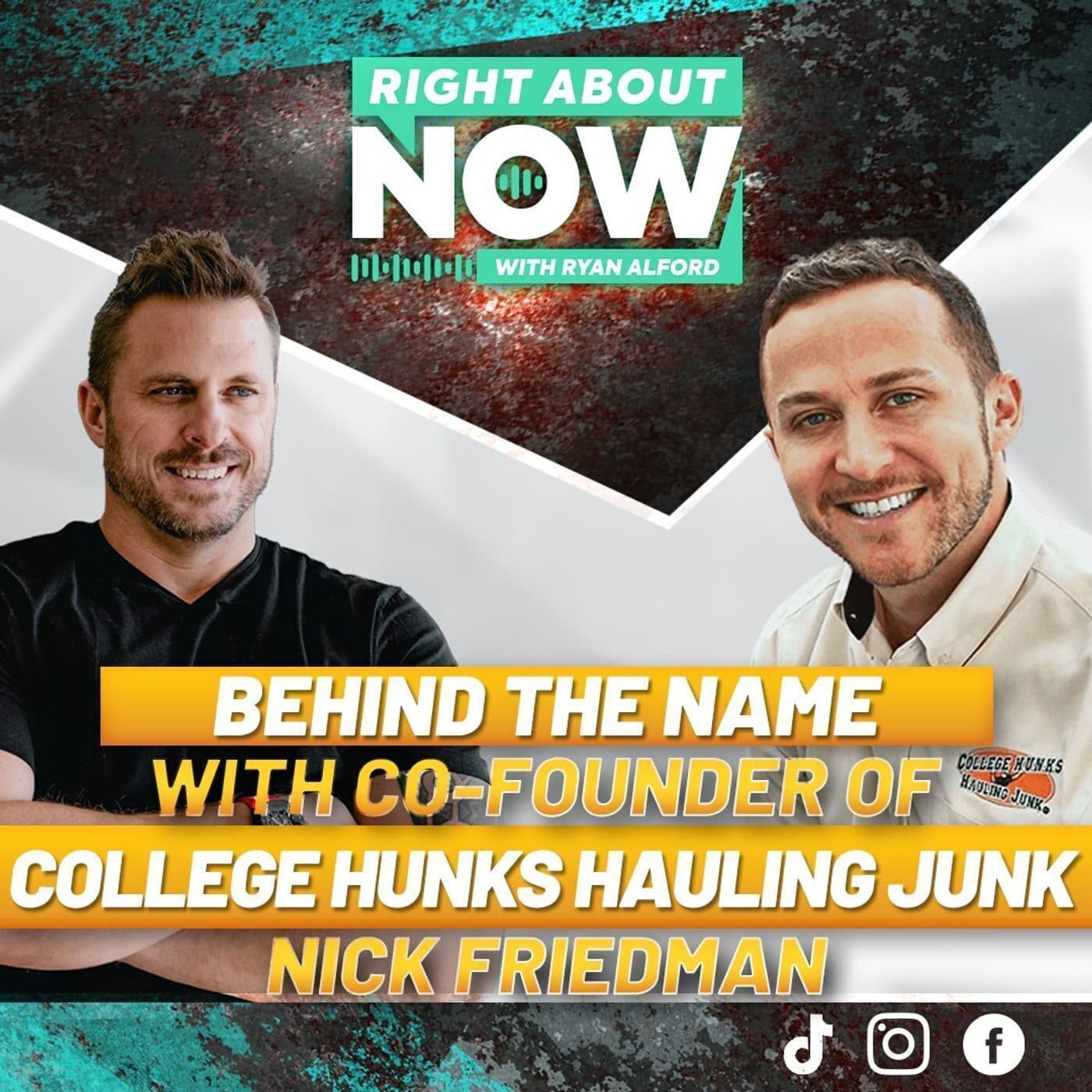
Behind The Name With Co-Founder of College Hunks Hauling Junk | Nick Friedman
College Hunks Hauling Junk co-founder Nick Friedman on the name, turning down Shark Tank, and scaling to 250 franchises and $300M in revenue.
- A pattern-interrupt name plus loud colors can break through a commodity industry — orange and green came from University of Miami athletics, then got reframed as playful culture and eco-friendly recycling.
- The brand sizzle must be backed by the steak: HUNKS was retrofitted into "honest, uniformed, nice, knowledgeable service" after customers kept asking if the crews were really hunks.
- Reading The E-Myth Revisited pushed Nick and Omar to work on the business instead of in it — they had been driving trucks while fielding complaint calls on their own 800 number.
- Turning down Robert Herjavec's $250,000 for 10% on Shark Tank season one was worth it — that stake would be worth $25 million or more today, and the reruns still deliver free exposure.
- Unscripted TV keeps paying off years later: Millionaire Matchmaker got picked up on Netflix roughly 15 years after taping, putting the truck in front of a whole new audience.
- Marketing is art plus science — Nick and Omar own the creative visionary side and hired part-time freelance "marketing ninjas" and financial strategists early because they couldn't afford full-time hires.
- Nick's four marketing buckets: get found (SEO/paid search), find them (direct mail to new home listings), loyalty development (remarketing to existing clients), and build the brand (truck placement, guerrilla marketing).
- Follow the elements of the work you love, not the industry — Nick isn't passionate about junk removal but is passionate about promotion, creativity, and franchise owner success.
It's said that there's a fine line between being bold and reckless. I think fortune favors the bold and of course when you reckless you may completely drive off a cliff and so you gotta be mindful about which one you're being.
My dad gave me a piece of advice. He said, Nick, you've got a great life, a great family. Just don't eff it up.
Horrible date idea. Amazing branding opportunity.
I don't know that people realize the amount of risk tolerance and or risk that's involved in growing a business and really the mindset you have to have. Yeah, I think it's a combination of risk tolerance and pain tolerance, quite frankly. It's said that there's a fine line between being bold and reckless. I think fortune favors the bold and of course when you reckless you may completely drive off a cliff and so you gotta be mindful about which one you're being. This is right about now with Ryan offered a Radcast Network production. We are the number one business show on the planet with over one million downloads a month. Taking the BS out of business for over six years and over 400 episodes. You're ready to start snap and accent cash in checks. Turn it up. It starts right about now.
Hey guys, what's up? It's time for right about now. I'm Ryan offered your host. We like to say if it's radical, we cover it. We're taking the BS out of business. That's why we got my friend Nick Friedman. He is the founder of college hooks hauling junk. What's up, Nick? What's up, Ryan? How are you, man? I'm good brother. It's good to have you. I'm ready to talk trash. I love talking trash junk junk. Moving trash. You guys move everything and we talked pre episode. I've had personal experience. I don't mind saying I called up the hunks. I'm a proud here to heterosexual male. But I don't buy call in the hunks because they are the best movers in Greenville, South Carolina. So I'll start you out with that one right there.
That was a softball, but we got 250 locations and we like to say that hunks stands for honest, uniformed, nice, knowledgeable service. It's not just about the physical attributes, but it really is about saving the time, energy, and hassle and headache of moving your stuff. Yes, I would agree and they do it. We've moved quite a bit in the Alfred family. We have four boys and had moved around with the growing family. Future college hunks right there. They can be future franchise owners. Yeah. Hey, I like your outfit the way it's run. And so it's funny. A team like introduced me to you and I'm like, yeah, I love those guys and I've used your first hand. So I was like, I got I'm ready to give them the seal of approval before even comes on the show.
It is it's been our preferred movers. So I do appreciate that, but let's set the table for everyone a little bit Nick talk about your background. And what made you start a moving company? Yeah, I don't think many kids grew up saying I want to start a junk removal and moving business when I grow up. And I was not that kid either. I had been brought up to follow that more traditional career path. You get good grades, get into college, you get a job and you move up the corporate ladder. And I had an internship while I was in college was not fulfilling for me. This was right around the time the movie office space came out. And if you remember that movie, the early 2000s, TPS reports and work sucks.
And I was like, okay, what am I signing up for here? I got lucky this summer before my senior year of college. My best friend from high school, his mom had a beat up cargo van from her furniture store. And she said, why don't you guys take the van? You can haul people's junk away. You can move their furniture and then she's paused for a second. She looked at us, looked us up and down. She goes, you guys could be like college hunks who haul junk. And then we just laughed about it at first. And we were like, actually, that's catchy. That's not what people really associate with your typical mover. So we made a flyer. We stuck it in mailboxes. The phone started ringing and I realized that was the light bulb moment for me.
For me, people had a need for the service and they thought the name was a pattern interrupt. It set us apart from everybody else in this crowded industry. And ended up writing a business plan, our senior year, one-on-notch entrepreneurship competition gave us a little more confidence. And then we graduated and decided to make it a full year round venture. Today we've got over 250 franchises across the country. I describe ourselves as a 20 year overnight success. It's been a long journey to get to where we are. But it's been a fun journey nonetheless. I love it. And we could say freshly minted international franchise entrepreneur of the year. IFA. Hey, congratulations on that award. Thank you. Yeah, we just got back from the IFA annual franchise conference.
Over 6,000 attendees from all the different franchise brands represented. And Omar and I received entrepreneur of the year. It was a really cool honor to receive that. I remember going to the IFA conferences when we first started franchising our business and being looking up to the Fred Deluca's of subway and the dominoes, pizza founders and being like, wow, those guys are pretty big time. And to get that kind of recognition and accolade from the official franchise industry association was a pretty cool testament. Not just to meet Omar as entrepreneurs, but really as the team folks we got running the show, the franchise owners all around the country. And then of course the hunks, the guys doing the heavy lifting. That's the hardest part of the business right there.
I love it, Nick. I also author of effortless entrepreneur. It's the path I wanted to go down first, Nick. It's funny. You say the 20 year overnight success. I've been known to use that with myself. You know, it took only took 19 years of my 20 to get to that. Like the last year. And it's funny in the Nick how we you grow up. And like you mentioned with school, like what you think you're going to do. What you're going to do. You do always think that success is a destination. And I think your journey and your growth, all that. You probably can tell us a billion stories or why it's not a destination. It's that constant journey. Talk about that entrepreneurial journey for you.
And when you guys really realized you had a franchise. And just some of that growth path for you. Yeah, I always started the story with when we first began. We had high aspirations. We wanted to be a national brand. But we were doing all the work ourselves. So we're driving the truck, answering the phone, hauling the furniture. And we went out and bought an 800 number because we wanted to look like a bigger company than we really were. We put it on the back of the truck, but it was still routed to our cell phone. And so I'd be driving the truck. And people would call the 800 or 800 number to complain about the driving. And I'd be in the one of the drivers.
He being like, we can't we can't condone that driving in our company. We'll fire those guys and they give back to the office. Probably fired ourselves three or four times that for a summer. And realized very quickly that we couldn't scale a business if we were doing all the work ourselves. So one of our mentors recommended a book called the emith revisited by a guy named Michael Gerber. And when we read that book, it almost felt like it was written about us. Because really the message in that book is learning how to work on your business, not just in your business. Creating a framework and a structure and a long term vision with systems to help make that vision a reality. And it started on the long march as you called it the journey to make it a reality.
So in that book, they also talked about franchising and the idea of systemize your business in such a way that you could package it up and hand it to somebody else to run it as if it were a franchise. Even if you're not thinking about franchising, but that sort of planted that word in the back of our head. And I'll be honest, we were probably a little naive when we jumped into franchising. We were like, hey, passive income royalties like these all sounded like easier ways to make money. Farthest thing from the truth, it was a very steep learning curve, very slow long march to scale once we got into franchising the business. But realize that we did have a brand and systems that could be a platform for other people to have business ownership themselves.
So that was the path that we started down. And like you said, it was grinding in the early days, it was getting to a point where we could afford good people making mistakes, hiring the wrong people. And then eventually things start to compound in the momentum is real. It starts to really fly that flywheel effect starts to take shape. And all of a sudden, you're taking your hand off the wheel and you look around, you're like, wow, this is a real business. And we're making the money that we always imagine we would. And then you're looking up at, whoa, the mountain is much higher than we ever thought. We can be on where we are right now. So you just keep climbing. Talk to me, Nick. I think a lot of books and things that talk about entrepreneurism or talk about franchising.
And I think, you know, one of the things that I've started to like think about them a lot with what it takes to go on these journeys to do these things is something I risk tolerance. Would you talk a little bit about that from your standpoint or both you and Omar, like how you guys managed risk if you guys were always willing to throw it all in. Because I think back to that destination journey and all that, I don't know that people realize the amount of risk tolerance and or risk that's involved in growing a business and really the mindset you have to have. Yeah, I think it's a combination of risk tolerance and pain tolerance quite frankly. And you know, it's said that there's a fine line between being bold and reckless.
Like I think fortune favors the bold. And of course, when you reckless, you may completely drive off a cliff. And so you got to be mindful about which one you're being. When we first started, we were using a motivation and doubters as our motivation like we told people what we were doing and a lot of people were skeptical. They were like, you're going to quit your job to do what Paul junk and it's going to be called college hunks or what kind of stupid name is that or the guys taking their shirts off to move furniture. How do you decide who you're going to hire? But we heard all that nonsense. I could hear it, man. I could hear it. I could hear it. I could hear you hearing it.
Exactly. Exactly. I was still here to this day sometimes when we tell people about what we do and they they're not familiar with the brand for some reason they haven't seen our trucks or it's in a market where we're just getting going. And so we use that as motivation. We always looked at it as, hey, we're not throwing away our degree to start a trash business. We're going to go and build something meaningful and packed full and lasting. And what's the worst case scenario? I was kind of at least when we started out had this worst case scenario in my mind. Okay, go back and get a job somewhere or go back and get better schooling or take the lessons that I learned and try to start a business and apply it to something else.
But along the way, we just kept seeing more and more progress. And my dad gave me some advice recently because I think once you get to a certain level of success, the risk tolerance, you have to be a little bit more guarded and weighted. So like when I was a lot younger, we started the business, no wife, no kids, no mortgage, no really responsibilities. Today, we've got a $300 million business, four kids, multiple house homes, 5,000 employees around the country relying on this brand for their well-being. So the obligations and the responsibilities to all those stakeholders, including myself are much greater. My dad gave me a piece of advice. He said, Nick, you've got a great life, a great family. Just don't eff it up. Don't mess it up.
And I let that ring around in my head a little bit before making bets on the business or before over leveraging certain decisions. I think now that we can afford to be a little bit more risk mitigative. And we've got really good people in our team that are good at telling us know myself and my business partner because as entrepreneurs, there's a lot of this notion of wanting to ready fire then aim. And I think you got to do a lot of that out of the gates, but then once you start to reach certain levels of success and you've got a successful business and enterprise, you need folks are going to weigh the risk reward. And there's still folks that will tell us know and sometimes we'll override them because we just have this gut instinct that what this new marketing initiative is going to be worth it and worth testing.
But I think the stakes get higher, the bigger things get. Yeah, don't fuck it up, son. Yeah, that's what he said. I wasn't sure about a lot of curse on him. Yes, out of business. I should know better. Yeah, it's my dad gave me this was motivating. And I think there is some power in setting expectations for the younger generation of what you are capable of. My dad, he said it jokingly, but he was like, Nick, you're smarter than I am. You're better educated than I was. If you don't do better than I did, you messed up. You have to you fucked up. And I'm like, you know what, Dad, I'm going to use that as motivation. I appreciate you giving me that gift to say that I am better prepared than you were.
And then I can go make something of myself. So I didn't view that as a as a knock, but really as a handing me the baton to say, go get it. I love it. Hey, sage advice from the old man. My dad's my best friend and confident to this day. So I can respect still getting that knowledge from him. Yeah, that's great. Isn't it funny? Like I've wasted past anything that he ever did professionally. But it is still really comforting to be able to have somebody like that in your inner circle that you can just go and talk to and is going to give you just unfettered opinion. It may not be wisdom because they may not have been down the path that we're on at this point,
but it'll be at least a place from the point of love and trust. I do want to point out for people listening, Nick's given a lot of dropping some major bombs already. I just want to say this to like back to the bravery of the naming and that breaking through with college homes hauling junk. But yeah, rhymes and it's got a duration and that's cool at all. But in an industry that's not that sexy and not that cool typically to really break through both with the green color choice, the orange and the name as a lifelong marketer. I want to commend you with the boldness and like I would have if I was in the room when you wrote on the board, I don't care if you were 2019 or whatever,
I would have gone ding ding. There's a winner because that's going to break through and it's going to get attention and people talking and your friends could screw off. Right. And I got goosebumps as you were saying that because that really is what we, I don't know if we just innately saw that, but we were like, how do we stand out in a crowded landscape? And we were looking actually when we picked the colors, we knew the name was catchy. The new, we knew the name was going to capture attention. When we picked the colors, we were looking at college sports teams and we grew up in the DC area. So we actually first looked at black and red University of Maryland. But actually my business partner went to University of Miami in Florida.
And we thought, that's a small private university, but their athletic program is infamous, the youth. It's a widely known brand. So we said, look, orange and green, it's bright, it's colorful, it stands out. Now we tell people the oranges are playful company culture. And the greeners are environmentally friendly recycling practices because not everybody likes the Miami Hurricanes. But that was the idea. And there was another book we read which kind of hits your point on marketing called The Purple Cow by Seth Golden. And he says, look, if you're driving down a country road and you see a field of cows that are all the same color, you've always brown cows, you've seen them all before. You just keep driving. It's nothing unique or remarkable about it.
But if there's a purple cow in that field, you're going to pull over, you're going to take pictures of it, put it on social media, tell your friends and neighbors about it. And then he goes on to say that the purple cow has to be the brand, the image, that's the sizzle. But it's also got to be the product or the service experience. That's the stake. So when we started the interview, you talked about you were an client, a customer of college hunks moving. And that you had a positive experience. So like the name or the colors might have been like, oh, that's a funny company. Let's give them a shot. But then when you actually had us move you, that was the stake. It's okay.
I'm going to use them again in the future or recommend them to my friends and neighbors or talk about them on my, on my show. And so I think that's really like why people I think can relate to our story. As we didn't go try to invent TikTok or Snapchat or Facebook, we took a simple business trucks and labor. We put a very intentional focus on a creative name, a creative image. And then a very intentional focus on the customer experience and the team member experience as well. And I created that to the compounding effect of our, like we said earlier, 20 year overnight success. Yes, I like to say you got a long road to haul if you're trying to be better. But if you're different, you'll win, baby.
That's great. Purple cow, purple horse, whatever it is. We would walk into networking events, my business partner and I, 21, 22 years old with bright orange and green polos or buttoned ups on and might turn some people away or turn some people off, but we captured people's attention. We put in a marketing award application for the American Market Association. And we walked away with two or three awards that first year. And this was against like actual branding and marketing agencies. We were just running these campaigns ourselves. We knew we had something that marketing was going to be the key and branding was going to be the key just helping us separate ourselves over time. I want to pause for one second, Nick. I want to come back to some lessons and trials and tribulations and where we're going with the franchise here.
But I have to say you've got to have, we do, we talk about radical fun things here, Nick. You got to have some good stories. So you name your business college, huh? You got to have a story or two of women or men or hell. Who knows? People that call like expecting a certain experience or something. There's got to be a story in there. So I don't want to hear any of those stories. If they're happening, I don't want to hear them because that's not the brand that we're putting out there. But there are probably some brand confusion or mistaken consumers out there that have, and certainly in those early days, open the door when they're bathrobe, men or women said, oh, you guys are the college hunts.
Come on in. Let me show you around. And I'm like, listen, it ain't that kind of party. Yeah, quickly. I just assumed that somewhere along the way in those early days, people just being, you know, was funny. We were, we were actually on the very first episode of the very first season of Shark Tank. Yeah. And we were, we actually weren't going to pitch college hunts to go on that show. We were pitching a sister company that had popped into our head once. We were going to call it college foxes packing boxes. The idea was like moving crap and organizing. Yeah. The sharks had the same reaction you just did. They were willing to invest, but they wanted equity and college hunks. They didn't really think that the fox's idea was a great one.
And in hindsight, it probably wasn't because we would have probably had a lot more of those sort of guys and trench coats calling and being like, hey, I got to move again. Oh, yeah. And in addition to that, the female is typically the household decision maker. So she doesn't want the foxes around her husband. And most of the foxes don't want to pack boxes anyway. So we scrapped that idea. We left it on the shelf. It was good publicity. It was good experience going on a shark tank. But the hunks. Yes. We had those incidents where customers maybe get a little bit ambitious or confused about what they are going to get when we show up to the house. And we have to dispel that upfront.
Anyway, the way that I think you guys, because I even been doing my research the first time I used you guys, I kind of got underneath it. And look, let's be honest, when somebody's going to be moving your 5,000 or maybe a 5,500 pound dresser or something. Look, you need some muscle. That's right. Yeah. A lot back to the branding piece. Like most of our branding besides the name hunks isn't really what I say like sexualized or about physical attributes. Yeah, we got the guy with the logo sort of holding up the name. But most of what we talk about is like I said, our brand promise acronym. We came up with that acronym. By the way, after we got tired of people asking us, are they all really hunks?
We're like, you know what? We need a different answer for that. So now we come up with honest, uniform, nice, knowledgeable service. And that has become our brand promise. We tell everybody that's what you can expect when you hire the hunks, honest, uniform, nice, knowledgeable service. And so yeah, so the idea is yeah, you want guys who are strong. I'm going to be able to do the job, get it done. So you can just sit back and relax and drink lemonade while the work is taking place. They are professional. I will say that. So that's all that matters. The start tank. You brought it up. I was going to ask it's been a while. First season. It was like. Yeah. So one season one. Yes.
We went into this show not knowing what to expect. We got an offer from Robert Hergevek. He wanted 10% of the company for 250,000 bucks, which would have valued the business about 2.5 million bucks. And we turned it down. And we only had about four or five franchises at the time. So it probably was a fair offer. People always ask me, do you wish you had taken the deal? And I'm like, heck no. Because if I look at that, his business investment would be worth 100 times that maybe more today. So we'd be paying him 25 million plus on a $250,000 investment. I'd rather keep that 25 million to myself. And the other thing is we didn't know that those sharks at the time were going to turn into television celebrities.
We had no clue that the show was going to be on for 15 seasons. And all these guys were going to become basically TV personalities. I'm glad that we did what we did. And the show reruns every now and again. I'll see you're on demand. So it's a gift that keeps on giving. Exactly. That's the thing, like with TV and stuff, like just going on. I think people figured out now that you guys were smart and early with figuring out like whether you take the deal or not. And maybe if you have a good enough idea, it's probably better that you don't take the deal. Right. But you get the repeated airplay of reaching frequency of television. That was something Ryan, I think we also figured out too early on in our businesses.
Like whatever we got to do to get the name out there. Let's do it. People might call you shameless promoters or publicity whores or whatever they want to call you. They're not out promoting something that they're doing. And if you're not going to promote yourself, who's going to do it? You got to be the one that's promoting out of the gates. And eventually other people are going to experience what you're promoting. And they're going to become promoters for you as well. So after Shark Tank, we went on a dating show for God's sakes called millionaire matchmaker. And my business partner picked up his date in the college hunk truck to go clean out of garage. Horrible date idea. Amazing branding opportunity. And that show just got picked up on Netflix.
Reruns from like almost 15 years ago. A whole new generation of people are watching that on demand that never had heard of college hunk. And they're seeing this stupid date fall apart. But there's the college hunk truck on Netflix. And so we've done undercover boss where Omar and I went into skies and took a risk of exposing some of the warrants in some of our franchise locations that show shines a magnifying glass on. So like taking risks like you asked earlier, being willing to put yourself out there and step out of your comfort zone to promote what it is that you're doing. Especially in the early days, you got to be willing to do that and not be bashful about what other people are going to say or how they're going to judge you and so forth.
What has yeah, a man, brother, the what's been the growth like I've sure there's been stages being as large as you are now in the ambitions you have. We talk about we've been dancing all around the marketing and obviously once you get franchise as you get the name out there or 250 more times with franchise ease and stuff. But talk about what has been the path of marketing and branding holistically for your growth. Yeah, marketing and branding is science and art and I will say that Omar and I are a little bit more on the creative visionary art side of things like I can picture what happens if we get our show, if we get our company or brand on a TV show. Or if we publish a book or if we park our vehicles in a really high traffic corner, all the eyeballs at that produces like I can just intuitively see that's the art side of it.
The science side of it, which one might argue is a little more boring, not as fun or sizzly. One might also argue is more important than the art form or at least equally important and that's the understanding your consumer dynamics understanding pay per click and search engine optimization understanding lead conversion and lead capture and lead nurturing and client follow ups and all those sorts of things. So for those things that are a little bit more analytical and data driven we just brought in experts because i'm not as financially astute or sharp with analyzing the X's and O so we brought in marketing ninjas and financial strategists both in the early days. Part time freelancers because we couldn't afford somebody full time and now today we got really powerful and and skilled folks that can dial up the levers and so I think it's been that combination of us.
The really creative ambitious visionaries to get the name out there and talk about some of the examples the TV show or the marketing as we call it I bought a gift certificate it was like a thousand bucks but it was to have Omar throw out the first pitch at a sample raise baseball game. And so he got to do that we all came in our branded t shirts there was a guy sitting next to us who was working for a different moving company up in Michigan and he ended up buying one of our franchises and he's our our most successful franchise in our system in terms of revenue per population so he's just crushing it he's netting over a million dollars a year. And so putting yourself out there again I can't stress enough how important that is but then having some of the strategists in your inner circle to help dial in the tactical levers.
I love the throw in the baseball that's brilliant I love the grill of marketing and like just different ideas like that they get you just don't ever know especially you got how many hundred people there at the house of people there. Yeah, watching the game and it was on camera so you get the video of it you can make it live forever like I love this stuff is fun for me is like people always ask follow your passion and I'm like it's not like I was passionate about moving and junk removal. But I am passionate about the creative process about promoting about getting the name out there and seeing impact others how our franchise owners could take those systems into their market and that produces financial success for them.
And their employees that's the stuff that gets me excited gets my juices rolling. So yeah, so I think that's also key as you're thinking about what am I passionate about maybe it may not be the specific business model itself but it's the elements that go into building that business or building that brand that actually get you get you moving. Oh man, I don't I'm on don't get me on the passion patrol baby. Following your passion is bullshit like you follow you follow your passion when you make some money when you're good at translates to success. I was very passionate about basketball and little school high school and college and I can tell you I barely scratched six feet my vertical barely scratches probably 12 inches and for a white guy my three pointer was not that not that pure.
If I just continued following that passion, I'd probably be mopping the floor in a locker room right now. Yeah, I know you're wrong you follow your passion, but if you want the definitive role or way to high in success look everybody's visions different if you just want to make it and you're happy with that then certainly go do it. But it's I don't know there's a lot of dangerous advice given out there sometimes with people. It's a cliche that gets defaulted to and there's layers to it that have to be really understood because if you just hear follow your passion is okay I'm going to go do something. I like yeah, are you good at it and you love it and can you get paid for it and is that going to continue to drive you collectively.
Exactly. You got to exist at the very least. That's right. What's the what's the goals, man? I'm sure you saw it out. If you saw me able to told you in the 20 years ago, if you'd been sitting exactly where you're at out. Oh, shit, you picked that right. You saw that one, wouldn't you? Yeah, right man. I've actually had a lot of reflection about this recently because we've achieved like almost everything that I put on my vision board 10 years ago. Like 10 years ago, my wife and I wrote out a vision board and I'm like I'm looking at them like checking the boxes on every single thing. So now what, right? Like you've achieved everything you set out to do. You don't just put your feet upon the on the table and drink martini's the rest of your life.
So I used to think that was going to be what I would do. But I've seen Nick saving interviews and he won seven national championships and they asked him how do you say motivated year and year out. He said complacency leads to bad decisions lead to bad outcomes. And so then I reflected on my dad's advice. Don't fuck it up. I actually have a blank pallet right now that I can think about. Okay, these next 10 years of my life and I got four young kids. How do I want to weave them into my day to day? I've got a business that's doing over a quarter million dollars and a quarter billion dollars. Excuse me in revenue annually. How are we going to grow it to a billion and beyond?
So I'm getting to written it's exciting for me because it's for the first time. I'm able to do it out of place of abundance as opposed to I would say a place of scarcity. Like everything up to this point was like I want to have X Y and Z because I don't have X Y and Z. Now I feel like I've obtained and achieved X Y and Z. So now it's okay, how can we bring more to the table to be more fulfilling, more rewarding for everybody that's part of this platform. So that's the exciting part for me. But yeah, if I had my 20 year old self, my 30 year old self would be very happy. When we first started the business, we were like, man, if we could just get it to 100 million in system wide franchise revenue, wouldn't that be amazing.
And we got there and since we got there, we three X that number. We're doing 300 million in annual sales now. So now it's okay. How do we three X this number, but do it from a place of abundance, not a place of scarcity. So that I'm not always feeling like there's an empty void that I've got to fill because that was what drove me in the early days was that scarcity feeling. Yeah. It's funny. What it takes to get to a certain point is not the same thing. You got to create these new challenges for yourself and new ladders and new things because the motivations become different. And it's just very much. It's like staying. And that's almost back to where we started the bold versus reckless and how you might get to that next ring is different than what got you there.
But you still got to have that drive and passion. So I want to give you like a two-parter there like respond to that what it takes from one to the next. And then I would just think because I'm sitting here doing the math like, when does it become and I'm sure you're not going to give away your exit plans here on the show. But does that those things have to start to enter the brain on your mind on some level. It does. It's funny. So we sold about 25% of the company to a private equity group about three years ago. So I got a really nice liquidity event out of that. And having that chunk and then talk to some other people who have actually sold their entire companies are the majority of their companies.
The psychology is a little bit different when you don't have the income producing asset that's generating cash flow year and year out. And so having experienced that sort of in a micro my expectation or anticipation of wanting to go just get a big bucket. And then again, figure out what the hell am I to do with it has also shifted is okay. The asset that I have right now the golden goose is producing is this brand. And I come out of this franchise conference that we just attended meeting all these other franchise or is it have multi brand platforms that they've started developing. And I'm like, why can't we become that once we start maturing out our franchise owner success and selling out a territory for college hunks franchises.
Why can't we start bringing in other whether it's home service franchises or other franchise concepts utilizing our marketing, our cash, our financing, our call center. And all the different resources we provided to our college hunks business. Why can't we do that for other businesses as well. So whether that involves bringing in additional outside capital or not. I have a podcast scheduled at this time. Jeff my guy. Are you guys almost done? You're exactly what I was just thinking of man, that's awesome. I'm just waiting on you, but it seems like my whole career. I've been following you. Yeah, you're always like two or three steps ahead. Yeah, man. For those of you guys don't know that Jeff do it in he's a franchise guru entrepreneur success mentor advisor friend of mine and very cool.
Great surprise. I don't know if you had him ready in the wings the whole time. I didn't know he knew you. He's here. He's a friend and we met. He's on the rat cast network his show on the home front is a part of our network and he's good buddy. And I did not know I did not that was not pretty right. I did not know that y'all do each other. That's awesome. Yeah, Jeff's awesome. I used to send conferences when I talk about some of the franchise royalty that I would look up to. He's one that I'd just be taking vigorous notes from his from his sessions. Yeah, he's awesome. No, that's awesome, man. Well, it's funny. So you what do you do for fun?
What's an idea of fun for Nick? Yeah. Didn't have the worries of yesterday year. Can probably do just about anything you want. So like, where do you find happy? Yeah, so funny is I used to have a lot where I still struggle with what I call FOMO fear missing out. I wouldn't want to miss the party, the trip, the conference, the meeting, the lunch breakfast lunch or dinner with this person or that person. This year, my mantra has been focused over FOMO. So I'm trying to scale back. I call it addition by subtraction. What can I remove from my plate that's actually going to make things more meaningful or impactful? And look, for fun for me, I love spending time with my kids. I love spending time with my friends that are in my inner circle.
I'm part of a young presence organization. My forum, which again, Jeff Dunes, we're very familiar with is really fun for me to go spend time with sporting events, travel, hanging out with my friends and family. Like those are the simple things that are fun. The the biggest benders of yesterday are off in the distance of my rear view mirror because hangovers with four young kids. Just don't don't bounce back like they used to. I have four boys and I have to choose my moments or not at all. I used to get it. I will say one of my friends would call me up and go, Hey, we're going to go on a bachelor party or boys trip. Like I used to get anxiety about missing those trips.
But now I sometimes will get anxiety about going on them. I realized all the stuff that's going to have to be working in behind the scenes while I'm gone. And when I get back all the stuff that I'm going to have to deal with in recoveries. Yeah, I think again, addition by subtraction. Do you got any fun projects or anything with the brand, with content, anything that's upcoming that you can talk about? Nothing that's going to really shake up the audience right now. Last year I did what I would call my fun side quests. I produced and acted in a movie. It was called Bezos, the beginning. It's on Amazon Prime and all the different streaming on demand. It was the first movie ever made about Jeff Bezos.
It's a biopic. And I played the role of Shell Caffin who was the first employee that Bezos hired to come work on the garage programming. So it was a fun stretch of the comfort zone for me. It was sort of a bucket list item for me. Some people run marathons or climb mountains. That doesn't really appeal to me. I had done unscripted reality TV. This was the first opportunity for me to do a scripted movie, great experience. But I'm not running out to do it again anytime soon. And then earlier this year, my business partner and I did a comedy, a stand-up comedy show called the CEO comedy challenge. Where we performed at the Tampa improv with each we performed a 10 minute set. It was pre-prepared and we had a comedy coach again stepping out of my comfort zone doing something that maybe a little bit outside of the box.
But other than those two things that I would call side quests, just trying to lock in and stay focused. The housing market isn't booming right now. So our franchisees are maybe struggling to get leads and put jobs on the calendar. So we want to support them the best we can to make sure they can weather the storm. Which I think is actually the best time to be in this sort of business because things aren't just raining and falling into your bucket into your lap, which makes it. Makes you become a better business owner when we first started franchising college hunks. It was like the peak of the housing downturn of 2008, 2009. And had we not experienced that? I don't think we would have gotten to have exercised the resilience muscle or the grit muscle that we ultimately did.
Two more questions here Nick that kind of come to mind as we close out finishing up here with Nick Friedman founder of college hunks hauling junk co-founders. Excuse me. The Nick I think about long lines of you just talking about with business and leads and this interplay of lead generation versus brand awareness. It's always a hot topic for me because I've been in the business for 22 years. And it was really all about brand and mass awareness for a lot of the my early career working in wireless the first iPhone like a lot of big brand stuff. And then performance marketing came along and it was all about performance. But everybody forgot you got to have a brand too. Talk to me about how you guys look at that interplay and don't do you or do not visit just all day.
Now I can just go swoop up the leads or do we have. No, I think we are branding guys obviously by nature. And so that we naturally lean in that direction and like I said we've had to hire the scientists on the sort of demand generation side of things. But we think about marketing and what I call four buckets it's get found. So that's when people are searching for movers or searching for haulers it's being able to be top of Google or top of being. It's find them which are things like behavioral direct mail people list their home for sale they get a mail or they are called it's asking them if they need movers. So there's a loyalty development which are things like remarketing and rebuilding relationships with your existing clients.
And then there's the broader bucket that I call build the brand which is things like marketing, marketing, putting the trucks out in visible locations, the little bandit signs, the gorilla marketing stuff that you don't have a direct ROI or response from necessarily. Maybe when they're searching for movers and your name pops up the fact that they saw your truck in the community is going to resonate with them now they're going to click on your link over the competitor. So I think it's an integrated approach to me and you'll have tactics within each of those buckets. But I don't think you can neglect branding for everything else. And that's why I think some of these aggregator companies that are have multiple companies on them multiple brands within them.
They sometimes struggle because they don't have a brand themselves when they're spending so much money on Super Bowl ads and mainstream marketing because they're trying they've got to drive traffic to their site for people to then select a service platform through their site. Yeah, you can familiarity breeds comfort and so you can be at that top of the list on Google. But if they've never heard of you, then there's a pause right there's friction. And so when you build the brand and you have a standout brand with a name and the colors it helps. Absolutely helps a lot. Absolutely. Finally, Nick, a lot of people listen. They it's so hard I find in these interviews to convey the struggle and the realness of what it takes to build a business.
We're talking about it at a high level. We could have a four hour discussion probably about every minutia of your journey. I'm gonna break four day discussion. So it's like wanting to hit the high strokes, wanting to get value to people listening. And for someone listening, is there something beyond like the points we've talked about that ultimately can help someone carve out that path or push through from idea to execution? Anything you any final wisdom you can share from your journey? Yeah, everything we've talked about feels the bucket of the journey. I always say urgency of effort, patience for results. Like you got to be urgent and somewhat manic about the effort that you put in every single day. And you try to be a magnet for others to want to put in that much urgency and effort as well.
But you got to be patient because the results don't come overnight. And if you beat yourself up for the results day in day out, you're going to beat yourself up and your health is going to suffer. You're going to make haphazard decisions trying to shortcut the success, which is ultimately going to backfire on you. And so I think having the urgency of effort, the patience for the results is a good mantra to tuck in the back of your head along the entire path of the journey. A lot of wisdom there, brother. I love that. You and I are like, I don't know some of these quotes I thought I came up with. I'm joking, but we're reading out like the same playbooks. Like you named some obscure ones that I'll say that no one's ever heard of.
And I'm like, damn, I boy, Nick, we're reading the same journals. Are we on the same wavelength? I love it. I love that last one. I don't know if that's yours or that's from a book, but that one, that one's great urgency for effort, patience for results. Well, I appreciate what's funny. I heard I don't know if you guys know Cameron hero. He's an entrepreneurial speaker, but he says he'll credit the quote the first two or three times he uses it in his speech. And after that, he just starts taking it as his own. I used to do that. I've forgotten who I've gotten some of these books from some of them are my own. Some of them I've said so many times where I modified them slightly so you ink it.
You own it. You just just start saying it. Hey, you know, not only have those people founded college hunks. Have they gone on Shark Tank? Have they done and built a $350 million business? I don't think so. Probably not. It's all kudos to you, brother. I really appreciate you coming on. Where could everybody stay up with everything you're doing and the hunks? Yes, I've got a personal website nickfreedman.com F R I E D M A N. Also, my social media handles is Nick Friedman and the number one Nick Friedman won somebody had already beat me to the that Nick Friedman. And then of course, college hunks is a pretty simple college hunks.com or college hunks hauling junk.com takes. If you want to type out the whole name takes you to the same place you can learn about franchising.
You can learn about moving and hauling services. If you need one of those and see if we're in your market. I love it, brother. Thank you so much for coming on the show. We appreciate having you. Yeah, thank you guys. Hey, that was Nick Friedman and he was right about now. This is Ryan Alfred. Go to find me at Ryan Alfred on all the social media platforms. You'll follow me on TikTok. I'm blowing up over there. We'll see you next time about now to listen or watch full episodes of right about now on the web. Go to Ryan is right.com or follow Ryan Alfred on all social media platforms.
Justin Brennan on Multifamily and Other People's Money
Real estate investor Justin Brennan explains syndication, check equity vs. sweat equity, bonus depreciation, and how to buy apartments without your own
Hiring Is a Marketing Problem: Nicole Feenstra
Nicole Feenstra of The DNA Agency tells Ryan Alford why job descriptions fail, how to market the trades, and how geofencing and storytelling win

Jason Brown on Options Trading, Risk and Rebuilding
Jason Brown turned a $10K student loan into six figures, lost $250K on one trade, and rebuilt. He shares his options, risk and wealth roadmap with Ryan