
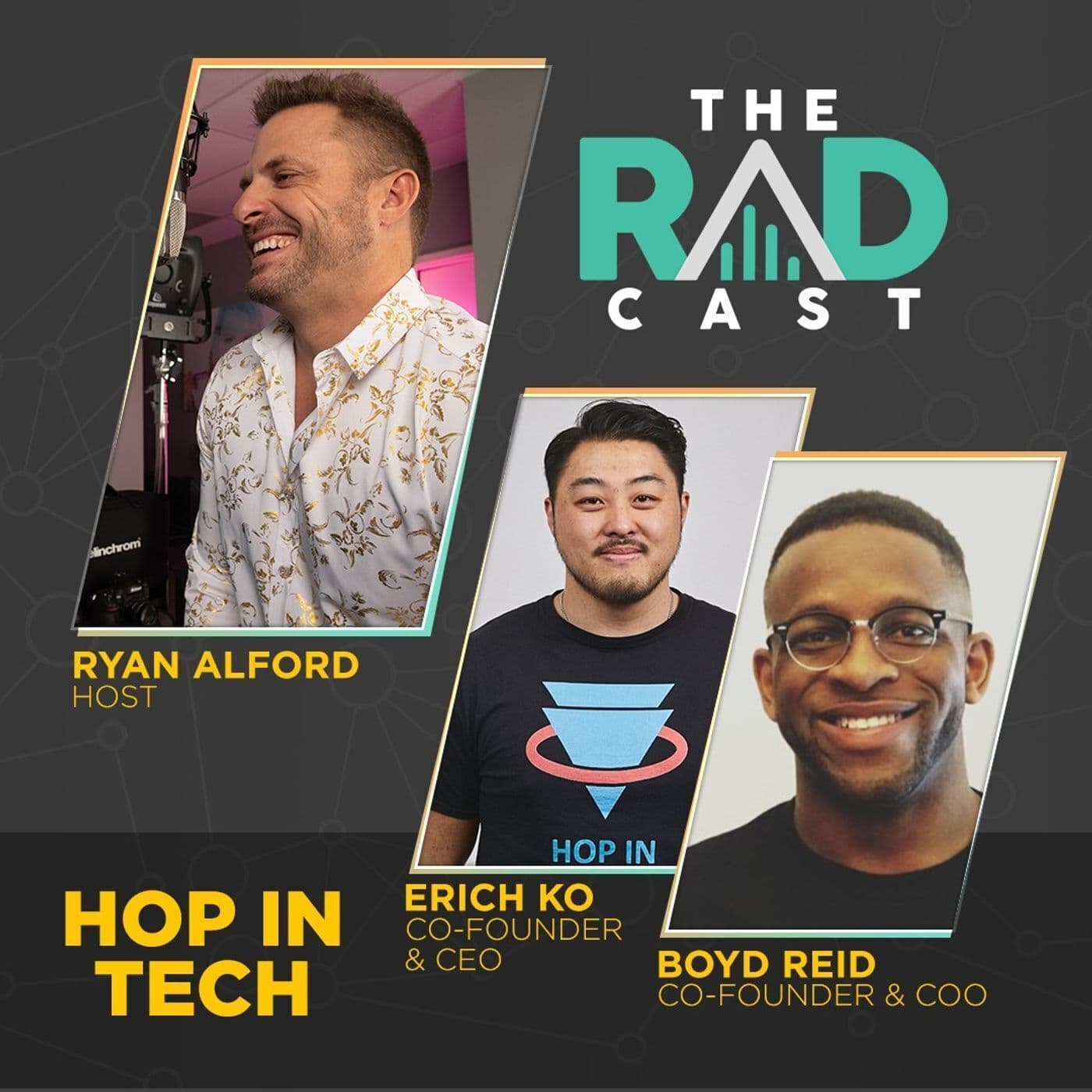
HopinTech: Creating Sustainable Solutions to Real Commuting Problems
Hop In co-founders Erich Ko and Boyd Reid tell Ryan Alford how they turned idle buses into employer commutes, pivoted through COVID and raised impact
- Hop In owns no vehicles — it licenses software and mobilizes existing rideshare and charter bus fleets, which lets it enter new markets without buying buses or securing local licenses.
- Charter bus operators normally live off events and weddings; Hop In gives them consistent Monday-to-Friday revenue by routing them to employer commutes.
- The COVID pivot came from recognizing that food processing, manufacturing and fulfillment workers can't work from home, so the company added in-app symptom tracking and at-home rapid test kits.
- Sales starts upstream: the founders work with municipalities, regions, boards of trade, chambers of commerce, commercial developers and property management firms because transit and development are a chicken-and-egg problem.
- Each employer engagement begins with a 'need assessment' that surfaces the commuting challenges employees actually face before routes are plotted.
- The company ran operations for years and only started building software in January of the launch year — four products followed, including rider and driver apps, a corporate dashboard and a backend server.
- They built a calculator showing how many trees a company saves by using the shuttle service, and plant trees quarterly on client's behalf through the same San Francisco partner used by clothing brand Ten Tree.
- They turned down money from larger private equity firms and raised instead from B Corp-certified social impact investors whose goals matched the company's mission.
there's a ton of transportation options that are available to people, but it's just not being mobilized for the purpose of the commute.
we don't own any of the infrastructure there. We only own the software.
He said, you know, unsexy areas is where we're going for the places that you wouldn't normally think a tech company would be, right?
You're listening to the Radcast. If it's radical, we cover it. Here's your host, Ryan Alford. Hey guys, what's up? Welcome to the latest edition of the Radcast. It is the beginning of March as we blow through the beginning of 2021. It's been a great year. We've had some amazing guests. It has been world class as we bring to you the best in marketing and business podcasting. And I'm excited today to be joined by Eric Coe and Boyd Reed who are the co-founders of Hoppin Tech. What's up guys? Welcome to the show. Hey, thanks for having us. Glad to be here. Hey, man. Appreciate you guys coming on. I know you're both in Canada and staying a little locked down as you guys are separated and everyone watching the video will see that
more clearly as we have the split screen. But how's everything going for you guys in general? It's going pretty well. Business is picking up again. I think everyone's thinking about return to work now and everyone's healthy, right? That's what matters. Yes, that's good. Everybody, state safe and sound. And I guess it's been interesting. I do want to start. Let's just start a little bit. Obviously being in Canada with a lot of our audience in the US. We are worldwide as we mentioned to you at the beginning of the session. But a lot of our audience in the US and may not know all of your background, you know, being in Canada and all that. Let's just start right there and you know, you guys, Eric
or Boyd, either one of you guys could go first with like your background and what led to starting Hoppin. Yeah, for sure. You know, Eric and I are actually, we've been friends in high school, you know, we got really close to over the years and we've always been talking about starting our own business. Ever since we've known each other, we've originally started out looking at like starting a bar, to be honest, like any like young 20 year olds looking to start a business. Hey, Hoppin could have worked for either one. I mean, you know, right? Exactly. If this doesn't work out, I'm going to be all in for the hops bar.
Sorry, I digress. And you know, that's something we were always talking about in like over the years, was we started getting into the, you know, professional life. We went into our separate careers, you know, something that we were continuously complaining about was our commute, you know, how do we make that better? And, you know, Toronto is quite a mess sometimes when it comes to the commute, whether you're taking public transit or driving in, it's quite complicated sometimes, closer again to the city. So we sat down and we also invited a lot of other co-founders, Erwin, who is focused more on the tech side, a job of conversation about how we go about solving this problem. And what we realized over time was, you know, there's a ton of
transportation options that are available to people, but it's just not being mobilized for the purpose of the commute. They're all separate and each municipality's working independently of each other. And, you know, what we really need is a connector. And what we focus on with hop intact is focusing on the logistics aspect of it is about creating routes that are based around the needs of companies and their employees. And looking at the transportation options available, whether it's a rideshare like Uber or it's a charter bus company, I have a lot of idle fleets at this time, we use those and mobilize those fleets to kind of fill the gaps that are left by public transit. And that's how our solution is come about to kind of, it's one of those classes like
solve your own problems at initiatives. Great, great. So how did you all the three of you come together? Is it three of you? I'm assuming I've heard a third name there, but how did all of that kind of transpire together? It sounds like you guys got different facets, specializations, is where my brain goes, and naturally, but I'd love to hear how that kind of all came together.
Yeah, I'll take this one. Like Boyd said, he and I have been friends since high school. I've actually known Erwin, our CTO since, I don't know, I was like 10 years old. He was actually my little brother's friend growing up in elementary school. Oh wow. And yeah, we all just kind of came together at the right time here, I think. And we were all talking about something, right? It was the bar first, then it kind of moved to something else and it kept moving. And one day it was like four in the morning, I woke up and had this idea. So I called them. I was like, guys, we need to do this. We need to talk about this right now. And Boyd's like, okay, let me call you back in about
three hours and I wake up. I was talking about this. And it's just been kind of going ever since then. Great. So what, where are we in the evolution of the company? I mean, how, how long has this process been and kind of where are we at? I imagine there's been some slew down with COVID. Unfortunately, I would imagine with, with transit, things like that. I don't know you guys can fill me in, but talk to me about kind of the evolution of the company and how far along we're into it.
You know, like you'd think that yeah, transportation company would probably go down during COVID. But we've found some really interesting pivots. And the one thing we realized is that not everybody can't work from home, right? You have all the food processing plants, manufacturing, Amazon, I know is making a killing right now and opening a ton of new fulfillment centers. They still need to get to work, right? And if you look at the surveys, the majority of the people around the world are not comfortable taking public transit anymore. It's brought to light a lot of issues, not just with health, but also with general safety and security riding. So we started offering up these transit systems or these shuttle systems to help the company stay in business and to give like a bit of a safer and
healthier commute. So we actually partnered with a bunch of health tech companies. We offer symptom tracking on our apps before you even board the bus. It sends like aggregate data to the companies so they understand the health of the workforce on a daily basis. And then we actually also do rapid test kits that are brought to your home. So you don't have to leave home to get tested. That makes a lot of sense. The smart, I didn't even think about the the extensions of that. You guys have been smart with pivoting is so talk to me about the nuts and bolts of, you know, it's funny. When I think of bus riding and I don't know how it is in Canada, but like here in
Greenville, South Carolina, and I'm sure someone local is going to like DM me as soon as this goes live. And you can't be talking about people like that. But the local bus is just not the most popular ride. Like, you know, it's like my whole life, it's just been like, you know, you're trying to avoid the bus at all costs. It gives it the same, I assume it's similar everywhere, right? I mean, is that is that part of the challenge even in Canada? Yeah, and I think that you mentioned it is a problem kind of everywhere, you know, probably transit. If you have the luxury of owning your own personal vehicle, like that's where you will go with just to be able to get going whenever you want
wherever you want to go without any restrictions, I think that's where the goal is. But when we look at some of the, you know, bigger cities in terms of the metropolitan cores, the ownership of vehicles goes down not necessarily because of the not needing or wanting a car, but they just don't need it because there's access to so much more public transit when you look at Toronto, you have the subways, the street cars, the buses, like, you know, it didn't quite get huge volume. You mentioned you were from Manhattan, same kind of concept. The more you're into the city, you have a lot more public transit options. So to have a car in those situations, it may not be a need per se, but when you come into more suburban or rural areas, having the cars
a lot more needed because the buses are not as accessible and you're not able to get around as often. So same kind of concept, I think you see quite uniformly across the globe. So that's why we tend to work a lot into these suburbs and rural areas where there's not access to those really strong public transit infrastructures. And that's where we come in with our solutions kind of, again, make sure to fill those gaps with those those those transportation options because it's really to get someone to work sometimes very, very difficult by public transit. And when you talk about like what Eric mentioned, the people who were servicing those essential workers, they're normally a minimum wage to go income earners. So they tend to not maybe have, you know, one, our multiple
vehicles for the family. So solution like ours fits in perfectly to meet that need. There's a lot of boxes that get checked with your solution. You talk about green, you talk about like conserving energy and different things. So there's a lot of positive going on as I don't need to tell you, but they kind of come to my head. Because when I was in New York, like it was right when like the bike rent the bikes and rent the scooters and all that stuff. This was like 2013, 2014. And it just not only just congested things, it left little, you know, bikes for the left everywhere. Like made no sense. And if you go to like Santa Monica or like some of these other big cities, it's like, you know, it seems like a good solution. But it's just more stuff like
around the cities and are dangerous on the streets. There's people. There's idiots, you know, riding these scooters that think they know how to ride a scooter. You know, they're like, you know, like this 45 year old and not that 45 anything wrong with 45 year olds. But they're like bunny hop and over curves. And it's like, what are you doing? You know, but in all seriousness, but yeah, makes a lot of sense. Talk to me about the nuts and bolts for, you know, how, how businesses find you like it, you know, it's Canadian company. I want to talk about expansion here shortly. But being, you know, outside of Toronto in the Toronto area, you know, how do businesses go about finding you and utilizing your services? What are kind of the nuts and bolts for that sales
process? Yeah. I think the first thing to understand is that we had to figure out what the root cause of a bad commute was, right? And it's not just because there are tons of cars in the road, but it's why are there tons of cars in the road? And so we found it in economic development and urban planning, actually, because the way that we design cities, the way that we bring in corporate citizens and residential citizens eventually, all of that contributes towards congested and traffic flow, right? So we work directly with them. We work directly with municipalities, with regions, even with provincial or state governments as well. And we kind of understand the problem a little bit more. So we understand how they're building cities right now or the rural areas
are developing where they're looking to put manufacturing facilities or office parks and how we can start to construct more efficient lines of transit or shuttles there. Because the other problem is that with transit and city development, it's kind of like a chicken in the egg story, right? Transit's always waiting for the demand because they don't want to waste taxpayer money, building bus lines or whatever it is, right? But the economic developers, they need transit to come in to be able to get their corporate citizens to come and plant themselves there. So we come in and act as a bit of a catalyst for that. So we work between all of these different bodies, we work with like the boards of trade, chambers of commerce, the commercial developers and real estate firms. We're actually working on a partnership with
a property management firm right now. And you know, we look at what their needs are, right? What their needs, the needs of their tenants are. And we kind of work around that and get clients that way, I guess. So every contract's very unique, I imagine. It's kind of building it out into what that proposal and or contract ends up looking like the terms, etc. The length of time and all that and the number of people. I mean, how many operating buses or what do you call your, your, your transporters? Are they, they have a special branded name? Are they just vans?
So we work with a variety of different types of like we mentioned, the ride share and charter. So for some of the smaller solutions, we look at using kind of a ride share kind of model because you know, they only need, we'll give you a few people at a time. But when we're looking at some of the bigger companies, when we look at some of our bigger companies, like, for example, Maple Losh Farms that we have out here in Brampton, up here in Canada, they need to move, you know, multiple people like hundreds and thousands of employees they have. So in terms of moving them, we use charter bus companies and they are the charter bus companies that you would take to to Niagara Falls or ship to a wedding party or something like that. With them, they focus
mostly on events. And so like that, so we're able to provide them more consistent businesses with working with these businesses because they need to get to work Monday to Friday. So what we do is we provide opportunity for those charter bus companies to be able to provide those charter services. And when it comes to the actual needs of the individual businesses, what we do is be, what we call a need assessment. And that need assessment allows us, but also the company as well to understand the community challenges that their employees are facing. And they can kind of see where we go in terms of plotting routes and how we can optimize the community to make it a lot easier to get into. Great. So you know, I guess I'm slow to the game here. I don't know if it's just my
I Tuesday cobwebs or what, but so how much infrastructure do you guys like you guys are aggregating existing infrastructure, be it bands, buses, cars, whatever that might be going unused, which I love even more, even smarter. I mean, I know you guys are smart. So are we, you guys actually own any of your own infrastructure as it goes to the ride sharing or is it all using up existing infrastructure that's there, but you guys kind of aggregate it, bring it, bring the deals together, bring the technology together. Am I hearing that right? Yeah, it's, we don't own any of the infrastructure there. We only own the software. We put things together and there are two reasons why we did that. Number one, it helps us expand really quickly. Like if we're just expanding software, we fund the
local shuttles, we can give back to the local economies by contributing to these businesses as well. And like it's helping us right now, we're we're selling a North Dakota right now as well. And that wouldn't be possible this quickly if we had to bring buses over and get licenses and everything, right? The second thing is exactly that what you said, we're using the existing infrastructure and we're just redirecting it. And for us, it's more of a clean tech thing. We, we want to take single occupancy vehicles off the road. We want to reduce traffic congestion. We want to reduce carbon emissions as a whole on your daily commute. And we actually have some cool initiatives coming as well through that where we're going to be donating trees and planting
trees with some of our partner clients and companies to kind of offset the carbon emissions that we have right now. Wow, that's awesome. I love that. Let's come back to that one. But so talk to me about expansion. So we're we started in the Toronto area and surrounding suburbs. I imagine not knowing or pretending to know every suburb. I guess that's inconsequential. Now, now, no Ajax. But it's not just under my kitchen sink. But in all seriousness, what's where are we expanding to from here or what what are the both the maybe near-term and long-term kind of aspirations with all this because obviously this now understanding and I apologize for not kind of getting that quicker. But the implications for this are worldwide. So you know, I like
to drink big. I know you guys are. I'll go big to small then. I mean, yeah, long-term we want to be everywhere because commuting is a global problem. We are talking to a few bodies in Asia and a few of the countries there a little bit in Europe, although they actually have a bit of a better transit system like Paris as an insanely efficient transit system. But mainly North America and getting into Latin America a bit more right now. I mentioned so Toronto is great. It's its own body. But all across our province, Ontario, I think it's like three times the size of Texas. So we're working right now from Toronto all the way to the border of Quebec, the other province beside us. We're also expanding out to Vancouver, to British Columbia, a little bit to Alberta,
which kind of leads us down to the Midwest US. So we're going through North Dakota, looking at a lot of those industrial and like manufacturing zones. I think one of our advisors put it really well. He said, you know, unsexy areas is where we're going for the places that you wouldn't normally think a tech company would be, right? Yep. Hey, the riches are in the niches. The, you guys can have that one. Yeah, if you make merchandise then you know, um, in all seriousness, the, uh, what's, uh, what is it like as far as the technology that's involved in this? Like, talk to me, you know, and, and layman's terms. We're not talking about zeros and ones here. But like, what kind of infrastructure and technology are we talking about
this kind of, and I'm not asking for trade secrets as much as, you know, the softwares because it seems very complex to me. Just knowing what the little bit that I know about government and how behind some of their stuff is combined with just tapping into all of these available infrastructures, it seems complex. Can you walk me through some of the, the tech side of all of that?
Um, you know what? I think again, in the long term, yeah, it gets really complicated, right? And like the large scale change that we're trying to evoke here will get there. But for now, it's pretty simple. Companies need to get their employees to work. There's a connection for obviously from like transit hubs that are already there. And we can just run shuttles back and forth like that. Right. You know, the data that we collect on the rides themselves, that's what's kind of feeding back into our, our software that we're building, um, and, and kind of optimizing everything on that end. And that's where we start to scale it out a bit more, work more closely with, uh, with existing infrastructure and then the transit companies themselves and the cities. Um, and we're
starting to do that little bit. You can see on the rural areas, like I mentioned from Toronto to the Quebec border. It's basically all like rural areas out there. Um, so we're starting to develop it there, develop the technology and deploy it. It's obviously easier and smaller towns and it would be in Toronto or New York or something like that. Um, and then the products, it's funny because we actually didn't build any tech until this year. We started building it like January. Um, we didn't need it. We, you know, we ran the company, understood the, the operational process and kind of how it would work. And then we built the tech around that and kind of what our clients really wanted. So we do have four products coming out this year, two mobile apps, one for the riders,
one for the drivers. And then, um, like a corporate dashboard on, on the internet for, um, for our clients to, to go and check out all the data and things that we're tracking for them. Um, kind of showing them how their workforce is, is being more efficient after using hop in. Uh, and then kind of our backend internal server. Uh, and all of this is, I mean, I'm talking about it, but I can't take any credit for like Boyd and Irwin architect this entire thing. They, they've set up like the stages in which we're going to go and build bus lines and then eventually they're going to say Eric, okay, go and tap into our municipal contacts and things and start to do this, uh, this longer
process. That's cool. So I do want to bring back up the green initiative with the planning of the trees. So can you talk, you know, expand a little bit more about how that happens and, you know, where and who you might be partnering with to kind of bring all of that to life. Yeah. Uh, that's the part I'm like most excited about these days. You can, you can ask anybody in our team, um, on our Monday meeting yesterday. It's all I was talking about. Um, I don't know if you know the company 10 tree. They get the sweater. Yes. Yes. Yeah. So they, they plant a tree for every sweater that they sell. And so we talked to somebody that, I don't know, he knew the connection and we're using
the same company as them now, actually, they're in San Francisco. Yeah. Um, so basically what we'll do is like we have a calculator that we created that shows like how many trees you're able to save by using our bus service as a company, right? And I think we're up to what 30, 35 trees now, Boyd? Yeah. Absolutely. Yeah. Yeah. Yeah. So we're actually going to go and plant about 35 trees to start with them. Um, in Madagascar or like the mangroves, they have different sites that they use as well. Um, and then basically every quarter we're going to partner with the companies kind of donate on their behalf because they're the ones that are paying for the rides and contributing and, um, again, help to offset the carbon emissions because at the end of the day, I think that's,
it's, you know, it's a small step per tree that you plant, but everything kind of counts, right? And it's just one step towards being clean. Love it. I love it. Um, you know, it sounds like there's a lot. I mean, there's ancillary things that happen just naturally by the way you're bringing the, you know, using the existing infrastructure. There's a lot of green happening there. So big story there, which I always appreciate. Love to kind of expand on. So, uh, as people go along, like, how are you guys kind of documenting all this? How can people kind of keep up with, you know, the story and everything that's happening with you guys. You guys have some, some channels and different things that we could pub, you know, for, for you guys for how people can
learn more and stay up to date with everything with Hop and Tech. Yeah, for sure. Um, I mean, our social media platforms are very active like Eric mentioned before the call, you know, our social media, um, there's some cases is on top of all these things. So you're posting a lot of updates on not just, you know, what we're doing as a company, but what we're doing in terms of impact as well. On our website, we also have, um, impact calculations. So you can see in terms of the malware servicing. Like you mentioned, you know, how much, um, you know, we're reducing in terms of reducing the single occupancy vehicles and what that means in terms of impact on the environment as well. We're also posting about that on our social. So, you know, our, like, Instagram is at hopentag.com.
Our website is www.hopentag.com. Um, started www.hopentag.com as well. Um, and if you hop into search hop and attack as well on LinkedIn, we're very active on there too and Twitter. So all this social media platforms, you look for hopentag, you'll be able to find us. We keep very regular updates in terms of what's happening with the company, whether it's a new clients, whether it is our social impact, we also were very much active on the COVID initiative that we started for COVID. Like Eric mentioned, you know, when the situation first happened in March when we had our first initial lockdown here in Canada, we decided instead of sweating around, we wanted to make some sort of impact. So we did, you know, we delivered over a hundred meals to frontline healthcare
workers. We did 250 kilometers of free rides to help them get to work as well. We did donate it over 25,000, um, masks as well during that time. So all those kind of updates and other things we share on our social media so people can be aware. We also share all of our partners because it's not just us as a company and we like, like, just like our business model, we like to bring other people in as well and provide that leadership and provide a platform for people to create impact too. So anything you research hopentag on any social platform, um, our website as well, you'll be able to follow along on the story. I love that. So I mean, are we looking for investment? I mean, where are we, uh,
where are we wanting to take, you know, you know, the, uh, the business? Is it just, you know, the, the three amigos kind of going at it? Or are we, uh, are we, uh, looking for, uh, investment down the road? Like, uh, anything that anybody should, should hear or know about? Yeah, I mean, we've actually been talking to a few firms in the US already. Um, we're, uh, we're actually in the middle of a round. So we're looking for, uh, yeah, we're looking for about 100 and more. Um, we have a group of investors that are already interested, but, you know, we're really big on the, on the, the, the proper backing for our investors, right? Like, we've turned down quite a bit of money from, from some bigger firms and private equity firms.
And we went with social impact investors, like our lead investor in the 70 kit, their B Corp certified. And all the investors are aligned. They see what we're trying to do. Not just for profit, but also to, to change the world and kind of impact it. So we're looking for investors that are really big on social impact. Yeah, that's great. It's smart to stay aligned with, with your core values. A lot of people, a lot of startups, uh, you know, get lowered by the money because they want to see it be successful. But then you get into some real some unfortunate situations when you're not aligned, uh, kind of where you want to go directionally and from a brand and everything else, that's smart. So be patient with that. I,
that's a little counsel. Not that you asked for it. Yeah. Yes. But hey, guys, Eric Boyd, really, really, you appreciate you guys coming on. Uh, and I really encourage everyone to fall along with everything with Hop and Tech. You heard where they are. You will see all of the links on our profiles and the social media content to come. And we really appreciate these guys coming on. You know where to find us. We're at the radcast.com at the.rad.cast. And I'm always at Ryan Alfred on all the social networks. And we'll see you next time. Yo, guys, what's up, Ryan Alfred here? Thanks so much for listening. Really appreciate it. Do us a favor. If you've been enjoying the radcast, you need to share the word with a friend or anyone else. We really
appreciate it and go leave us a review at Apple or Spotify. Do us a solid tell more people, leave us some reviews. And hey, here's the best news of all. If you want to work with me directly, if you want to get your business kicking ass and you want radical or myself involved, you can text me directly at 864-729-3680. Don't wait another minute. Let's get your business going. 864-729-3680. We'll see you next time.

Justin Brennan on Multifamily and Other People's Money
Real estate investor Justin Brennan explains syndication, check equity vs. sweat equity, bonus depreciation, and how to buy apartments without your own
Hiring Is a Marketing Problem: Nicole Feenstra
Nicole Feenstra of The DNA Agency tells Ryan Alford why job descriptions fail, how to market the trades, and how geofencing and storytelling win

Jason Brown on Options Trading, Risk and Rebuilding
Jason Brown turned a $10K student loan into six figures, lost $250K on one trade, and rebuilt. He shares his options, risk and wealth roadmap with Ryan